
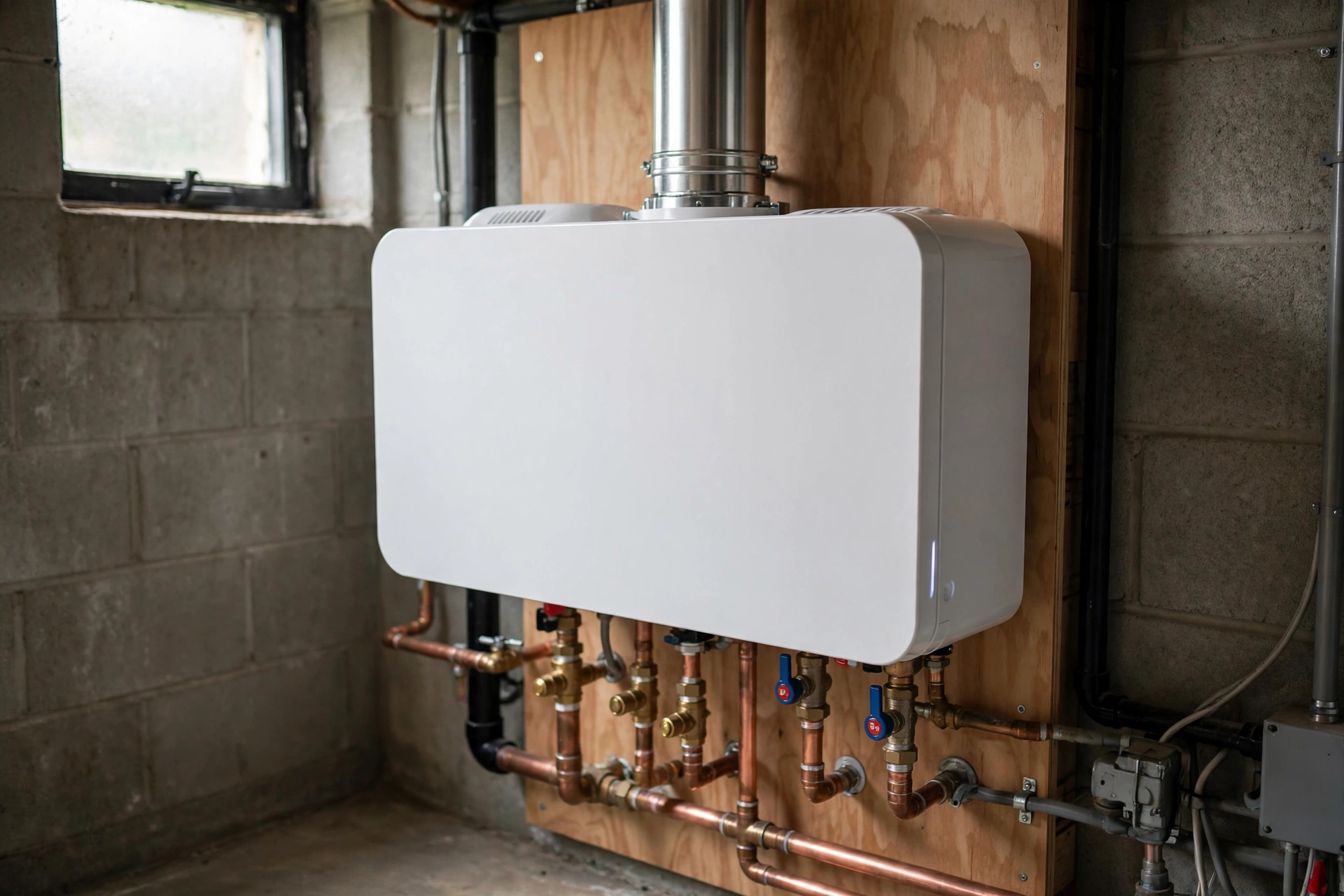
The tankless water heater installation cost in the US in 2026 typically runs $1,800–$4,500 fully installed, with a wider national range of $1,400–$5,600 depending on fuel type, unit size, and how much of the existing plumbing and gas or electrical infrastructure needs to be upgraded. The unit itself accounts for $1,000–$2,500, and professional labor adds $600–$2,500. Gas tankless systems cost more to install than electric ones — $2,100–$5,600 for gas versus $1,400–$3,000 for electric — largely because gas installs often require venting and gas-line upgrades.
Quick-answer table (typical 2026 installed costs):
| Install type | Typical installed cost | Unit cost | Labor cost |
|---|---|---|---|
| Electric tankless, whole-home | $1,400–$3,000 | $1,000–$1,800 | $600–$1,500 |
| Gas tankless, whole-home | $2,100–$5,600 | $1,200–$2,500 | $900–$2,500 |
| Tank-to-tankless conversion (gas) | $2,500–$5,600 | $1,200–$2,500 | $1,200–$2,500 |
| Tankless-for-tankless replacement | $1,800–$3,500 | $1,000–$2,500 | $1,000–$2,500 |
| Electric point-of-use tankless | $500–$1,200 | $200–$600 | $300–$800 |
Tankless systems heat water on demand instead of keeping a 40–50 gallon tank hot around the clock, which is why they appeal to energy-conscious homeowners. But installation is more involved than a tank swap: gas models need dedicated venting and often a larger gas line, electric models draw very high amperage, and sizing matters far more than with a tank. This guide breaks down every line of the bill, what drives it, and when the higher upfront cost actually pays for itself.
Tankless Water Heater Installation Cost at a Glance
Most homeowners land near the middle of the range. A straightforward electric tankless install where the electrical panel already has capacity typically comes in at $1,400–$2,000. A gas tankless replacement where venting and the gas line are already sized correctly runs about $2,100–$3,500. The bills that push past $4,000 almost always involve infrastructure work: running a new vent through the roof or an exterior wall, upsizing the gas line from the meter, or upgrading the electrical service.
Here’s how the total typically splits:
| Cost component | Typical range | Notes |
|---|---|---|
| Tankless unit | $1,000–$2,500 | Whole-home gas units run highest |
| Labor | $600–$2,500 | Plumber hourly rates run $45–$150/hr; most installs take 6–12 hours |
| Gas line upsizing | $350–$2,000 | Only when the existing line can’t feed the unit’s BTU demand |
| New venting | $500–$1,500 | Direct-vent or concentric runs to an exterior wall or roof |
| Permits | $50–$200 | Required in most jurisdictions; usually passed through at cost |
| Old-unit disposal | ~$50 | Haul-away of the old tank; some installers include it free |
| Electrical circuit work | $200–$800 | New dedicated circuit for electric tankless; panel upgrades cost more and are usually separate |
The single biggest swing factor is whether your home is already “tankless-ready.” A previous tankless owner replacing a unit at the same location pays the least. A homeowner converting from a standard tank to a gas tankless unit pays the most — because gas lines, venting, and sometimes the whole mounting arrangement change.
What’s Included in Tankless Installation Cost
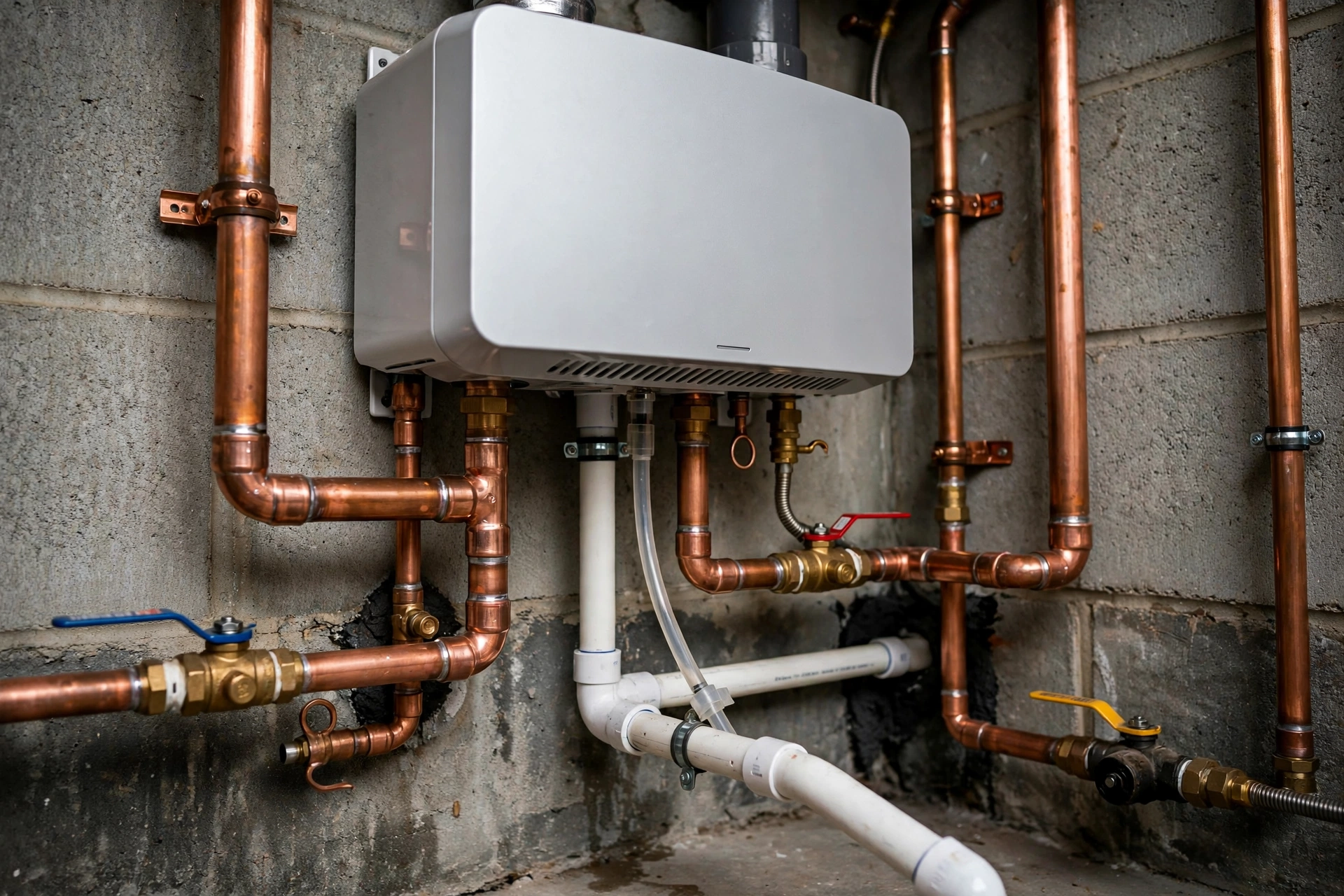
A full-service tankless quote from a licensed plumber normally covers: wall-mounting the unit (tankless models hang on the wall rather than sitting on the floor), hot and cold water connections with service valves and isolation valves, fuel or power hookup, venting (gas), condensate drain where needed, system startup, temperature setup, and leak and combustion-safety testing. The installer typically supplies trade materials from the van — flex connectors, dielectric unions, pipe dope, sealant, and minor fittings.
What a tankless quote usually does not include, and what inflates bills: the permit fee ($50–$200, usually billed at cost), major gas-line upsizing ($350–$2,000 when the existing line is undersized), a completely new vent run ($500–$1,500), electrical service or panel upgrades (separate job, never in a water-heater quote), and structural work like building a mounting wall or running pipe through finished walls. If you’re comparing quotes, ask each bidder: “Is the gas line sized for this unit, or is upsizing extra?” — the answer is where quotes diverge.
One useful comparison: if you already have a quote broken out into parts and materials, our guide to labor-only tankless installation shows what the labor slice alone should look like, so you can judge whether a combined bid is fair.
Gas vs Electric Tankless Water Heater Installation Cost
Gas and electric tankless units serve the same purpose but install very differently. Gas units fire at 150,000–200,000 BTU and need both combustion air and exhaust venting, while electric units need no venting but draw 100–150 amps at full load — a demand that reshapes the electrical side of the job.
| Factor | Gas tankless | Electric tankless |
|---|---|---|
| Typical installed cost | $2,100–$5,600 | $1,400–$3,000 |
| Unit cost | $1,200–$2,500 | $1,000–$1,800 (whole-home) |
| Labor cost | $900–$2,500 | $600–$1,500 |
| Venting required | Yes — direct vent or concentric, $500–$1,500 new | None |
| Fuel infrastructure | Gas line often upsized ($350–$2,000) | New dedicated 240V circuits, $200–$800 |
| Best for | Whole-home use, cold climates, high hot-water demand | Smaller homes, warm climates, point-of-use or supplemental |
| Ongoing energy cost | Lower where natural gas is cheap | Higher per BTU in most regions |
| Efficiency | ~0.80–0.98 EF (condensing highest) | ~0.98 EF — nearly all electricity becomes heat |
Gas is the default choice for whole-home tankless in most of the country: it delivers far higher flow rates and keeps operating costs down where natural gas is inexpensive. Electric makes sense where there’s no gas service, in warm climates where incoming water temperatures are high, or for point-of-use units feeding a single bathroom or sink. The U.S. Department of Energy’s tankless water heater guide is a solid neutral starting point for understanding how the two technologies differ in energy use.
Watch out for one trap: electric tankless is not a cheap shortcut. If your electrical panel lacks the capacity for a whole-home unit, a service upgrade can cost more than the entire gas-installation difference — and it isn’t included in any standard water-heater quote.
Tank-to-Tankless Conversion Costs
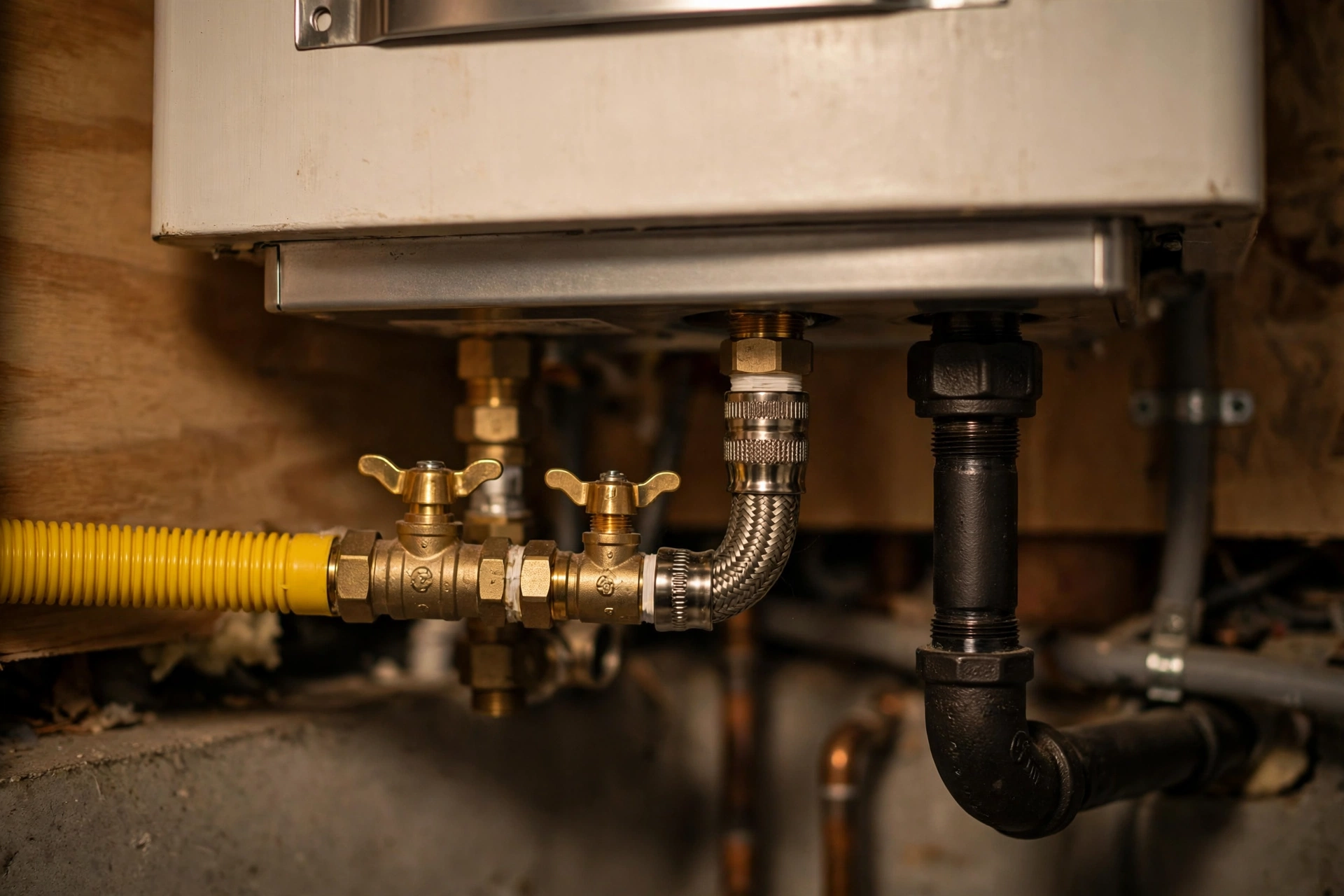
Converting from a conventional tank to a tankless unit is the most expensive scenario because the infrastructure changes. Here’s what each conversion task typically adds on top of the basic install:
| Conversion task | Typical cost | When it’s needed |
|---|---|---|
| Gas line upsizing | $350–$2,000 | When the existing line can’t supply the tankless unit’s BTU demand; longer runs cost more |
| New venting run | $500–$1,500 | Gas tankless can’t reuse a standard tank flue — it needs dedicated direct-vent or concentric venting to an exterior wall or roof |
| Wall mounting and framing | $150–$400 | Tankless units hang on the wall; may need backing or a small platform built |
| Condensate drain | $100–$300 | Condensing gas units produce acidic condensate that must drain to a proper location |
| New 120V outlet | $100–$250 | Gas tankless still needs a small electrical supply for controls and ignition |
| Electrical service upgrade | $1,000–$3,000+ | Electric tankless when the panel lacks capacity (separate job, separate quote) |
| Relocating the unit | $200–$600 | Moving the heater location to a better venting or access point |
A like-for-like tank swap is the cheapest water-heater job in plumbing; a tank-to-tankless conversion is among the priciest. Before committing, have a plumber assess the gas line size, the venting route, and the electrical panel — the tank-to-tankless conversion labor can run $1,000–$1,900 on top of the unit, so the assessment visit is worth it.
Sizing a Tankless Unit for Your Household
Sizing is the step homeowners most often get wrong — and it’s more critical than with a tank, because an undersized tankless unit can’t recover; it simply delivers a weak, lukewarm flow when demand peaks. Tankless units are rated by flow rate in gallons per minute (GPM), and your target is the GPM you’ll need with multiple fixtures running at once:
| Household | Typical peak fixtures | Recommended GPM (gas) | Notes |
|---|---|---|---|
| 1–2 people, small home | 1 shower + sink | 4–5 GPM | Single bathroom, no simultaneous heavy use |
| 2–3 people, 2-bath home | 2 showers or shower + dishwasher | 6–7 GPM | The most common whole-home size |
| 4+ people, 2–3 baths | 2 showers + laundry | 8–9 GPM | Consider a condensing unit for efficiency at this size |
| Large home, 3+ baths | 3+ simultaneous draws | 9–11 GPM | May need a high-capacity unit or two units in tandem |
Two adjustments matter. First, incoming water temperature: in cold northern winters, groundwater can arrive at 40°F and the unit must raise it much further than in the South, which reduces effective GPM — northern homes should size up one step. Second, electric units deliver lower maximum GPM than gas at the same price point, so whole-home electric installations need careful math on the panel’s spare capacity. A.O. Smith’s tankless installation guide notes that professional sizing and installation matter for both performance and warranty coverage — and most manufacturers require licensed installation to keep the warranty valid.
Tankless vs Tank: Payback Comparison
Tankless units cost roughly 2–3x more installed than a conventional tank. The payback question is whether the energy savings and longer life close that gap:
| Factor | Tankless | Conventional tank |
|---|---|---|
| Typical installed cost | $1,800–$4,500 | $900–$2,000 |
| Lifespan | 15–20+ years | 8–12 years |
| Energy savings | 24–34% over tank (per DOE, homes using less hot water) | Baseline |
| Annual maintenance | Descaling/flushing, $100–$200/year | Anode rod replacement every few years |
| Standby heat loss | None — heats on demand | Continuous |
| Space | Wall-mounted, compact | Large floor footprint |
The payback math: a gas tankless unit typically saves $80–$150 per year on water-heating energy for an average household. On a $1,500–$2,500 installation premium over a tank, that’s a 10–20 year payback — roughly in line with the unit’s lifespan. The math improves substantially in homes with high hot-water use, where gas is cheap, or where the tankless replaces two short-lived tanks over its lifetime (one tankless often outlives two tank installations, which can save $1,800–$4,000 in replacement costs alone). The math rarely works when the conversion requires heavy infrastructure work that inflates the installed price past $4,500.
When conversion makes sense: gas service available, a venting route to an exterior wall, a gas line that doesn’t need major upsizing, a household that uses enough hot water to capture the energy savings, or a home where reclaiming the tank’s floor space matters. It makes less sense for small households with low hot-water use, homes needing a full electrical service upgrade for electric tankless, or anyone planning to move within a few years.
DIY vs Hiring a Pro
| Factor | DIY | Licensed plumber |
|---|---|---|
| Cost | Unit + $100–$300 in fittings and materials | $1,800–$4,500 installed (gas $2,100–$5,600; electric $1,400–$3,000) |
| Skill required | Very high — gas, venting, condensate, electrical | Their daily work |
| Time | 1–3 days, first time | Usually one full day (6–12 hours) |
| Gas safety | High risk — combustion venting and gas-line work done wrong can be lethal | Routine, tested, and insured |
| Warranty | Most manufacturers require professional installation; DIY often voids it | Pro install satisfies warranty terms |
| Code compliance | You pull the permit and schedule the inspection | Plumber handles permit and inspection |
| Best for | Almost never recommended for gas tankless | Every gas tankless install; most electric whole-home installs |
This is the clearest “hire a pro” call in home water heating. Gas tankless installation involves gas-line sizing, sealed combustion venting, condensate handling, and electrical controls — each one a safety-critical system. Even a simple swap of an identical electric unit involves high-amperage 240V circuits that can arc dangerously if miswired. If you’ve bought the unit yourself and just need hands, labor-only tankless installation runs $600–$2,500 and keeps the warranty intact.
How to Save on Tankless Installation
- Get three itemized quotes with the same unit model. Tankless quotes vary wildly because one bidder includes gas-line upsizing and venting while another assumes the existing infrastructure works. Same specs, itemized lines — the only fair comparison.
- Ask whether the gas line and venting are already adequate. If a previous tankless unit was there, you may only need a $600–$1,500 labor swap instead of a $2,500–$5,600 conversion. Never assume — have it verified.
- Schedule in spring or fall. Plumbers are slowest in the off-season; a non-emergency install booked outside winter’s freeze-burst rush and summer’s vacation crunch can come in 10–20% lower.
- Consider condensing models where gas is expensive. Condensing gas tankless units cost more upfront but run ~0.95+ efficiency, shortening the payback period noticeably.
- Compare against Home Depot water heater installation pricing. Big-box install programs publish flat-rate pricing — a useful ceiling when a plumber’s quote looks inflated, especially for electric tankless.
- Don’t oversize. A 9-GPM unit costs more to buy and install than a 6-GPM one; size to your actual peak demand with the GPM table above, not to the biggest unit the salesperson recommends.
- Maintain it yearly. A $100–$200 annual descaling flush protects the heat exchanger, preserves efficiency, and is often a warranty condition — skipping it is the most expensive “saving” there is.
Frequently Asked Questions
How much does it cost to install a tankless water heater in 2026?
Tankless water heater installation costs $1,800–$4,500 typically in 2026, with a wider range of $1,400–$5,600. Gas tankless installs run $2,100–$5,600 and electric tankless runs $1,400–$3,000. The unit itself is $1,000–$2,500 and labor adds $600–$2,500. Conversions from a conventional tank to tankless land at the top of the range because of venting and gas-line work.
Why is tankless water heater installation so expensive?
Mostly infrastructure. Gas tankless units can’t reuse a tank’s standard flue — new dedicated venting runs $500–$1,500 — and the high BTU demand often forces gas line upsizing at $350–$2,000. Electric tankless can require new dedicated 240V circuits. The unit itself also costs 2–3x a tank unit ($1,000–$2,500), and the install takes a full day of skilled labor at $45–$150/hr.
How long does a tankless water heater last, and is it worth it?
Tankless units last 15–20+ years versus 8–12 for a tank, and use 24–34% less energy for homes with moderate hot-water use. With $80–$150/year in energy savings, payback on the installation premium typically takes 10–20 years. It pays best in households with high hot-water use, cheap natural gas, or where one tankless unit replaces two tank installations over its lifetime.
Do I need a bigger gas line for a tankless water heater?
Often, yes. Gas tankless units fire at 150,000–200,000 BTU — far more than a 40,000 BTU tank — and many existing gas lines were sized for the smaller load. Upsizing typically costs $350–$2,000 depending on the length of the run. A plumber should verify gas-line sizing before you buy the unit, because it’s the most common surprise line item in tankless quotes.
What maintenance does a tankless water heater need?
An annual descaling flush is the main requirement — a professional flush typically costs $100–$200 and removes mineral buildup from the heat exchanger. In hard-water areas, skipping it cuts efficiency and shortens the unit’s life, and many manufacturers treat annual maintenance as a warranty condition. Some homeowners install a scale-reduction system to stretch flush intervals.
The Bottom Line
Tankless water heater installation costs $1,800–$4,500 for most US homes in 2026 — $2,100–$5,600 for gas, $1,400–$3,000 for electric — with the unit at $1,000–$2,500 and labor at $600–$2,500. Tank-to-tankless conversions land at the top of the range because of venting ($500–$1,500) and gas-line upsizing ($350–$2,000). Size the unit to your actual peak GPM, get three itemized quotes on the same model, and budget $100–$200/year for the descaling flush. The energy savings pay the premium back in roughly 10–20 years — faster in high-use homes with cheap gas.
Prices are typical 2026 US ranges gathered from contractor pricing data and industry sources; your actual cost depends on fuel type, unit size, existing gas/electrical infrastructure, venting route, code requirements, region, and the installer’s rate. Always get at least three written, itemized quotes from licensed, insured plumbers.
2 thoughts on “Tankless Water Heater Installation Cost in 2026”