
Home Depot Tile Installation Cost Per Square Foot in 2026?
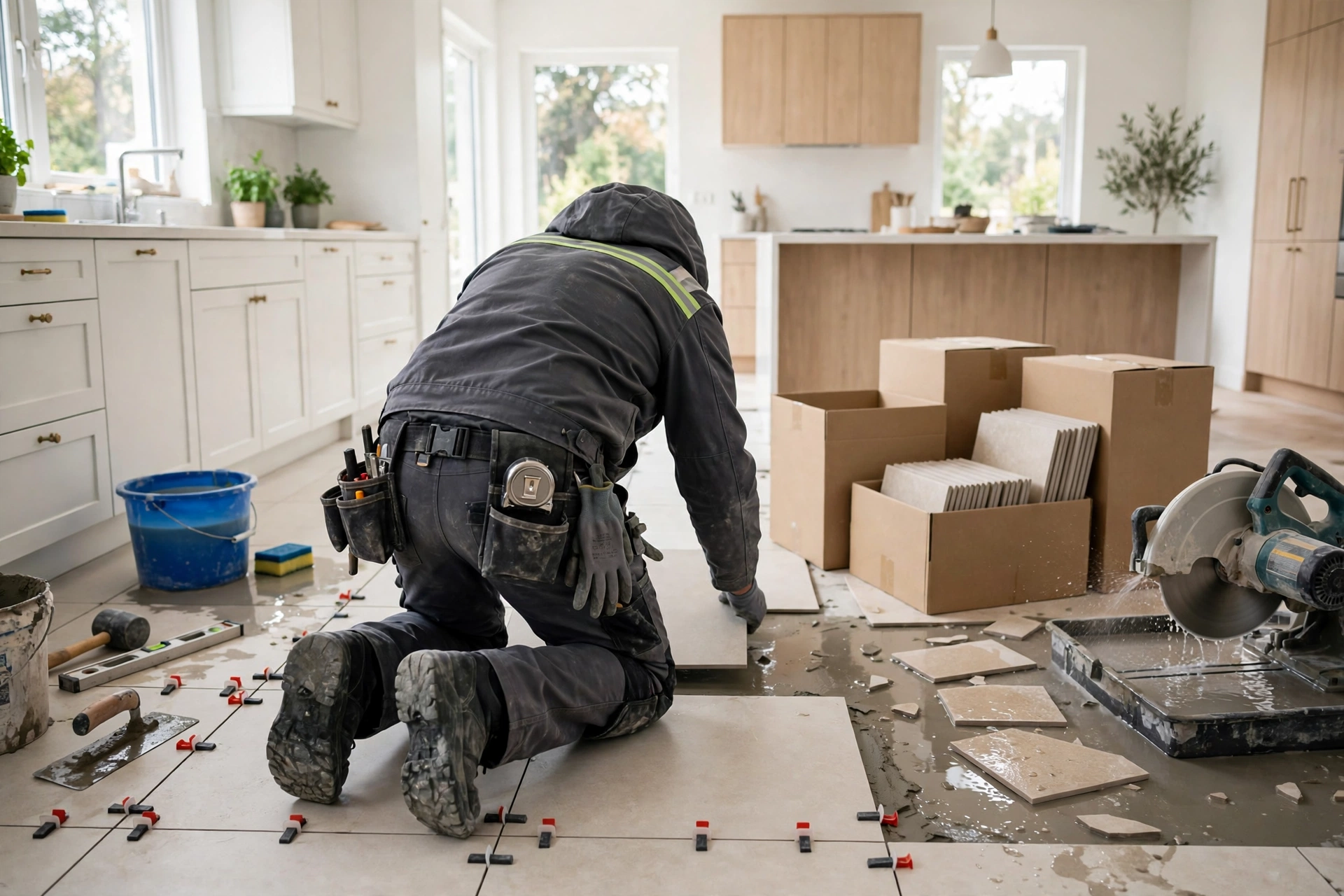
Home depot tile installation cost per square foot in 2026 is typically $4–$9 per square foot for labor alone, with an average labor rate of about $5.50 per square foot. Tile material at Home Depot typically runs $2–$10 per square foot, so a typical all-in installed price — tile plus labor — lands around $6–$19 per square foot, and the average Home Depot customer spends about $2,600 on a tile installation in total. A typical 100-square-foot bathroom tiled all-in through Home Depot runs about $800–$2,000. Those ranges cover a standard job on a sound subfloor, before extras such as old-floor removal, subfloor repair, and waterproofing.
Home Depot is often the first place homeowners price a tile job: you can pick the tile, book a measurement, and get an installed price from one store, without finding and vetting an installer yourself. But the number on the shelf is not the installed number, and the per-square-foot labor rate is only one line of the final quote. The total depends on the tile you choose, the size and shape of the room, what has to come off the floor first, and what the subfloor looks like underneath. This guide breaks down the Home Depot tile installation cost per square foot in 2026 — labor, materials, and the extras — explains how Home Depot’s process works from measurement to warranty, compares it honestly with hiring an independent installer, and shows how to keep the bill down.
For background on proper tile installation standards, substrates, and grout joints, the Tile Council of North America publishes the industry-standard installation handbook and consumer guidance at tilecouncil.org.
Quick-answer table (typical 2026 Home Depot tile installation costs):
| Item | Typical cost |
|---|---|
| Home Depot tile installation labor | $4–$9 per sq ft |
| Average Home Depot labor rate | About $5.50 per sq ft |
| Some published guides (complex jobs) | $5–$15 per sq ft labor |
| Tile material at Home Depot | $2–$10 per sq ft |
| Ceramic / porcelain tile material | About $3–$10 per sq ft |
| All-in installed (tile + labor) | $6–$19 per sq ft |
| Average total customer spend | About $2,600 |
| In-home measurement deposit | About $35, credited toward the project |
| Minimum labor charge (small jobs) | About $500–$600 |
| Old-floor removal (extra) | About $1–$2 per sq ft |
| Subfloor repair (extra) | About $1–$3 per sq ft |
| Typical 100 sq ft bathroom, all-in | About $800–$2,000 |
Home Depot Tile Installation Cost Per Square Foot: The Quick Answer
The headline number most homeowners want is the labor rate, and at Home Depot it is typically $4–$9 per square foot. That is the price to set the tile you buy — laying the tile, grouting, and finishing — on a floor that is ready to tile. The average labor rate works out to about $5.50 per square foot, which is why the average customer spends about $2,600 in total: a mid-size job of roughly 150–200 square feet, with mid-range tile, lands very close to that figure. Some published guides quote a wider labor range of $5–$15 per square foot, and that higher end is real too — it is what complex work costs, such as natural stone, large-format tile that needs a perfectly flat floor, mosaic, herringbone patterns, and shower walls with waterproofing. A straight-lay porcelain floor in an open room sits near the $4–$6 end; a stone shower or a herringbone entry sits near the top.
The labor rate alone does not tell you what you will pay, because Home Depot sells you the tile and the installation as one project. Tile material at Home Depot typically runs $2–$10 per square foot, with ceramic and porcelain — the tiles most customers buy — at about $3–$10 per square foot. Add labor to material and the all-in installed price is typically $6–$19 per square foot: $6 at the very bottom (cheap ceramic at $2 plus $4 labor) and $19 at the top (porcelain at $10 plus $9 labor). Compare all-in to all-in, not Home Depot’s labor rate to someone else’s total.
One important fact about how Home Depot works: the installation is done by licensed and insured local third-party contractors, not Home Depot employees. Home Depot sells the tile, arranges the measurement, and coordinates the project, and a local pro from its installer network does the work in your home. That matters for expectations — the quality of the job depends on the local contractor assigned to it, just as it would if you hired an installer yourself — and it is also why the warranty and the complaint route run through Home Depot rather than directly to the person laying the tile.
Tile Types and Material Costs at Home Depot
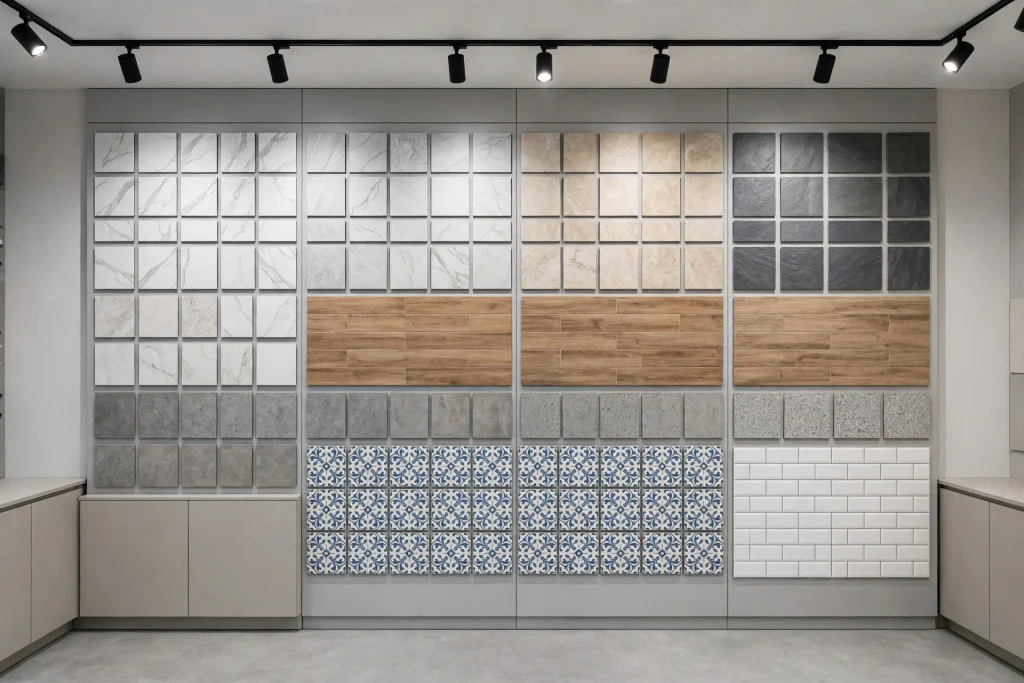
The tile you pick off the shelf is the second-biggest driver of the price after the size of the job, and Home Depot stocks the full range — from budget ceramic at a few dollars a square foot to natural stone that costs several times as much. In a 100-square-foot room, a $5-per-square-foot difference in material is a $500 swing; in a 300-square-foot kitchen and living area, the same $5 difference is a $1,500 swing:
| Tile type | Material per sq ft | Installed per sq ft (material + labor) | Total, 100 sq ft installed |
|---|---|---|---|
| Ceramic | $3–$7 | $7–$16 | $700–$1,600 |
| Porcelain | $3–$10 | $7–$19 | $700–$1,900 |
| Natural stone (marble, travertine, slate) | $10–$20+ | $14–$29+ | $1,400–$2,900+ |
| Large-format porcelain (24×24) | $5–$10 | $9–$19 | $900–$1,900 |
| Mosaic / penny tile (shower floors, accents) | $5–$15 | $9–$24 | $900–$2,400 |
Ceramic tile ($3–$7 per sq ft material) is the budget choice at Home Depot and the most common tile for floors that do not get constantly wet. It is easy to cut and install, which keeps labor near the $4–$6 end of the range. Its weakness is water: glazed ceramic is fine on a kitchen or bathroom floor, but not the best choice for a shower floor, where standing water demands porcelain or stone.
Porcelain tile ($3–$10 per sq ft material) is the sweet spot for most Home Depot tile jobs, and the tile the store sells most of for floors and showers. It is denser and less porous than ceramic, so it handles shower walls, shower floors, and entryways far better, and it comes in convincing wood-look and stone-look finishes. A porcelain floor in a straight lay typically lands in the middle of the $6–$19 all-in range.
Natural stone ($10–$20+ per sq ft) — marble, travertine, or slate — costs the most to buy and install, needs sealing before and after grouting, and demands a perfectly flat substrate; budget for re-sealing every year or two. Large-format tile costs more to install ($9–$19 per sq ft all-in) because the floor must be flatter, while mosaic and penny tile are slow, fiddly work best used on shower floors or as accents, not across a whole room.
How much tile to buy. Measure the room, then add 10–15% extra for cuts and waste — a 100-square-foot floor needs 110–115 square feet of tile. Bathrooms and kitchens waste more tile than open rooms because of the cuts around cabinets, toilets, and vanities, and a diagonal or herringbone pattern needs the full 15%. Buy all the tile from the same dye lot, keep one unopened box for future repairs, and confirm Home Depot’s return policy on unopened boxes before you buy.
What a Typical Home Depot Tile Job Costs by Room Size
The per-square-foot rate is only useful once you multiply it by your room. Here is what the $6–$19 all-in range means for the rooms homeowners tile most often. Small jobs are lifted by the minimum labor charge of about $500–$600, so a tiny room never costs as little as the per-square-foot math alone suggests:
| Room / project | Size | Typical all-in cost |
|---|---|---|
| Small bathroom or entry floor | 50 sq ft | $500–$950 |
| Bathroom floor (typical) | 100 sq ft | $800–$2,000 |
| Kitchen floor | 150 sq ft | $900–$2,850 |
| Kitchen + dining area | 200 sq ft | $1,200–$3,800 |
| Large living area | 300 sq ft | $1,800–$5,700 |
| Whole main floor | 500 sq ft | $3,000–$9,500 |
| Whole-home tile job | 1,700 sq ft | $10,200–$32,300 |
The 100-square-foot bathroom ($800–$2,000) is the most common small job and a good honesty test: a floor-only quote in ceramic or porcelain on a sound subfloor should land inside this range, and anything well above it should be explained by removal, repair, or shower walls as separate line items. The average job (about $2,600) sits between the 150- and 200-square-foot rows — a kitchen floor in mid-range porcelain, or a bathroom floor plus shower. The whole-home job (1,700 sq ft) is rarely a single Home Depot project, since most homes mix tile in wet areas with other flooring elsewhere. For the full breakdown of tiling a house that size, see our guide to tiling a 1,700 sq ft home, and for one bathroom, our guide to tiling a 10×10 bathroom covers the floor-only, floor-plus-shower, and full re-tile scopes.
What Is Included in the Price — and What Costs Extra
A Home Depot tile quote is an installed-project quote, not a labor-only price. Here is how a typical 200-square-foot kitchen in mid-range porcelain breaks down — a job that lands very close to the $2,600 average:
| Cost component | Per sq ft | Total, 200 sq ft job |
|---|---|---|
| Tile material (porcelain, about $6) | About $6 | About $1,200 |
| Installation labor (about $5.50 average) | About $5.50 | About $1,100 |
| Thinset, grout, and sealant | Varies by job | $100–$300 |
| Backer board (where needed) | About $2 | $200–$400 |
| Typical all-in total, straightforward job | — | About $2,600 |
| Old-floor removal (extra) | About $1–$2 | $200–$400 |
| Subfloor repair (extra) | About $1–$3 | $200–$600 |
| Waterproofing membrane, shower work (extra) | Varies by job | $200–$600 |
What is usually included. The tile itself, installation labor, thinset and grout, and standard finishing — edge trim, grout sealing, and cleanup. Backer board is included when the quote calls for it; on a concrete slab or sound plywood it may not be needed, which is one reason two quotes for the same room can differ by hundreds of dollars.
Old-floor removal (about $1–$2 per sq ft extra). If old tile, vinyl, or laminate has to come off first, the installer charges for it separately — $200–$400 on a 200-square-foot floor. Tile set in a thick mortar bed, common in older homes, has to be chipped out, and the subfloor underneath often needs repair. Get removal quoted as its own line item, and ask the installer to inspect the old floor before quoting.
Subfloor repair (about $1–$3 per sq ft extra). Tile needs a flat, rigid, sound base, and the subfloor is where hidden costs live: leveling compound, a rotted section under an old tub or dishwasher, or a spongy area that flexes underfoot. A quote with no allowance for subfloor work is a quote that may grow — ask what happens if repair is needed, and at what rate, before you sign.
The minimum labor charge (about $500–$600). Small jobs carry fixed costs — measurement, delivery, travel, and setup — that do not shrink with the room. A 30-square-foot entry in cheap tile does not cost $180 in labor; it costs the minimum. If your room is small, the minimum is the number that matters, not the per-square-foot rate.
Waterproofing. A floor-only job needs little waterproofing, but any job with shower walls needs a full membrane system. Tile and grout are not waterproof — water passes through grout, and the membrane behind the tile is what keeps your walls dry. Budget $200–$600 for the membrane and sealing on a shower, and if a shower quote has no waterproofing line item, do not accept the job without it.
How the Home Depot Tile Installation Process Works
One advantage of going through Home Depot is that the process is standardized — the same steps, in the same order, for every customer:
Step 1 — Choose the tile in store or online. You pick the tile from Home Depot’s flooring department, where the shelf price is the material price — typically $2–$10 per square foot. This is where the material budget is set: in a 200-square-foot room, a $3-per-square-foot saving is $600. Ask the flooring associate which tiles are rated for your room — floor tile, shower floor tile, and wall tile are not interchangeable — and confirm the dye lot and the return policy on unopened boxes.
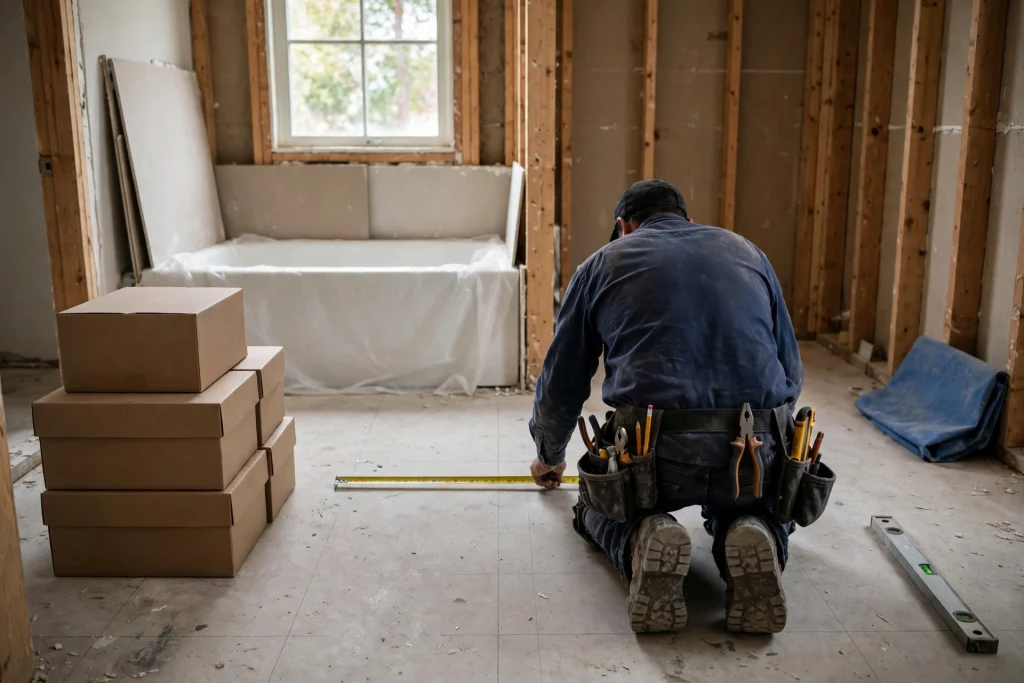
Step 2 — Book the in-home measurement. Home Depot sends a measurer to your home to measure the room, check the subfloor, and note the details that change the price: doorways, transitions, fixtures, and the condition of the existing floor. The measurement costs a deposit of about $35, and that deposit is credited toward the project if you go ahead — it is not an extra fee on top of the job. The measurement is also the point where removal and subfloor repair first get flagged, so walk the room with the measurer and ask what they see.
Step 3 — Get the installed quote. Home Depot turns the measurement into an itemized installed quote: tile, labor at the per-square-foot rate, removal, subfloor work, backer board, and any waterproofing. Check that the tile is the one you picked, the square footage includes the 10–15% waste factor, removal and repair are separate lines rather than buried in the labor rate, and the minimum labor charge is shown. Get the quote in writing before you agree to anything.
Step 4 — Schedule the installation. Once you accept the quote and the tile is in stock or delivered, Home Depot schedules the local third-party contractor. The installer is licensed and insured, and scheduling, delivery, and coordination run through Home Depot. A straightforward floor takes one to two days; a floor plus shower walls takes three to five days, including curing time. Confirm the start date, the daily working hours, and who to call if the crew is delayed.
Step 5 — Installation day. The crew removes the old floor if that is in the quote, repairs or levels the subfloor, lays backer board where needed, sets the tile, and then grouts and seals. Check the work at two points: after the first few rows are laid, when the layout and grout lines are easy to correct, and before the grouting, when lippage and alignment are still visible. Take photos of the subfloor before the tile goes down — if a problem appears later, those photos are the record of what was underneath.
Step 6 — Walkthrough and warranty. When the job is finished, walk the floor with the installer: check the grout lines, the edges and transitions, the level of the tile, and the cleanup. Home Depot backs the installation with a warranty that runs through the store — if something fails because of the installation, the complaint goes to Home Depot, not to the individual contractor, and that single point of accountability is one of the main reasons homeowners choose the store over hiring directly. Get the warranty terms in writing, including how long it lasts and what it covers, before the crew leaves.
If you are comparing Home Depot with its biggest rival before you commit, our guide to Lowe’s tile installation cost per square foot works through Lowe’s per-square-foot pricing the same way, so you can compare the two stores line by line. Home Depot is not the only big-box route to a tiled floor, and the honest comparison is all-in price against all-in price for the same tile and the same scope.
What Affects the Cost of Home Depot Tile Installation
Room size and the minimum charge. Large open rooms get the best per-square-foot price, because the crew can lay big areas without stopping. Small rooms cost more per square foot, and very small rooms hit the minimum labor charge of about $500–$600.
Tile type and size. Porcelain at $3–$10 per square foot is the middle of the range; ceramic at $3–$7 is the low end; natural stone at $10–$20+ is the top end, and it also costs more in labor because it needs sealing and a flatter floor. Large-format tile costs more to install than standard tile, and mosaic costs the most of all.
Tile pattern. A straight grid lay is the cheapest pattern to install. A diagonal lay, a herringbone floor, or a brick-pattern shower wall takes more cutting, more time, and 15% waste instead of 10% — and the labor rate moves toward the $9 end of the range. A herringbone floor costs roughly 20–30% more in labor than the same tile laid straight.
Old-floor removal and subfloor condition. Removal at about $1–$2 per square foot and subfloor repair at about $1–$3 per square foot are the two extras most likely to appear after the measurement. A flat, sound subfloor keeps labor near the $4–$6 end of the range; a floor that needs leveling or a rotted section adds labor that only shows up after the old floor comes off.
Shower walls and waterproofing. Adding shower walls roughly doubles the tiled area and adds the most skilled part of the job. The waterproofing membrane adds $200–$600, and the labor rate moves toward the top of the $4–$9 range — or into the $5–$15 range quoted by some guides for complex work.
Local installer rates. Home Depot’s installers are local contractors, and their rates follow your market. A quote in a high-cost metro area will run higher than the same job in a smaller market, even for the identical tile. Get the Home Depot quote and at least one independent quote for the same scope, and compare them line by line.
If you are pricing several projects at once, remember that the store’s per-project pricing works the same way across departments. Our guide to Home Depot window replacement cost shows the same measurement, labor-rate, and extras structure on the window side.
Home Depot vs. Hiring an Independent Tile Installer
Home Depot is convenient, but convenience has a price — or, sometimes, it does not, and the only way to know is to compare the same job both ways. Here is the honest comparison:
| Factor | Home Depot | Independent installer |
|---|---|---|
| Labor rate | Typically $4–$9 per sq ft, average about $5.50 | Typically $4–$10 per sq ft, varies by market |
| Tile material | $2–$10 per sq ft, from the store’s stock | You buy it, or the installer supplies it |
| Average total spend | About $2,600 | Similar for the same scope, often $2,000–$3,000 |
| Measurement | About $35 deposit, credited toward the project | Often free, sometimes $50–$100 |
| Minimum labor charge | About $500–$600 | Varies; some have none, some charge a day rate |
| Who does the work | Licensed and insured local third-party contractor | The installer you hire, or their crew |
| Scheduling | Through the store; can be slower at peak times | Direct; often faster, depends on availability |
| Warranty | Through Home Depot, single point of accountability | Through the installer; varies by contractor |
| Tile choice | Limited to what Home Depot stocks or orders | Any tile from any supplier |
| Quote comparison | Itemized installed-project quote | Itemized quote if you ask for one |
When Home Depot wins. You want one store to handle the tile, the measurement, the scheduling, and the warranty, and you are happy with the tile Home Depot stocks. The $35 measurement deposit credited toward the job, the itemized quote, and the single point of accountability if something goes wrong are genuinely valuable — especially for a first-time tile job.
When an independent installer wins. You want a tile Home Depot does not stock, a complex pattern or a natural stone that needs a specialist, or a tight schedule the store cannot meet. An independent installer can also be cheaper on a large job, because there is no store coordination in the price — but only if you compare the same scope, with removal, subfloor work, and waterproofing on separate lines in both quotes. A low independent quote that leaves out waterproofing or removal is not cheaper than a higher Home Depot quote that includes them.
For a related big-box comparison on a different floor, our guide to Lowe’s laminate flooring installation cost shows how Lowe’s prices a laminate job — the same measurement, quote, and third-party installer structure, applied to a cheaper floor covering.
DIY vs. Hiring a Pro to Install Tile
| DIY | Hiring a pro (Home Depot or independent) | |
|---|---|---|
| Tile materials | $2–$10 per sq ft | Included in the installed price |
| Labor cost | $0 (your time) | $4–$9 per sq ft (Home Depot), average about $5.50 |
| All-in total, 100 sq ft bathroom | $200–$1,000 plus tools and backer board | $800–$2,000 typical |
| All-in total, 200 sq ft kitchen | $400–$2,000 plus tools | $1,200–$3,800 typical |
| Time required | A weekend for a floor; a week or more with shower walls | 1–2 days for a floor; 3–5 days for floor + shower |
| Tools needed | Wet saw, trowels, level, spacers, knee pads | Included in the labor price |
| Waterproofing | You install it — mistakes are on you | Professional membrane, installer warranty |
| Warranty | None | Home Depot warranty or installer’s warranty |
| Best for | A floor-only job with basic ceramic tile and a sound subfloor | Any job with shower walls, natural stone, or a heated floor |
Tiling a floor is one of the more approachable DIY jobs: the floor is flat, the area is small, and ceramic tile is forgiving to cut. A confident DIYer can tile a 100-square-foot bathroom floor for $200–$1,000 in materials — tile at $2–$10 per square foot, plus thinset, grout, and backer board — and save the $400–$900 a pro would charge in labor. When DIY wins: the job is floor-only, the tile is basic ceramic or porcelain in a straight lay, the subfloor is flat and sound, and you have a weekend to spare. Rent the wet saw rather than buying one.
When a pro wins: the job includes shower walls. Waterproofing a shower is skilled work with no margin for error — a pinhole in the membrane or an unsealed corner means water in your walls, and there is no warranty to fall back on when you did it yourself. Natural stone, large-format tile, a herringbone pattern, and a heated floor are also pro jobs: the materials are too expensive to learn on, and a bad first row is visible forever. A common middle path is to DIY the floor and hire a pro for the shower walls.
Money-Saving Tips for Home Depot Tile Installation
1. Compare the tile one shelf down. Porcelain at $3 per square foot and porcelain at $10 can look very similar once grouted, and in a 200-square-foot room the difference is $1,400. Check the nearest cheaper option in the same color family before you commit. 2. Use the $35 measurement, and walk the room with the measurer. The deposit is credited toward the project, so it costs nothing if you go ahead — and it is your best chance to learn about removal and subfloor repair before the quote is written. 3. Get the quote itemized, and read it. Tile, labor, removal at about $1–$2 per square foot, subfloor repair at about $1–$3 per square foot, backer board, and waterproofing on separate lines. A quote with no removal or repair line is a quote that may grow. 4. Keep the layout straight. A straight grid lay is the cheapest pattern to install and wastes only 10% of your tile. Save herringbone or diagonal for a small accent area, where the extra labor is a few hundred dollars instead of a thousand. 5. Buy 10–15% extra, not 25%. The 10–15% waste factor covers a standard room. Ordering far more ties up hundreds of dollars in tile you may not be able to return. 6. Remove the old floor yourself if the quote allows it. At about $1–$2 per square foot, doing it yourself on a 200-square-foot floor saves $200–$400. Confirm with Home Depot first — some installer warranties require the contractor’s crew to do the removal and subfloor preparation. 7. Choose porcelain over natural stone. Porcelain at $3–$10 per square foot looks like stone, handles water better, needs no sealing, and costs a fraction of stone to buy and install. On a 200-square-foot job, the saving over stone can be $2,000 or more. 8. Time the job outside peak season. Installers are busiest in spring and summer, and scheduling through a store can mean a longer wait at peak times. A fall or winter booking can mean faster scheduling and, occasionally, a promotional labor rate. 9. Get one independent quote for the same scope. Even if you plan to use Home Depot, an independent itemized quote for the identical tile and scope tells you whether the store’s price is competitive. 10. Keep the old tile if you can. If the existing floor tile is flat, sound, and well bonded, some new tile can go over it — skipping removal saves about $1–$2 per square foot. Confirm with the installer first; loose or cracked tile is never a suitable base.
Frequently Asked Questions
How much does Home Depot charge to install tile per square foot?
Home Depot tile installation labor typically costs $4–$9 per square foot, with an average of about $5.50 per square foot. Tile material runs $2–$10 per square foot, so the typical all-in installed price is $6–$19 per square foot. Some published guides quote labor of $5–$15 per square foot for complex jobs such as stone, mosaic, or shower walls. The average customer spends about $2,600 in total.
What is the average cost of a Home Depot tile installation?
The average Home Depot customer spends about $2,600 on a tile installation. That covers a mid-size job — roughly a 150- to 200-square-foot kitchen or a bathroom floor plus shower — in mid-range porcelain, with straightforward layout and no major subfloor work. Small jobs are lifted by the minimum labor charge of about $500–$600, and large or complex jobs with removal, repair, or shower waterproofing run higher.
Does Home Depot charge for measuring tile installation?
The in-home measurement costs a deposit of about $35, and the deposit is credited toward the project if you go ahead — so it costs nothing extra on a job you proceed with. The measurer measures the room, checks the subfloor, and notes anything that changes the price, such as old-floor removal or subfloor repair.
Who installs tile for Home Depot?
Installation is done by licensed and insured local third-party contractors, not Home Depot employees. Home Depot sells the tile, arranges the measurement and the quote, and coordinates the project, and a local pro from its installer network does the work in your home. The warranty runs through Home Depot, so the store is the single point of accountability if something fails because of the installation.
Is Home Depot tile installation cheaper than hiring an independent installer?
Usually it is competitive, not dramatically cheaper or more expensive. Home Depot labor at $4–$9 per square foot, averaging about $5.50, sits in the same range as independent installers, and the all-in installed price of $6–$19 per square foot overlaps theirs for the same tile and scope. Home Depot wins on convenience, the itemized quote, and the store-backed warranty; an independent installer can win on tile choice, specialist work such as natural stone, or a faster schedule. Compare the two quotes line by line for the identical scope — including removal, subfloor repair, and waterproofing — before you decide.
The Bottom Line
For Home Depot tile installation in 2026, budget $4–$9 per square foot for labor, averaging about $5.50 per square foot, with tile material at $2–$10 per square foot — an all-in installed price of roughly $6–$19 per square foot. The average customer spends about $2,600 in total, a typical 100-square-foot bathroom runs about $800–$2,000 all-in, and small jobs are subject to a minimum labor charge of about $500–$600. The in-home measurement costs about $35, credited toward the project, and the installation itself is done by a licensed and insured local contractor, backed by a Home Depot warranty. Get the quote itemized — tile, labor, removal at about $1–$2 per square foot, subfloor repair at about $1–$3 per square foot, backer board, and waterproofing on separate lines — and compare it with one independent quote for the same tile and the same scope before you sign. The per-square-foot rate gets you in the door; the itemized total is the number that matters.
Prices are typical 2026 US ranges for planning purposes and vary by region, tile choice, and site condition; get itemized local quotes for an exact project price.

1 thought on “Home Depot Tile Installation Cost Per Square Foot in 2026?”