
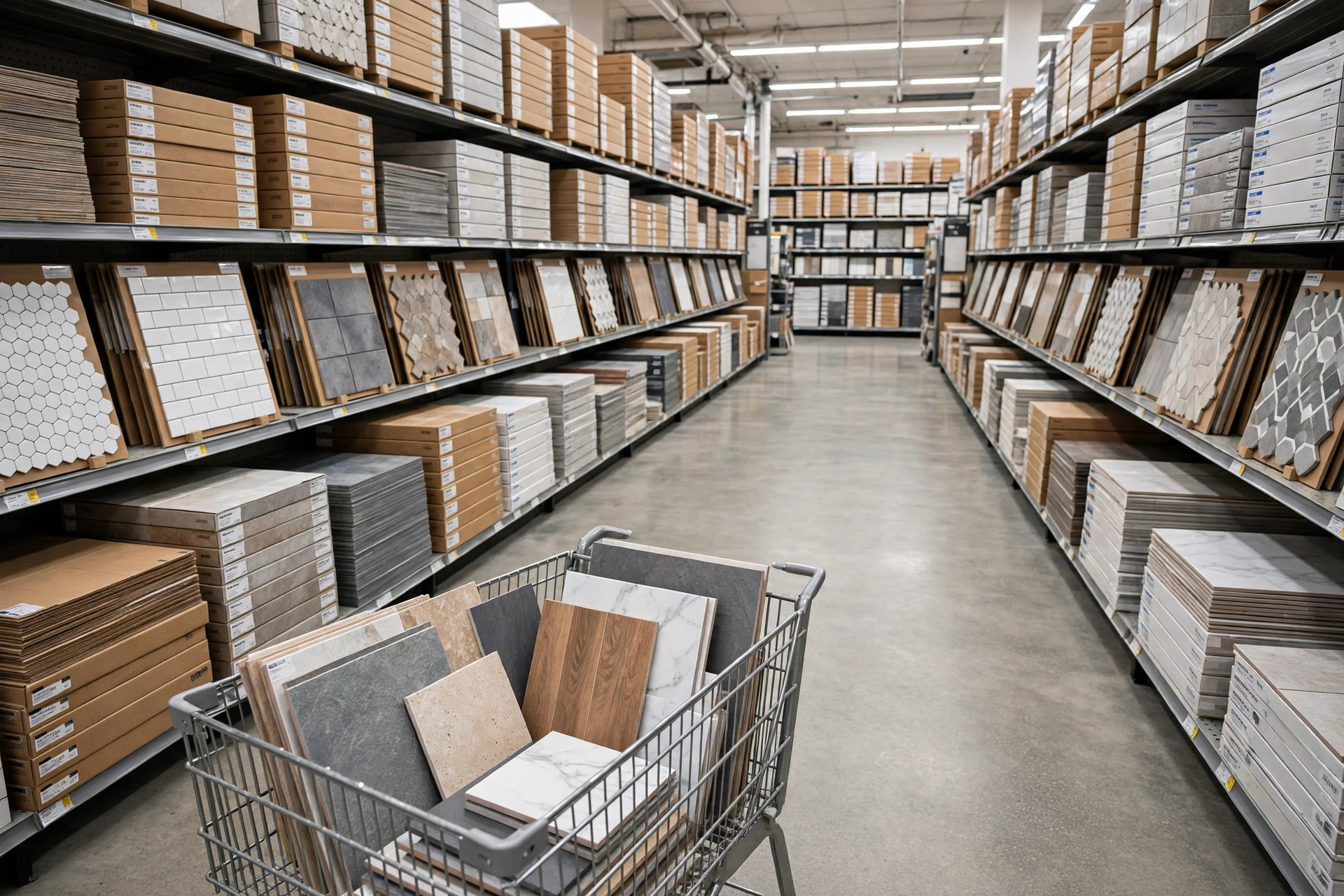
How Much Does Lowe’s Charge Per Square Foot to Install Tile in 2026?
How much does Lowe’s charge per square foot to install tile in 2026? The typical all-in price is $5–$14 per square foot installed, with installation labor running $5–$10 per square foot. That range covers the tile material, labor, and basic setting materials for a standard ceramic or porcelain floor tile job. A budget ceramic tile install can land near $5–$7 per square foot all-in, a mid-range porcelain install typically costs $8–$14 per square foot, and a natural stone install runs $9–$34 per square foot installed — before extras such as old-floor removal, subfloor repair, and underlayment, which Lowe’s bills separately. One widely cited source puts Lowe’s tile installation labor alone at $3–$7 per square foot, which sits at the lower end of the typical $5–$10 labor range and generally reflects a straightforward job on a sound subfloor.
Lowe’s does not install tile with its own employees. Like other big-box retailers, Lowe’s contracts the work to local independent installers in its network, and the price you are quoted is built from the tile you buy, the labor rate of the installer assigned to your job, and the condition of your floor. A measurement visit comes first — Lowe’s charges a measurement fee, which is often credited toward the job if you go ahead — and the written quote that follows is the number that matters, because the per-square-foot rate on a website or in a store display never includes your subfloor, your layout, or your old floor. This guide breaks down Lowe’s tile installation cost by tile type, shows the materials-versus-labor split, explains how the Lowe’s process works from measurement to warranty, compares project sizes, and shows what a $1,000 quote, a $3,000 quote, and a $6,000 quote actually buy you — so you can read any Lowe’s estimate line by line.
For background on what a proper tile installation should include — substrate preparation, grout joints, and movement joints — the Tile Council of North America publishes industry installation standards and consumer guidance at tilecouncil.org.
Quick-answer table (typical 2026 Lowe’s tile installation cost):
| Item | Typical cost |
|---|---|
| Lowe’s tile installation, all-in, typical range | $5–$14 per sq ft |
| Installation labor (typical) | $5–$10 per sq ft |
| Installation labor (low-end source) | $3–$7 per sq ft |
| Budget ceramic tile, installed | $5–$7 per sq ft |
| Mid-range porcelain tile, installed | $8–$14 per sq ft |
| Natural stone tile, installed | $9–$34 per sq ft |
| Ceramic tile material | $0.50–$7 per sq ft |
| Porcelain tile material | $1–$15 per sq ft |
| Natural stone tile material | $5–$20 per sq ft |
| 100 sq ft bathroom, typical all-in total | $500–$1,400 |
| 200 sq ft kitchen, typical all-in total | $1,000–$2,800 |
| Measurement fee | Charged, often credited toward the job |
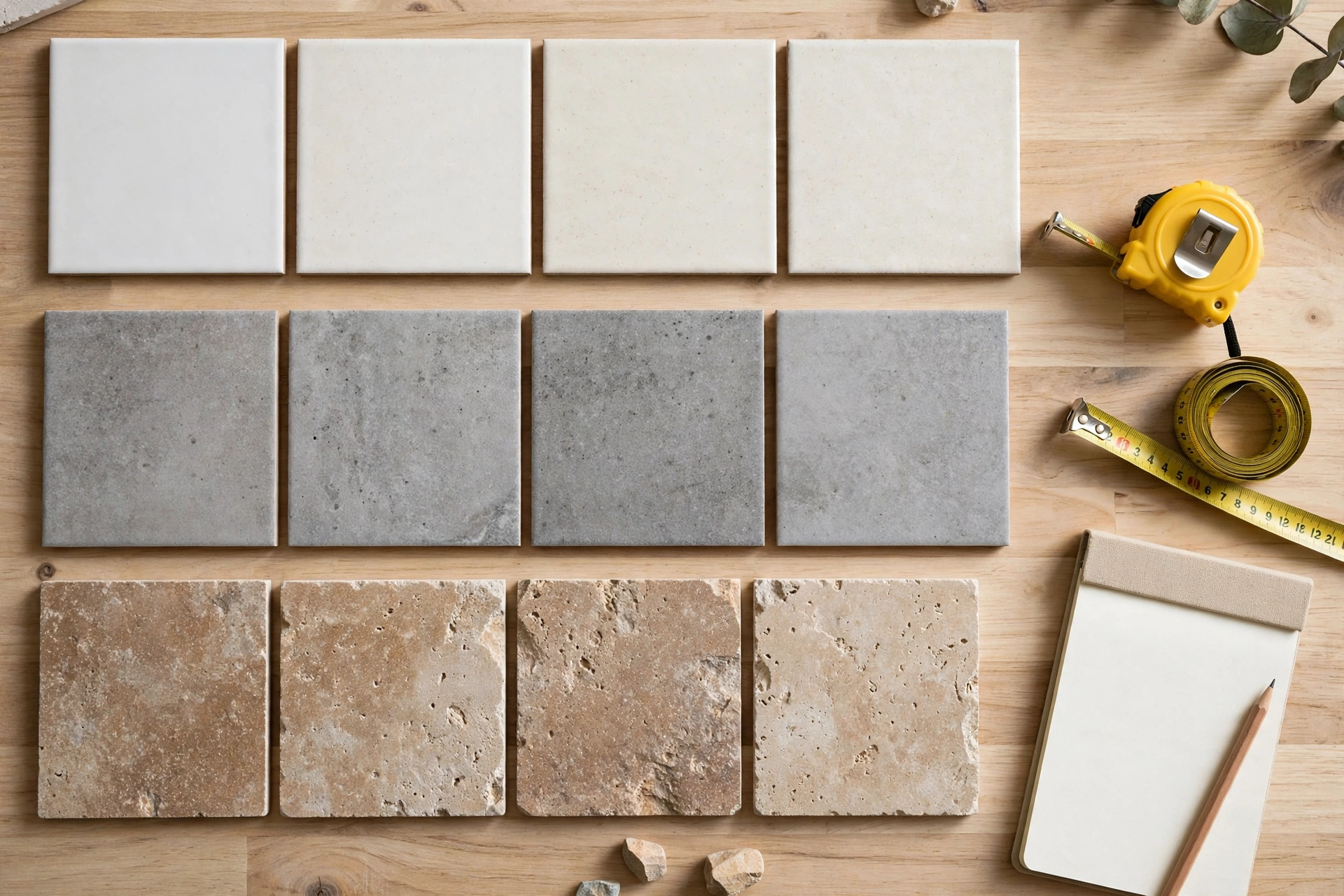
How Much Does Lowe’s Charge Per Square Foot to Install Tile by Tile Type
The tile you choose is the single biggest driver of a Lowe’s tile quote. Labor is broadly similar across tile types — a crew lays ceramic and porcelain at a comparable pace — but material prices vary enormously, and on a 200-square-foot kitchen a $5-per-square-foot difference in tile price is a $1,000 swing in the total:
| Tile type | Material per sq ft | Labor per sq ft | Total installed per sq ft |
|---|---|---|---|
| Ceramic tile | $0.50–$7 | $5–$10 | $4.50–$21 |
| Porcelain tile | $1–$15 | $5–$10 | $5–$29 |
| Natural stone tile | $5–$20 | $5–$10 | $9–$34 |
The totals above come from combining the material and labor ranges, which is why the top end of each installed range is higher than the typical all-in range of $5–$14 per square foot. The typical range describes the ordinary job — standard-size ceramic or porcelain tile, a flat subfloor, a rectangular room — while the top end of the installed range describes premium tile, large-format pieces, or intricate layouts that push both material and labor upward. A basic ceramic floor at $0.50 per square foot for material plus $5 per square foot for labor can genuinely install for around $5 per square foot all-in, while a large-format porcelain tile at $15 per square foot for material plus $10 per square foot for labor lands near $25 per square foot installed.
Ceramic tile is the cheapest way to get a tiled floor from Lowe’s, and it makes sense for bathrooms, laundry rooms, and low-traffic areas where water resistance matters but heavy wear does not. Glazed ceramic is easy to clean and comes in the widest range of colors and patterns at the lowest prices, but it is softer than porcelain and can chip under a dropped pot or a heavy appliance. Porcelain tile is the workhorse choice for most Lowe’s tile jobs: denser, harder, and less porous than ceramic, it handles kitchens, entryways, and mudrooms without complaint, and through-body porcelain hides chips better because the color runs through the tile. It costs more per square foot — $1–$15 for material against ceramic’s $0.50–$7 — but for a floor that gets daily traffic, the upgrade usually pays for itself in longevity. Natural stone tile — marble, travertine, slate, granite — is the premium option, and it is the only one where the installed price routinely passes $20 per square foot. Stone needs sealing, it needs a perfectly flat substrate, and it needs an installer experienced with stone, which is why labor on stone jobs tends toward the top of the $5–$10 range or beyond. Stone is beautiful and it adds real resale appeal, but it is also the tile most likely to surprise you with extra prep costs.
What a $1,000 quote buys vs. a $3,000 quote vs. a $6,000 quote. A $1,000 quote is typically a small bathroom — around 100 square feet — in budget ceramic tile, with labor and basic setting materials and nothing else. A $3,000 quote is usually a 200-square-foot kitchen in mid-range porcelain, including underlayment and transitions. A $6,000 quote generally means a larger area, premium porcelain or natural stone, plus the extras: old-floor removal, subfloor leveling, and new trim. None of these is automatically a bad deal — the question is whether the line items match the price, and whether the extras you need are in the quote or waiting to surprise you later.
Lowe’s Tile Installation Cost by Project Size
Tile is priced per square foot, but the total you pay depends heavily on the size of the room. Small jobs carry the worst effective rate because the measurement visit, delivery, and minimum installer charges are the same whether the crew lays 50 square feet or 500:
| Project size | Typical installed total | Effective rate per sq ft |
|---|---|---|
| 50 sq ft (small bathroom / powder room) | $350–$700 | $7–$14 |
| 100 sq ft (standard bathroom) | $500–$1,400 | $5–$14 |
| 200 sq ft (kitchen) | $1,000–$2,800 | $5–$14 |
| 300 sq ft (large kitchen / living room) | $1,500–$4,200 | $5–$14 |
| 500 sq ft (open-plan main floor) | $2,500–$7,000 | $5–$14 |
The 50-square-foot powder room has the highest effective rate because fixed costs dominate: the measurement, the delivery, and the installer’s minimum charge are spread over very little area. By the time you reach 100 square feet the rate settles into the typical $5–$14 band, and on larger jobs the per-square-foot rate stays in that band while the total climbs — tile does not offer the same whole-house discount you see with laminate, because cutting and setting tile is slow, skilled work that does not get much faster at scale. A large-format tile job can actually cost more per square foot than a small one, because big tiles need a flatter floor and more careful leveling.
If you are costing a single room first, see our guide to how much Lowe’s charges to install laminate flooring — laminate is the cheaper hard-surface alternative for the same rooms, and the two quotes are worth comparing side by side before you commit to tile.
Tile Installation Materials vs. Labor Breakdown
On a tile job, the split between materials and labor is how you spot a quote that is padded in one place or another. Here is how a typical 200-square-foot porcelain kitchen breaks down:
| Cost component | Per sq ft | Total for 200 sq ft |
|---|---|---|
| Porcelain tile material | $1–$15 | $200–$3,000 |
| Installation labor | $5–$10 | $1,000–$2,000 |
| Thinset, grout, and setting materials | $1–$2 | $200–$400 |
| Underlayment / backer board | $1–$3 | $200–$600 |
| Trim, transitions, and thresholds | Varies by job | $100–$400 |
| Typical all-in total | $5–$14 | $1,000–$2,800 |
Labor is the most predictable part of a tile quote. At $5–$10 per square foot, labor alone on a 200-square-foot kitchen runs $1,000–$2,000, and it is the line item least likely to change between quotes — the tile you pick is what moves the total. Setting materials are a modest but real cost: thinset mortar, grout, and sealant run roughly $1–$2 per square foot, and they matter more than their price suggests, because the wrong thinset over the wrong substrate is how tiles crack and pop loose. Underlayment or cement backer board is often a separate line at $1–$3 per square foot, and it is essential over wood subfloors — tile laid directly on plywood without backer board is a cracked-tile job waiting to happen. For the labor-only breakdown by surface, see our guide to tile installation labor cost per square foot.
The low-end labor figure. One widely cited source puts Lowe’s tile installation labor at $3–$7 per square foot, below the typical $5–$10 range. That figure usually reflects a best-case job: standard-size ceramic tile, a flat and sound subfloor, a simple rectangular layout, and no removal or prep. Treat $3–$7 as the floor for labor on an easy job, not the price you should expect on a kitchen with an uneven slab or a bathroom with a complicated layout. If your Lowe’s quote comes in at $5–$10 per square foot for labor, it is squarely in the typical range — and if it comes in below $5, check carefully what has been left out.
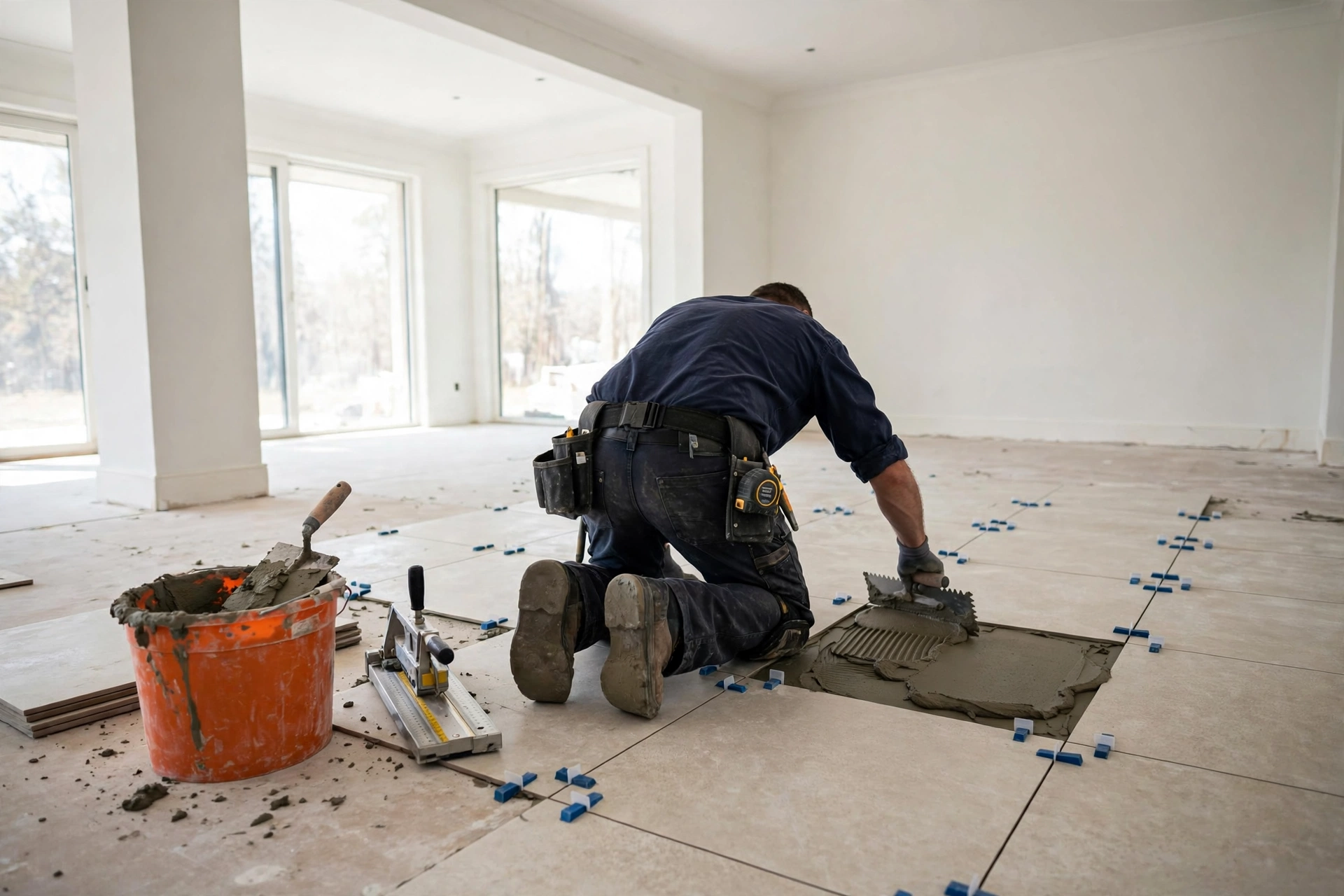
How Lowe’s Tile Installation Works: Measurement, Quote, Installation, and Warranty
Lowe’s tile installation follows a fixed sequence, and understanding it before you start keeps the process from stalling between steps:
1. Measurement. You book a measurement visit, either in store or online. A Lowe’s associate or a local installer measures the room, checks the subfloor, and notes obstacles such as doorways, fixtures, and transitions to other floors. Lowe’s charges a measurement fee for this visit, and it is often credited toward the job if you go ahead with the installation. The measurement is also when subfloor problems surface — an uneven slab or a damaged plywood subfloor is usually found here, not on installation day.
2. Quote. After the measurement, Lowe’s gives you a written quote built from the tile you selected, the labor rate of the installer assigned to your job, and any extras the measurement uncovered. This is the number that matters. Get it itemized — tile, labor, setting materials, underlayment, removal, and trim on separate lines — so you can compare it with an independent installer’s quote on the same scope.
3. Installation. The work itself is done by an independent contractor from Lowe’s installer network, not by a Lowe’s employee. A typical bathroom takes one to two days; a kitchen takes two to four days, including drying time for thinset and grout. The installer lays the tile, grouts, seals where needed, and installs transitions. Ask who your installer is and how to reach them directly — on a big-box job, the store is the middleman, and the installer is the person actually in your house.
4. Warranty. Lowe’s installation work typically carries a labor warranty through the installer, with the length varying by job and installer — commonly one year on labor, while the tile itself is covered by the manufacturer’s warranty. Get the warranty terms in writing before work starts, including who to call if a tile cracks or a grout line fails: Lowe’s, or the installer directly. Keep the quote, the receipt, and the warranty paperwork together, because a warranty claim without paperwork is a long conversation.
For tile product options and care guidance from a major manufacturer, Daltile publishes tile collections and maintenance resources at daltile.com.
What’s Included vs. What Costs Extra on a Lowe’s Tile Job
A Lowe’s tile quote covers the basics, but several common line items are billed separately — and on a tile job, each one can be a meaningful swing if you miss it:
| Line item | Included or extra? | Typical cost |
|---|---|---|
| Tile material | Included in all-in price | $0.50–$20 per sq ft |
| Installation labor | Included in all-in price | $5–$10 per sq ft |
| Thinset, grout, setting materials | Usually included | $1–$2 per sq ft |
| Measurement fee | Charged, often credited | Credited if you proceed |
| Old-floor removal and haul-away | Usually extra | Quoted by the job |
| Subfloor repair and leveling | Extra | Quoted after inspection |
| Underlayment / backer board | Sometimes extra | $1–$3 per sq ft |
| Trim, transitions, and thresholds | Usually extra | $100–$400 |
| Sealing (natural stone) | Usually extra | Quoted by the job |
Three extra-cost questions that protect your budget. First, does the quote include removal and haul-away of your old floor? Pulling up old tile is slow, dusty, heavy work, and on a 200-square-foot kitchen it is a real line item — get it in writing rather than discovering a pile of broken tile in your driveway. Second, has anyone inspected your subfloor? Tile needs a flat, rigid, deflection-free substrate, and leveling compound or backer board is frequently a separate charge that only appears after the measurement visit. Third, is sealing included? Natural stone must be sealed, and porcelain grout lines benefit from it — if sealing is not on the quote, it is not in the price.
What Affects the Cost of Lowe’s Tile Installation
No two Lowe’s tile quotes are identical, because the price is built from your house, your tile, and your local installer. These are the factors that move it most:
Tile type and size. The gap between budget ceramic at $0.50 per square foot and premium porcelain or stone at $15–$20 per square foot is the single largest variable in any quote. Large-format tiles cost more to install as well as more to buy: they need a flatter floor, more leveling, and more careful handling, which pushes labor toward the $10 end of the range.
Total square footage. Small jobs carry the worst effective rate because the measurement, delivery, and minimum installer charges are fixed. A 50-square-foot powder room can cost $7–$14 per square foot effectively, while a 200-square-foot kitchen typically lands at $5–$14.
Subfloor condition. Tile is the least forgiving floor when the subfloor is wrong. An uneven slab, a bouncy plywood floor, or a substrate that needs backer board adds labor and materials that only show up after the measurement visit — and a quote with no subfloor line item is a quote that may grow.
Old-floor removal. Removing glued-down vinyl or old tile costs more than pulling up loose carpet, and hauling away broken tile is heavy work. On a kitchen-sized job, removal is a real line item, not a rounding error.
Room shape and layout. Hallways, closets, and rooms with many doorways take more cutting and more time. Diagonal layouts, herringbone patterns, and intricate borders push labor up and waste up — budget 10–15% extra tile for a diagonal layout, against 10% for a straight lay.
Local installer rates. Lowe’s uses local independent contractors, so labor rates follow your market. A quote in a high-cost metro area will run higher than the same job in a smaller market, even for the identical tile, because the $5–$10-per-square-foot labor range is wide and local.
Timing. Spring and summer are the busiest seasons for flooring installers. If your schedule is flexible, asking about off-season availability can sometimes produce a faster booking and occasionally a better quote, especially on a multi-day job.
DIY vs. Hiring Lowe’s for Tile Installation
| DIY | Hiring Lowe’s | |
|---|---|---|
| Material cost | $0.50–$20 per sq ft | $0.50–$20 per sq ft |
| Labor cost | $0 (your time) | $5–$10 per sq ft |
| All-in total (200 sq ft porcelain) | $400–$3,400 plus tools and setting materials | $1,000–$2,800 typical |
| Time required | Several weekends for most homeowners | 2–4 days for a kitchen |
| Tools needed | Wet saw, trowels, spacers, level, knee pads | Included in the labor price |
| Measuring and ordering | You measure — mistakes are on you | Professional measurement, correct tile count |
| Warranty | None | Labor warranty through the installer |
| Best for | Small, simple rooms; confident DIYers | Kitchens, bathrooms, stone, large-format tile |
Tile is one of the least DIY-friendly floors. Unlike click-lock laminate, tile is permanent the moment the thinset sets — a crooked first row or an uneven bed cannot be nudged straight later, and a bad subfloor decision shows up as cracked tiles months after the job. Renting a wet saw and buying trowels and spacers eats into the savings, and a 200-square-foot kitchen is several weekends of kneeling work for a first-timer. When DIY wins: a small, square bathroom, standard-size ceramic tile, a flat subfloor, and a homeowner who already owns or can borrow a wet saw. When Lowe’s wins: kitchens, natural stone, large-format tile, uneven subfloors, or any job where a cracked tile in six months would cost more to fix than the labor saved. A common middle path is to DIY a small laundry room first and hire out the kitchen once you have seen how the product handles.
If you are weighing tile against the other hard-surface options for the same rooms, compare our guide to vinyl plank flooring installation cost — vinyl plank is fully waterproof, installs faster, and often prices out below mid-range porcelain. And if some of the rooms in your project would be better soft underfoot, see our guide to carpet installation cost for a bedroom for the quieter alternative.
Money-Saving Tips for a Lowe’s Tile Installation
1. Compare the all-in price, not just the labor rate. A low labor quote with expensive tile is not a bargain. Get tile, labor, setting materials, and extras as separate lines from Lowe’s and from at least one independent installer, and compare the same scope. 2. Pick porcelain for the rooms that earn it, ceramic everywhere else. Porcelain at $1–$15 per square foot is worth it in kitchens and entryways; budget ceramic at $0.50–$7 per square foot is fine for a guest bathroom. Mixing tile grades by room is the fastest way to cut a tile bill without cutting quality where it matters. 3. Ask whether the measurement fee is credited. Lowe’s often credits the measurement fee toward the job if you proceed — but “often” is not “always.” Confirm it before you book the visit, and get it in writing on the quote. 4. Buy 10% extra tile, not 20%. The 10% waste factor covers a standard straight lay. Ordering far more than you need ties up hundreds of dollars in boxes you may not be able to return — and tile dye lots vary, so a mid-job restock can leave a visible shade change. 5. Ask what is actually included. Removal, subfloor repair, backer board, and trim are the classic surprise charges on a tile job. Get them listed separately on the quote before you accept it. 6. Keep the old floor if you can — but only if the installer agrees. Some tile can go over a flat, sound existing floor with the right preparation, skipping removal entirely. Confirm with the installer first; tile over a bad base is a cracked-tile job waiting to happen. 7. Buy samples and test them at home. A tile that looks right under store lighting can look wrong in your kitchen. Samples are cheap; a 200-square-foot install in the wrong shade is not. 8. Time it for the off-season if you can. Flooring demand peaks in spring and summer. A flexible schedule on a multi-day tile job can mean faster booking and occasionally a better quote.
Frequently Asked Questions
How much does Lowe’s charge per square foot to install tile?
Typically $5–$14 per square foot all-in, with installation labor at $5–$10 per square foot. Budget ceramic installs land near $5–$7 per square foot, mid-range porcelain near $8–$14, and natural stone at $9–$34 per square foot installed. One source cites labor as low as $3–$7 per square foot for a straightforward job on a sound subfloor. Extras such as old-floor removal, subfloor repair, and underlayment are billed separately.
Does Lowe’s charge for tile measurement?
Yes, Lowe’s charges a measurement fee for the in-home visit — but it is often credited toward the job if you go ahead with the installation. Confirm the credit before you book, and get it noted on the written quote. The measurement is also when subfloor problems are found, so it is worth having even if you end up hiring an independent installer instead.
Who actually installs the tile when you hire Lowe’s?
An independent contractor from Lowe’s local installer network, not a Lowe’s employee. Lowe’s takes the order, schedules the measurement, and manages the job, while the assigned local installer does the work in your home. Ask who your installer is and how to reach them directly, and get the labor warranty terms in writing before work starts.
How much does it cost to tile a 200 sq ft kitchen through Lowe’s?
Typically $1,000–$2,800 all-in for a 200-square-foot kitchen — $5–$14 per square foot. Budget ceramic lands near the bottom of that range, mid-range porcelain in the middle, and premium porcelain or natural stone at the top or beyond it. Old-floor removal, subfloor leveling, and backer board are usually extra, so a kitchen that needs prep work can cost more than $2,800.
How long does Lowe’s tile installation take?
A typical bathroom takes one to two days and a kitchen takes two to four days, including drying time for thinset and grout. The timeline depends on the size of the job, the tile size and layout, and whether old flooring has to come out first. Your installer will confirm the schedule after the measurement visit.
Is it cheaper to install tile through Lowe’s or hire an independent installer?
It depends on the job. Lowe’s labor at $5–$10 per square foot is broadly in line with independent installer rates, and Lowe’s offers the convenience of one-stop shopping, a written quote, and a labor warranty. An independent installer can sometimes beat the Lowe’s price on labor alone — especially on a large or straightforward job — but may not match the warranty or the single point of contact. Get itemized quotes from both on the same scope and compare the all-in totals, not just the labor lines.
The Bottom Line
For tile installation through Lowe’s in 2026, budget $5–$14 per square foot all-in — with labor at $5–$10 per square foot and tile material from $0.50 per square foot for budget ceramic to $20 per square foot for natural stone. A 100-square-foot bathroom typically costs $500–$1,400, a 200-square-foot kitchen $1,000–$2,800, and a natural stone job $9–$34 per square foot installed. Remember that Lowe’s charges a measurement fee — often credited if you proceed — that the work is done by an independent contractor from Lowe’s network, and that old-floor removal, subfloor repair, and underlayment are usually billed separately. Get the quote itemized — tile, labor, setting materials, removal, and prep on separate lines — and compare it with an independent installer’s quote on the same scope before the first tile goes down.
Prices are typical 2026 US ranges for planning purposes and vary by region, tile grade, and site condition; get itemized local quotes for an exact project price.


2 thoughts on “How Much Does Lowe’s Charge Per Square Foot to Install Tile in 2026?”