
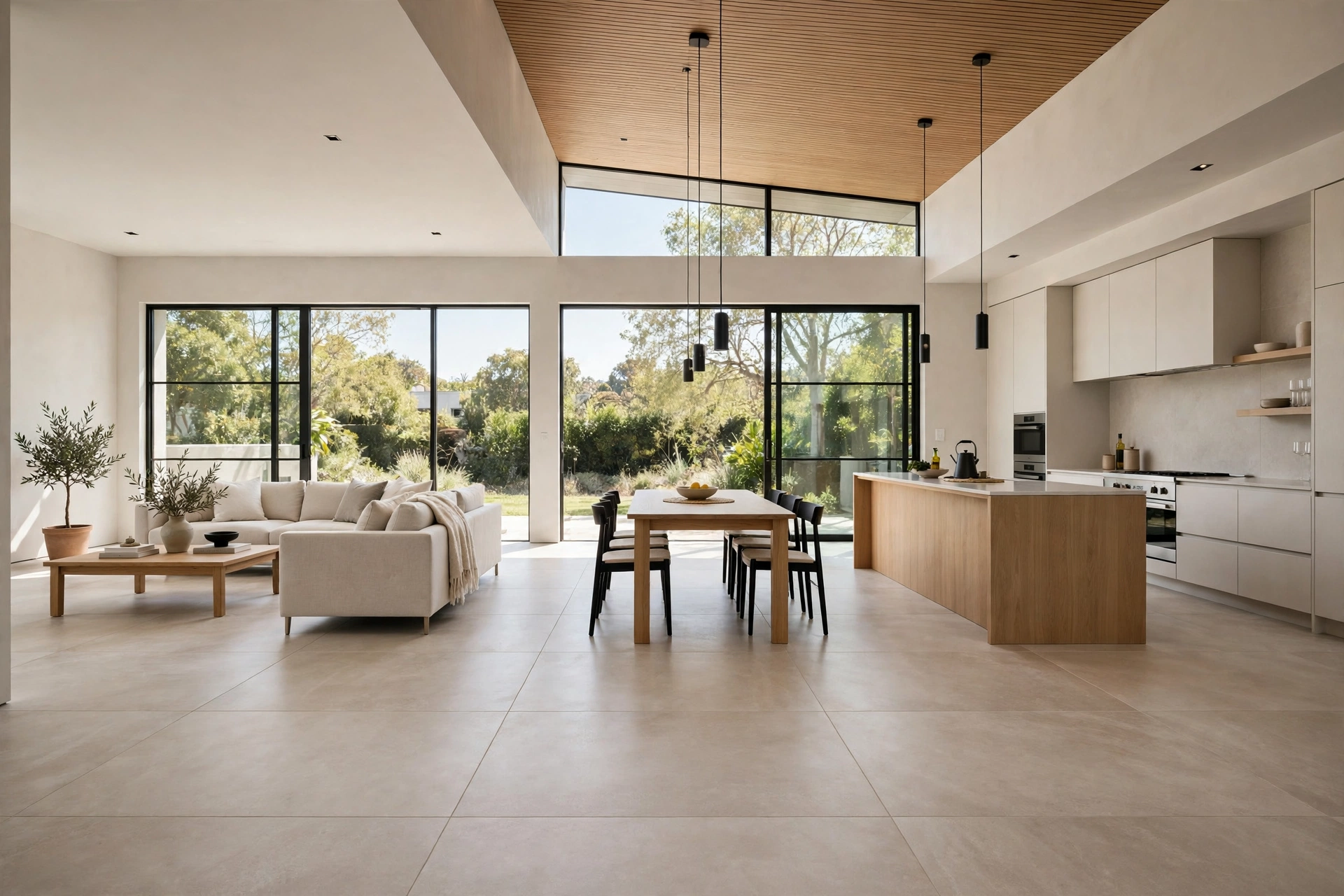
How Much Does It Cost to Tile a 1,700 Sq Ft Home in 2026?
How much does it cost to tile a 1700 sq ft home in 2026? The typical all-in price is $12,000–$25,000 for a mid-range whole-home job, covering materials, labor, thinset, grout, and underlayment across 1,700 square feet of floor. That works out to roughly $7–$15 per square foot installed for standard 12×12 tile, with ceramic tile costing $5–$11 per square foot installed, porcelain running $7–$16 per square foot installed, and natural stone reaching $11–$32 per square foot installed. A budget ceramic job can land near $8,500–$12,000, a mid-range porcelain install typically costs $12,000–$25,000, and a premium natural-stone project runs $25,000–$54,400 — before extras such as old-floor removal, subfloor repair, and waterproofing, which are usually billed separately.
One important clarification before we go further: this guide is about tiling the floors of a whole 1,700-square-foot home — the living areas, kitchen, bathrooms, and hallways. It is not about roof tile. Search results for “tile a home” mix in roofing content, so if you landed here looking for a tile roof, the numbers below will not apply; roof tile is priced by the roofing square and installed by roofers, not tile setters. For floor tile, 1,700 square feet is a full whole-house project — typically three bedrooms, a living room, a dining area, a kitchen, two bathrooms, and hallways — and the economics change at that scale. You are buying roughly 1,900 square feet of tile once waste is counted, crews work more efficiently over a week or more on one address, and whole-house jobs often earn a better per-square-foot rate than tiling a single bathroom. This guide breaks down the 1,700-square-foot tile cost by tile type, shows the materials-versus-labor split, explains how much tile to buy, compares project sizes, breaks the job down room by room, and shows what a $12,000 quote, a $25,000 quote, and a $50,000 quote actually buy you — so you can read any estimate line by line.
For background on tile installation standards, grout joints, and what a proper install should include, the Tile Council of North America publishes the industry’s installation handbook and consumer guidance at tilecouncil.org.
Quick-answer table (typical 2026 cost to tile a 1,700 sq ft home):
| Item | Typical cost |
|---|---|
| 1,700 sq ft tile installed, typical mid-range | $12,000–$25,000 |
| Ceramic tile, installed, 1,700 sq ft | $8,500–$18,700 |
| Porcelain tile, installed, 1,700 sq ft | $11,900–$27,200 |
| Natural stone tile, installed, 1,700 sq ft | $18,700–$54,400 |
| All-in installed rate, standard 12×12 tile | $7–$15 per sq ft |
| All-in installed rate, large-format 24×24+ tile | $10–$20 per sq ft |
| Tile installation labor | $4–$12 per sq ft |
| Ceramic tile material | $1–$4 per sq ft |
| Porcelain tile material | $2–$4 per sq ft |
| Natural stone tile material | $2–$20+ per sq ft |
| Tile to buy (with 10–15% waste) | About 1,870–1,955 sq ft |
| Professional install time, whole home | 5–10 days |
How Much Does It Cost to Tile a 1700 Sq Ft Home by Tile Type
The tile you choose is the single biggest driver of a 1,700-square-foot quote. At this scale, a $1-per-square-foot difference in material price is a $1,700 swing in the total, and a $5-per-square-foot difference is an $8,500 swing — so the tile type matters far more here than it does in a single bathroom:
| Tile type | Material per sq ft | Labor per sq ft | All-in installed per sq ft | Total for 1,700 sq ft |
|---|---|---|---|---|
| Ceramic (standard 12×12) | $1–$4 | $4–$7 | $5–$11 | $8,500–$18,700 |
| Porcelain (standard 12×12) | $2–$4 | $5–$12 | $7–$16 | $11,900–$27,200 |
| Porcelain, large format 24×24+ | $3–$6 | $7–$14 | $10–$20 | $17,000–$34,000 |
| Natural stone (marble, travertine, slate) | $2–$20+ | $9–$12 | $11–$32 | $18,700–$54,400 |
Ceramic tile is the cheapest way to tile a whole house, and it makes sense for bedrooms, hallways, and living areas where the floor will not see standing water. The trade-off is a softer glazed surface that chips more easily than porcelain and a body that absorbs more moisture, which is why ceramic is a poor choice for showers and a mediocre one for busy kitchens. Porcelain tile is the sweet spot for most whole-home projects: denser, harder, and far less porous than ceramic, so it handles kitchens, entryways, and bathrooms without complaint, and its price keeps the job in the $12,000–$25,000 mid-range for most homes. Natural stone is the premium option — marble, travertine, and slate look unmatched and add real resale value, but the material alone can cost $2–$20+ per square foot, the stone needs sealing, and labor runs $9–$12 per square foot because each piece is heavier, more fragile, and slower to set.
What a $12,000 quote buys vs. a $25,000 quote vs. a $50,000 quote. A $12,000 quote is almost always standard ceramic or entry-level porcelain, basic thinset and grout, and labor only — no removal, no waterproofing membrane, no subfloor work. A $25,000 quote is typically mid-range porcelain throughout the house with underlayment, a waterproofing membrane in the wet areas, and a professional crew working across several rooms. A $50,000 quote usually means natural stone or large-format porcelain plus the full package: old-floor removal and haul-away, subfloor leveling, waterproofing, new baseboards, and sealing. None of these is automatically a bad deal — the question is whether the line items match the price.
Standard 12×12 vs. Large-Format Tile: What Changes the Price
Tile size changes the installed price almost as much as tile type does. Standard 12×12 tile installs at $7–$15 per square foot all-in, while large-format tile — 24×24 inches and larger — installs at $10–$20 per square foot all-in, and the reasons are practical rather than cosmetic:
| Factor | Standard 12×12 tile | Large-format 24×24+ tile |
|---|---|---|
| All-in installed rate | $7–$15 per sq ft | $10–$20 per sq ft |
| Total for 1,700 sq ft | $11,900–$25,500 | $17,000–$34,000 |
| Labor per sq ft | $4–$7 | $7–$14 |
| Pieces to set for 1,700 sq ft | About 1,700 tiles | About 425 tiles |
| Subfloor flatness required | Standard tolerance | Much flatter — lippage risk |
| Grout lines | More lines, more grout | Fewer lines, cleaner look |
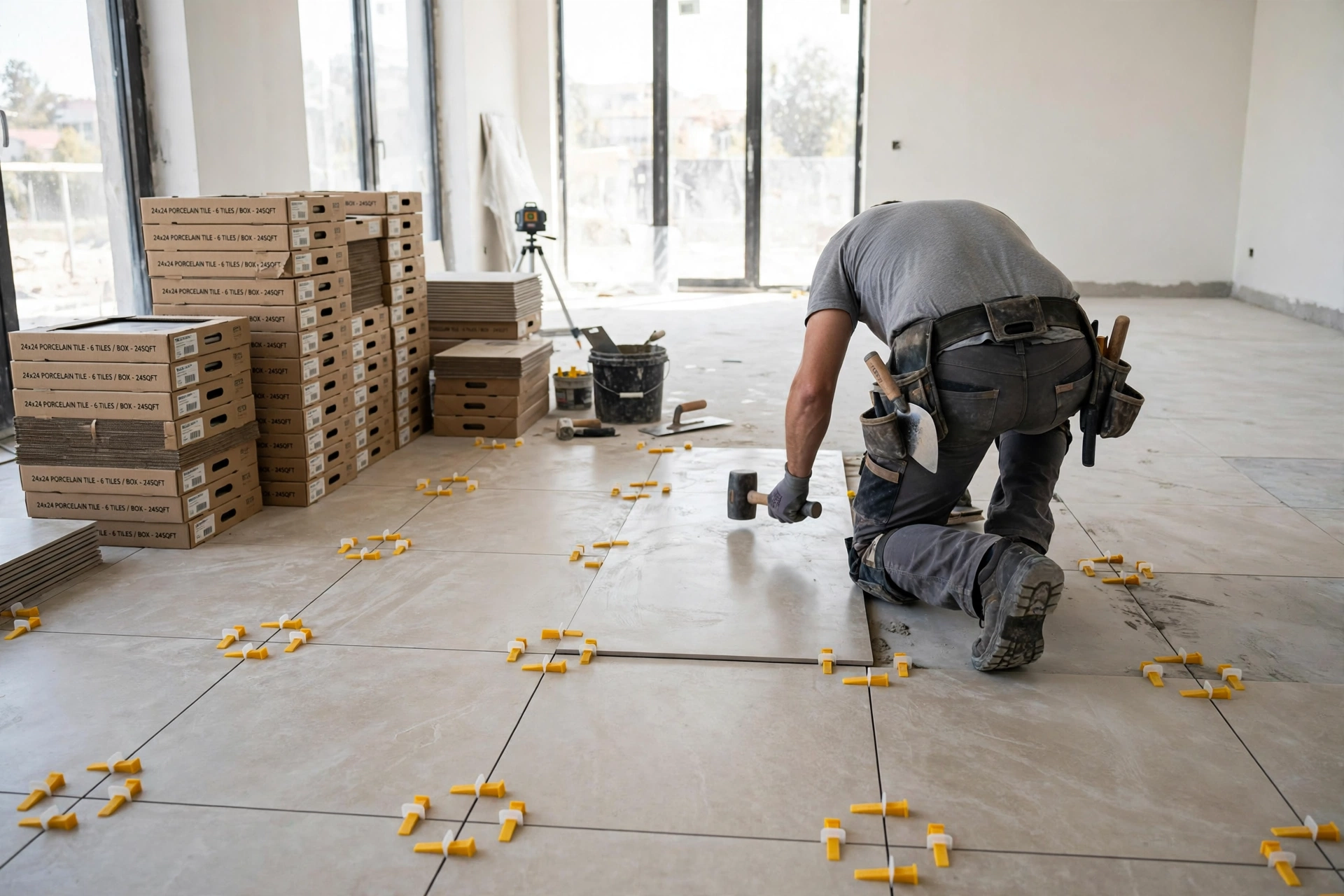
Large-format tile costs more to install because each piece is heavier and harder to handle, the subfloor must be far flatter (a large tile telegraphs every dip as lippage, the raised edge you feel underfoot), and the installer usually works with a leveling-clip system that adds material cost and time. The payoff is fewer grout lines, a cleaner modern look, and less grout to clean over the life of the floor — which is why large-format porcelain is the most requested whole-house tile style in 2026. If your subfloor is not flat, the leveling work alone can add thousands of dollars to a large-format job, so get the flatness measured before you commit to 24×24 tile.
Tile Flooring Cost by Project Size: 500 vs. 1,000 vs. 1,700 vs. 2,500 Square Feet
The per-square-foot rate improves as the project grows, because measuring, delivery, and crew setup are spread over more area. Here is how the totals compare by tile type:
| Project size | Ceramic installed | Porcelain installed | Natural stone installed |
|---|---|---|---|
| 500 sq ft (kitchen + baths) | $2,500–$5,500 | $3,500–$8,000 | $5,500–$16,000 |
| 1,000 sq ft (main floor) | $5,000–$11,000 | $7,000–$16,000 | $11,000–$32,000 |
| 1,700 sq ft (whole home) | $8,500–$18,700 | $11,900–$27,200 | $18,700–$54,400 |
| 2,500 sq ft (large home) | $12,500–$27,500 | $17,500–$40,000 | $27,500–$80,000 |
The 500-square-foot job has the worst effective rate because fixed costs dominate: the measurement visit, delivery, and minimum installer charges are the same whether the crew tiles 500 square feet or 1,700. By the time you reach 1,000 square feet the rate settles into its normal band, and at 1,700 square feet the whole-house efficiency is fully in effect — setup and travel time are amortized across a week of work instead of a single visit. The same logic applies at 2,500 square feet, where a large-home job can earn the best per-square-foot rate of all, provided the whole house is booked as one continuous project.
If you are costing a smaller flooring project first, see our guide to how much it costs to laminate a 12×12 room — a 144-square-foot room is the smallest common flooring job, and its per-square-foot rate is the highest you will see. And if you want the full picture on a 1,000-square-foot hard-surface install for comparison, our guide to installing 1,000 square feet of laminate flooring shows how laminate pricing compares with tile at the same scale.
Room-by-Room Cost Breakdown for a 1,700 Sq Ft Home
A 1,700-square-foot tile job is never one big room. It is a combination of rooms, and the cost per room varies because wet areas need waterproofing and small rooms need more cutting per square foot:
| Room | Square feet | Tile type typically used | Typical installed cost |
|---|---|---|---|
| Kitchen | 200 | Porcelain | $1,400–$3,200 |
| Living room + dining area | 600 | Porcelain or ceramic | $3,000–$9,600 |
| Primary bathroom | 60 | Porcelain | $420–$1,920 |
| Hall bathroom | 50 | Porcelain or ceramic | $250–$1,600 |
| Hallways | 150 | Porcelain or ceramic | $750–$4,800 |
| Bedrooms (3) | 600 | Ceramic or porcelain | $3,000–$9,600 |
| Entryway / foyer | 40 | Porcelain | $280–$1,280 |
| Whole home total | 1,700 | Mixed | $8,500–$27,200 |
The bathrooms are the most expensive rooms per square foot, even though they are the smallest: a 50-square-foot bathroom can cost $250–$1,600 because of the waterproofing membrane, the shower curb and niche work, and the sheer number of cuts around the toilet, vanity, and tub, and for a larger see how much it would cost to tile a 10×10 bathroom. The kitchen is the next most expensive per square foot, because of cuts around cabinets and the island, plus a waterproofing membrane under the sink and dishwasher area. Bedrooms and living areas are the cheapest per square foot — big open rectangles with few obstacles, where a crew can set tile fast. This is also why many homeowners tile only the kitchen, baths, and living areas and choose a cheaper floor for the bedrooms: see our guide to carpet installation cost for a bedroom if some of the bedrooms in your 1,700 square feet would be better soft underfoot.
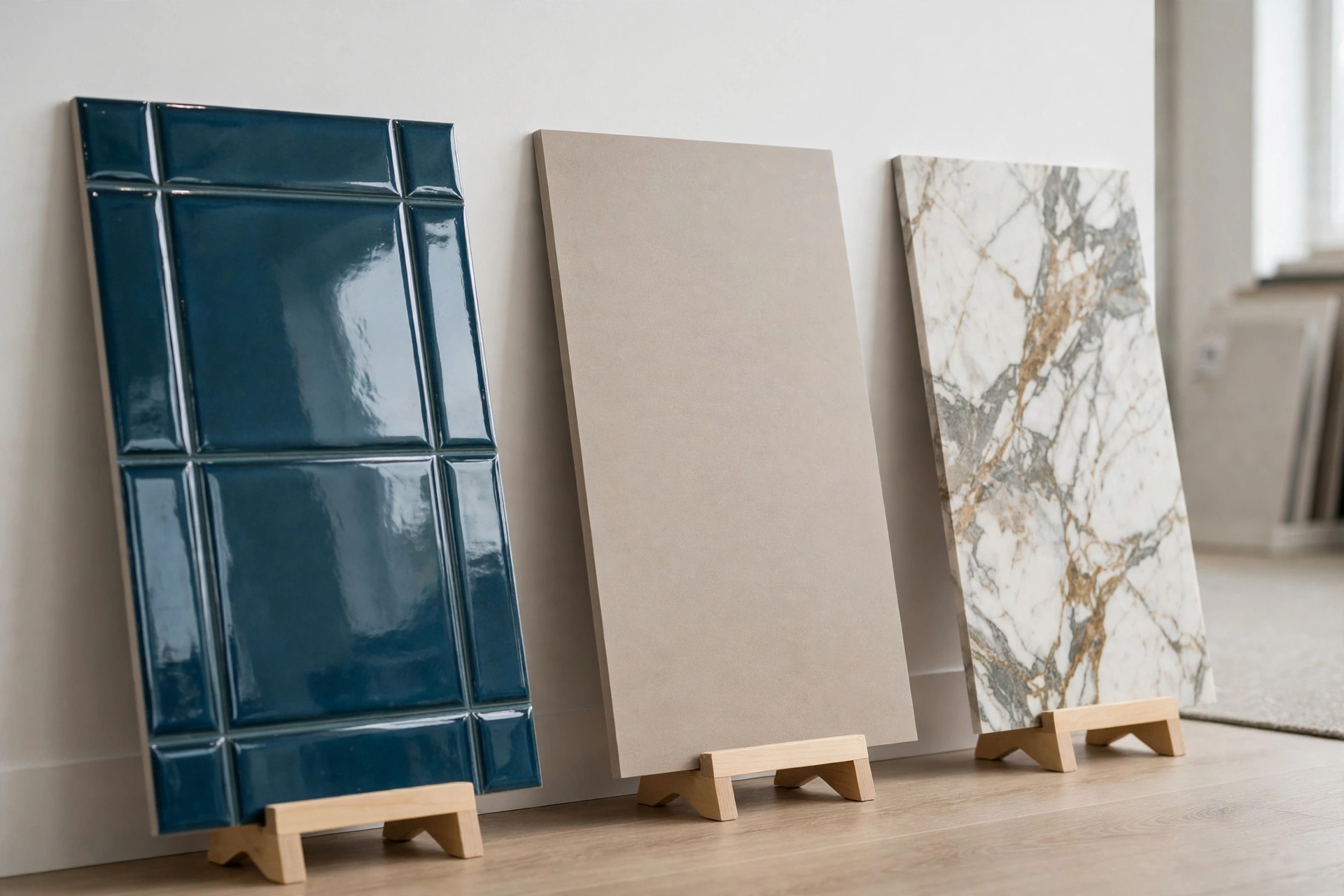
How Much Tile Do You Need for a 1,700 Sq Ft Home?
Ordering the right amount of tile is the most common mistake on a whole-house job. Order too little and the crew stops mid-job while you wait for a restock — possibly from a different dye lot that does not match. Order far too much and you have paid for boxes you will return, if the store accepts returns at all:
| Layout | Waste factor | Tile to buy | Boxes (at 15 sq ft per box) |
|---|---|---|---|
| Straight lay, rectangular rooms | 10% | 1,870 sq ft | About 125 boxes |
| Straight lay, many cuts and closets | 12% | 1,904 sq ft | About 127 boxes |
| Diagonal or herringbone layout | 15% | 1,955 sq ft | About 130 boxes |
| Rooms with angled walls or niches | 15% | 1,955 sq ft | About 130 boxes |
The rule is simple: buy about 10% extra tile for cuts and waste on a standard straight-lay install, and 15% extra for a diagonal or herringbone layout. For 1,700 square feet, that means buying roughly 1,870 square feet of tile for a straight lay, or about 1,955 square feet for a diagonal layout. Tile cartons typically cover 10–20 square feet each, so check the coverage printed on the box you actually buy — at 15 square feet per box you need about 125 boxes for a straight lay, and at 10 square feet per box you need about 187.
Three ordering rules that save real money. First, buy all the tile from the same production run and dye lot — tile shades vary slightly between lots, and a mid-job restock can leave a visible line across a room. Second, keep one unopened box after the install for future repairs; a discontinued color or pattern is impossible to match later. Third, confirm the store’s return policy on unopened boxes before you buy, so the 10% overage is a safety net rather than a sunk cost. If you are buying tile through a big-box store, see our guide to Home Depot tile installation cost per square foot.
1,700 Sq Ft Tile Job: Materials vs. Labor Breakdown
On a 1,700-square-foot project, materials and labor each make up a large share of the bill, and seeing the split is how you spot a quote that is padded in one place or another. The table below uses a mid-range porcelain job at $12,000–$25,000 as the example:
| Cost component | Per sq ft | Total for 1,700 sq ft |
|---|---|---|
| Porcelain tile material | $2–$4 | $3,400–$6,800 |
| Installation labor | $4–$12 | $6,800–$20,400 |
| Thinset, grout, and setting materials | $1–$2 | $1,700–$3,400 |
| Cement backer board / underlayment | $1–$2 | $1,700–$3,400 |
| Waterproofing membrane (wet areas) | Varies by job | $500–$2,000 |
| Trim, transitions, and thresholds | Varies by job | $300–$1,000 |
| Typical all-in total (porcelain) | $7–$16 | $11,900–$27,200 |
Labor is a bigger share of a tile job than of almost any other flooring job. At $4–$12 per square foot, labor alone on 1,700 square feet runs $6,800–$20,400, which is why a cheap tile choice does not automatically produce a cheap total — the crew still has to set, level, and grout roughly 1,700 tiles across multiple rooms. Thinset and grout are usually a modest line item at $1,700–$3,400 for the whole job, but they matter: the wrong thinset over a wood subfloor can cause cracked tiles, and a waterproofing membrane is essential in bathrooms and under kitchen sinks. For manufacturer guidance on which tile and setting materials suit each room, Daltile publishes product and installation resources at daltile.com.
The all-in local installer example. A typical all-in quote from a local installer — including removal of the old floor, furniture moving, subfloor prep, and waterproofing — runs $15,000–$30,000 for 1,700 square feet of porcelain. That sits above the $12,000–$25,000 typical range precisely because it bundles the extras that a bare materials-plus-labor quote leaves out. When you compare quotes, always compare the same scope: a $13,000 quote that excludes removal and waterproofing is not cheaper than a $18,000 quote that includes them.
What’s Included vs. What Costs Extra on a 1,700 Sq Ft Tile Job
A 1,700-square-foot quote covers the basics, but several common line items are billed separately — and at this scale, each one is a four-figure swing if you miss it:
| Line item | Included or extra? | Typical cost |
|---|---|---|
| Tile material | Included in all-in price | $1–$20+ per sq ft |
| Installation labor | Included in all-in price | $4–$12 per sq ft |
| Thinset, grout, and setting materials | Usually included | $1,700–$3,400 for the job |
| Cement backer board / underlayment | Usually included | $1,700–$3,400 for the job |
| Waterproofing membrane (wet areas) | Sometimes extra | $500–$2,000 |
| Old-floor removal and haul-away | Usually extra | Quoted by the job |
| Subfloor repair and leveling | Extra | Quoted after inspection |
| Sealing (natural stone) | Extra | Quoted by the job |
| Trim, transitions, and thresholds | Usually extra | $300–$1,000 |
| Furniture moving | Usually extra | Quoted by the job |
| Delivery fees | Sometimes extra | Varies by supplier and distance |
Three extra-cost questions that protect your budget. First, does the quote include removal and haul-away of your old floor, or will the old carpet or laminate still be on the ground when the installers leave? On 1,700 square feet, removal is a major line item — get it in writing. Second, has anyone inspected your subfloor? Uneven concrete, damaged plywood, or a floor that needs leveling adds labor and materials that only show up after the measurement visit, and a quote with no subfloor line item is a quote that may grow. Third, is waterproofing included in the bathrooms? A membrane under the tile in wet areas is not optional, and on a whole-house job it is a $500–$2,000 line item that some quotes quietly leave out.
What Affects the Cost of Tiling a Whole Home
No two 1,700-square-foot tile quotes are identical, because the price is built from your house, your tile, and your local market. These are the factors that move it most:
Tile type. The gap between ceramic at $1–$4 per square foot and natural stone at $2–$20+ per square foot is a $32,000 swing on 1,700 square feet at the top end — the single largest variable in any quote. Porcelain sits in the middle at $2–$4 per square foot of material and is the value choice for most whole-home jobs.
Tile size. Large-format 24×24+ tile installs at $10–$20 per square foot versus $7–$15 for standard 12×12, because each piece is heavier, the subfloor must be flatter, and leveling clips add time and material. A large-format job on 1,700 square feet typically costs $17,000–$34,000 all-in.
Subfloor condition. A flat, sound subfloor keeps labor near the $4 end of the range. Uneven concrete, damaged plywood, or a floor that needs leveling adds labor and materials that only show up after the measurement visit — and across 1,700 square feet, a leveling problem can add thousands of dollars.
Old-floor removal. Removing glued-down flooring, tile, or multiple layers of old flooring costs more than pulling up loose carpet. On a whole-house job, removal and haul-away is a real line item, not a rounding error — especially if the old floor is tile, which has to be chipped out and hauled in heavy loads.
Room shape and obstacles. Hallways, closets, bathrooms, and rooms with many doorways take more cutting and more time, which pushes labor toward the $12 end. Wide-open rectangular rooms are the cheapest to tile — and a 1,700-square-foot open-plan floor will usually quote lower per square foot than the same area split into eight small rooms.
Waterproofing needs. Bathrooms, kitchens, and laundry areas need a waterproofing membrane under the tile. A home with two full bathrooms and a kitchen needs more membrane work than a home with one bath, and the difference shows up in the quote.
Local installer rates. Labor rates follow your market. A quote in a high-cost metro area will run higher than the same job in a smaller market, even for the identical tile, because the $4–$12-per-square-foot labor range is wide and local.
Timing. Spring and summer are the busiest seasons for tile installers. If your schedule is flexible, asking about off-season availability can sometimes produce a better quote, especially on a multi-day whole-house job that fills a crew’s calendar.
DIY vs. Hiring a Pro for 1,700 Sq Ft of Tile Flooring
| DIY | Hiring a pro | |
|---|---|---|
| Material cost | $1–$20+ per sq ft ($1,700–$34,000+) | $1–$20+ per sq ft ($1,700–$34,000+) |
| Labor cost | $0 (your time) | $4–$12 per sq ft ($6,800–$20,400) |
| All-in total (porcelain) | $5,100–$10,200 plus tools | $11,900–$27,200 typical |
| Time required | Several weeks for most homeowners | 5–10 days for a professional crew |
| Tools needed | Wet saw, trowels, spacers, leveling clips, knee pads | Included in the labor price |
| Measuring and ordering | You measure — mistakes are on you | Professional measurement, correct box count |
| Warranty | None | Installer warranty varies by contractor |
| Best for | Confident DIYers with time and simple, rectangular rooms | Whole-house jobs, wet areas, large-format tile, tight timelines |
Tile is one of the least DIY-friendly floors at whole-house scale. A single bathroom is a manageable weekend project for a confident DIYer, but 1,700 square feet means setting roughly 1,700 tiles, mixing dozens of bags of thinset, and living with the disruption for weeks while the job stretches out. A bad first row, an uneven subfloor, or a poorly waterproofed bathroom is visible forever — and a leaking shower has no warranty to fall back on. When DIY wins: you have a simple layout, you already own a wet saw, and your time is worth less than the $4–$12 per square foot of labor. When a pro wins: the job spans multiple rooms, the bathrooms need waterproofing, the tile is large-format, or you need the floor finished in days rather than weeks. A common middle path is to hire a pro for the bathrooms and kitchen and DIY a single spare bedroom later, once you have seen how the tile handles.
If you are weighing tile against the other budget hard-surface option for a whole house, compare our guide to vinyl plank flooring installation cost — vinyl plank is fully waterproof, installs faster, and often prices out well below mid-range tile. And if the bathrooms in your 1,700 square feet are part of a bigger renovation, see our guide to the 5×10 bathroom remodel cost for what a full bathroom rebuild adds on top of the tile.
Money-Saving Tips for a 1,700 Sq Ft Tile Flooring Project
1. Compare the all-in price, not just the labor rate. A low labor quote with expensive tile is not a bargain. Get the material, labor, and extras as separate lines from at least two installers, and compare the same scope. 2. Bundle the whole house into one job. One measurement visit, one delivery, and one crew setup spread the fixed costs across 1,700 square feet — and whole-house jobs often earn a better per-square-foot rate than single rooms booked separately. 3. Use porcelain in wet rooms and ceramic elsewhere. Porcelain is the right call in the kitchen and bathrooms, but standard ceramic at $5–$11 per square foot installed is fine for bedrooms and hallways — mixing tile types by room can save thousands on a whole-house job. 4. Buy 10% extra, not 20%. The 10% waste factor covers a standard straight lay on 1,700 square feet. Ordering far more than you need ties up hundreds of dollars in boxes you may not be able to return. 5. Ask what is actually included. Removal, subfloor repair, waterproofing, and trim are the classic surprise charges on a whole-house tile job. Get them in writing before you accept the quote. 6. Keep the old floor if you can. If your existing floor is flat and sound, some tile can be set over it with the right preparation — skipping removal saves a major line item on 1,700 square feet. Confirm with the installer first; not every old floor is a suitable base, and tile over tile needs a proper bond. 7. Buy samples and test them at home. A $2-per-square-foot tile that looks wrong in your light is a wasted install across 1,700 square feet. Samples are cheap; regret is not. 8. Time it for the off-season if you can. Tile demand peaks in spring and summer. A flexible schedule on a multi-day job can mean faster booking and occasionally a better quote.
Frequently Asked Questions
How much does it cost to tile a 1700 sq ft home?
Typically $12,000–$25,000 all-in for a mid-range whole-home job. That is $7–$15 per square foot installed for standard 12×12 tile: ceramic costs $5–$11 per square foot installed ($8,500–$18,700 for 1,700 sq ft), porcelain costs $7–$16 per square foot installed ($11,900–$27,200), and natural stone costs $11–$32 per square foot installed ($18,700–$54,400).
How much tile do I need for a 1,700 sq ft home?
About 1,870 square feet of tile for a standard straight-lay install, including the recommended 10% extra for cuts and waste — roughly 125 boxes at 15 square feet per box. For a diagonal or herringbone layout, buy 15% extra, or about 1,955 square feet. Always buy from the same dye lot and keep one unopened box for future repairs.
Is tile cheaper than laminate for a whole house?
No — tile costs more. Laminate installs at $3–$8 per square foot, or $3,000–$8,000 for 1,000 square feet, while tile installs at $7–$15 per square foot for standard sizes. Tile lasts longer, handles water far better, and adds more resale value, which is why many homeowners tile the kitchen and bathrooms and use laminate or vinyl plank in the bedrooms. See our guide to installing 1,000 square feet of laminate flooring for the full laminate comparison.
How long does it take to tile a 1,700 sq ft home?
A professional crew typically takes 5–10 days for 1,700 square feet, depending on the number of rooms, the amount of cutting, whether old flooring has to come out first, and grout curing time. A DIY install of the same area usually takes several weeks. Your installer will confirm the schedule after the measurement visit.
What is not included in a typical 1,700 sq ft tile quote?
Old-floor removal and haul-away, subfloor repair and leveling, waterproofing membranes in wet areas, natural-stone sealing, new trim and transitions, and furniture moving are usually extra — and on 1,700 square feet each is a meaningful line item. An all-in local installer quote that includes removal, furniture moving, waterproofing, and prep typically runs $15,000–$30,000 for porcelain. Always get these items listed separately on the quote.
The Bottom Line
For tiling the floors of a 1,700-square-foot home in 2026, budget $12,000–$25,000 all-in for a mid-range porcelain job — $7–$15 per square foot installed for standard 12×12 tile, with materials at $2–$4 per square foot and labor at $4–$12 per square foot. Ceramic tile lands near $8,500–$18,700, porcelain near $11,900–$27,200, and natural stone near $18,700–$54,400. Large-format 24×24+ tile runs $10–$20 per square foot installed, or $17,000–$34,000 for the whole house. Buy about 1,870 square feet of tile (the 10% waste factor), book the whole house as one job to capture the best per-square-foot rate, and get the quote itemized — tile, labor, thinset and grout, backer board, waterproofing, removal, and trim on separate lines — before the first tile goes down. If the quote includes removal, furniture moving, waterproofing, and prep, expect $15,000–$30,000 instead, and remember that a premium natural-stone job with the full package can reach $54,400 or more.
Prices are typical 2026 US ranges for planning purposes and vary by region, product grade, and site condition; get itemized local quotes for an exact project price.


1 thought on “How Much Does It Cost to Tile a 1,700 Sq Ft Home in 2026?”