
How Much Do Electricians Charge for Installing a Ceiling Fan in 2026?
How much do electricians charge for installing a ceiling fan? In 2026, the typical installed total runs $146–$360, with the average job landing around $253 — but that range hides a wide spread, because the price depends almost entirely on what is already in your ceiling. A simple fan-for-fan swap, where a ceiling fan replaces an existing fan on a fan-rated box, costs $150–$300 in labor, and if you supply a basic fan yourself the all-in total can stay near the bottom of the range. Converting a light fixture to a fan, which usually means swapping the ceiling box for a fan-rated one and possibly adding a switch, runs $200–$400 in labor. And if there is no wiring at all in the ceiling — no fixture, no box, no switch — the job becomes new electrical work and the total jumps to $500–$1,500+. Electricians typically charge $50–$130 per hour, and most jobs also carry a service-call fee of $100–$200 for the first hour, so even a one-hour swap is rarely a $50 job.
The fan itself is a separate purchase on top of the labor, and it is the second-biggest lever on the final bill: a basic builder-grade fan costs $50–$100, a standard mid-range fan with a light kit runs $100–$250, and a premium, smart, or large outdoor-rated fan can cost $300–$600 for the fixture alone. That means a budget job — a basic fan on an existing fan-rated box — can come in around $146–$250 all-in, a typical mid-range job with a decent fan and a light-to-fan conversion lands at $300–$550, and a high-end job with a premium fan and new wiring can run $800–$1,500+. The single most important thing to know before you call an electrician is which of the three scenarios you are in, because the scenario sets the price more than the fan or the electrician’s rate does.
A ceiling fan is one of the cheapest comfort upgrades in a house: it can make a room feel about 4 degrees cooler in summer, let you raise the thermostat without losing comfort, and reverse in winter to push warm air back down. The U.S. Department of Energy’s own ceiling fans guide explains how to use a fan in both seasons and why blades should sit 7 to 9 feet above the floor. This guide breaks down the real 2026 cost by scenario and by fan type, explains exactly what the electrician does, shows what is included and what costs extra, compares an electrician with a handyman and with doing it yourself, and shows how to keep the bill down — including why installing two or three fans on the same visit is cheaper per fan than doing them one at a time.
Quick-answer table (typical 2026 ceiling fan installation costs):
| Item | Typical cost |
|---|---|
| Typical installed total, fan + labor | $146–$360 |
| Average installed total | ~$253 |
| Electrician hourly rate | $50–$130 per hour |
| Service-call fee / first hour | $100–$200 |
| Fan-for-fan swap, labor | $150–$300 |
| Light-to-fan conversion, labor | $200–$400 |
| No existing wiring, total | $500–$1,500+ |
| New wiring run | $150–$250 |
| New circuit from the panel | $150–$600 |
| Ceiling fan, basic builder-grade | $50–$100 |
| Ceiling fan, standard mid-range with light kit | $100–$250 |
| Ceiling fan, premium / smart / large | $300–$600 |
| Fan-rated ceiling box replacement | $50–$150 |
| New wall switch or dimmer | $50–$150 |
| Permit (where required) | $20–$100 |
| High-ceiling surcharge (vaulted / 12 ft+) | $50–$200 |
| Time on site, simple swap | 1–2 hours |
| Time on site, conversion or new wiring | 2–4 hours |
| Handyman, ceiling fan installation | $100–$250 |
| DIY, parts only (mount, wire nuts, screws) | $20–$50 |
How Much Do Electricians Charge for Installing a Ceiling Fan by Scenario
Your ceiling decides your price. There are three scenarios, and the labor roughly doubles at each step — because each step adds work that the previous one did not need. Here is the full picture:
| Scenario | Labor | Fan (if supplied by you) | Typical total installed |
|---|---|---|---|
| Fan-for-fan swap (existing fan, fan-rated box) | $150–$300 | $50–$600 | $146–$360 |
| Light fixture to fan (existing wiring, new fan-rated box) | $200–$400 | $50–$600 | $250–$550 |
| No existing wiring (new wiring + box + switch) | $400–$900 | $50–$600 | $500–$1,500+ |
| No existing wiring + new circuit from panel | $600–$1,200 | $50–$600 | $800–$1,500+ |
| Second / third fan on the same visit | $75–$150 each | $50–$600 each | $125–$300 each |
| Outdoor / patio fan installation | $200–$450 | $100–$600 | $300–$800 |
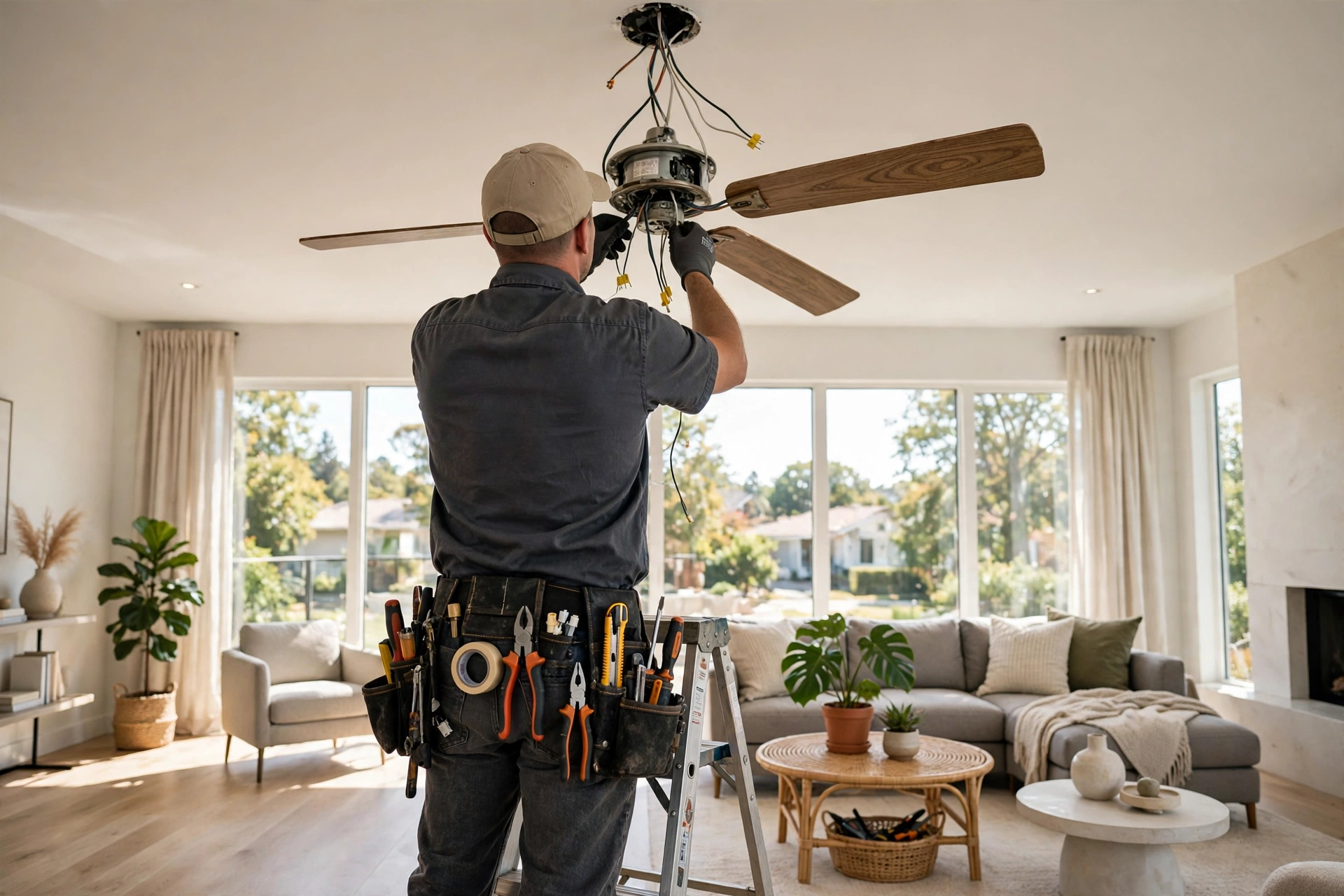
Fan-for-fan swap ($146–$360 installed). This is the cheapest scenario and the one most homeowners are in. An old ceiling fan is already hanging from a fan-rated ceiling box with wiring and a switch in place, so the electrician removes the old fan, disconnects the wires, mounts the new fan to the same box, reconnects the wiring, balances the blades, and tests it. The job takes 1–2 hours on site, and labor runs $150–$300. With a basic fan at $50–$100, the all-in total can land near the bottom of the $146–$360 range; with a premium fan at $300–$600, the total climbs toward the top. The $253 average installed total comes mostly from this scenario, because it is the most common job. If your existing fan wobbles, check the box before you buy: a fan-rated box is braced to hold a moving, vibrating fan, and a swap onto a box that was never rated for a fan is not a swap at all — it is a conversion.
Light fixture to fan conversion ($250–$550 installed). This is the second scenario: a light fixture hangs where you want the fan, so the wiring and the switch already exist, but the ceiling box was built for a light — a light weighs a few pounds and never moves, while a fan weighs 15–50 pounds and vibrates constantly. The electrician has to remove the light, replace the standard ceiling box with a fan-rated box (usually $50–$150 for the box and the bracing work), and then mount and wire the fan. Labor runs $200–$400, and the job takes 2–3 hours. If the existing switch is a single light switch and you want separate fan and light control, a new switch or a fan-speed control adds $50–$150. This is also the scenario where a remote-controlled fan earns its keep: a remote avoids the cost of running a second switch leg through the wall. For the labor rate behind these numbers, see our guide to what the rate for electricians is in 2026.
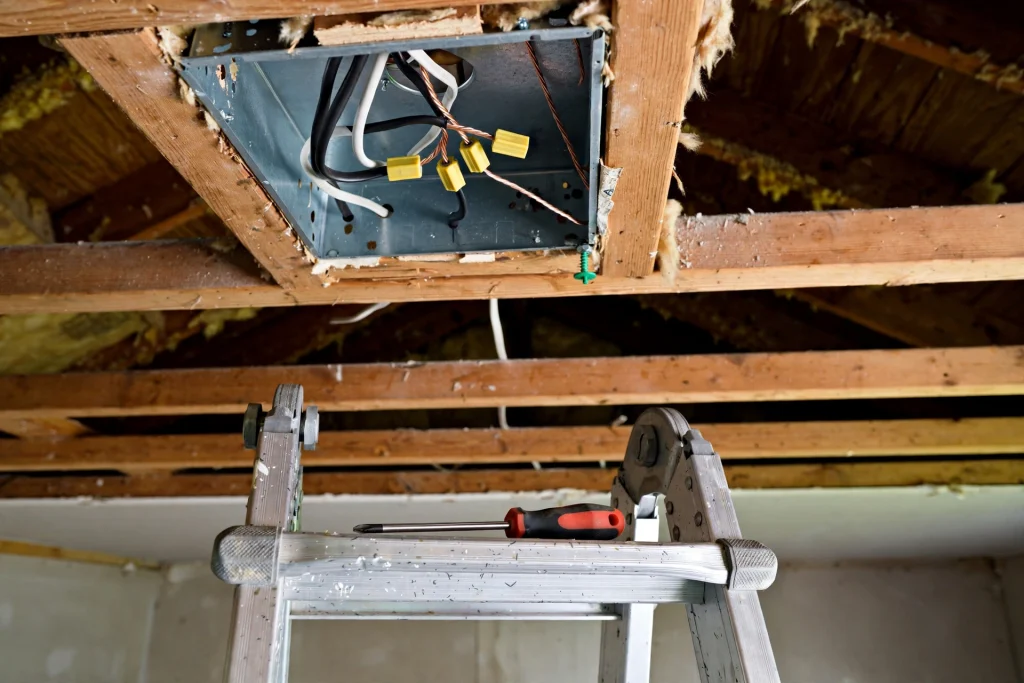
No existing wiring ($500–$1,500+ installed). This is the expensive scenario: a room with no ceiling fixture at all — no box, no wiring, no switch — and the electrician has to create the whole circuit. Running a new wiring run from a nearby circuit costs $150–$250; if the existing circuits cannot take the load or there is no convenient source, a new circuit from the electrical panel costs $150–$600. Add the fan-rated box, a new wall switch, and the fan installation itself, and labor runs $400–$900 for a wiring-only job or $600–$1,200 if a new circuit is needed. The total lands at $500–$1,500+, and it can go higher if the ceiling is finished and the electrician has to open drywall to fish wires — drywall patching and repainting are usually a separate cost. A permit is also most likely in this scenario, at $20–$100. If you are adding fans to several rooms with no wiring, do them all in one visit: the electrician is already opening the panel and running wire, and each additional fan costs far less than the first. For the full breakdown of this scenario, see our guide to how much it costs to install a ceiling fan without existing wiring.
Multiple fans on one visit. This is the best money-saving fact in the whole guide. The first fan carries the service-call fee of $100–$200 and the travel time; the second and third fans on the same visit only cost the incremental labor, typically $75–$150 each for a swap. If you need three fans replaced, booking them as one job instead of three separate visits can save $200–$400 in repeated service-call fees alone. Always ask for a multi-fan price when you call — most electricians quote it happily, because a three-fan visit is a better job for them too.
Outdoor / patio fans ($300–$800 installed). An outdoor-rated fan — damp-rated for a covered porch, wet-rated for an exposed location — costs more to buy ($100–$600) and slightly more to install, at $200–$450 in labor, because the wiring has to be weatherproof and the box has to be rated for exterior use. Never install an indoor-rated fan outdoors: humidity and rain will corrode the motor, and the warranty will not cover it.
Ceiling Fan Installation Cost by Fan Type
The fan you buy is the second-biggest lever on the total, after the scenario. A basic fan and a premium smart fan do the same job — move air — but the fixture price differs by a factor of ten, and the installation labor differs too, because heavier and larger fans take longer to mount and balance.
| Fan type | Fan price | Installation labor | Typical total installed |
|---|---|---|---|
| Basic builder-grade (42–44 in, no light) | $50–$100 | $150–$300 | $146–$250 |
| Standard with light kit (52 in) | $100–$250 | $150–$300 | $250–$450 |
| Large / great-room fan (60–72 in) | $200–$400 | $200–$400 | $400–$700 |
| Smart fan (Wi-Fi / app / voice control) | $250–$600 | $200–$400 | $450–$900 |
| Outdoor damp-rated (covered porch) | $100–$300 | $200–$450 | $300–$600 |
| Outdoor wet-rated (exposed) | $200–$600 | $200–$450 | $400–$800 |
| Low-profile / hugger (low ceilings) | $75–$200 | $150–$300 | $225–$400 |
| Dual-motor / designer fan | $300–$600 | $250–$450 | $550–$1,000 |
Basic builder-grade ($146–$250 installed). A basic 42–44-inch fan with no light kit costs $50–$100 for the fixture, plus $150–$300 in labor for a swap. This is the cheapest installed ceiling fan and the right choice for a bedroom or a rental where the fan just needs to move air quietly. The trade-off is a smaller motor, fewer speeds, and a pull chain instead of a remote — but for a straightforward swap, nothing beats it on price.
Standard with light kit ($250–$450 installed). This is the range most homeowners actually land in. A standard 52-inch fan with an integrated light kit costs $100–$250, plus $150–$300 in labor, and it replaces both the old fan and the room’s main light in one fixture. The 52-inch size suits most bedrooms and living rooms (rooms up to about 400 square feet), and the light kit means the electrician wires both the fan motor and the light — usually to the same switch, or to separate controls if you pay for a new switch. When the $253 average installed total is quoted, it is this category — a standard fan with a light kit on an existing fan-rated box — that sits closest to the middle of the range.
Large / great-room fans ($400–$700 installed). A 60–72-inch fan for a great room or a vaulted living room costs $200–$400 for the fixture, plus $200–$400 in labor. The labor is higher because the fan is heavier, the blades are longer, and the mount usually needs a downrod and extra bracing — and on a high ceiling the electrician works from a taller ladder or scaffolding, which adds time and a $50–$200 high-ceiling surcharge. Size the fan to the room: a 52-inch fan in a 500-square-foot great room will look lost and move too little air, and an oversized fan in a small bedroom will feel like a wind tunnel.
Smart fans ($450–$900 installed). A smart fan with Wi-Fi, app control, and voice-assistant support costs $250–$600 for the fixture, plus $200–$400 in labor. The labor is higher because the electrician also has to pair the fan with your home network and test the app and voice controls — and because a smart fan usually replaces a standard switch with a compatible control, which adds $50–$150. Buy the smart fan for the convenience, not for the savings: the energy difference between a smart fan and a standard ENERGY STAR fan is small. Speaking of efficiency, look for the ENERGY STAR label when you buy — ENERGY STAR ceiling fans move air about 20% more efficiently than standard models, and the ENERGY STAR ceiling fans page explains the label and the sizing rules.
Outdoor fans ($300–$800 installed). A damp-rated fan for a covered porch costs $100–$300, and a wet-rated fan for an exposed location costs $200–$600, plus $200–$450 in labor. The labor is higher because exterior wiring has to be weatherproof and the box has to be exterior-rated. Check the rating before you buy: a damp-rated fan under a roof is fine, but a damp-rated fan in the open rain will fail, and an indoor-rated fan outdoors is a fire and corrosion risk.
Low-profile / hugger fans ($225–$400 installed). A hugger fan mounts flush to the ceiling and costs $75–$200, plus $150–$300 in labor. It is the right choice for ceilings under 8 feet, where a standard fan on a downrod would hang too low — fan blades should sit 7 to 9 feet above the floor. The trade-off is less airflow than a downrod fan of the same size, because the blades sit closer to the ceiling.
Dual-motor / designer fans ($550–$1,000 installed). A dual-motor or designer fan costs $300–$600 for the fixture, plus $250–$450 in labor. These are statement pieces — two fan heads on one mount, sculptural blades, designer finishes — and the labor is higher because they are heavier, more complex to assemble, and harder to balance. Budget for the top of the labor range and ask the electrician to confirm the ceiling box can carry the weight before you buy.
How a Ceiling Fan Installation Works
Understanding the process matters as much as understanding the price, because the difference between a one-hour swap and a four-hour wiring job is entirely about what the electrician finds in your ceiling.
The electrician checks the box first. Before anything is unboxed, the electrician turns off the circuit at the breaker, removes the existing fixture or fan, and inspects the ceiling box. A fan-rated box is braced to a joist or mounted on a fan-rated brace bar and is stamped or labeled for fan support — it has to hold a moving, vibrating load of 15–50 pounds. A standard light box is not rated for that load, and hanging a fan from it is the single most common cause of a wobbling, noisy, or eventually falling fan. If the box is not fan-rated, it gets replaced — $50–$150 for the box and bracing — and that is what turns a swap into a conversion.
The fan is assembled on the floor, then mounted. The electrician assembles the motor housing, downrod, and blades on the floor, then lifts the assembly to the ceiling, hangs it from the mounting bracket, and connects the wires: black to black (fan motor), blue to black or to a separate switch leg (light kit), white to white (neutral), and green or bare copper to ground. Wire nuts and electrical tape secure each connection, and the canopy covers the wiring. A remote receiver, if the fan has one, is tucked into the canopy at this stage.
Balancing and testing take real time. A new fan almost always wobbles a little on first spin-up, and the electrician balances it by adjusting blade screws and, if needed, adding a small balancing weight to a blade. Then the fan is tested at every speed, the light kit is tested, the wall switch and remote are tested, and the electrician checks that the fan runs quietly with no clicking or humming. This is also when a bad switch or a loose connection shows up — and it is why a professional installation includes a workmanship warranty, usually 1 year, while a DIY job has no warranty at all. For the hourly rate behind the labor charges, see our guide to residential electrician cost per hour.
New wiring adds a full second phase. If there is no wiring in the ceiling, the electrician has to find a power source — usually a nearby circuit or the electrical panel — run cable through the ceiling and walls, install a fan-rated box, cut in a switch box, and wire the switch. On a finished ceiling this means fishing wire through joists and possibly cutting small access holes in the drywall, which is why the job takes 2–4 hours and costs $500–$1,500+. A permit, at $20–$100, is usually required for new wiring, and the work may need an inspection before the drywall is closed up.
What’s Included — and What’s Not
A standard ceiling fan installation quote covers the core work of mounting and wiring the fan on an existing fan-rated box. The trouble starts at the edges of that quote, where the items most likely to be needed — a fan-rated box, a new switch, a permit — are priced as extras. Before you book, know exactly where the line falls:
| Item | Standard installation | Notes |
|---|---|---|
| Removal of old fan or light fixture | Included | Standard installation includes removing the existing fixture |
| Disposal / haul-away of old fan | Included | Confirm in writing — some electricians charge a small disposal fee |
| Mounting the new fan | Included | Assembly, hanging, and securing to the ceiling box |
| Wiring the fan motor and light kit | Included | Connections to the existing wiring |
| Balancing the blades | Included | Blade adjustment and balancing weights as needed |
| Testing at all speeds + light | Included | Full function test before the electrician leaves |
| Cleanup | Included | Work area left clean |
| Workmanship warranty | Included (usually 1 year) | Covers defects in the installation |
| The ceiling fan itself | Not included | Purchased separately, $50–$600 by type |
| Fan-rated ceiling box replacement | Not included | $50–$150 extra |
| New wall switch, dimmer, or fan control | Not included | $50–$150 extra |
| New wiring run | Not included | $150–$250 extra |
| New circuit from the panel | Not included | $150–$600 extra |
| Permit | Not included | $20–$100 extra where required |
| High-ceiling surcharge (vaulted / 12 ft+) | Not included | $50–$200 extra |
| Drywall patching and repainting | Not included | Priced per job if wire fishing needs access holes |
| Smart-home pairing and setup | Sometimes included | Confirm — some electricians charge extra for app/voice setup |
The three items most often missing. The fan-rated box, the switch, and the permit are the classic surprise charges on a ceiling fan installation. The box is hidden in the ceiling, so nobody knows whether it is fan-rated until the old fixture comes down — and a $50–$150 box replacement is the most common change order on a conversion. If your existing switch is a single light switch and you want separate fan and light control, that is another $50–$150. And if the job needs new wiring, a permit at $20–$100 is usually required and is rarely included in the headline quote. None of this is a scam — it is genuinely unknowable until the ceiling is opened — but it is why the $146–$360 installed range is wider than the $150–$300 swap-labor range, and why you should get the quote in writing with the box and switch spelled out.
Common Add-On Charges
Add-ons are where a $150 swap becomes a $400 conversion — or a $1,500 wiring job. Here is what each one typically costs and when you are likely to face it:
| Add-on | Typical cost | When it comes up |
|---|---|---|
| Fan-rated ceiling box replacement | $50–$150 | Existing box is a standard light box, not rated for a fan |
| New wall switch or dimmer | $50–$150 | Single switch needs to become separate fan/light control |
| Fan-speed / smart wall control | $75–$200 | Upgrading to a dedicated fan-speed or smart control |
| New wiring run | $150–$250 | No wiring in the ceiling; run from a nearby circuit |
| New circuit from the panel | $150–$600 | No nearby circuit can take the load |
| Permit | $20–$100 | New wiring or a new circuit; required by most local codes |
| High-ceiling surcharge | $50–$200 | Vaulted ceilings or ceilings 12 feet and higher |
| Downrod extension | $20–$75 | High ceiling needs a longer downrod to bring blades to 7–9 feet |
| Drywall patching and repainting | $100–$500+ | Access holes cut to fish new wiring through a finished ceiling |
| Remote control receiver | $25–$75 | Fan has no remote and you want one added |
| Light kit (if fan bought without one) | $30–$100 | Adding a light kit to a fan-only model |
Materials vs. Labor Breakdown for a Ceiling Fan Installation
On a ceiling fan installation, labor is usually the bigger share of the bill for a swap — which is the opposite of a fixture-heavy job like a toilet replacement, where the fixture dominates. Here is how a typical mid-range installation at $250–$450 installed breaks down:
| Cost component | Typical range |
|---|---|
| Ceiling fan, standard with light kit | $100–$250 |
| Installation labor (fan-for-fan swap) | $150–$300 |
| Fan-rated box replacement (if needed) | $50–$150 |
| New switch or fan control (if needed) | $50–$150 |
| Small parts (wire nuts, screws, mounting hardware) | Included in labor |
| Old fan removal and disposal | Included in labor |
| Typical all-in total, basic fan swap | $146–$250 |
| Typical all-in total, standard fan with light kit | $250–$450 |
| Typical all-in total, light-to-fan conversion | $250–$550 |
| Typical all-in total, no existing wiring | $500–$1,500+ |
Labor runs $150–$300 for a swap and $200–$400 for a conversion, and it is the most predictable part of the bill: the electrician’s rate is $50–$130 per hour, the service-call fee is $100–$200 for the first hour, and a swap is a 1–2-hour job. The fan price is the more variable part — a basic fan at $50–$100 versus a premium or smart fan at $300–$600 — because the fan you pick is entirely your choice. The add-ons are the least predictable part, because they depend on what the electrician finds in your ceiling: a standard light box that needs replacing, a switch that needs upgrading, or no wiring at all.
A real-world example. A standard fan with a light kit at $100–$250, plus swap labor at $150–$300, comes to $250–$450 all-in — and that is the most common story in customer reports: the fan costs about as much as the labor, and the total lands near the $253 average. The total reaches $500–$1,500+ once new wiring at $150–$250 or a new circuit at $150–$600 enters the picture, which is why the first question to answer is always whether wiring already exists in the ceiling.
What Affects the Cost of Installing a Ceiling Fan
No two ceiling fan installation quotes are identical, because the price is built from your ceiling, your fan, and your local market. These are the factors that move it most:
Whether wiring already exists. This is the single biggest factor, and it swamps everything else: a swap at $150–$300 in labor, a conversion at $200–$400, and new wiring at $500–$1,500+ total. Before you call for quotes, look at the ceiling: if a fan or a light already hangs there, you are in the cheap half of the range; if the ceiling is bare, budget for the expensive half.
The ceiling box. A fan-rated box costs $50–$150 to install, and it is the most common extra on a light-to-fan conversion. A fan that weighs 15–50 pounds and vibrates constantly needs a box braced to a joist; a light box does not have that bracing, and no licensed electrician will hang a fan from one. If your home was built before ceiling fans were common in every bedroom, expect the box to need replacing.
Ceiling height. A standard 8-foot ceiling is a one-ladder job. A vaulted ceiling or a ceiling 12 feet or higher adds a $50–$200 surcharge, because the electrician needs a taller ladder or scaffolding, a longer downrod ($20–$75), and more time working overhead. Blades should sit 7 to 9 feet above the floor, so on a high ceiling the downrod length matters as much as the fan itself — and a fan mounted too close to a vaulted ceiling will not move air properly.
The fan you pick. A basic fan at $50–$100 keeps the all-in total at $146–$250, while a standard fan with a light kit at $100–$250 pushes it to $250–$450, and a premium or smart fan at $300–$600 takes the total past $450–$900 before a single extra is added. The fan is the lever with the biggest effect on the final number after the wiring scenario.
Your local market. The $50–$130 per hour electrician rate is wide for exactly this reason: the same swap costs more in a high-cost metro area than in a smaller market, because the local electrician’s rate follows local labor costs. The $100–$200 service-call fee also varies by market, and in a high-cost city it can sit at the top of that range before any work begins.
How many fans you install at once. The first fan carries the $100–$200 service-call fee; each additional fan on the same visit costs only $75–$150 in incremental labor. Three fans booked as one visit can save $200–$400 against three separate visits. This is the cheapest saving in the guide, and it requires no skill at all — just one phone call instead of three.
Permits and inspections. New wiring usually needs a permit at $20–$100, and some jurisdictions require an inspection before the drywall is closed. A swap or a conversion on existing wiring rarely needs a permit. Ask your electrician whether a permit is included in the quote or billed separately — and be wary of any electrician who offers to skip a required permit, because unpermitted electrical work can void your homeowner’s insurance.
Regional cost differences. Electrician rates follow local labor markets, and the same fan installation can cost 30–40% more in a high-cost metro than in a lower-cost region:
| Region | Typical electrician rate | Typical swap labor | Typical installed total |
|---|---|---|---|
| Northeast (Boston, New York, DC) | $90–$130 per hour | $200–$300 | $250–$450 |
| West Coast (Los Angeles, San Francisco, Seattle) | $85–$130 per hour | $200–$300 | $250–$450 |
| Midwest (Chicago, Columbus, Kansas City) | $60–$100 per hour | $150–$250 | $200–$350 |
| South (Atlanta, Dallas, Charlotte) | $50–$90 per hour | $150–$250 | $146–$350 |
| Mountain West (Denver, Phoenix, Salt Lake City) | $65–$110 per hour | $150–$275 | $200–$400 |
| Rural / small-town markets | $50–$80 per hour | $125–$225 | $146–$300 |
These are typical ranges, not quotes: your zip code sets the real number, and a rural electrician who drives 40 minutes to reach you may charge a higher service-call fee even at a lower hourly rate. Get the quote in writing for your address before you commit.
Electrician vs. Handyman for a Ceiling Fan Installation
| Licensed electrician | Handyman | |
|---|---|---|
| Typical swap labor | $150–$300 | $100–$250 |
| Typical conversion labor | $200–$400 | $150–$350 |
| New wiring | $500–$1,500+ total | Usually will not take the job |
| Hourly rate | $50–$130 per hour | $40–$90 per hour |
| Service-call fee | $100–$200 first hour | $50–$100, or none |
| Can replace a ceiling box | Yes — fan-rated box and bracing | Sometimes — confirm before booking |
| Can run new wiring / new circuit | Yes — licensed for electrical work | No — not licensed for new circuits |
| Permit handling | Yes — pulls the permit if required | Usually no |
| Workmanship warranty | Usually 1 year | Varies; often none |
| Insurance / liability | Licensed and insured | Varies — ask for proof |
| Time on site, swap | 1–2 hours | 1–2 hours |
| Best for | Conversions, new wiring, high ceilings, smart fans | A simple fan-for-fan swap on a sound fan-rated box |
When an electrician wins. Any job that touches wiring beyond a straight swap — a light-to-fan conversion, a fan-rated box replacement, a new switch leg, new wiring, or a new circuit — is electrician work, and in most jurisdictions a handyman is not legally allowed to do it. An electrician also wins on a smart fan, where the network pairing and the compatible wall control are part of the job, and on a high ceiling, where the mounting and bracing have to be right. The electrician’s $50–$130 per hour rate is higher than a handyman’s, but the work comes with a license, insurance, a permit where required, and a 1-year workmanship warranty. For the rate context, see our guide to what the rate for electricians is in 2026.
When a handyman wins. A handyman charges $100–$250 for a ceiling fan installation — cheaper than an electrician at the low end, and often available faster. For a straightforward fan-for-fan swap on a confirmed fan-rated box, where no wiring changes are needed, a handyman is a fair budget option and the saving is real: $100–$250 against an electrician’s $150–$300. The trade-off is that a handyman usually offers no 1-year workmanship warranty and may not be licensed for electrical work. Before you book a handyman, confirm two things: that the ceiling box is already fan-rated (have them check it before they start, not after the old fan is down), and that they carry liability insurance. If either answer is no, hire the electrician. For a related small electrical job, see our guide to how much an electrician costs to fix an outlet — the same service-call and hourly-rate math applies. For the full breakdown, see our guide to the handyman cost to install a ceiling fan.
DIY vs. Hiring a Pro for a Ceiling Fan Installation
| DIY | Hiring a pro (electrician) | |
|---|---|---|
| Fan cost | $50–$600 by type | Same — you buy the fan either way |
| Labor cost | $0 (your time) | $150–$300 (swap); $200–$400 (conversion) |
| Parts (mount, wire nuts, screws) | $20–$50 | Included in the labor price |
| Fan-rated box replacement | $50–$150 in parts, if you can do it | $50–$150, done by the electrician |
| All-in total, basic fan swap | $70–$150 | $146–$360 |
| All-in total, standard fan with light kit | $120–$300 | $250–$450 |
| All-in total, no existing wiring | Not a DIY job | $500–$1,500+ |
| Time required | 2–4 hours for a first-timer; 1–2 hours with experience | 1–2 hours on site |
| Tools needed | Ladder, screwdriver, wire strippers, voltage tester, drill | Included in the labor price |
| Electrical safety | You work on live-capable wiring — mistakes can cause fire or shock | Licensed pro, breaker off, tested before leaving |
| Heavy lifting overhead | You lift a 15–50 lb fan above your head on a ladder | The electrician does it |
| Warranty | None — mistakes are on you | Usually 1-year workmanship warranty |
| Best for | A straightforward fan-for-fan swap by a confident DIYer | Any conversion, new wiring, high ceiling, or smart fan |
A ceiling fan installation is one of the more DIY-friendly electrical jobs in a house — but it is still electrical work, and it is done on a ladder with your arms above your head. The parts cost $20–$50 — a mounting bracket, wire nuts, and screws — and a straightforward swap is a 2–4-hour job for a first-timer. When DIY wins: the job is a fan-for-fan swap, the ceiling box is confirmed fan-rated, the wiring is in good shape, and you are comfortable turning off the breaker, testing the wires dead with a voltage tester, and lifting a 15–50 lb fan overhead on a ladder. The saving is real — $70–$150 all-in for a basic fan against $146–$360 through an electrician. When a pro wins: the box needs replacing, the job is a light-to-fan conversion, there is no wiring, the ceiling is high, or the fan is a smart model. A loose wire nut or a fan hung from a light box is a fire risk and a falling-fan risk, and there is no warranty to fall back on when you did it yourself. If you have any doubt about the box or the wiring, pay the $150–$300 and hire the electrician.
Money-Saving Tips for a Ceiling Fan Installation
1. Install all your fans in one visit. The first fan carries the $100–$200 service-call fee; each additional fan on the same visit costs only $75–$150 in incremental labor. Three fans as one job can save $200–$400 against three separate visits. This is the single biggest saving in the guide. 2. Know your scenario before you call. If a fan or a light already hangs in the ceiling, say so when you call — the electrician can quote a swap at $150–$300 or a conversion at $200–$400 instead of pricing for the worst case. A photo of the ceiling fixture sent with your quote request gets you a tighter number. 3. Buy the fan yourself, on sale. The fan is the second-biggest cost, and a standard fan with a light kit at $100–$250 goes on sale regularly. A $50 saving on the fixture is a $50 saving on the total — and buying the fan yourself means the electrician charges labor only, with no markup on the fixture. 4. Check the box before the electrician arrives. If the old fan wobbles or the fixture is a light, expect a $50–$150 fan-rated box replacement. Knowing before the electrician arrives means you can budget for it instead of approving a change order on the spot. 5. Choose a remote-controlled fan instead of a new switch. If you want separate fan and light control but your wall has only one switch, a remote-controlled fan avoids the $50–$150 cost of running a second switch leg through the wall. The remote receiver lives in the canopy, and no new wiring is needed. 6. Get two or three quotes for anything beyond a swap. For a conversion or new wiring, an electrician’s rate runs $50–$130 per hour and the service-call fee $100–$200, so quotes for the same job can differ by $100–$300 between companies. A five-minute phone call to two more electricians is the cheapest way to know whether the first quote is fair. 7. Do not buy a smart fan for the energy savings. A smart fan at $250–$600 costs $150–$350 more than a standard fan with a light kit, and the energy difference is small. Buy the smart fan for the app and voice control, not for the payback — and buy an ENERGY STAR fan if efficiency is the goal, since ENERGY STAR fans move air about 20% more efficiently than standard models. 8. Time the job outside the busy season. Electricians are busiest in spring and early summer, when renovation season peaks. A fall or winter booking can mean a faster start date and occasionally a better price, especially for a multi-fan job that fills a half-day slot. 9. Replace the switch while the electrician is already there. If the wall switch is old, cracked, or a single switch you want split into fan and light control, replacing it during the installation costs $50–$150 in parts and a few minutes of the electrician’s time. Replacing it later means another $100–$200 service-call fee.
Frequently Asked Questions
How much do electricians charge for installing a ceiling fan?
In 2026, the typical installed total runs $146–$360, with the average job landing around $253. Labor for a fan-for-fan swap runs $150–$300, a light-to-fan conversion runs $200–$400, and a job with no existing wiring runs $500–$1,500+. Electricians typically charge $50–$130 per hour, with a service-call fee of $100–$200 for the first hour. The fan itself is a separate purchase: $50–$100 for a basic fan, $100–$250 for a standard fan with a light kit, and $300–$600 for a premium or smart fan.
How long does it take an electrician to install a ceiling fan?
A simple fan-for-fan swap takes 1–2 hours on site, including removal of the old fan, mounting, wiring, balancing, and testing. A light-to-fan conversion takes 2–3 hours, because the ceiling box has to be replaced with a fan-rated box. A job with no existing wiring takes 2–4 hours, and longer if a new circuit has to be run from the panel or drywall has to be opened to fish wires. Scheduling typically takes a few days to a week — same-day installation is rarely available.
Do I need a permit to install a ceiling fan?
Usually not for a swap or a conversion on existing wiring. A permit, at $20–$100, is usually required when the job involves new wiring or a new circuit from the panel, and some jurisdictions require an inspection before the drywall is closed up. Ask your electrician whether a permit is included in the quote or billed separately — and be wary of any electrician who offers to skip a required permit, because unpermitted electrical work can void your homeowner’s insurance.
Can a handyman install a ceiling fan?
Yes, for a simple fan-for-fan swap on a confirmed fan-rated box — a handyman charges $100–$250, against an electrician’s $150–$300. But a handyman is not licensed for new wiring or new circuits, usually cannot pull a permit, and usually offers no 1-year workmanship warranty. For a light-to-fan conversion, a box replacement, new wiring, a high ceiling, or a smart fan, hire a licensed electrician. Before you book a handyman, confirm that the ceiling box is already fan-rated and that they carry liability insurance.
Is it cheaper to install a ceiling fan myself?
Yes, for a straightforward swap: DIY parts cost $20–$50, and a basic fan swap done yourself comes to $70–$150 all-in, against $146–$360 through an electrician. But the saving only applies to a fan-for-fan swap on a confirmed fan-rated box with wiring in good shape. A conversion, a box replacement, new wiring, or a high ceiling is not a DIY job — a loose connection is a fire risk, a fan hung from a light box is a falling risk, and there is no warranty when you did it yourself. If you have any doubt about the box or the wiring, hire the electrician.
The Bottom Line
For a ceiling fan installation in 2026, budget a typical installed total of $146–$360, with the average job landing around $253. Labor for a fan-for-fan swap runs $150–$300, a light-to-fan conversion runs $200–$400, and a job with no existing wiring runs $500–$1,500+. Electricians typically charge $50–$130 per hour, with a service-call fee of $100–$200 for the first hour. The fan itself is a separate purchase — $50–$100 for a basic fan, $100–$250 for a standard fan with a light kit, and $300–$600 for a premium or smart fan. The scenario sets the price more than anything else: check whether wiring and a fan-rated box already exist in your ceiling before you call, get the quote in writing with the box and the switch spelled out, and install every fan you need in a single visit — each additional fan on the same visit costs only $75–$150 in incremental labor, against a fresh $100–$200 service-call fee for a separate trip. A handyman at $100–$250 is a fair budget option for a simple swap on a sound fan-rated box, but any conversion, new wiring, or smart fan is electrician work, and a permit at $20–$100 is usually required when new wiring is involved. If the job is a straightforward swap, the electrician’s price is a fair deal with a 1-year workmanship warranty; if there is no wiring at all, get two or three quotes, because the same job can differ by hundreds of dollars between companies.
Prices are typical 2026 US ranges for planning purposes and vary by region, fan choice, and site condition; get itemized local quotes for an exact project price.


6 thoughts on “How Much Do Electricians Charge for Installing a Ceiling Fan in 2026?”