
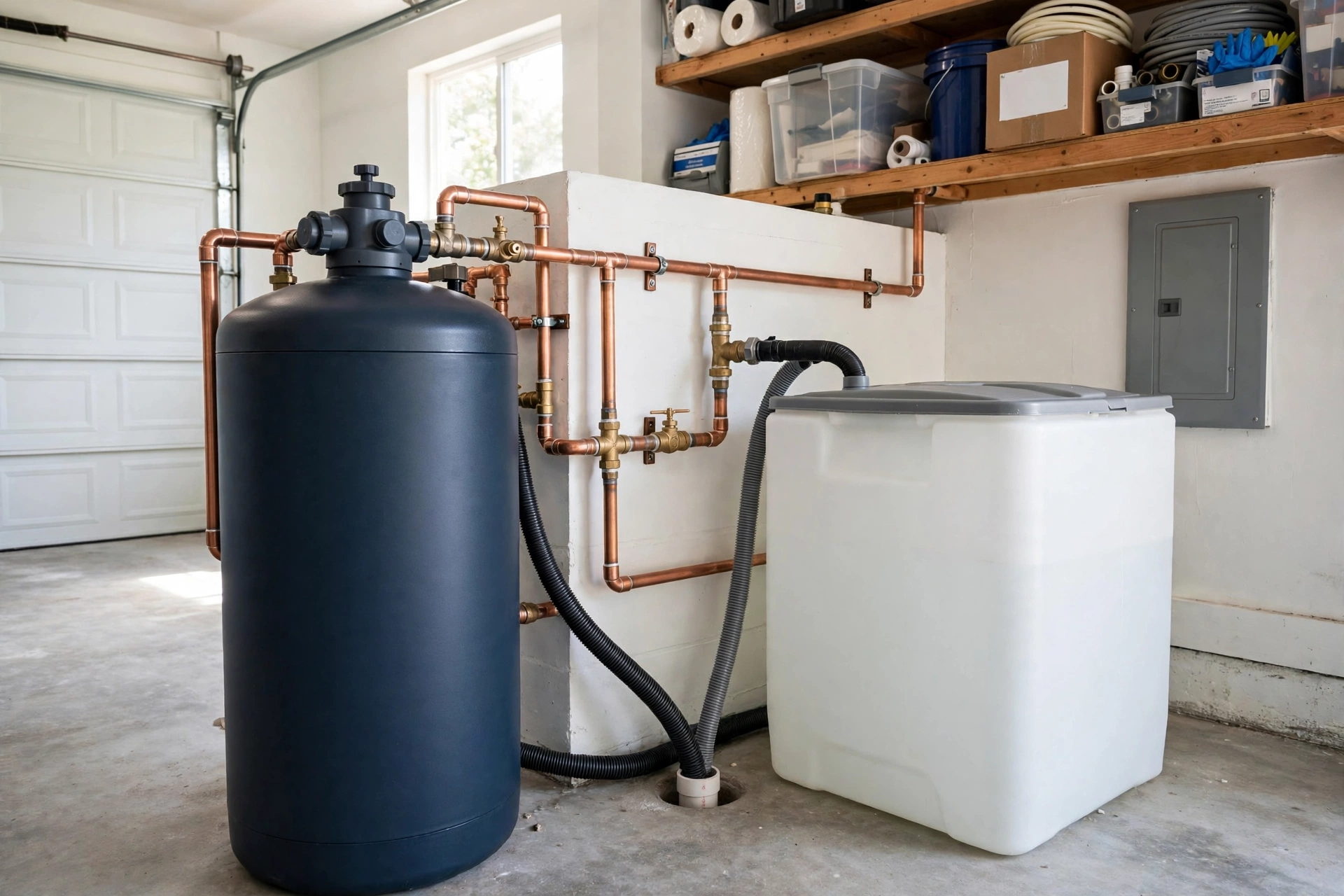
How Much Is a Water Softener for a 2000 Sq Ft House in 2026
When homeowners ask how much is a water softener for a 2000 sq ft house, they usually want one number: what will the whole job cost, unit plus fitting, for a home that size? The short answer is that a water softener for a 2,000 sq ft house typically costs $1,000–$3,000 installed in 2026, and most homes land near $1,500. The unit itself costs $400–$2,000 for the 32,000–48,000-grain system a home this size usually needs, and professional installation adds $150–$1,000 in labor. A premium or dual-tank system can reach $3,000–$5,000 installed, while a basic cabinet unit on an existing loop can come in under $1,000 all in. The gap between those numbers is the whole point of this guide: the system type, the grain capacity, the hardness of your water, and the state of the plumbing underneath all move the total, and the cheapest quote is not always the cheapest project once the extras are counted.
That gap is also why the numbers you see online disagree with each other. Angi lists an average of about $1,500, with jobs from $200 to $6,000, while HomeGuide puts salt-based softeners at $1,200 to $3,800 installed — and both are right, because they measure different things. A $400 unit on a shelf is not the same purchase as a $3,000 installed system, and a softener sized for two people is not the same purchase as one sized for six. The other thing to know before you budget: softeners are sized by people and water hardness, not by square footage. A 2,000 sq ft house with two people needs a smaller unit than the same house with six people and very hard well water. This guide gives the price for the house size you searched for, then shows you how to size the system for the people in it — so you can see the real number before you buy anything. This article is about the total price for a home this size; if you want the labor side on its own, see our guide to how much is labor to install a water softener, and for the store-priced version of the same job, see how much does Home Depot charge to install a water softener.
Quick-answer table (typical 2026 water softener cost for a 2000 sq ft house):
| Item | Typical cost |
|---|---|
| Total installed, typical | $1,000–$3,000 |
| Most homes land near | $1,500 |
| Unit only, 32,000–48,000 grain | $400–$2,000 |
| Installation labor | $150–$1,000 |
| Basic cabinet unit, installed | $800–$1,500 |
| Premium / dual-tank system, installed | $3,000–$5,000 |
| Angi average (all homes) | ~$1,500 (range $200–$6,000) |
| HomeGuide salt-based, installed | $1,200–$3,800 |
| Salt | $5–$15 per month |
| Annual maintenance | $150–$300 per year |
| Total annual upkeep | $210–$480 per year |
| Job time | 2–4 hours |
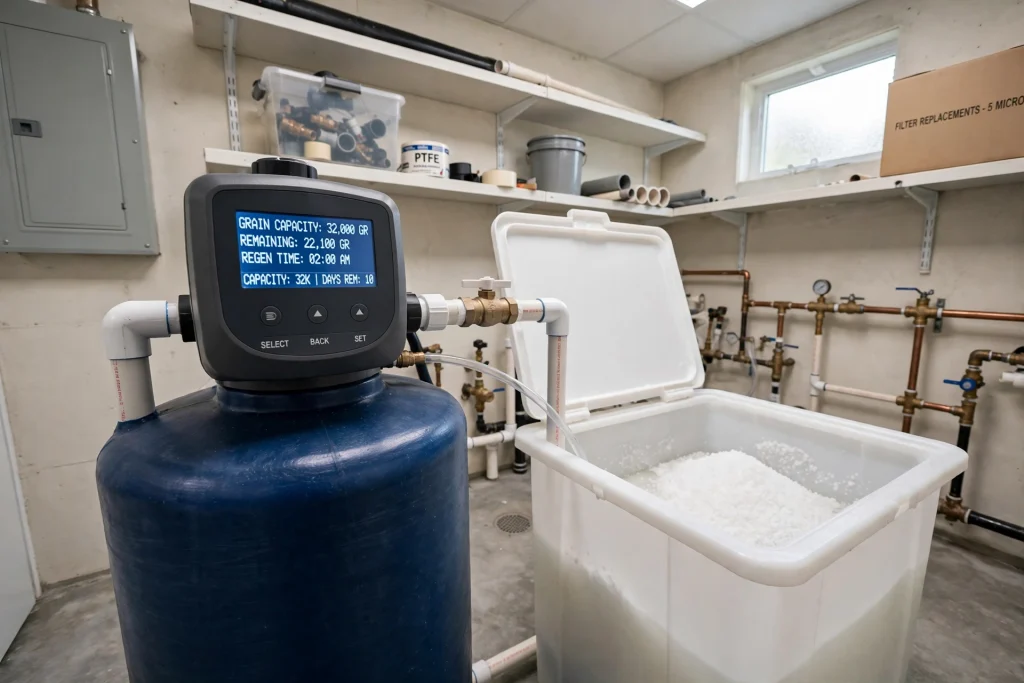
How Much Is a Water Softener for a 2000 Sq Ft House by System Type
A water softener for a 2,000 sq ft house typically costs $1,000–$3,000 installed — but the system type is what puts you at the low end or the high end of that range. The table below gives the price by system type, using the same figures throughout so the options are comparable. Every total in this table uses the same installation labor of $150–$1,000 and the same job time of 2–4 hours.
| System type | Unit | Installation labor | All-in total | Best for |
|---|---|---|---|---|
| Basic cabinet softener (salt-based) | $400–$1,000 | $150–$500 | $800–$1,500 | City water, 2–4 people, moderate hardness |
| Mid-range single-tank softener | $800–$2,000 | $300–$700 | $1,000–$3,000 | Most 2,000 sq ft homes, 3–5 people |
| Dual-tank softener | $1,500–$3,500 | $500–$1,000 | $3,000–$5,000 | Large families, very hard water, no downtime |
| Salt-free conditioner | $800–$3,000 | $150–$700 | $1,000–$3,500 | Light hardness, no salt, no drain needed |
| Softener + iron filter (well water) | $1,200–$3,000 | $500–$1,200 | $2,500–$4,500 | Well water with iron |
| Softener + whole-house filter | $1,500–$4,000 | $500–$1,000 | $2,500–$5,000 | City water with taste or chlorine concerns |
| Dealer system (Culligan / Kinetico) | $3,500–$8,000+ | $300–$1,000+ | $4,500–$9,000+ | Ongoing service and maintenance plan |
Basic cabinet softener ($800–$1,500 installed). A basic cabinet unit costs $800–$1,500 installed — the low end of the range, and the figure to expect for a 2,000 sq ft home on city water with 2–4 people and moderate hardness. The unit costs $400–$1,000, the labor runs $150–$500 on an existing loop, and the job takes 2–4 hours. The trade-off is the capacity: a 32,000-grain cabinet unit regenerates more often in a busy household, and it has no backup tank, so the house has hard water during regeneration. If the quote shows $800–$1,500 all in, check what is included — a loop, a drain run, or an outlet is not in it, and each one is an extra.
Mid-range single-tank softener ($1,000–$3,000 installed). A mid-range single-tank system costs $1,000–$3,000 installed — where most 2,000 sq ft homes actually land. The unit costs $800–$2,000 for a 32,000–48,000-grain system with a demand-controlled valve, the labor runs $300–$700, and the job takes 2–4 hours. This is the system most homeowners should budget for: a demand-controlled valve regenerates only after a set number of gallons, so it wastes less salt and water than a timed unit. If a quote shows labor well above $700 for a standard install, ask what is in it — it should be plumbing work, a new loop, or a drain run, not the fitting itself.
Dual-tank softener ($3,000–$5,000 installed). A dual-tank system costs $3,000–$5,000 installed — the high end for a home this size, and the right choice for a large family or very hard water. The unit costs $1,500–$3,500, the labor runs $500–$1,000, and the job takes 4–6 hours. The advantage is continuous soft water: one tank regenerates while the other serves the house, so there is no hard-water window. The trade-off is the price: a dual-tank system costs roughly double a single-tank system for the same house, and the extra capacity only pays off if the household actually uses it.
Well water with iron ($2,500–$4,500 installed). A softener plus an iron filter costs $2,500–$4,500 installed for a 2,000 sq ft home on well water. The equipment runs $1,200–$3,000, the labor runs $500–$1,200, and the job takes 4–8 hours because it includes pre-treatment and a water test. A softener alone does not remove iron: iron fouls the resin bed, so a well with iron above a few parts per million needs a filter in front of the softener. Get the water tested before you buy — the test is the only reliable number for your home, and it decides whether the iron filter is needed at all.
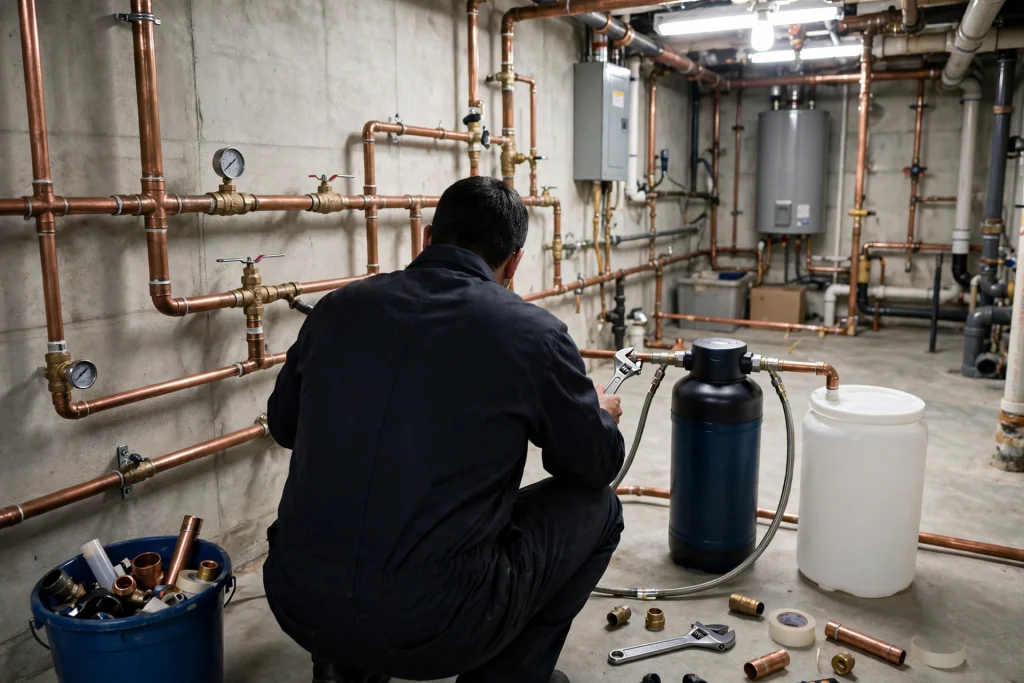
What a 2000 Sq Ft House Actually Needs: Sizing the System
Softeners are sized by grain capacity, and grain capacity is set by two numbers: how many people live in the house, and how hard the water is. Square footage is a rough proxy for both — a 2,000 sq ft house usually holds 2–4 people — but the people and the hardness are the numbers that matter. The table below shows the size a 2,000 sq ft home usually needs, and what it costs.
| Household | Daily water use | Grain capacity | Unit cost | Installed total |
|---|---|---|---|---|
| 2 people, moderate hardness | ~150 gallons | 24,000–32,000 grain | $400–$1,000 | $800–$1,500 |
| 3–4 people, moderate hardness | ~250 gallons | 32,000–48,000 grain | $800–$2,000 | $1,000–$3,000 |
| 5+ people, moderate hardness | ~400 gallons | 48,000–64,000 grain | $1,500–$3,000 | $2,000–$4,000 |
| Any household, very hard water | Higher | 48,000+ grain | $1,500–$3,500 | $2,500–$5,000 |
| Well water with iron | Higher | 48,000+ grain + iron filter | $1,200–$3,000 + filter | $2,500–$4,500 |
Get the water tested first. A hardness test is the only reliable number for your home, and it sizes the unit. Penn State Extension notes that water below 7 grains per gallon will probably not cause major scaling, so a test can save you the whole $1,000–$3,000 job if your water does not need softening. See Penn State Extension’s guide to water softening for the hardness bands and the sizing worked example. A test also sizes the unit: a softener that is too small regenerates constantly and wastes salt and water, while a softener that is too big costs more than you need.
The 32,000–48,000-grain sweet spot. For a 2,000 sq ft home with 3–4 people, a 32,000–48,000-grain unit is the usual size — the unit costs $800–$2,000, the labor runs $300–$700, and the installed total lands at $1,000–$3,000. A smaller unit saves a few hundred dollars up front and then costs more in salt and water every year; a bigger unit costs more up front and saves nothing unless the household actually uses the capacity. Size for the people and the hardness, not for the square footage.
Demand-controlled vs. timed regeneration. A demand-controlled unit regenerates only after a set number of gallons, while a timed unit regenerates on a clock whether the resin needs it or not — so a demand-controlled unit wastes less salt and water. A salt-based softener needs salt about once a month and uses about 50 gallons of water per regeneration cycle, according to Penn State Extension. Ask which type the quote is for before you agree, because the cheaper unit can cost more over ten years. For the labor-only breakdown, see our guide to how much is labor to install a water softener.
Labor vs. Materials: Where the $1,000–$3,000 Goes
The $1,000–$3,000 installed total splits roughly into the unit and the labor, and knowing the split is how you tell whether a quote is fair. The unit runs $400–$2,000. Installation labor runs $150–$1,000. The rest is delivery, materials, complex plumbing, the permit, and any removal the job needs.
| Cost element | Typical cost | Notes |
|---|---|---|
| Water softener unit, 32,000–48,000 grain | $400–$2,000 | Retail unit; dealer systems run $3,500–$8,000+ |
| Installation labor | $150–$1,000 | Plumber or local pro; job takes 2–4 hours |
| Most projects, labor | $500–$700 | Standard single-tank unit on an existing loop or short main-line run |
| Basic install, labor | $150–$300 | Clean install on an existing loop |
| Materials and fittings | $100–$500 | Valves, drain tubing, bypass valve, fittings |
| Complex plumbing | $200–$800 | New loop, drain run, or outlet where none exists |
| Permit, where required | $200–$500 | Location-dependent; check the local rule |
| Old unit removal | Priced per job | Disconnecting and hauling out the old softener |
| Salt, first bag | $5–$15 | Starter salt, sometimes included |
| All-in total | $1,000–$3,000 | Unit + labor + delivery + extras |
| Annual running cost | $210–$480 | Salt $5–$15/month + maintenance $150–$300/year |
Why the sources disagree. The sources disagree because they measure different things: a $400 unit is equipment only, a $1,500 figure is the average installed job, a $1,200–$3,800 figure is a salt-based system installed, and a $3,000–$5,000 figure is a premium or dual-tank system. None of them is wrong — but a single number quoted without its scope is meaningless. Ask for the quote in writing with the labor, the unit, the delivery, the materials, the complex plumbing, the permit, and the removal each listed as its own line, and compare that quote against an independent plumber at $150–$1,000 labor before you book.
What Drives the Total Cost for a 2000 Sq Ft House
The $1,000–$3,000 installed total is the starting point, not the final price. Here is what moves the bill up or down, and by how much — and which of these drivers you can control before you get the quote.
| Cost driver | Effect on the total project cost | Notes |
|---|---|---|
| System type | $800–$1,500 basic; $1,000–$3,000 mid-range; $3,000–$5,000 dual-tank | The system is the biggest single line |
| Grain capacity | 24,000–32,000 grain cheapest; 48,000+ grain costs more | Size for people and hardness, not square footage |
| Water hardness | Very hard water needs a bigger unit | A test decides the size |
| Well water with iron | Add an iron filter, $2,500–$4,500 total | Iron fouls the resin without pre-treatment |
| Complex plumbing | Add $200–$800 | New loop, drain run, or outlet where none exists |
| Permit | Add $200–$500 where required | Location-dependent; check the local rule |
| Old unit removal | Add cost, priced per job | Separate line where charged |
| Region / ZIP code | Labor varies by area | Lower in small-town markets, higher in major metros |
| Who does the work | $150–$1,000 labor | Plumber, store pro, or dealer; DIY costs $50–$150 in parts |
| Scheduling urgency | No fee difference, but a wait | Most pros can schedule within a few days |
DIY vs. Hiring a Pro
| DIY | Independent plumber | Store pro / dealer | |
|---|---|---|---|
| Unit cost | $400–$2,000 | $400–$2,000 | $400–$2,000 retail; $3,500–$8,000+ dealer |
| Installation labor | $0 | $150–$1,000 | $150–$1,000 |
| Parts and fittings | $50–$150 | Included in the labor price | $100–$500 materials |
| Complex plumbing | Parts only, if you can do it | $200–$800, done by the pro | $200–$800, done by the pro |
| Permit | $200–$500 where required | $50–$150 where required, handled by the pro | $200–$500 where required |
| All-in total, standard install | $450–$2,150 in unit and parts | $1,000–$3,000 | $1,000–$3,000 retail; $4,500–$9,000+ dealer |
| Time required | 2–4 hours for a confident DIYer on a loop install | 2–4 hours on site | 2–4 hours on site; 4–8 hours dealer |
| Plumbing safety | A bad connection leaks into the floor — check for drips for a week | Pro leak-tests and runs a regeneration cycle before leaving | Pro leak-tests and runs a regeneration cycle before leaving |
| Water damage risk | A cross-threaded main-line connection can flood a basement | Licensed pro, insured, tested before leaving | Licensed pro, insured, tested before leaving |
| Warranty | None — mistakes are on you | 90 days to 1 year on the workmanship is typical for a pro job | Minimum 1 year on labor (store); dealer service plan |
| Best for | A confident DIYer with an existing loop, drain, and outlet | Lowest total on a standard install | One-stop shopping or ongoing service |
DIY costs $50–$150 in parts. Doing the job yourself costs $50–$150 in parts on top of the unit at $400–$2,000 — which is the main reason homeowners attempt it — but the saving only holds on an existing loop install, where the loop, the drain, and the outlet are already in place. The risk is the main line: a bad connection on the main water line leaks into the floor, and a cross-threaded fitting can flood a basement. Check for drips for a week after the job, and do not attempt a main-line cut, a new loop, or a dual-tank system yourself — those need a pro, and the labor at $150–$1,000 is cheaper than the water damage. For the labor-only breakdown, see our guide to how much is labor to install a water softener.
Money-Saving Tips for a Water Softener in a 2000 Sq Ft House
1. Get the water tested before you buy — that is where the real money is. A hardness test tells you whether you need a softener at all and what size to buy. Penn State Extension notes that water below 7 grains per gallon will probably not cause major scaling — so a test can save you the whole $1,000–$3,000 job if your water does not need softening. A test also sizes the unit: a softener that is too small regenerates constantly and wastes salt and water, while a softener that is too big costs more than you need. See Penn State Extension’s guide to water softening for the hardness bands and the sizing worked example. 2. Budget $1,000–$3,000 all in, not just the unit. The $400–$2,000 unit figure is the equipment only, not the job price — and the job price is what you pay. Budgeting $1,000–$3,000 from the start means the quote is expected, not a surprise — and budgeting $150–$1,000 for the labor means the fitting is expected too. The cheapest surprise on a plumbing job is the one you budgeted for before you got to the quote. 3. Get the quote in writing before you buy — it is your price. The price depends on the system type, the grain capacity, and the plumbing underneath, and the written quote shows your price once the unit and the fitting are in the order. Check it before you pay, because the quote is the only reliable number for your area: a price quoted for another home, or a price from a review or a forum post, may not match yours. If the quote shows $1,000–$3,000 all in, you are looking at the typical prices in this guide; if it shows something else, that quote price is your price, and this guide’s totals should be recalculated from it. 4. Buy a demand-controlled unit, not a timed one. A demand-controlled unit regenerates only after a set number of gallons, while a timed unit regenerates on a clock whether the resin needs it or not — so a demand-controlled unit wastes less salt and water. A salt-based softener needs salt about once a month ($5–$15) and uses about 50 gallons of water per regeneration cycle, according to Penn State Extension — and those running costs compound over the life of the unit. Ask which type the quote is for before you agree, because the cheaper unit can cost more over ten years. 5. Use the existing loop if you have one. An install on an existing softener loop costs $150–$300 in labor at the low end, against $500–$700 for most projects — and complex plumbing adds $200–$800 on top. If your home already has a loop, use it: the saving is the loop itself, not a cheaper fitting. If you are building or remodeling, have the builder put in a softener loop while the walls are open — it costs far less then than after the walls are closed. 6. Check the drain and outlet before you book. If the drain and the electrical outlet are within a few feet of the install spot, say so when you get the quote — the pro can quote the standard $150–$1,000 labor instead of pricing for the worst case, and the job stays near the $1,000–$3,000 range. If there is no drain or outlet nearby, expect complex plumbing at $200–$800 on top of that total, and budget for it now rather than discovering it on installation day. A photo of the install spot sent with your booking gets you a tighter number. 7. Compare three quotes: a plumber, a store, and a dealer. A plumber costs $1,000–$3,000 all in on a standard install, a store pro costs about the same, and a dealer system costs $4,500–$9,000+ — so quotes for the same job can differ by thousands of dollars between providers. A five-minute phone call to one more pro is the cheapest way to know whether the first price is fair. Compare the written quotes line by line: unit, labor, delivery, materials, complex plumbing, permit, and removal should each be named, so you are comparing the same job. For the store-priced version, see our guide to how much does Home Depot charge to install a water softener. 8. Do not buy capacity you will not use. A 48,000-grain unit costs more than a 32,000-grain unit and saves nothing unless the household actually uses the capacity. Size for the people and the hardness: 2 people need 24,000–32,000 grains, 3–4 people need 32,000–48,000 grains, and 5+ people need 48,000–64,000 grains. A unit that is too big regenerates less often but costs more up front; a unit that is too small regenerates constantly and wastes salt and water. 9. Decide on old-unit removal deliberately, not by default. Old unit removal is a separate line on the order, priced per job — so check whether it is on the quote before you agree. If you can haul the old softener yourself to a municipal drop-off, the project total falls by that line. If you cannot, the charge is money well spent — but it should be a decision, not a default you only notice after you have paid. 10. Check the salt and water cost of the system you buy. A salt-based softener needs salt about once a month at $5–$15 a bag, and annual maintenance runs $150–$300 — a total upkeep of $210–$480 a year. A demand-controlled unit uses less salt and water than a timed unit, so the cheaper unit can cost more over ten years. Ask which type the quote is for before you agree.
Frequently Asked Questions
How much is a water softener for a 2000 sq ft house?
In 2026, a water softener for a 2,000 sq ft house typically costs $1,000–$3,000 installed, and most homes land near $1,500. The unit itself costs $400–$2,000 for the 32,000–48,000-grain system a home this size usually needs, and professional installation adds $150–$1,000 in labor. A premium or dual-tank system can reach $3,000–$5,000 installed, while a basic cabinet unit on an existing loop can come in at $800–$1,500 all in. Salt costs $5–$15 a month and annual maintenance runs $150–$300, for a total upkeep of $210–$480 a year. Prices vary by system type, household size, water hardness, and region, so the written quote is the reliable number — get it before you buy.
What size water softener do I need for a 2000 sq ft house?
Softeners are sized by people and water hardness, not by square footage. A 2,000 sq ft house with 3–4 people usually needs a 32,000–48,000-grain unit, costing $800–$2,000 for the equipment and $1,000–$3,000 installed. Two people need 24,000–32,000 grains, and 5+ people need 48,000–64,000 grains. Get the water tested first: Penn State Extension notes that water below 7 grains per gallon will probably not cause major scaling, so a test can save you the whole job if your water does not need softening. See Penn State Extension’s guide to water softening for the hardness bands and the sizing worked example.
How much does it cost to install a water softener?
Installation labor to fit a water softener typically runs $150–$1,000 for most homes in 2026, with most straightforward installs at $500–$700, and the job takes 2–4 hours on site. A basic install on an existing loop can come in at $150–$300 in labor, while complex plumbing — a new loop, drain run, or outlet — adds $200–$800. For the full labor breakdown, see our guide to how much is labor to install a water softener.
How much does a water softener cost per month?
A salt-based water softener costs $5–$15 a month in salt, plus annual maintenance of $150–$300 a year — a total upkeep of roughly $210–$480 a year, or $18–$40 a month. A demand-controlled unit uses less salt and water than a timed unit, because it regenerates only after a set number of gallons rather than on a clock. The unit also uses about 50 gallons of water per regeneration cycle, according to Penn State Extension.
Is a water softener worth it for a 2000 sq ft house?
It depends on your water hardness. If your water tests above 7 grains per gallon, a softener at $1,000–$3,000 installed protects pipes, fixtures, and appliances from scale, and most homeowners recover the cost over the life of the unit in fewer repairs and longer appliance life. If your water tests below 7 grains per gallon, it will probably not cause major scaling, according to Penn State Extension — and a softener is money you do not need to spend. Get the water tested before you buy, and size the unit for the people and the hardness, not the square footage.
The Bottom Line
For homeowners asking how much is a water softener for a 2000 sq ft house in 2026, budget $1,000–$3,000 installed — with most homes landing near $1,500. The unit itself costs $400–$2,000 for the 32,000–48,000-grain system a home this size usually needs, and professional installation adds $150–$1,000 in labor. A basic cabinet unit can come in at $800–$1,500 all in, a mid-range single-tank system at $1,000–$3,000, and a premium or dual-tank system at $3,000–$5,000. Salt costs $5–$15 a month and annual maintenance runs $150–$300, for a total upkeep of $210–$480 a year. The cheapest way to keep the bill down is to get the water tested before you buy, size the unit for the people and the hardness rather than the square footage, buy a demand-controlled unit, use the existing loop if you have one, and get three written quotes — a plumber, a store pro, and a dealer — with the unit, the labor, the delivery, the materials, the complex plumbing, the permit, and the removal each listed as its own line. And before you buy at all, check whether your water needs softening: the difference between a $400 unit and a $5,000 system is the equipment and the service, not the fitting — and the difference between $150–$1,000 labor and $1,000–$3,000 all in is the unit, the delivery, and the plumbing, not the fitting.
Prices are typical 2026 US ranges for planning purposes and vary by region, contractor, and site condition; confirm your price on an itemized written quote before you buy and get itemized local quotes for an exact project price.
1 thought on “How Much Is a Water Softener for a 2000 Sq Ft House in 2026”