
First Time Dishwasher Installation Cost in 2026
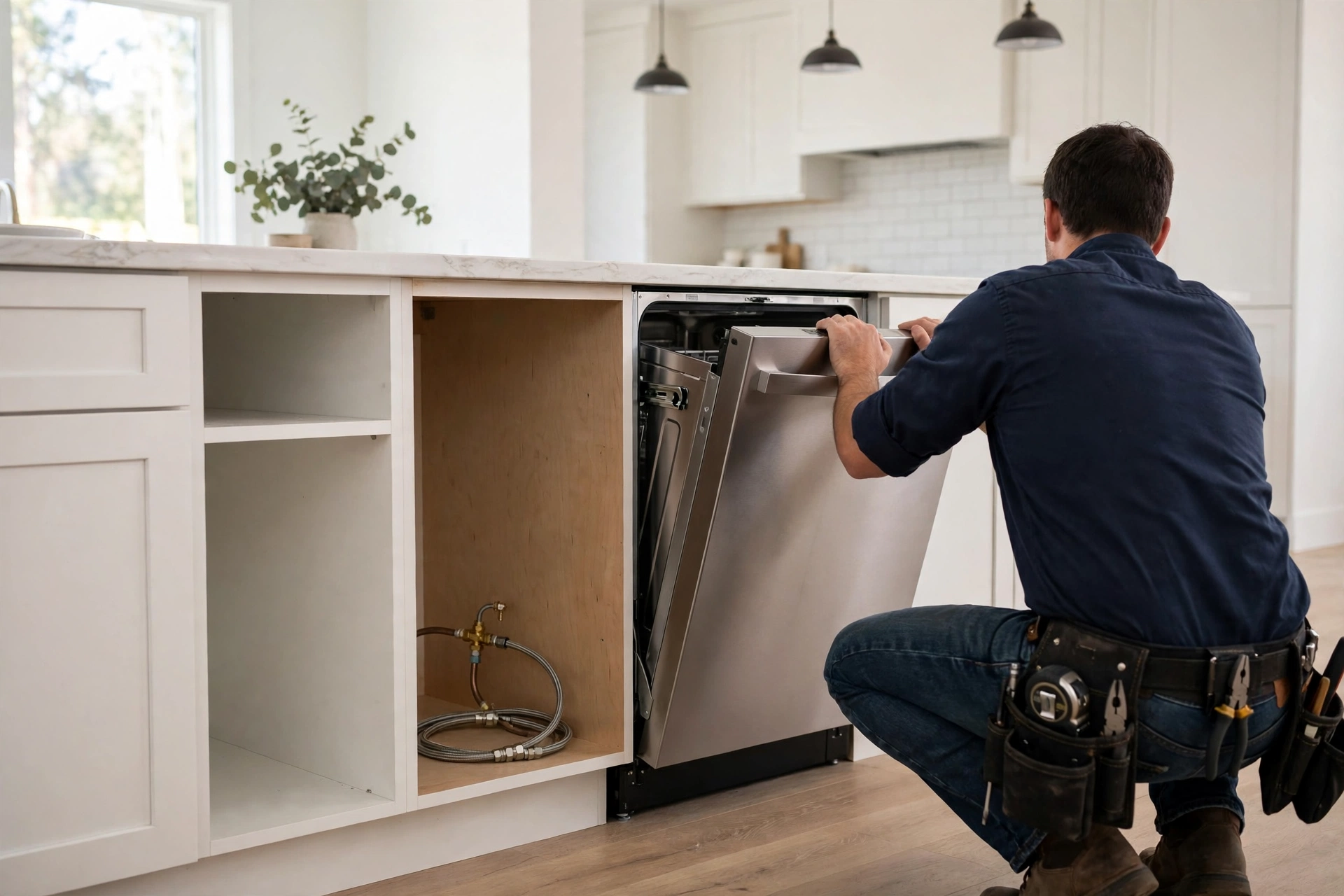
When homeowners search for first time dishwasher installation cost, they are usually asking a very different question from the one behind a standard replacement quote. A replacement dishwasher slides into an opening where a dishwasher has already lived for years: the water line is there, the drain is there, the electrical circuit is there, and the cabinet opening is already the right size. A first-time installation starts from none of that. There is no water connection where the dishwasher will go, no drain route, often no electrical outlet or dedicated circuit, and sometimes no opening at all — just a run of kitchen cabinets that has to be cut, removed, or rebuilt before a dishwasher can even be slid into place. That is why the labor alone for a first-time install typically costs $300–$1,300 in 2026, against $150–$350 for a basic replacement, and why the all-in project — dishwasher, labor, and extras together — typically lands at $1,200–$3,200.
The gap between the two jobs is the whole point of this guide. A first-time installation is not one job but three or four jobs done in sequence: plumbing work to bring a hot-water supply and a drain to the new location, electrical work to give the dishwasher power, cabinet work to create the opening, and then the installation itself. Each of those trades bills separately, each has its own range, and each one can push the total toward the top of the range if the kitchen fights back — a sink on the far side of the room, an electrical panel with no spare breaker space, or a cabinet run that cannot be cut without disturbing the countertop. This guide breaks down the full project cost of a first-time dishwasher installation: the labor, the dishwasher, the plumbing, the electrical work, the cabinet work, the permits, the totals by scenario, region, and installer, and how a first-time install compares with a replacement, so you can see the real number before you buy the dishwasher. For the labor-only side of the same job — what a pro charges when you supply the dishwasher yourself — see our guide to the average labor cost to install a dishwasher, which breaks the labor charge down by scenario, installer type, and dishwasher type.
Quick-answer table (typical 2026 first time dishwasher installation cost):
| Item | Typical cost |
|---|---|
| First-time installation labor | $300–$1,300 |
| All-in first-time project (dishwasher + labor + extras) | $1,200–$3,200 |
| Dishwasher unit, budget to mid-range | $400–$1,200 |
| Replacement labor, for comparison (basic) | $150–$350 |
| Replacement labor, for comparison (standard range) | $200–$500 |
| New water connection, parts and labor | $150–$350 |
| Rough-in plumbing, minimum | $400–$600 |
| New electrical outlet, parts and labor | $150–$350 |
| New dedicated circuit, parts and labor | $250–$900 |
| Cabinet removal or modification, parts and labor | $150–$400 |
| Installation kit (supply line, fittings, drain parts) | $20–$40 |
| Old-unit removal or disposal (where one exists) | $50–$150 |
| Plumber hourly rate | $45–$150 per hour |
| Handyman hourly rate | $50–$80 per hour |
| Permit for a first-time installation | Priced per job |
| Time on site, first-time installation | 3–5 hours for the install itself; a full day with cabinet or electrical work |
| Time on site, replacement for comparison | 1–2 hours |
| Clean first-time example (labor $650 + unit $800 + kit $30 + water $250 + outlet $250) | $1,980 |
| First-time install near the sink, mid-range dishwasher | $1,200–$2,000 |
| First-time install across the kitchen, mid-range dishwasher | $2,000–$3,200 |
What a First-Time Dishwasher Installation Actually Involves
A first-time dishwasher installation is a small construction project, not a swap. Before the dishwasher itself is ever unboxed, someone has to answer four questions about the kitchen: where does the hot water come from, where does the dirty water go, where does the power come from, and where does the dishwasher physically sit. In a replacement, all four questions were answered years ago, when the first dishwasher went in. In a first-time install, each one is a line of work, and the labor range of $300–$1,300 is really the sum of those lines: the plumbing, the electrical connection, the cabinet work, and the fitting itself.
The work usually runs in this order. First, the cabinet work: a base cabinet is removed, or a run of cabinets is cut to create a standard 24-inch-wide opening, 34 inches high and 24 inches deep. Second, the plumbing rough-in: a hot-water supply line is run from the sink to the new opening, and a drain route is run back to the sink drain or the garbage disposal. Third, the electrical work: a new outlet is fitted, or a new dedicated circuit is run from the electrical panel, because a dishwasher needs its own circuit and cannot safely share one with the garbage disposal or the kitchen outlets. Fourth, the installation itself: the dishwasher is slid into the opening, leveled, secured so it cannot tip forward, connected to the water and the drain, connected to power, and run through a leak test and a test cycle. Each step depends on the one before it, which is why a first-time installation takes 3–5 hours on site for the install itself and a full day once cabinet and electrical work are added, against 1–2 hours for a replacement.
The table below shows what is included in a typical first-time installation quote and what is priced as a separate line, so you can read a quote line by line instead of guessing what the headline number covers.
| Task | Usually included in a first-time labor quote? | Notes |
|---|---|---|
| Positioning and leveling the new dishwasher | Included | Unit slid into the opening and leveled front to back and side to side |
| Securing the unit (anti-tip bracket) | Included | Dishwasher secured to the countertop or cabinet so it cannot tip forward |
| Connecting the water supply line | Included | Connection to the new supply line once it is run |
| Connecting the drain line | Included | Drain hose connected to the garbage disposal or the sink drain |
| Electrical connection | Included | Hardwired or plugged in to the new outlet or circuit once it exists |
| Leak test and test cycle | Included | Installer runs water and a test cycle, checks every connection before leaving |
| Cleanup of the work area | Included | Cabinet and floor wiped down, old parts and packaging gathered |
| The dishwasher itself | Not included | You buy it: budget to mid-range $400–$1,200 |
| Installation kit (supply line, fittings, drain parts) | Not included | $20–$40 in parts, bought with the dishwasher |
| New water connection | Priced separately | $150–$350 in parts and labor |
| Rough-in plumbing | Priced separately | $400–$600 minimum where new lines must be run through walls or floors |
| New electrical outlet | Priced separately | $150–$350 in parts and labor |
| New dedicated circuit | Priced separately | $250–$900 in parts and labor, done by a licensed electrician |
| Cabinet removal or modification | Priced separately | $150–$400 in parts and labor |
| Permit for a first-time installation | Priced separately | Priced per job where one is required |
| Old-unit removal or disposal | Priced separately | $50–$150 where an old unit exists to remove |
| Floor repair under the work area | Priced separately | Priced per job; water damage found once cabinets come out |
The hookups are the whole job. A dishwasher needs three services at the opening: hot water in, dirty water out, and power. A kitchen that has never had a dishwasher has none of the three at the spot where the dishwasher will go, and creating them is what turns a $150–$350 replacement into a $300–$1,300 first-time install. The water connection alone costs $150–$350, a new outlet costs $150–$350, and a new dedicated circuit costs $250–$900 — so even before the cabinet work is priced, the hookups can add $550–$1,600 to the project. That is why two first-time installations of the same dishwasher can cost very different amounts: one kitchen has the sink six inches away and a spare breaker in the panel, and the other has the sink across the room and a full panel. Before you buy the dishwasher, find out which kitchen you have.
First Time Dishwasher Installation Cost by Scenario
The single biggest driver of first time dishwasher installation cost is the scenario: how far the new dishwasher sits from the sink, whether the electrical panel has room for a new circuit, and whether the cabinet opening already exists or has to be created. The table below gives the full project cost for each scenario — dishwasher, labor, kit, and the likely extras — so the totals are comparable across scenarios instead of mixing labor numbers with all-in numbers.
| Installation scenario | Labor | Kit + disposal | Likely extras | All-in total (dishwasher $400–$1,200) |
|---|---|---|---|---|
| Replacement, working hookups (for comparison) | $150–$350 | $20–$40 kit; $50–$150 disposal | None | $620–$1,740 |
| Replacement, standard range (for comparison) | $200–$500 | $20–$40 kit; $50–$150 disposal | Minor plumbing $75–$300+ | $745–$2,090 |
| First-time install, hookups nearby, opening exists | $300–$700 | $20–$40 | $150–$350 water connection | $1,200–$2,000 |
| First-time install, hookups nearby, example (labor $650 + unit $800 + kit $30 + water $250 + outlet $250) | $650 | $30 | $500 | $1,980 |
| First-time install, new location, full rework | $700–$1,300 | $20–$40 | $150–$350 water, $250–$900 circuit, $150–$400 cabinet | $2,000–$3,200 |
| First-time install, no cabinet opening at all | $700–$1,300 | $20–$40 | $150–$400 cabinet removal, $400–$600 rough-in minimum | $2,000–$3,200 |
| First-time install in an older kitchen, corroded plumbing | $500–$1,300 | $20–$40 | $150–$350 water, $150–$350 outlet, valve and line fixes | $1,700–$3,200 |
| First-time install, portable dishwasher instead | $100–$200 | $20–$40 | Faucet adapter, often in the box | $520–$1,440 |
Replacement on existing hookups ($150–$350 labor, $620–$1,740 all in). A replacement is the cheapest dishwasher job, because everything the installer needs is already there: the water supply line, the shut-off valve, the drain connection, and the electrical circuit. The installer disconnects the old unit, slides it out, slides the new one in, connects the water and drain, makes the electrical connection, levels the unit, and runs a test cycle — usually 1–2 hours on site. With labor at $150–$350, a kit at $20–$40, disposal of the old unit at $50–$150, and a dishwasher at $400–$1,200, the whole project lands at $620–$1,740. The standard replacement labor range of $200–$500 covers jobs where the hookups need small fixes — a seized shut-off valve, a corroded supply line — and with those fixes the project lands at $745–$2,090. A replacement is included here only as the baseline: it is the number a first-time install is measured against, and the gap between $150–$350 and $300–$1,300 in labor is the cost of creating hookups that do not yet exist.
First-time install with hookups nearby and an opening that already exists ($300–$700 labor, $1,200–$2,000 all in). This is the cheapest first-time scenario, and it is the one to aim for if the kitchen allows it. The dishwasher goes into an existing 24-inch opening next to the sink, so there is no cabinet work, and the water line and drain run a short distance from the sink to the opening. The labor lands at $300–$700, the water connection at $150–$350, the kit at $20–$40, and with a dishwasher at $400–$1,200 the project totals $1,200–$2,000. A worked example: labor at $650, a mid-range dishwasher at $800, a kit at $30, a new water connection at $250, and a new outlet at $250, for a project total of $1,980. That example sits near the top of this scenario because it includes the outlet; where an outlet already exists near the opening, the same job lands nearer $1,200–$1,500. If your kitchen has a spare base cabinet next to the sink, this is the scenario you are in — and it is worth choosing that cabinet over a more convenient spot across the room, because the distance to the sink is the difference between $1,200–$2,000 and $2,000–$3,200.
First-time install in a new location with full rework ($700–$1,300 labor, $2,000–$3,200 all in). Putting a dishwasher where one has never been, away from the sink, is the most expensive first-time scenario, because the work is plumbing, electrical, and cabinet work on top of the installation: a water line run from the sink, a drain route, a new dedicated circuit at $250–$900, and often cabinet work at $150–$400. The labor alone runs $700–$1,300, and with a dishwasher at $400–$1,200 the project total is typically $2,000–$3,200. The price is set by the site conditions — how far the dishwasher sits from the sink, whether the floor and cabinets allow a water line to be run, and whether the electrical panel has room for a new circuit. Get the quote itemized in writing before you buy the dishwasher: the difference between a $2,000 new-location job and a $3,200 one is the distance to the sink and the state of the electrical panel, and neither is visible from the showroom floor.
First-time install with no cabinet opening at all ($700–$1,300 labor, $2,000–$3,200 all in). Where the kitchen has no spare 24-inch opening, a base cabinet has to come out or a run of cabinets has to be cut, and the plumbing has to be roughed in through the wall or floor. Cabinet removal or modification costs $150–$400, rough-in plumbing costs $400–$600 minimum, and the labor lands at $700–$1,300, for a project total of $2,000–$3,200 with a $400–$1,200 dishwasher. This is the scenario where the job can stretch over more than one day, because the cabinet work has to be finished before the dishwasher can be fitted, and the rough-in has to be inspected before the walls are closed up. If the kitchen has no space for a dishwasher at all, a portable dishwasher is the fallback — it connects to the sink faucet, needs no permanent plumbing, and costs $100–$200 to install, for a project total of $520–$1,440 with a $400–$1,200 unit.
First-time install in an older kitchen ($500–$1,300 labor, $1,700–$3,200 all in). An older kitchen adds a different kind of cost: the plumbing under the sink is corroded, the shut-off valve will not turn off, or the drain connection needs rerouting before the new dishwasher can be connected. The labor lands at $500–$1,300, the water connection at $150–$350, a new outlet at $150–$350, and with a dishwasher at $400–$1,200 the project totals $1,700–$3,200. Test the valve before you order: turn it off and run the kitchen faucet to check the water stops. If the valve turns but the water keeps running, or the valve will not turn at all, mention it when you book so the plumber prices the extra honestly instead of discovering it mid-job. For the faucet side of that same under-sink work, bundling the two jobs on one visit saves a second service call — see our guide to how much does Lowes charge to install a faucet for the faucet side of the same cabinet.
Total Cost of a First-Time Installation by Dishwasher Type and Price Tier
The dishwasher is the biggest single line on the bill after the labor, and the type you choose moves the project total because different types mean different amounts of fitting work. A freestanding dishwasher slides into place and connects to the new hookups; a built-in dishwasher has to be leveled and secured to the countertop or cabinet; an integrated or panel-ready dishwasher needs a custom cabinet panel fitted to its door; and a drawer dishwasher is two separate drawers, each plumbed and wired on its own. The table below shows the full project cost by type for a first-time installation — unit, labor, kit, and the typical extras together — so you can budget the whole project, not just the dishwasher price.
| Dishwasher type | Dishwasher unit | First-time labor | Typical extras | All-in project total |
|---|---|---|---|---|
| Freestanding dishwasher | $400–$800 | $300–$700 | $150–$350 water connection | $1,200–$2,000 |
| Built-in dishwasher | $500–$1,200 | $300–$1,300 | $150–$350 water, $150–$350 outlet | $1,200–$3,200 |
| Integrated / panel-ready dishwasher | $1,000–$1,200 | $500–$1,300 | $150–$350 water, $250–$900 circuit, $150–$400 cabinet | $2,000–$3,200 |
| Drawer dishwasher | $1,200 | $700–$1,300 | $150–$350 water, $250–$900 circuit | $2,000–$3,200 |
| Portable dishwasher | $400–$700 | $100–$200 | Faucet adapter, often in the box | $520–$1,440 |
Freestanding dishwasher: $1,200–$2,000 all in. A freestanding dishwasher costs $400–$800 for the unit, plus $300–$700 for first-time labor, plus a new water connection at $150–$350 and a kit at $20–$40, for a project total of $1,200–$2,000. The unit has finished sides and a top, so it slides into place under the counter or stands on its own, and the installer connects the water, the drain, and the power, levels the unit, and runs a test cycle. Freestanding units are the right choice for a kitchen without a built-in opening, and they are the cheapest type to fit for the first time because there is no panel to align and no cabinet to cut around a built-in frame. A freestanding unit that needs a new dedicated circuit at $250–$900 lands near the top of the range, while one next to the sink with an outlet already nearby lands near the bottom.
Built-in dishwasher: $1,200–$3,200 all in. A built-in dishwasher costs $500–$1,200 for the unit, plus $300–$1,300 for first-time labor, plus a water connection at $150–$350 and a new outlet at $150–$350, for a project total of $1,200–$3,200. The unit has to be leveled precisely and secured to the underside of the countertop or to the adjoining cabinets so it does not tip forward when the door is opened and the racks are pulled out. Most dishwashers sold in the United States are built-in units, so this is the range most first-time installers will actually pay. Measure the opening before you buy — a standard built-in opening is 24 inches wide, 34 inches high, and 24 inches deep — and compare it against the dishwasher’s dimensions in the manual. A dishwasher that is a fraction of an inch too wide will not fit, and the cabinet modification to make it fit costs $150–$400.
Integrated / panel-ready dishwasher: $2,000–$3,200 all in. An integrated or panel-ready dishwasher costs $1,000–$1,200 for the unit in the budget to mid-range band, plus $500–$1,300 for first-time labor, plus a water connection at $150–$350, a new circuit at $250–$900, and cabinet work at $150–$400, for a project total of $2,000–$3,200. The installation costs more because the front of the dishwasher is fitted with a custom cabinet panel that has to align exactly with the surrounding kitchen cabinets — same height, same gaps, same handle position — and the job takes longer than a standard built-in. The panel itself is an extra cost on top of the unit price, and if the panel is supplied by the cabinet maker and arrives late or cut to the wrong size, the installation has to wait and a second visit costs another service-call fee. Confirm the panel is on site, cut to size, and in hand before the installer is booked.
Drawer dishwasher: $2,000–$3,200 all in. A drawer dishwasher costs $1,200 for the unit at the top of the budget to mid-range band, plus $700–$1,300 for first-time labor, plus a water connection at $150–$350 and a new circuit at $250–$900, for a project total of $2,000–$3,200. A drawer dishwasher is two separate drawers, and each drawer is plumbed and wired on its own — two water connections, two drain connections, two electrical connections, and two test cycles — which is why the installation is the most labor-intensive of the common types. Drawer dishwashers are usually found in high-end kitchens where the extra installation labor is a small share of the total, and a first-time drawer installation is priced as a custom job, so get the quote in writing before checkout. For the energy side of the choice, the ENERGY STAR dishwasher criteria cap a certified standard dishwasher at 240 kWh per year and 3.2 gallons per cycle, which is a useful check when a higher unit price is justified partly on efficiency.
Portable dishwasher: $520–$1,440 all in. A portable dishwasher costs $400–$700 for the unit, plus $100–$200 to install, plus a kit at $20–$40, for a project total of $520–$1,440. It connects to the sink faucet with a temporary adapter and needs no permanent plumbing — the installer connects the faucet adapter, checks the drain, levels the unit, and runs a test cycle, usually in under an hour. Portable units are the right choice for a kitchen with no dishwasher opening at all, and many homeowners skip professional installation entirely for a portable unit because the connection is a faucet adapter rather than a plumbed supply line. If you do hire the installation, confirm the fee covers the faucet adapter: some portable units ship with one in the box, and some do not.
Plumbing and Electrical Work for a First-Time Dishwasher Installation
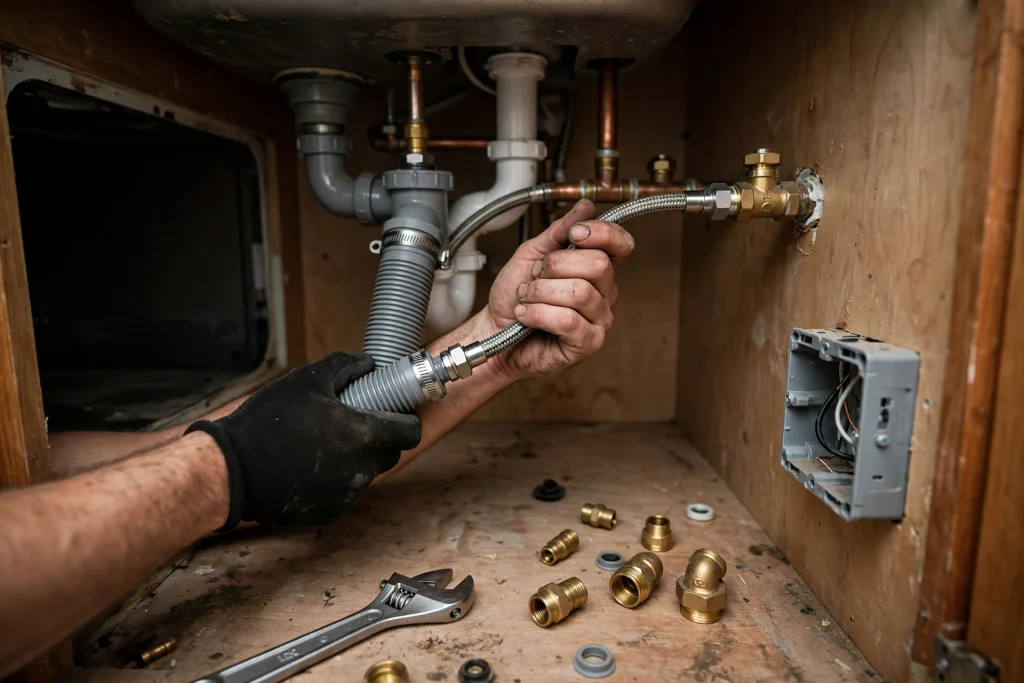
The plumbing and electrical work is where a first-time installation earns its price, and it is also where the quote is most likely to surprise a homeowner who expected a single installation fee. A dishwasher needs a hot-water supply, a drain, and power, and none of the three exists at a new location. The table below prices each piece separately, so a quote can be checked line by line.
| Plumbing and electrical item | Typical cost | When it comes up |
|---|---|---|
| New water connection, parts and labor | $150–$350 | No water line exists where the dishwasher will go |
| Rough-in plumbing, minimum | $400–$600 | New supply and drain lines must be run through walls or floors |
| New electrical outlet, parts and labor | $150–$350 | An outlet is needed near the dishwasher opening |
| New dedicated circuit, parts and labor | $250–$900 | No dedicated circuit exists, or the panel needs a new breaker |
| Installation kit (supply line, fittings, drain parts) | $20–$40 | Almost every job; the kit is sold separately from the dishwasher |
| New supply line / shut-off valve, parts and labor | $50–$150 | Old line corroded or kinked, or the valve will not turn off |
| Air gap or high-loop drain fitting | $25–$75 | Local code requires an air gap, or the drain needs a high loop |
| New drain hose | $25–$75 | Drain hose cracked, kinked, or the wrong length |
| Old-unit removal or disposal | $50–$150 | Where an old unit exists to remove |
| Permit for the plumbing or electrical work | Priced per job | First-time installation where a permit is required |
New water connection ($150–$350). A new water connection is the most common plumbing extra on a first-time dishwasher installation, because a dishwasher needs a hot-water supply line run from the sink to the dishwasher opening. The cost is $150–$350 in parts and labor. If the sink is right next to the dishwasher opening, the run is short and the cost lands near the bottom of the range; if the dishwasher is across the kitchen from the sink, the run is longer and the cost lands near the top. The connection also needs a shut-off valve where the line branches off, so the dishwasher can be isolated without shutting off the whole kitchen. A plumber doing this work charges $45–$150 per hour, and the water connection is usually one to two hours of that rate plus parts. For the labor-only picture behind this line, see our guide to the average labor cost to install a dishwasher.
Rough-in plumbing ($400–$600 minimum). Rough-in plumbing is the bigger job behind the water connection: running new supply and drain lines through walls, floors, or cabinets to a location that has never had them. The cost is $400–$600 minimum, and it rises where the run is long, the floor has to be opened, or the drain has to be tied into a stack on the far side of the kitchen. Rough-in is the line that separates a first-time install next to the sink from a first-time install across the room: next to the sink, a simple water connection at $150–$350 is enough; across the room, rough-in at $400–$600 minimum is the honest price. If a quote shows rough-in plumbing, ask what it covers — the supply line, the drain line, the shut-off valve, and the tie-in to the sink drain should each be named — and ask whether the price includes opening and closing the wall or floor, because patching and repainting are sometimes billed separately.
New electrical outlet ($150–$350). A new electrical outlet near the dishwasher opening costs $150–$350 in parts and labor, and it is the electrical line most first-time installations need at minimum. The outlet has to be on a circuit that can carry the dishwasher’s load, and in many kitchens the nearest outlet is on the small-appliance circuit that already serves the countertop outlets — which is not the right circuit for a dishwasher. An electrician can fit the outlet in one to two hours where the wiring run is short and the wall is open, and the cost lands near the top of the range where the run is long or the wall has to be opened and patched. If the quote includes an outlet, ask which circuit it is on: an outlet on the wrong circuit is a code problem and a tripping breaker, not a saving.
New dedicated circuit ($250–$900). A dishwasher needs a dedicated electrical circuit, and many kitchens do not have one where the dishwasher will go. A new dedicated circuit costs $250–$900 in parts and labor, and the work must be done by a licensed electrician in most jurisdictions — an appliance installer or a handyman cannot legally add a circuit. The range is wide because the price depends on the panel: where the panel has a spare breaker space and the run to the kitchen is short, the cost lands near $250; where the panel is full, the run is long, or the panel itself needs work, the cost lands near $900. This is the single most variable line on a first-time installation, and it is the one most likely to be discovered after the dishwasher is already bought. Before you buy, open the electrical panel and count the spare breaker spaces — or ask an electrician to look — because a $250–$900 circuit is the extra that moves a project from $1,200–$2,000 to $2,000–$3,200. For the wage data behind the electrician’s and the plumber’s rates, the U.S. Bureau of Labor Statistics reports a median wage of $30.67 per hour for plumbers, pipefitters, and steamfitters — the rate a customer pays is higher because it includes the business costs on top of the wage: the truck, the insurance, the tools, and the licensing.
Installation kit ($20–$40). The installation kit — a braided stainless supply line, an elbow fitting, clamps, and drain parts — costs $20–$40 and is sold separately from both the dishwasher and the labor. Some dishwashers ship with a supply line in the box, but many do not, and the installer will not reuse a corroded or kinked line. Budget $30 for a typical kit as a planning figure. Check the box contents of the dishwasher you are buying before checkout — if the kit is already in the box, you can skip that line; if it is not, add it, because the installer cannot finish the job without it. A braided stainless line lasts longer than a plastic one, but either one can corrode or kink, and an installer who finds a damaged line will recommend replacing it rather than reconnecting a part that may fail.
Cabinet Modification for a First-Time Dishwasher Installation
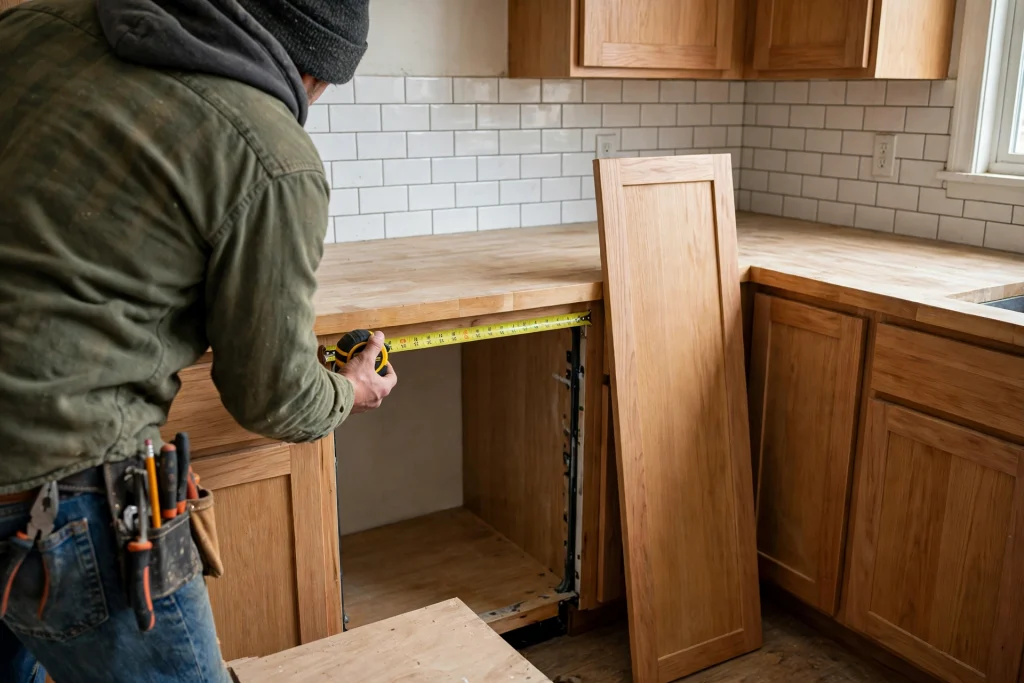
Cabinet work is the part of a first-time installation that homeowners most often forget to budget, because the dishwasher is sold as an appliance and the cabinet is treated as furniture — but the two have to fit together to a fraction of an inch. A standard built-in dishwasher needs an opening 24 inches wide, 34 inches high, and 24 inches deep. A kitchen that has never had a dishwasher usually has no such opening: it has a run of base cabinets, and one of them has to come out, or be cut, to make room.
| Cabinet item | Typical cost | When it comes up |
|---|---|---|
| Cabinet removal or modification, parts and labor | $150–$400 | Opening must be cut, widened, or a cabinet removed |
| Removing one base cabinet | $150–$400 | A spare cabinet sits next to the sink and can come out cleanly |
| Cutting a cabinet run to size | $150–$400 | The opening is a fraction of an inch too narrow or too short |
| Filler panels and trim to finish the opening | Included in the $150–$400 range | Gaps around the dishwasher need finishing |
| Countertop adjustment | Priced per job | The countertop overhangs the new opening or needs support |
| Floor repair under a removed cabinet | Priced per job | The floor under the cabinet is unfinished or damaged |
Removing one base cabinet ($150–$400). The cleanest cabinet job is removing one base cabinet next to the sink: the cabinet is unscrewed from its neighbors and the wall, lifted out, and the opening is trimmed and finished. The cost is $150–$400 in parts and labor, and it lands near the bottom of the range where the cabinet comes out cleanly and the floor underneath is finished, and near the top where the cabinet is glued or the countertop has to be supported while the cabinet is out. A handyman at $50–$80 per hour can usually do this work in two to four hours, which is why the range sits where it does. Before the cabinet comes out, check what is inside it: a cabinet that holds the sink’s plumbing or the garbage disposal cannot simply be removed, and a cabinet with drawers full of cutlery is not the one to lose. Pick the cabinet that holds the least, sits closest to the sink, and comes out without disturbing the countertop.
Cutting a cabinet run to size ($150–$400). Where the opening exists but is a fraction of an inch too narrow or too short, the cabinet has to be cut rather than removed. The cost is $150–$400 in parts and labor, and it is the cabinet job most likely to go wrong if it is rushed: a cut made a quarter inch too wide leaves a gap that shows, and a cut made too narrow means the dishwasher still will not fit. Measure the opening before you buy — width, height, and depth — and compare it against the dishwasher’s dimensions in the manual. A dishwasher that is a fraction of an inch too wide will not fit, no matter how good the installer is, and the cabinet modification to make it fit is the extra that turns a $1,200–$2,000 job into a $2,000–$3,200 one. If the opening is more than an inch too small in any dimension, removing the cabinet is usually cleaner than cutting it.
Cabinet work has to finish before the dishwasher can be fitted. This is the scheduling point that catches first-time installers out: the cabinet opening has to exist, trimmed and finished, before the dishwasher can be slid in, and the plumbing rough-in has to be done before the walls are closed up. A first-time installation with cabinet work is therefore a multi-step job, not a single visit, and it can stretch over more than one day. When you book, ask for the sequence in writing: cabinet work first, then rough-in, then electrical, then the fitting. A contractor who prices the whole job as one visit is either skipping a step or planning to come back — and a second visit costs another service-call fee.
Permits for a First-Time Dishwasher Installation
A like-for-like replacement almost never needs a permit, because nothing new is being built: the water line, the drain, and the circuit already exist and are only being reconnected. A first-time installation is different, because it creates new plumbing and new electrical work, and many jurisdictions require a permit for exactly that. The permit is priced per job, and the cost varies by city and county — there is no national figure to quote — but the rule to remember is simple: if the job adds a new water line, a new drain, or a new electrical circuit, ask whether a permit is required before the work starts.
| Permit question | Typical answer | Notes |
|---|---|---|
| Like-for-like replacement | Rarely needs a permit | Existing hookups are only reconnected |
| First-time install, new water line only | Often needs a plumbing permit | Priced per job by the local authority |
| First-time install, new dedicated circuit | Often needs an electrical permit | Priced per job; the electrician usually pulls it |
| First-time install, new water + new circuit | Often needs both permits | The plumber and the electrician each pull their own |
| First-time install with cabinet removal only | Rarely needs a permit | No new plumbing or electrical work is created |
| Inspection after the work | Usually required where a permit was pulled | The inspector checks the new lines before the walls close |
Who pulls the permit matters. Where a permit is required, the licensed trade usually pulls it: the plumber pulls the plumbing permit, the electrician pulls the electrical permit. That is one more reason to hire licensed trades for the rough-in and the circuit rather than a handyman: a handyman at $50–$80 per hour cannot pull a permit for work he is not licensed to do, and unpermitted plumbing and electrical work can cause problems when the house is sold, because a buyer’s inspector will ask what was done and when. Ask each trade whether the quote includes the permit fee, because a quote that excludes it will grow by the permit cost on the day the work starts. A permit also triggers an inspection, and the inspection is worth having: the inspector checks the new water line, the drain, and the circuit before the walls are closed up, and a failed inspection is caught while it is still cheap to fix.
First Time Dishwasher Installation Cost by Region and Installer
The labor for a first-time installation follows the local labor market the same way a plumber’s hourly rate does — and the same job costs noticeably more in a high-cost metro area than in a smaller market. The national labor range of $300–$1,300 breaks down roughly like this by region, and the dishwasher you buy costs the same wherever you live, so the only thing changing between regions is the labor and the extras.
| Region | Typical first-time labor | Typical all-in project (dishwasher $400–$1,200) | Typical plumber hourly rate |
|---|---|---|---|
| Northeast (New York, Boston, Washington DC) | $450–$1,300 | $1,500–$3,200 | $90–$150 per hour |
| West Coast (California, Seattle, Portland) | $400–$1,200 | $1,400–$3,200 | $85–$150 per hour |
| Midwest (Chicago, Minneapolis, Cleveland) | $300–$1,000 | $1,200–$2,700 | $60–$100 per hour |
| South (Atlanta, Dallas, Charlotte, Nashville) | $300–$900 | $1,200–$2,500 | $50–$90 per hour |
| Southeast / Gulf Coast | $300–$900 | $1,200–$2,500 | $50–$85 per hour |
| Mountain West (Denver, Phoenix, Salt Lake City) | $300–$1,100 | $1,200–$2,900 | $55–$100 per hour |
| Rural / small-town markets | $300–$800 | $1,200–$2,300 | $45–$90 per hour |
High-cost metros ($400–$1,300 labor). In the Northeast and on the West Coast, first-time labor commonly lands at $400–$1,300, and the all-in project lands at $1,400–$3,200. The labor market is most visible in these markets: a plumber at $90–$150 per hour for a four-hour first-time job costs $360–$600 in labor alone, before the water connection, the circuit, or the cabinet work. In a high-cost metro, a flat-rate quote from a contractor can be the best deal available, because it caps the labor even if the job runs long — but only if the quote is itemized, so the water connection at $150–$350 and the circuit at $250–$900 are named rather than hidden inside one number.
Who you hire changes the price as much as where you live. The table below compares the routes to a fitted dishwasher for a first-time installation, on the numbers that actually decide the total.
| Installer | Typical first-time labor | What they can do | Scheduling | Best for |
|---|---|---|---|---|
| Licensed plumber | $300–$1,300 (at $45–$150 per hour) | Water, drain, rough-in, and the fitting | A day or two | First-time installs with new plumbing |
| Licensed electrician | $250–$900 for the circuit | New outlet and new dedicated circuit | A day or two | Any job that needs a new circuit |
| Handyman | $50–$80 per hour | Cabinet removal, fitting, simple connections | A day or two | Cabinet work and the fitting where no new circuit is needed |
| Home Depot installation | Custom quote, replacement from $150–$350 | Standard replacement; first-time priced as custom work | A few days to a week | Buying the dishwasher and the install together |
| Lowes installation | Custom quote, replacement from $150–$350 | Standard replacement; first-time priced as custom work | A few days to a week | Buying the dishwasher and the install together |
| General contractor | $300–$1,300, coordinated | All trades under one quote | A few days to a week | Jobs needing plumbing, electrical, and cabinet work together |
Licensed plumber ($300–$1,300 labor). A licensed plumber is the most flexible route for a first-time installation, because the plumber can run the water line, connect the drain, and fit the dishwasher in the same visit. The labor range is the widest because it depends on the hourly rate — $45–$150 per hour — and on how many hours the job takes: a first-time install next to the sink at $100 per hour for three hours lands at $300, while a new-location install at $150 per hour for five hours, plus rough-in plumbing at $400–$600 minimum, lands at $1,300 and beyond. The plumber is the fastest option for an urgent job — usually a day or two — and the best option when the plumbing under the sink is unusual or corroded, because the plumber can fix the whole job in one visit instead of referring it out. For the full picture of what a plumber charges and how the hourly rate is set, see our guide to the average labor cost to install a dishwasher.
Handyman ($50–$80 per hour). A handyman is the cheapest hourly rate on a first-time installation, at $50–$80 per hour, and the right hire for the cabinet removal and the fitting itself where no licensed trade is required. A handyman can remove a base cabinet at $150–$400, slide the dishwasher into the opening, level it, and connect it to hookups that already exist — but a handyman cannot legally add a new dedicated circuit, and in many jurisdictions cannot run new plumbing rough-in. The saving on the hourly rate disappears if the handyman has to call a plumber and an electrician anyway, so hire the handyman for the cabinet work and the fitting, and hire the licensed trades for the water and the circuit. Get the handyman’s work in writing too: a cabinet cut a quarter inch too wide is a visible mistake, and a written quote is what makes it the handyman’s problem to fix.
Home Depot and Lowes installation (custom quote for a first-time install). The big-box route works differently for a first-time installation than for a replacement. For a replacement, both stores charge a flat fee — Home Depot and Lowes each run $150–$350 for the standard replacement labor — done by a licensed local third-party contractor, with a labor warranty. For a first-time installation, there is no flat fee: the contractor prices it as custom work, because the water connection, the circuit, and the cabinet work vary by kitchen. The dishwasher itself is bought at the store at $400–$1,200 for a budget to mid-range unit, and the installation is quoted after the site is seen. For the big-box replacement prices behind that comparison, see our guides to Home Depot dishwasher installation and dishwasher installation cost at Lowes, and for the Lowes fee in detail, our guide to how much does Lowes charge to install a dishwasher. The big-box route is the best choice when you are buying the dishwasher there anyway and want one checkout and a labor warranty; it is the worst choice when the kitchen needs rough-in plumbing at $400–$600 minimum, because the contractor will refer that work to a plumber you hire separately, and you will have paid for a quote that does not include the main job.
General contractor ($300–$1,300, coordinated). A general contractor or kitchen installer coordinates all three trades under one quote: the plumber, the electrician, and the cabinet work. The headline number is usually higher than hiring each trade separately, because the contractor takes a margin for the coordination, but the sequencing is on one person — the cabinet work finishes before the rough-in, the rough-in finishes before the walls close, and the fitting happens last. For a first-time install across the kitchen with a new circuit and cabinet work, where the project totals $2,000–$3,200, the coordination is worth paying for: a job with three trades and no coordinator is a job where the electrician arrives before the cabinet is out and has to come back, and the second visit costs another service-call fee.
What Drives the Total Cost of a First-Time Dishwasher Installation
The labor range of $300–$1,300 is the starting point, not the final price. Here is what moves the bill up or down, and by how much — and which of these drivers you can control before you buy the dishwasher.
| Cost driver | Effect on the total project cost | Notes |
|---|---|---|
| Dishwasher unit | $400–$1,200 for the unit | Budget to mid-range; the unit price does not change with the kitchen |
| Installation scenario | $300–$1,300 labor | Near the sink $300–$700; new location $700–$1,300 |
| Distance from the sink | $150–$350 water connection; $400–$600 rough-in minimum | The single biggest site driver |
| New dedicated circuit | Add $250–$900 | Needed where no dedicated circuit exists |
| New electrical outlet | Add $150–$350 | Needed where no outlet exists near the opening |
| Cabinet removal or modification | Add $150–$400 | Opening must be cut, widened, or a cabinet removed |
| Rough-in plumbing | Add $400–$600 minimum | New lines run through walls or floors |
| New water connection | Add $150–$350 | Needed where no water line exists |
| Installation kit | Add $20–$40 | Almost every job; check whether the kit is already in the box |
| Old-unit removal or disposal | Add $50–$150 | Where an old unit exists to remove |
| Corroded connections | Add labor at $45–$150 per hour | A seized connection can add 30–60 minutes to the job |
| Region / ZIP code | $300–$1,300 labor | $300–$800 in rural markets, $400–$1,300 in major metros |
| Permit | Priced per job | Needed where new plumbing or electrical work is created |
| Scheduling urgency | No fee difference, but a wait | A plumber takes a day or two; a big-box contractor takes a few days to a week |
Distance from the sink is the driver you control most. The water connection costs $150–$350 where the dishwasher sits next to the sink, and rough-in plumbing costs $400–$600 minimum where it sits across the room — a difference of at least $250 before the drain and the circuit are even priced. Before you choose a location, measure the distance from the sink to the proposed opening and ask the plumber what the run will cost. A location six inches from the sink is a $150–$350 water connection; a location ten feet away is a $400–$600 rough-in, a longer drain run, and a higher risk of slow draining later. The most convenient spot in the kitchen is rarely the cheapest spot for a dishwasher, and the cheapest spot is almost always the cabinet next to the sink.
DIY vs. Hiring a Pro for a First-Time Dishwasher Installation
| DIY | Hiring a licensed plumber | Hiring a handyman | Big-box installation | |
|---|---|---|---|---|
| Dishwasher unit cost | $400–$1,200 by type and tier | Same — you buy the dishwasher either way | Same — you buy the dishwasher either way | Same — you buy the dishwasher either way |
| Labor | $0 | $300–$1,300 | $50–$80 per hour | Custom quote; replacement from $150–$350 |
| Installation kit | $20–$40 in parts | $20–$40 in parts | $20–$40 in parts | $20–$40, bought at checkout |
| New water connection | Not a DIY job | $150–$350, done by the pro | Not a licensed plumbing job | $150–$350, priced as an upgrade |
| Rough-in plumbing | Not a DIY job | $400–$600 minimum, done by the pro | Not a licensed plumbing job | Priced as an upgrade or referred out |
| New electrical outlet | Not a DIY job | Done by a licensed electrician | Not a licensed electrical job | $150–$350, done by a licensed electrician |
| New dedicated circuit | Not a DIY job | $250–$900, done by a licensed electrician | Not a licensed electrical job | $250–$900, done by a licensed electrician |
| Cabinet removal or modification | $0 if you do it yourself | $150–$400, done by the pro | $150–$400, done by the handyman | Priced as an upgrade |
| Old-unit removal or disposal | $0 if you haul it yourself | $50–$150 | $50–$150 | $50–$150 |
| All-in total, first-time install near the sink | $420–$1,240 in parts (no labor) | $1,200–$2,000 | $1,200–$2,000 | $1,200–$2,000 |
| All-in total, first-time install in a new location | Not a DIY job | $2,000–$3,200 | $2,000–$3,200 | $2,000–$3,200 |
| Time required | A full weekend for a first-timer, if the hookups exist | 3–5 hours on site for the install; a full day with cabinet or electrical work | 3–5 hours on site for the fitting | 3–5 hours on site; a few days to a week to schedule |
| Tools needed | Adjustable wrench, screwdriver, level, bucket, towels, flashlight, drill, saw | Included in the labor price | Included in the hourly rate | Included in the fee |
| Plumbing safety | A bad seal leaks slowly into the cabinet — check for drips for a week | Pro leak-tests and runs a test cycle before leaving | Pro leak-tests where the connections are his | Licensed contractor, insured, tested before leaving |
| Water damage risk | A cross-threaded supply line can flood a cabinet | Licensed pro, insured, tested before leaving | Insured where the handyman carries insurance — ask | Licensed contractor, insured, tested before leaving |
| Permit | You pull it yourself where one is required | The pro pulls it where one is required | Cannot pull a plumbing or electrical permit | The contractor pulls it where one is required |
| Warranty | None — mistakes are on you | Usually 90 days to 1 year on the workmanship | Varies — get it in writing | Usually 1 year on the labor |
| Scheduling | Whenever you are free | A day or two | A day or two | A few days to a week |
| Best for | A confident DIYer where the hookups already exist | First-time installs with new plumbing | Cabinet work and the fitting | Buying the dishwasher and the install together |
A first-time installation is not a DIY job where new plumbing or electrical work is needed. If a dishwasher already exists, the new one is the same size, the supply lines are in good shape, and the shut-off valve works, a confident DIYer can swap a dishwasher in two to four hours with basic tools. A first-time installation is different: it needs a new water connection at $150–$350, rough-in plumbing at $400–$600 minimum where the lines must be run through walls or floors, a new outlet at $150–$350 or a new dedicated circuit at $250–$900, and sometimes cabinet work at $150–$400 — and that work belongs to a licensed plumber and a licensed electrician. The saving from doing it yourself is the labor of $300–$1,300, but the risk is a slow leak at a supply line or the drain connection, an overloaded circuit, or unpermitted work that causes problems when the house is sold. The one part of a first-time install that is a fair DIY job is the cabinet removal: taking out a base cabinet next to the sink, where no plumbing or wiring runs through it, saves $150–$400 and needs only a screwdriver, a drill, and a saw. Do the cabinet work yourself, and hire the licensed trades for the water and the power.
Hiring a licensed plumber is the best value when the job needs new plumbing. The labor of $300–$1,300 is in the same band as the cost of the hookups themselves, and it comes with a warranty of usually 90 days to 1 year on the workmanship, a leak test and a full test cycle before the plumber leaves, and a permit pulled where one is required. The trade-off is the wait for the other trades: the plumber does the water and the drain, but the electrician still has to run the circuit, and the cabinet work still has to be done. If the kitchen needs all three trades, a general contractor who coordinates them under one quote is worth the margin: the sequencing is on one person, and a job with three trades and no coordinator is a job where someone arrives before the step before theirs is finished and has to come back.
Money-Saving Tips for a First-Time Dishwasher Installation
1. Choose the cabinet next to the sink — that is where the real money is. The distance from the sink is the single biggest site driver: a water connection costs $150–$350 next to the sink, and rough-in plumbing costs $400–$600 minimum across the room. A location six inches from the sink is a short water run, a short drain run, and a low risk of slow draining later; a location ten feet away is a long run of both, a higher price, and a longer job. The most convenient spot in the kitchen is rarely the cheapest spot for a dishwasher, and the cheapest spot is almost always the cabinet next to the sink. Pick the location before you buy the dishwasher, and price the hookups for that location before you price anything else. 2. Get the electrical panel checked before you buy the dishwasher. A new dedicated circuit costs $250–$900, and the price depends on whether the panel has a spare breaker space and how far the kitchen is from the panel. Ask an electrician to look at the panel before you buy: if it has a spare space and the run is short, the circuit lands near $250; if the panel is full, it lands near $900. A $650 difference on one line is the difference between a $1,200–$2,000 project and a $2,000–$3,200 one, and it is decided by a panel you probably have not opened in years. Five minutes with an electrician is the cheapest check on the whole job. 3. Measure the opening before you buy. A standard built-in opening is 24 inches wide, 34 inches high, and 24 inches deep — measure yours and compare it against the dishwasher’s dimensions in the manual. A dishwasher that is a fraction of an inch too wide will not fit, and the cabinet modification to make it fit costs $150–$400. Five minutes with a tape measure is the cheapest insurance on the whole job, and it is the step that prevents a dishwasher being delivered to a kitchen it cannot fit into. 4. Do the cabinet removal yourself where no plumbing or wiring runs through it. Removing a base cabinet costs $150–$400 when a pro does it, and it is the one part of a first-time install that is a fair DIY job: a screwdriver, a drill, and a saw, two to four hours, and the cabinet is out. Check first what is inside the cabinet — a cabinet that holds the sink’s plumbing or the garbage disposal cannot simply be removed — and pick the cabinet that holds the least, sits closest to the sink, and comes out without disturbing the countertop. The saving is $150–$400, and the cabinet work has to finish before the dishwasher can be fitted anyway. 5. Check whether the installation kit is already in the box. The kit costs $20–$40 and is sold separately from both the dishwasher and the labor — but some dishwashers ship with a supply line in the box. If the kit is already there, you can skip that line at checkout and save $20–$40; if it is not, add it, because the installer cannot finish the job without it. Five minutes reading the box contents is the cheapest saving on the whole order, and a braided stainless line is worth choosing over a plastic one because it lasts longer. 6. Get three written quotes: a plumber, a handyman, and one more pro. A licensed plumber runs $45–$150 per hour, a handyman runs $50–$80 per hour, and a general contractor coordinates all three trades under one quote — so quotes for the same first-time job can differ by hundreds of dollars between providers. A five-minute phone call to one more pro is the cheapest way to know whether the first price is fair. Compare the written quotes line by line: labor, water connection, rough-in, outlet, circuit, cabinet work, kit, disposal, and testing should each be named, so a $1,200 quote and a $3,200 quote can be compared as two lists of lines instead of two unexplained totals. 7. Bundle the dishwasher with other kitchen plumbing work. If a plumber is already under the sink — replacing supply lines, fitting new shut-off valves, or installing a garbage disposal — adding a dishwasher to the same visit costs far less in labor than a separate trip, because the service-call fee and the cabinet setup are paid for once. A plumber at $45–$150 per hour who is already on site can run the dishwasher water connection at $150–$350 for little more than the parts and an extra hour, against a full separate visit. Ask for a bundled price when you call. For the faucet side of that same visit, see our guide to how much does Lowes charge to install a faucet. 8. Replace the supply line and shut-off valve at the same time. A new supply line and shut-off valve cost $50–$150 in parts and labor when the plumber is already there, and they are the parts most likely to fail next. Replacing them during the dishwasher installation means one visit and no second leak — replacing them later means a second visit and a second labor charge for a job that takes minutes. Test the valve before you order: turn it off and run the kitchen faucet to check the water stops. If the valve will not turn off, expect the fix to be priced into the job and budget for it now rather than discovering it on installation day. 9. Buy the dishwasher on sale — that is where the unit saving is. The dishwasher is the most controllable cost after the location, and a budget to mid-range dishwasher at $400–$1,200 goes on sale regularly, especially around holiday weekends. A $100 saving on the dishwasher is a $100 saving on the total, and the labor of $300–$1,300 does not change with the sale price — so a sale dishwasher plus the same labor is a cheaper project than a full-price dishwasher with discounted labor. A $400 dishwasher is the cheapest way to keep a first-time job near $1,200 all in, where the site allows it. 10. Do not pay for disposal you do not need, and do not wait for a sale if the kitchen is already damaged. Old-unit removal or disposal costs $50–$150 where an old unit exists to remove — but a first-time installation usually has no old dishwasher at all, so check whether that line is on the quote before you pay it. If there is no old unit, the disposal line should be zero. And if the kitchen already has water damage under the sink, do not wait for a holiday sale to fix it: a slow leak at a supply line rots a cabinet floor and a subfloor over months, and the floor repair costs far more than any sale saving on a $400–$1,200 dishwasher.
Frequently Asked Questions
How much does a first time dishwasher installation cost?
In 2026, first time dishwasher installation cost typically runs $300–$1,300 for labor, with the all-in project — dishwasher, labor, and extras together — typically landing at $1,200–$3,200. The dishwasher itself costs $400–$1,200 for a budget to mid-range unit, the installation kit adds $20–$40, a new water connection adds $150–$350, a new electrical outlet adds $150–$350, a new dedicated circuit adds $250–$900, and cabinet removal or modification adds $150–$400. A first-time install next to the sink with an opening that already exists typically totals $1,200–$2,000, while a first-time install in a new location with full rework typically totals $2,000–$3,200. A replacement, for comparison, costs $150–$350 in labor for a basic job, or $200–$500 in the standard range. The job takes 3–5 hours on site for the install itself, and a full day where cabinet or electrical work is added.
Is a first-time dishwasher installation more expensive than a replacement?
Yes — a first-time installation costs roughly twice as much in labor as a replacement, and often more all in. First-time labor typically costs $300–$1,300, against $150–$350 for a basic replacement or $200–$500 in the standard replacement range. The difference is the hookups: a replacement connects to a water line, a drain, and an electrical circuit that already exist, while a first-time install has to create all three. A new water connection costs $150–$350, rough-in plumbing costs $400–$600 minimum where new lines must be run through walls or floors, a new outlet costs $150–$350, a new dedicated circuit costs $250–$900, and cabinet work costs $150–$400. With a dishwasher at $400–$1,200, a first-time project typically totals $1,200–$3,200 all in, against $620–$1,740 for a basic replacement with the same dishwasher.
Do I need a plumber or an electrician for a first-time dishwasher installation?
Usually both, plus someone for the cabinet work. A plumber at $45–$150 per hour runs the water supply and the drain, and the water connection costs $150–$350, or $400–$600 minimum for rough-in plumbing where new lines must be run through walls or floors. A licensed electrician fits the new outlet at $150–$350 or runs the new dedicated circuit at $250–$900, because a dishwasher needs its own circuit and that work must be done by a licensed electrician in most jurisdictions. A handyman at $50–$80 per hour can handle the cabinet removal at $150–$400 and the fitting itself where no licensed trade is required. A general contractor can coordinate all three trades under one quote. The fitting itself — sliding the dishwasher in, leveling it, securing it, and running the leak test and test cycle — is included in the labor of $300–$1,300.
Do I need a permit for a first-time dishwasher installation?
Often, yes — where the job creates new plumbing or new electrical work. A like-for-like replacement almost never needs a permit, because the hookups already exist and are only reconnected. A first-time installation adds a new water line, a new drain, or a new dedicated circuit, and many jurisdictions require a permit for exactly that. The permit is priced per job by the local authority, and the licensed trade usually pulls it: the plumber pulls the plumbing permit, the electrician pulls the electrical permit. Ask each trade whether the quote includes the permit fee, because a quote that excludes it will grow by the permit cost on the day the work starts. A permit also triggers an inspection, and the inspection is worth having: the inspector checks the new water line, the drain, and the circuit before the walls are closed up, and a failed inspection is caught while it is still cheap to fix.
Can I install a dishwasher myself the first time?
A first-time installation is not a DIY job where new plumbing or electrical work is needed — it needs a new water connection at $150–$350, rough-in plumbing at $400–$600 minimum where lines must be run through walls or floors, a new outlet at $150–$350 or a new dedicated circuit at $250–$900, and sometimes cabinet work at $150–$400, and that work belongs to a licensed plumber and a licensed electrician. The saving from doing it yourself is the labor of $300–$1,300, but the risk is a slow leak at a supply line or the drain connection, an overloaded circuit, or unpermitted work that causes problems when the house is sold. The one part that is a fair DIY job is the cabinet removal: taking out a base cabinet next to the sink, where no plumbing or wiring runs through it, saves $150–$400 and needs only a screwdriver, a drill, and a saw. Do the cabinet work yourself, hire the licensed trades for the water and the power, and check under the sink and around the dishwasher for drips every day for a week after the job.
The Bottom Line
For first time dishwasher installation cost in 2026, budget $300–$1,300 for labor, plus a dishwasher at $400–$1,200 for a budget to mid-range unit, plus a kit at $20–$40, for an all-in project total of $1,200–$3,200. A first-time install next to the sink with an opening that already exists typically totals $1,200–$2,000 — the worked example in this guide, labor at $650, a mid-range dishwasher at $800, a kit at $30, a new water connection at $250, and a new outlet at $250, totals $1,980 — while a first-time install in a new location with full rework typically totals $2,000–$3,200, because it needs a new water connection at $150–$350, rough-in plumbing at $400–$600 minimum, a new dedicated circuit at $250–$900, and cabinet work at $150–$400. A replacement, for comparison, costs $150–$350 in labor for a basic job, or $200–$500 in the standard range. A plumber charges $45–$150 per hour, a handyman charges $50–$80 per hour, and the job takes 3–5 hours on site for the install itself, and a full day where cabinet or electrical work is added. The cheapest way to keep the bill down is to choose the cabinet next to the sink, get the electrical panel checked before you buy, measure the opening before you buy, do the cabinet removal yourself where it is safe to do so, check whether the kit is already in the box, and get three written quotes — a plumber, a handyman, and one more pro — with the labor, the water connection, the rough-in, the outlet, the circuit, the cabinet work, the kit, and the testing each listed as its own line. And before you buy at all, check whether the kitchen already has a water line and a circuit where the dishwasher will go: the difference between a $1,200–$2,000 project and a $2,000–$3,200 one is the hookups, not the dishwasher.
Prices are typical 2026 US ranges for planning purposes and vary by region, dishwasher choice, and site condition; first-time installation labor and extras are set by local rates and site conditions, so confirm your price with itemized local quotes before you buy and get the permit position confirmed with your local building department.
2 thoughts on “First Time Dishwasher Installation Cost in 2026”