

Replace Dishwasher Labor Cost in 2026
When a dishwasher dies, the first question most homeowners ask is not about the new appliance — it is about the labor. The replace dishwasher labor cost for a standard like-for-like replacement typically runs $200–$500 in 2026, with basic installation labor at $150–$350 when the hookups are already in place and working. That labor figure is only one part of the bill, though: add the old unit’s removal and disposal at $50–$150, an installation kit at $20–$40, and the dishwasher itself at $400–$1,200, and the all-in replacement — new unit, labor, kit, and haul-away together — typically lands at $600–$1,700. A first-time installation in a new location is a different job entirely, with labor alone at $300–$1,300, because it needs a new water line and often a new electrical outlet or circuit.
The reason the labor range is so wide — $200–$500 for the same job, on paper — is that “replacing a dishwasher” covers several different jobs. A clean swap in a five-year-old kitchen, where the shut-off valve turns freely and the supply line is sound, is a 1–2 hour job that lands near the bottom of the range. A swap in a twenty-year-old kitchen, where the valve is seized, the supply line is corroded, and the drain connection needs rerouting, is a half-day job that lands near the top. And the person doing the work matters just as much: a handyman charges $50–$80 per hour and typically $120–$250 for the job, a licensed plumber charges $45–$150 per hour and typically $150–$350, and a big-box installation runs $130–$230 depending on the store. This guide breaks the labor charge down by scenario, installer type, dishwasher type, and region, so you can see exactly what you should pay for your kitchen — and what you should not.
For the labor-only side of the same job priced the other way around — what a pro charges to install a dishwasher you already own — see our guide to what is the average labor cost to install a dishwasher, which breaks the labor charge down by scenario, installer type, and dishwasher type. And for the big-box prices behind the numbers in this guide, see our breakdowns of Home Depot dishwasher installation and Lowes dishwasher installation, plus the full dishwasher installation cost at Lowes.
Quick-answer table (typical 2026 replace dishwasher labor cost):
| Item | Typical cost |
|---|---|
| Replacement labor, like-for-like swap on existing hookups | $200–$500 |
| Basic installation labor | $150–$350 |
| Plumber hourly rate | $45–$150 per hour |
| Plumber install labor, typical | $150–$350 |
| Handyman hourly rate | $50–$80 per hour |
| Handyman install labor, typical | $120–$250 |
| Home Depot replacement labor | $130–$220 |
| Lowe’s replacement labor | $200–$230 |
| Best Buy replacement labor | $200–$215 |
| Old dishwasher removal and disposal | $50–$150 |
| Installation kit (supply line, power cord, fittings) | $20–$40 |
| Dishwasher unit, standard | $400–$1,200 |
| All-in replacement (unit + labor + kit + removal) | $600–$1,700 |
| Clean swap example (labor $300 + kit $30 + removal $75) | $405 labor and extras, $1,205 with an $800 unit |
| First-time install in a new location, labor only | $300–$1,300 |
| New electrical outlet, parts and labor | $150–$350 |
| New electrical circuit, parts and labor | $250–$900 |
| Time on site, standard replacement | 1–2 hours |
| Time on site, replacement with hookup fixes | 2–4 hours |
| Time on site, first-time installation | 3–5 hours |
| Scheduling lead time, big-box installer | A few days to a week |
| Scheduling lead time, local plumber or handyman | A day or two |
What the Replace Dishwasher Labor Cost Covers
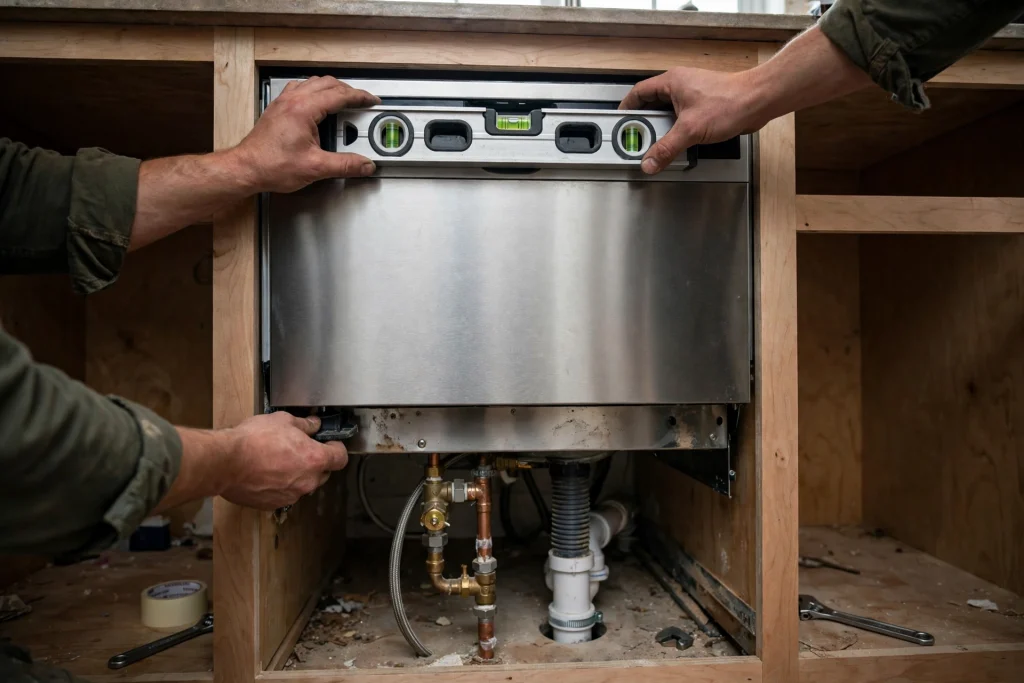
The labor charge for replacing a dishwasher pays for the work of getting the old unit out and the new one in, connected, level, and tested — and knowing exactly which tasks are inside that price is the fastest way to spot a quote that is missing something. A standard replacement labor charge covers shutting off the water and the power, disconnecting the old dishwasher from the water supply and the drain, pulling it out of the opening, sliding the new unit in, leveling it front to back and side to side, securing it so it cannot tip forward when the door is opened and the racks are pulled out, connecting the water supply and the drain hose, making the electrical connection to the existing circuit, and running a leak test and a test cycle before leaving. That is the job the $200–$500 labor range buys — a like-for-like swap on existing, working hookups — and it usually takes 1–2 hours on site.
What the labor charge does not cover is almost as important. The dishwasher itself is never included: you buy the unit separately at $400–$1,200 for a standard model, and the labor is charged on top. The installation kit — a braided stainless supply line, a power cord, an elbow fitting, clamps, and drain parts — costs $20–$40 in parts and is billed separately by most installers. Removal and disposal of the old dishwasher costs $50–$150 and is a separate line on many quotes, not part of the labor figure. And any work beyond a standard swap — a seized shut-off valve, a corroded supply line, a drain that needs rerouting, a missing electrical circuit, or a cabinet opening that needs cutting — is priced as an extra, because it is plumbing or electrical work on top of the installation itself.
| Task | Included in standard replacement labor? | Notes |
|---|---|---|
| Shutting off water and power | Included | Water shut off at the valve, power at the breaker or unplugged |
| Disconnecting the old dishwasher | Included | Water supply and drain disconnected, power disconnected |
| Pulling the old unit out of the opening | Included | Old unit slid out and set aside |
| Positioning and leveling the new dishwasher | Included | Unit slid into the opening and leveled front to back and side to side |
| Securing the unit (anti-tip bracket) | Included | Dishwasher secured to the countertop or cabinet so it cannot tip forward |
| Connecting the water supply line | Included | Connection to the existing supply line where it is in good shape |
| Connecting the drain line | Included | Drain hose connected to the garbage disposal or the sink drain |
| Electrical connection to the existing circuit | Included | Hardwired or plugged in to the existing circuit where one exists |
| Leak test and test cycle | Included | Installer runs water and a test cycle, checks every connection before leaving |
| Cleanup of the work area | Included | Cabinet and floor wiped down, old parts gathered |
| The dishwasher itself | Not included | You buy it: standard unit $400–$1,200 |
| Installation kit (supply line, power cord, fittings) | Not included | $20–$40 in parts, billed separately |
| Removal and disposal of the old dishwasher | Usually not included | $50–$150, a separate line on most quotes |
| New shut-off valve or supply line | Not included | Priced as an extra; part of a $200–$500 labor job at the top of the range |
| New water connection | Not included | First-time install only; labor $300–$1,300 |
| New electrical outlet | Not included | $150–$350 in parts and labor |
| New electrical circuit | Not included | $250–$900 in parts and labor |
| Cabinet modification | Not included | Opening must be cut or widened; priced per job |
| Permit for a first-time installation | Not included | Priced per job where one is required; rarely needed for a like-for-like swap |
The kit is the extra almost every homeowner pays. The installation kit costs $20–$40 and is sold separately from both the dishwasher and the labor charge: a braided stainless supply line, a power cord, an elbow fitting, clamps, and drain parts. Some dishwashers ship with a supply line in the box, but many do not, and no installer will reuse a corroded or kinked line from the old unit. Budget $30 for a typical kit as a planning figure: it is the number that turns a $300 labor charge into a $330 bill before removal is even added. Check the box contents of the dishwasher you are buying before the installer arrives — if the kit is already in the box, you can skip that line; if it is not, buy it, because the installer cannot finish the job without it.
Removal and disposal is the line most often left off the quote. The old dishwasher has to go somewhere, and removal and disposal costs $50–$150 depending on who does it and where it goes. Some installers include removal in the labor charge and charge only for disposal; some charge for both as a single $50–$150 line; and some quote labor only and leave the old unit sitting in your garage. Ask before the work starts whether removal and disposal are in the quoted price, and get the answer in writing. If you can haul the old unit yourself to a municipal drop-off, the disposal charge drops to zero — but the removal itself, disconnecting a heavy appliance full of water, is still work, and a dishwasher that weighs 60–80 pounds is not a one-person carry down a flight of stairs.
The labor warranty is part of what you are paying for. A licensed plumber typically warranties the workmanship for 90 days to 1 year, and a big-box installation through Home Depot, Lowe’s, or Best Buy usually carries a 1-year labor warranty. A handyman’s warranty is shorter — often 30–90 days — which is one of the reasons the handyman’s labor at $120–$250 costs less than a plumber’s at $150–$350. Get the warranty in writing before the work starts, and keep the paperwork with the dishwasher’s own warranty: if a connection leaks a week after the install, the warranty is what proves the job was theirs, and the leak test they ran before leaving is what proves it was done right.
Replace Dishwasher Labor Cost by Scenario
The single biggest driver of replace dishwasher labor cost is the scenario: a like-for-like replacement on existing hookups is a short, predictable job priced at the base labor rate, while a first-time installation in a new location is a half-day job that can involve a plumber, an electrician, and cabinet work. The table below gives the labor cost for each scenario — not the all-in project total, so the labor numbers are comparable across scenarios instead of mixing labor with the price of the dishwasher.
| Replacement scenario | Labor cost | Kit + removal | Likely extras | All-in total (standard dishwasher $400–$1,200) |
|---|---|---|---|---|
| Clean like-for-like swap, working hookups | $200–$500 | $70–$190 | None | $670–$1,890, typically $600–$1,700 |
| Clean swap example (labor $300 + kit $30 + removal $75) | $300 | $105 | None | $405 for labor and extras, $1,205 with an $800 unit |
| Replacement in an older kitchen, hookup fixes | $200–$500 | $70–$190 | Shut-off valve or supply line fix | $670–$1,890 |
| Older kitchen example (labor $350 + kit $30 + removal $75 + valve fix $100) | $350 | $105 | $100 | $555 for labor and extras, $1,355 with an $800 unit |
| Replacement with a new electrical outlet | $200–$500 | $70–$190 | $150–$350 for the outlet | $820–$2,240 |
| Replacement in a tight or non-standard opening | $250–$500 | $70–$190 | Cabinet work, priced per job | $720–$1,890+ |
| First-time install, hookups nearby | $300–$700 | $70–$190 | New water connection | $770–$2,090+ |
| First-time install in a new location, full rework | $300–$1,300 | $70–$190 | New circuit $250–$900, cabinet work | $1,020–$3,590+ |
Clean like-for-like swap ($200–$500 labor, $405 for labor and extras in the typical example). A clean replacement is the cheapest dishwasher job, because everything the installer needs is already there: the water supply line, the shut-off valve, the drain connection, and the electrical circuit. The installer disconnects the old unit, slides it out, slides the new one in, connects the water and drain, makes the electrical connection, levels the unit, and runs a test cycle — usually 1–2 hours on site. With labor at $300, a kit at $30, and removal and disposal at $75, the labor and extras total $405 before tax, and with a standard dishwasher at $400–$1,200 the whole project lands at $600–$1,700. A clean swap on a newer kitchen with working shut-off valves lands near the bottom of the labor range, while a swap with corroded supply lines or a seized shut-off valve lands near the top. The dishwasher shares its water supply and drain with the sink, so the hookups live in the same cabinet as the kitchen faucet — and if that faucet is due for replacement too, the plumber is already there.
Replacement in an older kitchen with hookup fixes ($200–$500 labor, $555 for labor and extras in the typical example). The most common variation on a standard replacement is a job where the shut-off valve, the supply line, or the drain connection needs attention before the new dishwasher can be fitted. A typical example: labor at $350, kit at $30, removal and disposal at $75, and a shut-off valve replacement at $100, for labor and extras of $555 — and $1,355 with an $800 dishwasher. Test the valve before you book: turn it off and run the kitchen faucet to check the water stops. If the valve turns but the water keeps running, or the valve will not turn at all, mention it when you book so the installer prices the extra honestly instead of discovering it mid-job. A seized valve is the single most common reason a $200 labor job becomes a $500 one, because the installer has to shut the water off at the main, replace the valve, and then do the dishwasher swap — and that adds 30–60 minutes to the job.
Replacement that needs a new electrical outlet ($200–$500 labor plus $150–$350 for the outlet). Some replacements need a new outlet because the old dishwasher was hardwired and the new one needs a plug, or because the existing outlet is damaged, ungrounded, or in the wrong place. A new outlet costs $150–$350 in parts and labor, and it must be done by a licensed electrician in most jurisdictions — an appliance installer cannot legally add one. If the kitchen already has a working outlet for the old dishwasher, the installer connects to it and there is no extra; if it does not, the outlet is the extra most likely to be discovered after the dishwasher is already bought. Ask before you book whether the quote includes any electrical work or whether you need a separate electrician, because a $150–$350 outlet is the kind of line item that turns a $405 labor-and-extras bill into a $555–$755 one.
Replacement in a tight or non-standard opening ($250–$500 labor). A replacement costs more when the opening is a fraction of an inch too narrow, too short, or blocked by a cabinet that has to be trimmed. The labor lands at $250–$500 because the installer has to shim, trim, or adjust the opening before the new unit will fit, and the cabinet work is priced on top. Measure the opening before you buy — a standard built-in opening is 24 inches wide, 34 inches high, and 24 inches deep — and compare it against the dishwasher’s dimensions in the manual. A dishwasher that is a fraction of an inch too wide will not fit, no matter how good the installer is, and the cabinet work to make it fit is the extra most likely to turn a same-day job into a two-visit job.
First-time installation in a new location ($300–$1,300 labor). A first-time installation costs $300–$1,300 in labor alone because there is no dishwasher hookup to connect to: the installer has to run a water line from the sink, connect the drain to the garbage disposal or the sink drain, and make an electrical connection where none existed. The job takes 3–5 hours, and the total rises further once a new electrical circuit at $250–$900 and any cabinet work are priced in. With a standard dishwasher the whole project can reach $1,020–$2,590+. This is also the scenario where a dishwasher is most often installed alongside a garbage disposal, because the dishwasher drains through the disposal — and it is the scenario where a flat labor quote is least useful as a guide, because the labor depends on the distance to the sink and the state of the electrical panel, and neither is visible from the showroom floor. Get the installer’s itemized quote in writing before you buy the dishwasher: the difference between a $300 first-time install and a $1,300 one is the distance to the sink and whether the panel has room for a new circuit.
Replace Dishwasher Labor Cost by Installer Type
Who does the work is the second-biggest driver of replace dishwasher labor cost, after the scenario. A handyman is the cheapest route at $120–$250 for the job; a licensed plumber runs $150–$350; and the big-box stores sit in between, with Home Depot at $130–$220, Lowe’s at $200–$230, and Best Buy at $200–$215. The table below compares all five routes on the labor number alone, so the comparison is apples to apples — the dishwasher, the kit, and the removal are the same whichever route you choose.
| Installer type | Labor cost | Hourly rate | Removal and disposal | Kit | Labor warranty | Scheduling | Best for |
|---|---|---|---|---|---|---|---|
| Licensed plumber | $150–$350 | $45–$150 per hour | $50–$150 | $20–$40 | Usually 90 days to 1 year | A day or two | Corroded plumbing, hookup fixes, urgent jobs |
| Handyman | $120–$250 | $50–$80 per hour | $50–$150 | $20–$40 | Often 30–90 days | A day or two | Clean like-for-like swaps on a budget |
| Home Depot | $130–$220 | Flat fee, not hourly | $50–$150 | $20–$40 | Usually 1 year | A few days to a week | One-stop purchase with a warranty |
| Lowe’s | $200–$230 | Flat fee, not hourly | $50–$150 | $20–$40 | Usually 1 year | A few days to a week | One-stop purchase with a warranty |
| Best Buy | $200–$215 | Flat fee, not hourly | $50–$150 | $20–$40 | Usually 1 year through Geek Squad | A few days to a week | Appliance purchase with Geek Squad support |
| Appliance installer / technician | $150–$350 | Flat fee or hourly | $50–$150 | $20–$40 | Often 30–90 days | A day or two | Clean like-for-like swaps |
Licensed plumber ($150–$350 labor, $45–$150 per hour). A licensed plumber is the most flexible route, and the labor range is the widest because it depends on the hourly rate — typically $45–$150 per hour — and on whether the job is a clean swap or a swap with fixes. A clean replacement at $100 per hour for 2 hours lands at $200; the same job at $150 per hour for 2 hours lands at $300; and a replacement with a seized valve or a corroded supply line at $150 per hour for 3 hours lands at $450, near the top of the $200–$500 replacement range. The plumber is the fastest option for an urgent job — usually a day or two against a few days to a week through a big-box contractor — and the best option when the plumbing under the sink is unusual or corroded, because the plumber can fix the whole job in one visit instead of referring it out. The warranty is usually 90 days to 1 year, so get it in writing before the work starts. For the wage data behind the hourly rate, the U.S. Bureau of Labor Statistics reports a median wage of $30.67 per hour for plumbers, pipefitters, and steamfitters — the rate a customer pays is higher because it includes the business costs on top of the wage: the truck, the insurance, the tools, and the licensing. For the full picture of what a plumber charges for this kind of labor-only work, see our guide to what is the average labor cost to install a dishwasher.
Handyman ($120–$250 labor, $50–$80 per hour). A handyman is the cheapest route to a replaced dishwasher, at $50–$80 per hour and typically $120–$250 for the job. At $60 per hour for 2 hours the labor is $120; at $80 per hour for 3 hours it is $240. The handyman is the right choice for a clean like-for-like swap where the hookups work and nothing needs fixing — the job is disconnect, reconnect, level, and test, and a competent handyman does it in 1–2 hours. The trade-offs are the warranty, usually 30–90 days against a plumber’s 90 days to 1 year, and the scope: a handyman cannot legally do electrical work in most jurisdictions, so a job that needs a new outlet at $150–$350 or a new circuit at $250–$900 still needs a licensed electrician. If the shut-off valve is seized or the supply line is corroded, hire the plumber instead — a handyman who forces a seized valve can crack the supply line, and a cracked supply line floods a cabinet.
Home Depot ($130–$220 labor). Home Depot’s replacement labor is the cheapest of the three big-box routes at $130–$220 for a standard replacement, done by a licensed local third-party contractor, with a 1-year labor warranty. The fee is a flat rate set by ZIP code at checkout, not an hourly rate, so the price is fixed even if the job takes two hours instead of one. The kit at $20–$40 and the removal and disposal at $50–$150 are separate add-ons, and any plumbing or electrical work beyond a standard replacement is priced as an upgrade or referred out. Home Depot is the best route when you are buying the dishwasher there anyway and want the lowest big-box labor price with a 1-year warranty — and for the full breakdown of what Home Depot charges, see our guide to Home Depot dishwasher installation.
Lowe’s ($200–$230 labor). Lowe’s replacement labor runs $200–$230 for a standard replacement, also a flat fee set by ZIP code and done by a licensed local third-party contractor, with a 1-year labor warranty — the strongest warranty of the common routes. The kit at $20–$40 and the removal and disposal at $50–$150 are separate add-ons, and the scheduling takes a few days to a week, because the contractor contacts you after you buy. Lowe’s labor costs $70–$100 more than Home Depot’s $130–$220 for the same standard replacement, so compare the two stores on the dishwasher price as well as the labor: if Lowe’s has the model you want on sale for $100 less, the total is the same. For the full breakdown, see our guides to Lowes dishwasher installation and the dishwasher installation cost at Lowes.
Best Buy ($200–$215 labor). Best Buy‘s replacement labor runs $200–$215 for a standard replacement, with the work done through Geek Squad or a local contractor and a 1-year labor warranty on the installation. Best Buy’s strength is the appliance side — deep stock of mid-range and premium models, and Geek Squad support if the dishwasher itself has a problem — rather than the labor price, which sits in the same band as Lowe’s $200–$230 and above Home Depot’s $130–$220. The kit at $20–$40 and the removal and disposal at $50–$150 apply here too, and a first-time installation or any plumbing or electrical work is priced as an upgrade. Best Buy is the best route when you are buying a premium dishwasher and want the retailer’s own support behind the appliance as well as the installation.
Appliance installer / technician ($150–$350 labor). An independent appliance installer or technician charges $150–$350 in labor for a standard replacement and is the fastest option for a clean swap — usually a day or two, against a few days to a week through a big-box contractor. The installer does the same work as the big-box contractor — removal, fitting, connections, leveling, testing — but without the retailer’s scheduling queue. The warranty is often 30–90 days, shorter than the big-box 1-year labor warranty, so get it in writing before the work starts. An appliance installer is the best route when you already own the dishwasher and want it fitted quickly, and the worst route when the plumbing under the sink is corroded — that job belongs to a licensed plumber, who can fix the plumbing and fit the dishwasher in the same visit.
Replace Dishwasher Labor Cost by Dishwasher Type
The type of dishwasher changes the labor charge, because different types mean different amounts of fitting work. A freestanding dishwasher slides into place and connects to existing hookups; a built-in dishwasher has to be leveled and secured to the countertop or cabinet; an integrated or panel-ready dishwasher needs a custom cabinet panel fitted to its door; and a drawer dishwasher is two separate drawers, each plumbed and wired on its own. The table below gives the labor cost for each type, with the unit shown separately so the two are never confused.
| Dishwasher type | Typical replacement labor | Dishwasher unit (you buy) | Typical time on site | Notes |
|---|---|---|---|---|
| Freestanding dishwasher | $200–$500 | $400–$800 | 1–2 hours | Simplest install; slides into place, connects to existing hookups |
| Built-in dishwasher | $200–$500 | $400–$1,200 | 1–2 hours | Leveled and secured to the countertop or cabinet |
| Integrated / panel-ready dishwasher | $300–$500 | $1,000–$1,200+ | 2–4 hours | Custom cabinet panel fitted to the door; must align with surrounding cabinets |
| Drawer dishwasher | $300–$500 | $1,200+ | 2–4 hours | Two separate drawers, each plumbed and wired on its own |
| Portable dishwasher | $120–$250 | $300–$700 | Under 1 hour | Connects to the sink faucet; no permanent plumbing |
Freestanding dishwasher replacement ($200–$500 labor). A freestanding dishwasher is the simplest type to replace, at $200–$500 in labor for about 1–2 hours on site. The unit has finished sides and a top, so it slides into place under the counter or stands on its own, and the installer connects the water, the drain, and the power, levels the unit, and runs a test cycle. A clean replacement on existing hookups lands near the bottom of the range, while a freestanding unit that needs a new supply line at $20–$40 for the kit lands near the top. Freestanding units are the right choice for a kitchen without a built-in opening, and the labor for them is the same standard replacement labor as a built-in unit.
Built-in dishwasher replacement ($200–$500 labor). A built-in dishwasher costs $200–$500 in labor to replace, because the unit has to be leveled precisely and secured to the underside of the countertop or to the adjoining cabinets so it does not tip forward when the door is opened and the racks are pulled out. The job takes 1–2 hours on site, and the labor lands near the top of the range when the opening is a fraction of an inch too narrow, or the floor is uneven and the unit needs shimming to sit level. Most dishwashers sold in the United States are built-in units, so this is the range most homeowners will actually pay. Measure the opening before you buy — a standard built-in opening is 24 inches wide, 34 inches high, and 24 inches deep — and compare it against the dishwasher’s dimensions in the manual.
Integrated / panel-ready dishwasher replacement ($300–$500 labor). An integrated or panel-ready dishwasher costs $300–$500 in labor to replace, because the front of the dishwasher is fitted with a custom cabinet panel that has to align exactly with the surrounding kitchen cabinets — same height, same gaps, same handle position. The job takes 2–4 hours, and the panel itself is an extra cost on top of the unit price. Confirm the panel is on site before the installer is booked: if it arrives late or cut to the wrong size, the replacement has to wait, and a second visit costs another service-call fee. Because the unit alone can cost $1,000–$1,200 or more, an integrated replacement with labor at $300–$500, a kit at $20–$40, and removal at $50–$150 can run past the $600–$1,700 all-in range for a standard replacement — budget $1,370–$1,890 or more for the whole project.
Drawer dishwasher replacement ($300–$500 labor). A drawer dishwasher costs $300–$500 in labor to replace, because it is two separate drawers, and each drawer is plumbed and wired on its own — two water connections, two drain connections, two electrical connections, and two test cycles. The job takes 2–4 hours, and the labor lands near the top of the range when the drawers need to be leveled independently so both open and close smoothly. Drawer dishwashers are the most labor-intensive type, which is why they are usually found in high-end kitchens where the extra labor is a small share of the total — and why the $600–$1,700 all-in range for a standard replacement does not cover them.
Portable dishwasher replacement ($120–$250 labor). A portable dishwasher costs $120–$250 in labor to replace, because it connects to the sink faucet with a temporary adapter and needs no permanent plumbing — the installer connects the faucet adapter, checks the drain, levels the unit, and runs a test cycle, usually in under an hour. Portable units at $300–$700 are the right choice for a kitchen with no dishwasher opening at all, and many homeowners skip professional installation entirely for a portable unit because the connection is a faucet adapter rather than a plumbed supply line. If you do hire the replacement, confirm the labor covers the faucet adapter: some portable units ship with one in the box, and some do not.
Replace Dishwasher Labor Cost by Region
Labor rates follow the local market, so the same standard replacement costs noticeably more in a high-cost metro area than in a smaller market. The national typical range of $200–$500 for replacement labor breaks down roughly like this by region — and the dishwasher you buy costs the same wherever you live, so the only thing changing between regions is the labor, the kit, and the removal.
| Region | Typical replacement labor | Plumber hourly rate | Handyman hourly rate | Typical all-in replacement ($400–$1,200 unit) |
|---|---|---|---|---|
| Northeast (New York, Boston, Washington DC) | $300–$500 | $90–$150 per hour | $60–$80 per hour | $770–$1,890, typically $600–$1,700 |
| West Coast (California, Seattle, Portland) | $250–$500 | $85–$150 per hour | $60–$80 per hour | $720–$1,890 |
| Midwest (Chicago, Minneapolis, Cleveland) | $200–$400 | $60–$100 per hour | $50–$70 per hour | $670–$1,790 |
| South (Atlanta, Dallas, Charlotte, Nashville) | $200–$350 | $50–$90 per hour | $50–$70 per hour | $670–$1,740 |
| Southeast / Gulf Coast | $200–$350 | $50–$85 per hour | $50–$70 per hour | $670–$1,740 |
| Mountain West (Denver, Phoenix, Salt Lake City) | $200–$400 | $55–$100 per hour | $50–$75 per hour | $670–$1,790 |
| Rural / small-town markets | $200–$300 | $45–$90 per hour | $50–$65 per hour | $670–$1,690 |
High-cost metros ($250–$500 labor). In the Northeast and on the West Coast, replacement labor commonly lands at $250–$500, because a plumber at $85–$150 per hour for 2 hours costs $170–$300 in labor alone, before the kit and removal. In a high-cost metro the flat-rate big-box labor is often the best deal available, because it caps the labor even if the job runs long: Home Depot at $130–$220 or Lowe’s at $200–$230 is a fixed price, while a plumber at $150 per hour for a 3-hour job with a seized valve costs $450 in labor alone.
Mid-cost markets ($200–$400 labor). In the Midwest and the Mountain West, replacement labor lands at $200–$400, and the national typical labor figure of around $300 fits most neatly. These are the markets where the choice of installer matters most: a handyman at $50–$70 per hour for 2 hours costs $120–$250 in labor, a plumber at $60–$100 per hour for 2 hours costs $150–$350, and Home Depot’s flat $130–$220 sits between them — so quotes for the same job can differ by $50–$100 between providers, and a five-minute phone call to one more pro is the cheapest way to know whether the first price is fair.
Lower-cost markets ($200–$350 labor). In much of the South and in rural and small-town markets, replacement labor lands at $200–$350, and the all-in replacement with a standard dishwasher is the cheapest in the country: a $400 budget dishwasher plus $200 in labor plus $20 for the kit plus $50 for removal is a complete new dishwasher for $670 all in. Even here, the extras are the same: a kit costs $20–$40 and removal and disposal costs $50–$150 wherever you live, and a new electrical circuit costs $250–$900 in parts and labor in any market.

Removal and Disposal of the Old Dishwasher
Removal and disposal is the part of a dishwasher replacement that homeowners most often forget to budget, and it costs $50–$150 depending on who does it and where the old unit goes. The old dishwasher is a heavy appliance — 60–80 pounds — full of water in the drain hose and the sump, and it has to be disconnected, pulled out of the opening, carried out of the house, and taken to a recycler or a municipal drop-off. That work is priced separately from the labor charge by most installers, which is why a quote that says “labor $300” can still leave you with a $50–$150 line on the final bill.
| Removal and disposal option | Typical cost | Notes |
|---|---|---|
| Removal and disposal by the installer | $50–$150 | Most common option; ask whether it is in the quoted price |
| Removal only, you dispose of the unit | $50–$100 | Installer pulls the unit out; you haul it to the drop-off |
| Disposal only, you remove the unit | $25–$75 | Rare; most homeowners cannot disconnect a dishwasher safely |
| Haul-away by the big-box store | $50–$150 | Added as a separate checkout item; confirm it is on the order |
| Municipal drop-off, you haul it yourself | $0–$50 | Some cities charge a disposal fee; some take appliances free |
| Scrap metal recycler | $0, sometimes a small payment | A dishwasher is mostly steel; some recyclers take it free |
| Curbside bulk pickup | $0–$50 | Check your city’s schedule and rules; some require an appointment |
Ask whether removal is in the quote — before the work starts. Some installers include removal in the $200–$500 labor charge and charge only for disposal; some charge for both as a single $50–$150 line; and some quote labor only and leave the old unit sitting in your garage. The difference matters: a $300 labor quote with removal included is cheaper than a $250 labor quote with a $100 removal line on top. Get the answer in writing, with removal, fitting, connections, supply line, shut-off valve, haul-away, and testing each listed as its own line. If the quote does not mention the old unit at all, the old unit is not in the price.
Hauling it yourself is the cheapest option — if you can do it safely. If you can disconnect the old dishwasher, carry it out, and take it to a municipal drop-off, the removal and disposal charge drops to zero or to the city’s fee of $0–$50. But the removal itself is real work: the unit has to be disconnected from the water supply and the drain without flooding the cabinet, and a dishwasher that weighs 60–80 pounds is not a one-person carry down a flight of stairs. A scrap metal recycler will often take a dishwasher free, because it is mostly steel, and some will pay a few dollars for it — but the recycler will not come to your house to collect it. If the old unit is leaking, do not wait: a slow leak at a supply line rots a cabinet floor and a subfloor over months, and the floor repair costs far more than any disposal saving.
The old unit’s condition changes the price. A dishwasher that is already disconnected and sitting in the garage costs less to dispose of than one that is still plumbed in, because the installer does not have to do the disconnection work. A dishwasher with a seized shut-off valve costs more, because the installer has to shut the water off at the main before the unit can come out. And a dishwasher that has been leaking costs the most of all — not because of the removal, but because of what is found underneath it once it comes out: water damage to the cabinet floor and the subfloor, priced per job, and sometimes a floor repair that costs more than the dishwasher itself.
How Installers Price Labor: Flat Fee vs. Hourly
Replacement labor is priced two ways — a flat fee agreed before the work starts, or an hourly rate that runs until the job is done — and understanding the difference is the fastest way to know whether the price you are quoted is the price you will actually pay. The big-box stores charge a flat fee: Home Depot at $130–$220, Lowe’s at $200–$230, and Best Buy at $200–$215, each set by ZIP code at checkout. A plumber or a handyman usually charges by the hour: a plumber at $45–$150 per hour, a handyman at $50–$80 per hour. Some plumbers also offer a flat rate for a standard replacement, agreed in advance, which sits in the same $150–$350 band as their hourly labor for a 1–2 hour job.
| Big-box flat fee | Plumber hourly pricing | Plumber flat-rate pricing | Handyman hourly pricing | |
|---|---|---|---|---|
| How it works | One fixed fee for the job, set by ZIP code at checkout | You pay per hour on site, plus any parts | You pay one fixed price for the job, agreed in advance | You pay per hour on site, plus any parts |
| Typical labor, standard replacement | $130–$230 by store | $150–$350 (at $45–$150 per hour for 1–2 hours) | $150–$350, agreed before work starts | $120–$250 (at $50–$80 per hour for 2 hours) |
| Typical labor, first-time install | $300–$1,300 as a custom job | $300–$1,300 (at $45–$150 per hour for 3–5 hours) | $300–$1,300, agreed before work starts | Not usually offered — needs a licensed plumber and electrician |
| Who carries the risk of a slow job | The contractor does — the fee is fixed even if it runs long | You do — a corroded connection means more time | The pro does — the price is fixed even if it runs long | You do — a seized valve means more time |
| What’s included | Removal, fitting, connections, leveling, testing | Labor only; the dishwasher is yours, parts billed separately | Usually includes removal, fitting, connections, and testing | Labor only; parts billed separately |
| Kit and removal | Separate add-ons: kit $20–$40, removal $50–$150 | Kit $20–$40, removal $50–$150 | Kit $20–$40, removal $50–$150 | Kit $20–$40, removal $50–$150 |
| Best for | Standard replacements bought at the store | Jobs with unknown conditions — old plumbing, corrosion | Jobs with unknown conditions, booked directly with a pro | Clean like-for-like swaps on a budget |
| Watch out for | The fee covers a standard installation only — extras are upgrades | A minimum charge — many plumbers bill a 1-hour minimum | The flat rate may be padded to cover the worst case | No license for electrical work — a new outlet or circuit needs an electrician |
The flat fee is the safer bet on an old kitchen. With a big-box flat fee of $130–$230, the price is fixed even if the job takes two hours instead of one, so a corroded supply line that adds 30–60 minutes does not add to the labor fee itself — although the parts and the extra work to fix it are still billed separately. With a plumber’s hourly pricing at $45–$150 per hour, a clean 1-hour replacement at $100 per hour costs $100 in labor before any minimum fee, a 2-hour job at $150 per hour costs $300, and a replacement with a seized valve at $150 per hour for 3 hours costs $450. Many plumbers also have a 1-hour minimum, so a 45-minute job may still be billed as a full hour. If your job is clearly simple — a dishwasher installed five years ago, no leaks, easy access, working shut-off valve — hourly pricing from a plumber or a handyman may be cheaper than a big-box flat fee. If the dishwasher is twenty years old and the cabinet shows water stains, the flat fee is the safer bet.
The flat rate from a plumber is the middle ground. A plumber who quotes a flat rate for a standard replacement — typically $150–$350 — gives you the price certainty of the big-box fee with the flexibility of a local pro: the plumber can fix a seized valve or a corroded supply line in the same visit instead of referring it out, and the flat rate does not change if the job runs long. The trade-off is that the flat rate may be padded to cover the worst case: a plumber who quotes $350 for a job that turns out to be a clean 1-hour swap has priced in the valve that might have been seized. Ask for the quote in writing, with the labor, the kit, the removal, and any extras each listed as its own line, so you can see what you are paying for — and compare it with the big-box flat fee for the same job before you decide.
Scheduling is the hidden difference between the two models. A big-box installation takes a few days to a week, because the third-party contractor contacts you after you buy the dishwasher and add installation at checkout — so this is not the route for a leaking dishwasher that needs to come out today. A local plumber or handyman can usually start in a day or two. If the dishwasher is leaking now and needs to come out today, hire the plumber. If the dishwasher still works and you are replacing it on your own schedule, the big-box route is the simpler purchase — and the flat fee is the price you see at checkout, not a number that grows while the installer is under your sink.
What Drives the Total Cost of Replacing a Dishwasher
The labor charge of $200–$500 is the starting point, not the final price. Here is what moves the bill up or down, and by how much — and which of these drivers you can control before you book.
| Cost driver | Effect on the total project cost | Notes |
|---|---|---|
| Dishwasher unit | $400–$1,200 for a standard unit | The unit moves the total more than the labor does |
| Replacement scenario | $200–$500 labor for a swap; $300–$1,300 for a first-time install | A first-time install is a different job, not a bigger swap |
| Installer type | $120–$350 labor | Handyman $120–$250; plumber $150–$350; big-box $130–$230 |
| Dishwasher type | $200–$500 labor | Freestanding and built-in $200–$500; drawer and panel-ready $300–$500 |
| Region / ZIP code | $200–$500 labor | $200–$300 in rural markets, $250–$500 in major metros |
| Installation kit | Add $20–$40 | Almost every job; check whether the kit is already in the box |
| Removal and disposal of the old unit | Add $50–$150 | Separate line on most quotes; zero if you haul it yourself |
| Shut-off valve or supply line fix | Add to the top of the $200–$500 labor range | Most common extra on an older kitchen |
| New electrical outlet | Add $150–$350 | Needed where the old unit was hardwired or the outlet is damaged |
| New electrical circuit | Add $250–$900 | Needed where no dedicated circuit exists |
| Cabinet modification | Add, priced per job | Opening must be cut, widened, or a cabinet removed |
| Corroded connections | Add 30–60 minutes of labor | A seized connection can push a $200 job toward $500 |
| Scheduling urgency | No fee difference, but a wait | Big-box takes a few days to a week; a plumber takes a day or two |
| Time on site | 1–2 hours for a swap; 3–5 hours for a first-time install | The longer the job, the more hourly labor costs |
The dishwasher unit is the biggest driver. The unit price moves the project total by $400–$1,200, while the labor charge moves it by only $200–$500 — so the unit you choose matters roughly twice as much as the labor. A $400 budget dishwasher with $200 in labor, a $20 kit, and $50 removal is a $670 project; the same labor with a $1,200 dishwasher is a $1,470 project. That is why the labor charge is the wrong number to optimize: a $50 saving on labor is worth less than a $100 saving on the dishwasher, and the dishwasher goes on sale far more often than labor rates change. For the energy side of the choice, the ENERGY STAR dishwasher criteria cap a certified standard dishwasher at 240 kWh per year and 3.2 gallons per cycle, which is a useful check when a higher unit price is justified partly on efficiency.
The scenario is the second-biggest driver. A like-for-like replacement on existing hookups is $200–$500 in labor; a first-time installation in a new location is $300–$1,300 — a difference of up to $800 for the same dishwasher. The difference is the hookups, not the dishwasher: the water line, the drain, and the electrical circuit either exist or they do not, and creating them is plumbing and electrical work priced on top of the installation. Before you buy, check whether the kitchen already has a water line and a circuit where the dishwasher will go: the difference between a $200–$500 replacement and a $300–$1,300 first-time install is the answer to that one question.
The installer type is the driver you control most easily. The same clean swap costs $120–$250 from a handyman, $130–$220 from Home Depot, $150–$350 from a plumber, $200–$215 from Best Buy, and $200–$230 from Lowe’s — a spread of $130 between the cheapest and the most expensive route for the same job. Get three written quotes before you decide, and compare them line by line: labor, kit, removal, supply line, shut-off valve, and testing should each be named. And remember that the cheapest labor is not always the cheapest project: a handyman at $120 who cannot fix a seized valve will cost you a second visit from a plumber at $150–$350, while a plumber who fixes the valve in the same visit costs you one trip.
DIY vs. Hiring a Pro to Replace a Dishwasher
| DIY | Hiring a plumber | Hiring a handyman | Big-box installation | |
|---|---|---|---|---|
| Dishwasher unit cost | $400–$1,200 by tier | Same — you buy the dishwasher either way | Same — you buy the dishwasher either way | Same — you buy the dishwasher either way |
| Labor | $0 | $150–$350 | $120–$250 | $130–$230 by store |
| Installation kit | $20–$40 in parts | $20–$40 in parts | $20–$40 in parts | $20–$40, bought at checkout |
| Removal and disposal of the old unit | $0 if you haul it yourself | $50–$150 | $50–$150 | $50–$150 |
| Supply line / shut-off valve | $10–$30 in parts, if you can do it | Included in the labor at the top of the range | Not usually — needs a plumber | Priced as an upgrade |
| New electrical outlet | Not a DIY job | $150–$350, done by a licensed electrician | Not a DIY job | $150–$350, done by a licensed electrician |
| New electrical circuit | Not a DIY job | $250–$900, done by a licensed electrician | Not a DIY job | $250–$900, done by a licensed electrician |
| All-in total, standard replacement | $420–$1,240 in parts | $620–$1,740 | $590–$1,640 | $600–$1,700 |
| All-in total, first-time installation | Not a DIY job | $770–$2,690 | Not a DIY job | $770–$2,690 |
| Time required | 2–4 hours for a first-timer on a replacement | 1–2 hours on site | 1–2 hours on site | 1–2 hours on site |
| Tools needed | Adjustable wrench, screwdriver, level, bucket, towels, flashlight | Included in the labor price | Included in the labor price | Included in the fee |
| Plumbing safety | A bad seal leaks slowly into the cabinet — check for drips for a week | Pro leak-tests and runs a test cycle before leaving | Pro leak-tests and runs a test cycle before leaving | Pro leak-tests and runs a test cycle before leaving |
| Water damage risk | A cross-threaded supply line can flood a cabinet | Licensed pro, insured, tested before leaving | Insured, tested before leaving | Licensed contractor, insured, tested before leaving |
| Warranty | None — mistakes are on you | Usually 90 days to 1 year on the workmanship | Often 30–90 days | Usually 1 year on the labor |
| Scheduling | Whenever you are free | A day or two | A day or two | A few days to a week |
| Best for | A confident DIYer doing a like-for-like replacement | Corroded connections, first-time installs, or anyone who wants a warranty | A clean swap on a budget | A standard replacement bought at the store |
A like-for-like replacement is a fair DIY job. If a dishwasher already exists, the new one is the same size, the supply lines are in good shape, and the shut-off valve works, a confident DIYer can swap a dishwasher in 2–4 hours with basic tools: an adjustable wrench, a screwdriver, a level, a bucket, and towels. The saving is the whole labor charge — $200–$500 — plus the $50–$150 removal and disposal if you haul the old unit yourself, and the risk is a slow leak at a supply line or the drain connection, so check under the sink and around the dishwasher for drips every day for a week after the job. If the connections are corroded, or the shut-off valve will not turn off, stop and call a pro: a seized connection is how supply lines get cracked, and a valve that will not shut off means you cannot stop the water if something goes wrong. A first-time installation is not a DIY job — it needs a new water connection, a new electrical circuit at $250–$900, and sometimes a cabinet modification, and that work belongs to a licensed plumber and a licensed electrician.
A plumber is the best value when the kitchen is older. The labor of $150–$350 is in the same band as the big-box flat fees, and it comes with a warranty of 90 days to 1 year plus the ability to fix the plumbing in the same visit — a seized valve, a corroded supply line, a drain that needs rerouting — instead of referring it out. The trade-off is the hourly risk: a plumber at $150 per hour for a 3-hour job with a seized valve costs $450 in labor alone, near the top of the $200–$500 replacement range. If the dishwasher is leaking now and needs to come out today, hire the plumber. If the dishwasher still works and you are replacing it on your own schedule, the big-box route is the simpler purchase.
A handyman is the best value for a clean swap on a budget. The labor of $120–$250 is the cheapest of the pro routes, and for a clean like-for-like swap where the hookups work, the job is the same work a plumber does: disconnect, reconnect, level, and test. The trade-offs are the warranty, usually 30–90 days, and the scope: a handyman cannot legally do electrical work, so a job that needs a new outlet at $150–$350 or a new circuit at $250–$900 still needs a licensed electrician. If the hookups are sound and the valve turns freely, the handyman is the cheapest way to get the job done right. If they are not, the plumber is the cheaper way to get it done once.
Money-Saving Tips for Replacing a Dishwasher
1. Buy the dishwasher on sale — that is where the real money is. The dishwasher is the most controllable cost, and a standard dishwasher at $400–$1,200 goes on sale regularly, especially around holiday weekends. A $100 saving on the dishwasher is a $100 saving on the total, and the labor charge does not change with the sale price — so a sale dishwasher plus the same $200–$500 labor is a cheaper project than a full-price dishwasher with discounted labor. A budget dishwasher at $400 is the cheapest way to keep a standard replacement near $600–$1,700 all in. 2. Get three written quotes: a plumber, a handyman, and one big-box store. A plumber runs $150–$350 in labor, a handyman runs $120–$250, Home Depot runs $130–$220, Lowe’s runs $200–$230, and Best Buy runs $200–$215 — so quotes for the same job can differ by $50–$100 between providers. A five-minute phone call to one more pro is the cheapest way to know whether the first price is fair. Compare the written quotes line by line: labor, kit, removal, supply line, shut-off valve, haul-away, and testing should each be named. 3. Check the shut-off valve before you book. If the valve under the sink turns easily and shuts the water off completely, say so when you book — the installer can quote the $200–$500 standard replacement labor instead of pricing for the worst case, and the job stays near the bottom of the range. A photo of the cabinet sent with your booking gets you a tighter number. If the valve will not turn off, expect the labor to land near the top of the $200–$500 range and budget for it now rather than discovering it on installation day. 4. Check whether the installation kit is already in the box. The kit costs $20–$40 and is sold separately from both the dishwasher and the labor charge — but some dishwashers ship with a supply line in the box. If the kit is already there, you can skip that line and save $20–$40; if it is not, buy it, because the installer cannot finish the job without it. Five minutes reading the box contents is the cheapest saving on the whole order. 5. Measure the opening before you buy. A standard built-in opening is 24 inches wide, 34 inches high, and 24 inches deep — measure yours and compare it against the dishwasher’s dimensions in the manual. A dishwasher that is a fraction of an inch too wide will not fit, and the cabinet work to make it fit is priced per job on top of the $200–$500 labor. Five minutes with a tape measure is the cheapest insurance on the whole job. 6. Do not pay for removal and disposal you do not need. Removal and disposal costs $50–$150, and it is a separate line on most quotes — so check whether it is on the quote before you pay. If you can haul the old unit yourself to a municipal drop-off, the charge drops to zero or to the city’s fee of $0–$50. If a scrap metal recycler will take the old dishwasher free, that is another zero. And if a retailer hauls the old unit away free when you buy the new dishwasher from them, do not pay the installer for the same service — check both quotes and keep the one that includes it. 7. Bundle the dishwasher replacement with other kitchen plumbing work. If a plumber is already under the sink — replacing supply lines, fitting new shut-off valves, or installing a garbage disposal — adding a dishwasher replacement to the same visit costs far less in labor than a separate trip, because the service-call fee and the cabinet setup are paid for once. A plumber at $45–$150 per hour who is already on site can fit the dishwasher in the same 1–2 hours, instead of charging a second $150–$350 labor call. Ask for a bundled price when you call. 8. Replace the supply line and shut-off valve at the same time. A new supply line and shut-off valve cost little in parts and labor when the installer is already there, and they are the parts most likely to fail next. Replacing them during the dishwasher replacement means one visit and no second leak — replacing them later means a second $150–$350 labor charge for a job that takes minutes. If the valve is seized or the line is corroded, the labor will land near the top of the $200–$500 range anyway, so the fix is already priced into the job. 9. Choose the installer for the job you actually have, not the cheapest headline. A handyman at $120–$250 is the cheapest labor for a clean swap, but a handyman who cannot fix a seized valve will cost you a second visit from a plumber at $150–$350. A plumber at $150–$350 who fixes the valve in the same visit is cheaper than a handyman plus a plumber. And a big-box flat fee — Home Depot $130–$220, Lowe’s $200–$230, Best Buy $200–$215 — is the cheapest labor when the job might run long, because the fee is fixed even if the installer is under the sink for three hours instead of one. 10. Time the purchase around a holiday sale, not around a leak. Dishwashers go on sale around holiday weekends, and a $100–$200 saving on a standard unit is the biggest single saving available on the whole project. Book the replacement for a weekday morning rather than a weekend: weekend and after-hours calls carry a premium on top of the $200–$500 labor. And if the old dishwasher is leaking, do not wait for a sale — a slow leak at a supply line rots a cabinet floor and a subfloor over months, and the floor repair costs far more than any sale saving.
Frequently Asked Questions
How much does it cost to replace a dishwasher, labor only?
In 2026, the replace dishwasher labor cost for a standard like-for-like replacement typically runs $200–$500, with basic installation labor at $150–$350 when the hookups are already in place and working. A licensed plumber charges $45–$150 per hour and typically $150–$350 for the job; a handyman charges $50–$80 per hour and typically $120–$250; Home Depot charges $130–$220, Lowe’s charges $200–$230, and Best Buy charges $200–$215. The installation kit adds $20–$40 and removal and disposal of the old unit adds $50–$150, so the labor and extras for a clean swap typically total $405 — labor $300, kit $30, removal $75 — before the dishwasher itself. A first-time installation in a new location costs $300–$1,300 in labor alone.
Does replace dishwasher labor cost include removal of the old dishwasher?
Usually not. Removal and disposal of the old dishwasher costs $50–$150 and is a separate line on most quotes, not part of the $200–$500 labor charge. Some installers include removal in the labor charge and charge only for disposal; some charge for both as a single $50–$150 line; and some quote labor only and leave the old unit sitting in your garage. Ask before the work starts whether removal and disposal are in the quoted price, and get the answer in writing. If you can haul the old unit yourself to a municipal drop-off, the disposal charge drops to zero or to the city’s fee of $0–$50.
How long does it take to replace a dishwasher?
A standard like-for-like replacement takes 1–2 hours on site, including shutting off the water and power, removing the old dishwasher, positioning and leveling the new one, connecting the water supply and drain, making the electrical connection, and running a leak test and a test cycle. A replacement with hookup fixes takes 2–4 hours, because the installer has to replace a seized shut-off valve or a corroded supply line before the new unit can be fitted. A first-time installation in a new location takes 3–5 hours, because the installer has to run a water line, connect the drain, and make an electrical connection where none existed. An integrated or panel-ready dishwasher takes 2–4 hours because the custom cabinet panel has to be fitted and aligned, and a drawer dishwasher takes 2–4 hours because each drawer is plumbed and wired separately. Scheduling takes a few days to a week through a big-box store, and a day or two through a local plumber or handyman.
Is it cheaper to replace a dishwasher yourself or hire a pro?
A like-for-like replacement is a fair DIY job for a confident homeowner, and the saving is the whole labor charge — $200–$500 — plus the $50–$150 removal and disposal if you haul the old unit yourself. The risk is a slow leak at a supply line or the drain connection, so check under the sink and around the dishwasher for drips every day for a week after the job. A first-time installation is not a DIY job: it needs a new water connection, a new electrical circuit at $250–$900, and sometimes a cabinet modification, and that work belongs to a licensed plumber and a licensed electrician. Hiring a pro also brings a labor warranty — usually 90 days to 1 year from a plumber, usually 1 year from a big-box installer — and a leak test and a full test cycle before the installer leaves, which is the step that catches the slow leaks a DIY job misses.
What is included in the replace dishwasher labor cost?
The $200–$500 replacement labor charge typically includes shutting off the water and power, disconnecting and removing the old dishwasher, positioning and leveling the new one, securing it with an anti-tip bracket, connecting the water supply and drain lines to the existing hookups, making the electrical connection to the existing circuit, a leak test, and a test run under normal use. It usually excludes the dishwasher itself ($400–$1,200 for a standard unit), the installation kit ($20–$40), removal and disposal of the old unit ($50–$150), a shut-off valve or supply line fix, a new electrical outlet ($150–$350), a new electrical circuit ($250–$900), a cabinet modification, and a permit for a first-time installation where one is required. The all-in replacement — unit, labor, kit, and removal together — typically totals $600–$1,700 for a standard replacement.
The Bottom Line
For replace dishwasher labor cost shoppers in 2026, budget $200–$500 for the labor on a standard like-for-like replacement — with basic installation labor at $150–$350 — plus $20–$40 for the installation kit and $50–$150 for removal and disposal of the old unit, for labor and extras of $405 in the typical clean-swap example: labor $300, kit $30, removal $75. Add the dishwasher on top — standard units run $400–$1,200 — and the all-in replacement typically totals $600–$1,700. A licensed plumber charges $45–$150 per hour and typically $150–$350 for the job; a handyman charges $50–$80 per hour and typically $120–$250; Home Depot charges $130–$220, Lowe’s charges $200–$230, and Best Buy charges $200–$215 — all with a 1-year labor warranty from the big-box stores. A first-time installation in a new location costs $300–$1,300 in labor alone, because it needs a new water connection and often a new electrical outlet at $150–$350 or a new circuit at $250–$900. The cheapest way to keep the bill down is to buy the dishwasher on sale, get three written quotes, check the shut-off valve before you book, check whether the kit is already in the box, measure the opening before you buy, and choose the installer for the job you actually have — a handyman for a clean swap, a plumber for an older kitchen, a big-box flat fee when the job might run long. And before you buy at all, check whether the kitchen already has a water line and a circuit where the dishwasher will go: the difference between a $200–$500 replacement and a $300–$1,300 first-time install is the hookups, not the dishwasher.
Prices are typical 2026 US ranges for planning purposes and vary by region, dishwasher choice, and site condition; installer labor rates and big-box fees are set by ZIP code, so confirm your price in the cart or in a written quote before you book and get itemized local quotes for an exact project price.
3 thoughts on “Replace Dishwasher Labor Cost in 2026”