
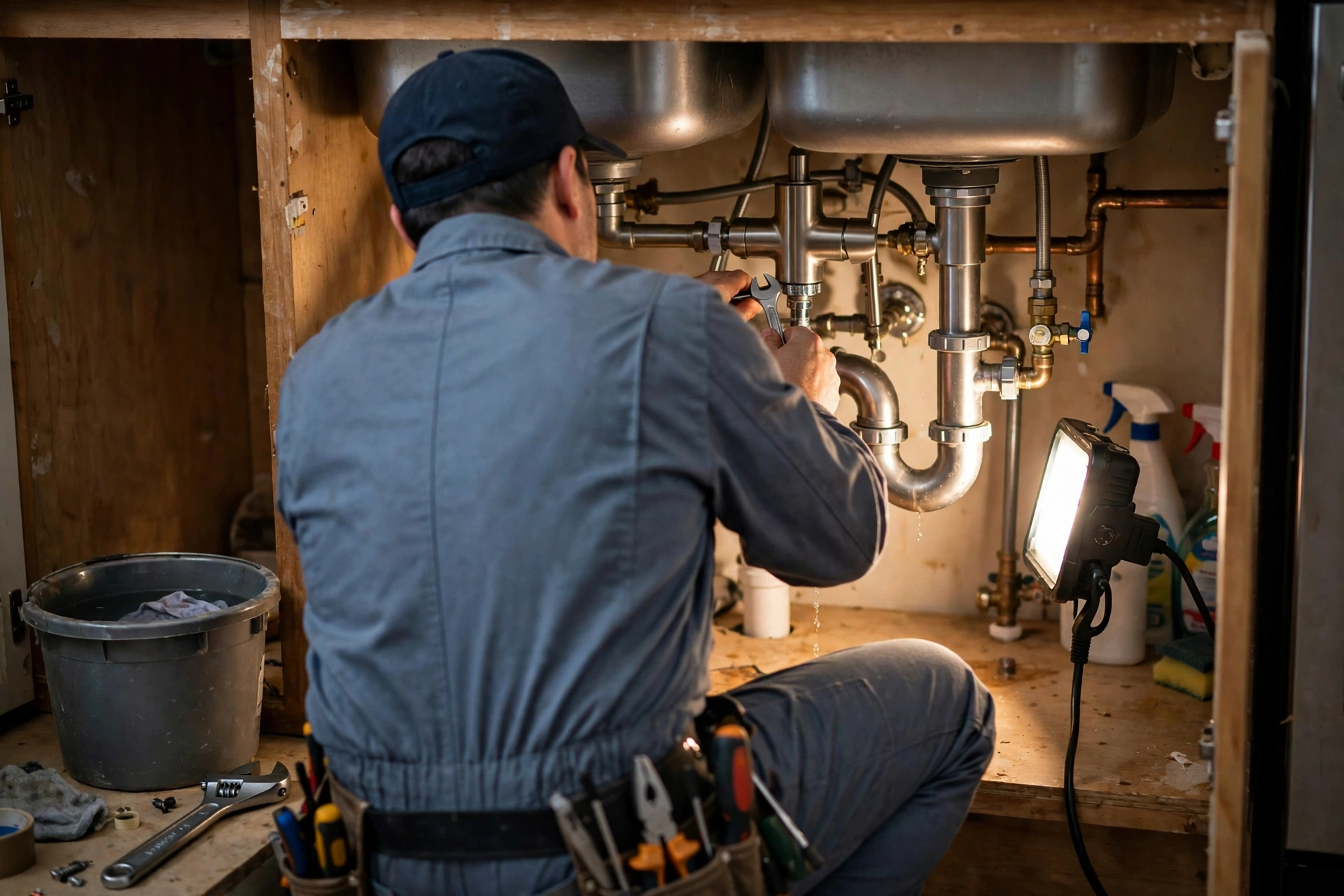
How Much Will a Plumber Charge to Install a Faucet in 2026
How much will a plumber charge to install a faucet in 2026? Typically $100–$200 in labor for a standard faucet installation — a job that takes 30–60 minutes on site at a plumber’s hourly rate of $45–$130 per hour, plus a $50–$100 service-call fee where one applies. With the faucet supplied, a standard job totals $150–$600 installed, depending on the faucet you choose and what the plumber finds under the sink. A simple bathroom faucet swap on existing plumbing lands near the bottom of that range, while a touchless kitchen faucet or a wall-mounted faucet in an older home lands near the top. The exact charge depends on who does the work, how the job is priced, what type of faucet it is, where you live, and whether the supply lines or shut-off valves need replacing too.
A faucet installation is one of the shortest jobs a plumber does, which is why the labor charge is small compared with most plumbing work — but it is also a job where the details matter. The faucet itself is the biggest variable in the total: a budget faucet costs $50–$100, a mid-range faucet $100–$350, and a premium faucet $350–$500 or more, and the labor is roughly the same whichever one you pick. The condition of the plumbing underneath is the second variable: new supply lines cost $50–$150 in parts and labor, and a corroded shut-off valve that will not turn off can add an extra charge on top of the base install. This guide breaks down how much a plumber charges to install a faucet by faucet type, by faucet price tier, by pro type, and by region, explains exactly what the labor charge covers, lists the extras most likely to appear on the final bill, and shows how to keep the total down without ending up with a faucet that drips or wobbles on day one.
If you are comparing a labor-only figure with an all-in quote, the distinction matters. Some quotes bundle the faucet into the price and some do not, and a quote that looks expensive may simply include a better faucet. Our guide to plumber cost per hour breaks down what plumbers charge across all kinds of jobs, so you can judge whether a faucet quote is in line with the going rate in your area. If the faucet is part of a bigger kitchen project, our kitchen remodel cost calculator shows how a fixture swap like this fits into a full kitchen remodel budget.
Quick-answer table (typical 2026 faucet installation cost):
| Item | Typical cost |
|---|---|
| Plumber labor, standard faucet installation | $100–$200 |
| Plumber hourly rate | $45–$130 per hour |
| Time on site, standard installation | 30–60 minutes |
| Service-call / trip fee (where one applies) | $50–$100 |
| Handyman, all-in for a standard faucet | $100–$300 |
| Big-box contractor, basic installation | $92–$119 |
| Faucet unit, budget | $50–$100 |
| Faucet unit, mid-range | $100–$350 |
| Faucet unit, premium | $350–$500+ |
| Total installed, standard faucet with a mid-range unit | $150–$600 |
| New supply lines, parts and labor | $50–$150 |
| Shut-off valve replacement, parts and labor | $50–$150 |
| Total installed, touchless kitchen faucet | $350–$650 |
| Total installed, wall-mounted faucet | $350–$800+ |
| Labor warranty, licensed plumber | Usually 90 days to 1 year |
How Much Will a Plumber Charge to Install a Faucet — Hourly Rates and Pricing Models
A plumber charges for a faucet installation in one of three ways — by the hour, as a flat rate for the whole job, or with a service-call fee on top of the labor — and the model changes what you pay, what is included, and who carries the risk if the job runs long. Understanding the model before you book is the fastest way to know whether a quote is fair.
| Hourly pricing | Flat-rate pricing | Service-call fee + labor | |
|---|---|---|---|
| How it works | You pay per hour on site, plus parts | You pay one fixed price for the job, agreed in advance | A fixed trip fee plus hourly or flat labor |
| Typical labor, standard faucet installation | $100–$200 (at $45–$130 per hour for 30–60 minutes) | $100–$200, agreed before work starts | $50–$100 trip fee + $100–$200 labor |
| Who carries the risk of a slow job | You do — a corroded connection means more time | The plumber does — the price is fixed even if it runs long | Shared — the fee is fixed, the labor may be hourly |
| What’s included | Labor only; faucet and parts billed separately | Usually includes removal, mounting, connections, and testing | The trip fee covers travel and diagnosis; labor is separate |
| Best for | Clean, simple swaps that will clearly take under an hour | Jobs with unknown conditions — old plumbing, corrosion | Emergency or same-day calls, rural areas |
| Watch out for | A minimum charge — many plumbers bill a one-hour minimum | The flat rate may be padded to cover the worst case | The fee is sometimes waived if you accept the quote |
| How to compare | Ask for the hourly rate and a time estimate in writing | Ask for an itemized list of what the flat rate covers | Ask whether the fee is credited against the job |
Hourly pricing ($45–$130 per hour). Most independent plumbers charge $45–$130 per hour for faucet work, and a standard installation takes 30–60 minutes on site, which is how the labor lands at $100–$200. The hourly rate is the plumber’s wage plus overhead — truck, insurance, tools, and licensing — and it is why the same job costs more in a high-cost metro than in a small town. For context, the U.S. Bureau of Labor Statistics reports a median wage of $30.67 per hour for plumbers, pipefitters, and steamfitters — the rate a customer pays is higher because it includes the business costs on top of the wage. With hourly pricing, a clean 30-minute swap at $100 per hour costs $100 in labor, which is the cheapest possible outcome; a one-hour job at $130 per hour costs $130; a job where the old faucet is seized and the shut-off valves are corroded can run past an hour and toward $200. Many plumbers also have a one-hour minimum, so a 30-minute job may still be billed as a full hour. Before you agree to hourly pricing, ask for the hourly rate, the estimated time, whether there is a minimum charge, and whether a service-call fee applies.
Flat-rate pricing ($100–$200 for a standard installation). With flat-rate pricing you agree on one price before the work starts — typically $100–$200 for a standard faucet installation from an independent plumber, and $92–$119 for a basic installation through a big-box contractor. The price is fixed even if the job takes two hours instead of one, so the risk of a slow job sits with the plumber, not with you. That certainty is worth something on an older faucet where the condition under the sink is unknown until the old faucet comes off. The trade-off is that a flat rate is usually priced for the average job, not the easiest one: a 30-minute swap that would cost $100 hourly may be quoted at $150 flat, because the plumber is pricing in the chance of a seized mounting nut. If your job is clearly simple — a faucet installed five years ago, no leaks, easy access, working shut-off valves — hourly pricing is usually cheaper. If the faucet is twenty years old and the cabinet shows water stains, flat-rate pricing is usually the safer bet.
Service-call fee ($50–$100). A service-call or trip fee of $50–$100 is a separate charge that covers the plumber’s travel and diagnosis, and it is the line item that most often surprises homeowners on a small job. Some plumbers fold it into the labor; others list it separately; and some waive it entirely if you accept the quote and have the work done on the same visit. The fee is most common on emergency or same-day calls and in rural areas where the drive is long. Always ask whether the quote includes a service-call fee before you book, because a $100 labor quote plus a $100 service-call fee is a $200 job, not a $100 one. On a $100–$200 labor job, the fee can nearly double the bill — which is also why bundling a faucet installation with other plumbing work on the same visit is one of the best ways to save money.
Which model should you choose? Ask for both. A plumber who quotes $150 flat and $100 per hour with a 30-minute estimate is telling you the job should take half an hour and the flat rate includes a cushion for trouble. If the job really is simple, take the hourly price; if the cabinet looks rough, take the flat rate and sleep better. Either way, get the quote in writing with the removal, the faucet, the supply lines, the shut-off valves, and the leak test each named — a quote that does not list them is not a quote you can compare. And remember that the pricing model only covers labor: the faucet at $50–$500 is separate either way, and new supply lines at $50–$150 are usually a separate line no matter how the labor is priced.
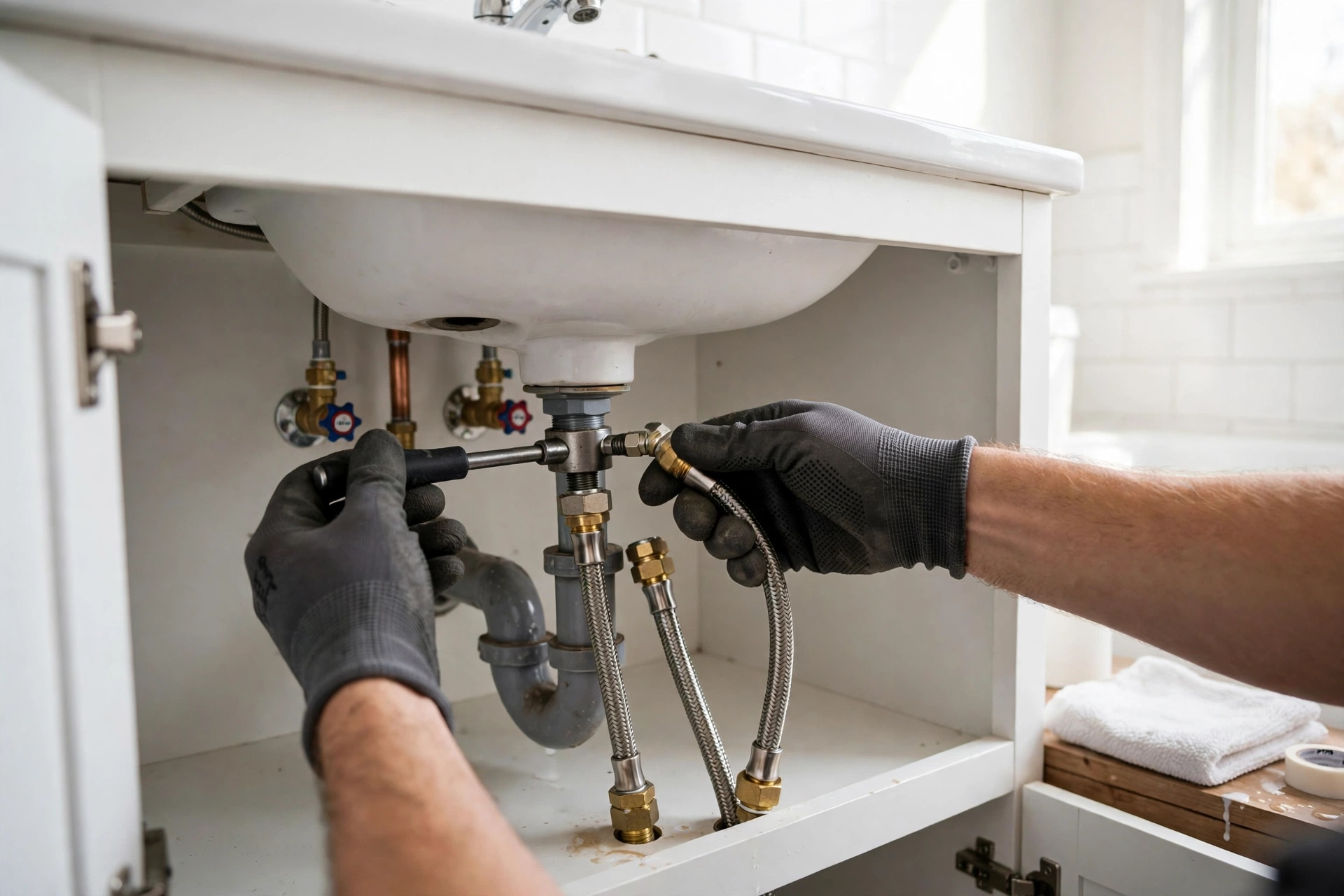
Faucet Installation Cost by Faucet Type
The type of faucet is the biggest driver of the total installed price, because different faucets take different amounts of time to fit and need different parts. A single-hole bathroom faucet is a 30-minute job; a wall-mounted faucet can mean opening up the wall. Here is the full breakdown for a standard installation with the faucet supplied:
| Faucet type | Typical total installed | Labor | Faucet unit | Notes |
|---|---|---|---|---|
| Single-hole bathroom faucet | $150–$350 | $100–$200 | $50–$150 | Simplest install; one hole, one handle |
| Centerset bathroom faucet | $150–$300 | $100–$200 | $50–$125 | Handles and spout on one base, 4-inch spread |
| Widespread bathroom faucet | $250–$450 | $100–$200 | $100–$300 | Three separate pieces, 8–16 inch spread |
| Pull-down kitchen faucet | $200–$450 | $100–$200 | $100–$300 | High-arc spout with pull-down sprayer |
| Touchless kitchen faucet | $350–$650 | $100–$200 | $250–$450 | Sensor and battery or power connection |
| Wall-mounted faucet | $350–$800+ | $200–$400 | $150–$400+ | Rough-in inside the wall; most labor-intensive |
| Tub / shower faucet | $250–$575 | $150–$300 | $100–$275 | Valve work behind the wall adds time |
| Outdoor hose bib | $150–$400 | $100–$200 | $50–$200 | Frost-free models cost more to fit |
Single-hole bathroom faucet ($150–$350 installed). A single-hole faucet is the simplest installation: one hole in the sink deck, one handle, one set of connections. The faucet unit costs $50–$150, and the labor is the standard $100–$200 for 30–60 minutes of work. This is the cheapest faucet job you can have, and it is the one most likely to land at the bottom of the $150–$600 total range. If your sink has one hole, this is the faucet to buy — and if it has three holes, a deck plate can cover the extra holes so a single-hole faucet still fits.
Centerset bathroom faucet ($150–$300 installed). A centerset faucet — spout and handles on a single base, with the handles 4 inches apart — is the most common bathroom faucet in American homes, and the installation is almost as simple as a single-hole faucet. The unit costs $50–$125, the labor is the standard $100–$200, and the total lands at $150–$300. Moen’s own lavatory faucet guide explains how to tell a centerset from a widespread faucet by measuring the distance between the handle holes — 4 inches means centerset, 8–16 inches means widespread — and getting that measurement right before you buy is the difference between a 30-minute install and a return trip to the store.
Widespread bathroom faucet ($250–$450 installed). A widespread faucet has three separate pieces — spout and two handles — spread 8–16 inches apart, and the installation takes longer because each piece is mounted and connected separately. The unit costs $100–$300, the labor is still typically $100–$200 but toward the top of that range, and the total lands at $250–$450. Widespread faucets are the standard choice for a larger vanity or a remodel where the sink deck has room for the spread, and they are the faucet type where buying a quality unit matters most — a cheap widespread faucet with three separate connections is three chances for a slow leak.
Pull-down kitchen faucet ($200–$450 installed). A pull-down kitchen faucet — high-arc spout with a spray head that pulls down into the sink — is the most common kitchen faucet today, and the installation is a standard 30–60 minute job. The unit costs $100–$300, the labor is the standard $100–$200, and the total lands at $200–$450. The extra work over a bathroom faucet is the sprayer hose, the counterweight under the sink, and the extra connections, all of which are straightforward for a plumber but fiddly for a first-timer. A pull-down faucet with a soap dispenser or a side sprayer adds one more hole and a little more time, but the labor stays in the same $100–$200 range.
Touchless kitchen faucet ($350–$650 installed). A touchless faucet — sensor-activated, hands-free — costs more to install because of the electronics: a sensor, a solenoid valve, and a battery pack or a power connection under the sink. The unit costs $250–$450, the labor is $100–$200, and the total lands at $350–$650. The plumber has to mount the control box, connect the sensor, and test the activation range, which adds 15–30 minutes to the job. If the faucet needs mains power rather than batteries, an electrician may be needed, which is a separate charge. Touchless faucets are the most expensive standard kitchen faucet to install, and the premium is entirely in the unit and the electronics — the plumbing itself is the same as any other kitchen faucet.
Wall-mounted faucet ($350–$800+ installed). A wall-mounted faucet is the most labor-intensive faucet to install, because the valve and the supply lines sit inside the wall rather than under the sink. If the rough-in is already there — the valve and the pipes are in the wall and the new faucet matches them — the labor is $200–$400 and the total lands at $350–$800+. If the rough-in is not there, the wall has to be opened, the pipes rerouted, and the wall repaired, and the total can pass $800 easily. Wall-mounted faucets are a remodel choice, not a simple swap, and the installation should be priced as part of the remodel, not as a standalone job. If you are planning a bathroom remodel around a wall-mounted faucet, our kitchen remodel cost calculator is for kitchens — but the same principle applies: a wall-mounted faucet is a project cost, not a fixture cost.
Tub / shower faucet ($250–$575 installed). A tub or shower faucet — a valve and trim behind the wall, with a spout and showerhead — costs more to install than a sink faucet because the valve work is behind the wall and the access is tighter. The unit costs $100–$275, the labor is $150–$300, and the total lands at $250–$575. A trim-only swap, where the valve body stays in the wall and only the visible parts change, is a $100–$200 labor job; a full valve replacement, where the wall has to be opened, is the job that lands at the top of the range. If the access panel behind the shower is already there, the labor stays near the bottom of the range; if there is no access panel, opening the wall adds time and cost.
Outdoor hose bib ($150–$400 installed). An outdoor hose bib — the faucet on the outside wall of the house — is a $100–$200 labor job with a unit cost of $50–$200, for a total of $150–$400. A frost-free hose bib, which is the right choice in cold climates because the valve sits inside the heated wall, costs more to fit than a standard hose bib because the pipe has to reach through the wall to the valve. A leaking hose bib that has frozen and split is the most common reason for this job, and the replacement is usually straightforward — unless the pipe inside the wall is damaged too, in which case the labor moves toward the top of the range.
Cost by Faucet Price Tier
The faucet itself is the biggest variable in the total installed price, and the labor is roughly the same whichever tier you buy. That means the tier you choose sets the total — a budget faucet keeps the job near $150, and a premium faucet pushes it toward $600.
| Faucet price tier | Faucet unit | Labor | Typical total installed |
|---|---|---|---|
| Budget faucet | $50–$100 | $100–$200 | $150–$300 |
| Mid-range faucet | $100–$350 | $100–$200 | $200–$500 |
| Premium faucet | $350–$500+ | $100–$200 | $450–$600+ |
Budget faucet ($50–$100 for the unit). A budget faucet costs $50–$100 for the unit, plus $100–$200 in labor, for a total of $150–$300 installed. Budget faucets are usually chrome-plated plastic or lightweight brass with a plastic cartridge, and they work fine — but the cartridge is the part that wears out first, and a budget cartridge can start dripping within a few years. If the faucet is for a rental, a guest bathroom, or a home you plan to sell soon, a budget faucet is a sensible choice. If it is for a kitchen or a bathroom you use every day, the mid-range tier is usually the better buy for the extra $50–$250, because the labor is the same either way and the better cartridge is the only difference in the bill.
Mid-range faucet ($100–$350 for the unit). A mid-range faucet costs $100–$350 for the unit, plus $100–$200 in labor, for a total of $200–$500 installed. This is the tier where most homeowners land: solid brass construction, a ceramic disc cartridge that lasts for years, a good warranty from a major brand like Moen or Delta, and a choice of finishes — chrome, brushed nickel, matte black — that actually match the rest of the room. A mid-range faucet is the sweet spot for most kitchens and bathrooms: enough quality to last, a price that keeps the total under $500 in most cases, and a wide choice of models. For a standard job with a mid-range faucet, budget $150–$600 installed and expect to land in the middle of that range.
Premium faucet ($350–$500+ for the unit). A premium faucet costs $350–$500 or more for the unit, plus $100–$200 in labor, for a total of $450–$600+ installed. Premium faucets are solid brass throughout, with ceramic disc cartridges, high-end finishes like oil-rubbed bronze or brushed gold, and features like touchless activation or a magnetic docking sprayer. The price premium over a mid-range faucet is real, but so is the difference in feel and in how long the finish lasts. If the faucet is the centerpiece of a new kitchen or a remodeled bathroom, the premium tier is the reason to spend the extra money — and remember that the labor is the same, so the whole premium is in the faucet itself. A premium faucet over $500 pushes the total past $600, which is why the $150–$600 total range in this guide is for a standard job with a mid-range faucet, not for a luxury fixture.
The labor share of the bill. On a budget faucet the labor is the bigger share — $100–$200 of labor against a $50–$100 faucet — while on a premium faucet the unit dominates. That is why the labor figure matters most on a cheap faucet: a $50 labor difference is a third of the total on a budget job and a tenth of it on a premium one. It is also why buying the faucet yourself, on sale, is the most effective way to cut the total: the labor is what it is, but the faucet price is entirely your choice.
Labor Cost by Pro Type: Plumber vs. Handyman vs. Big-Box Contractor
Who you hire is the single biggest driver of the labor cost to install a faucet, because each type of pro prices the same job differently — and each one brings a different level of license, warranty, and speed. Here is the full comparison for a standard faucet installation:
| Pro type | Typical labor / all-in | Hourly rate | Time on site | Warranty | Best for |
|---|---|---|---|---|---|
| Licensed plumber | $100–$200 labor | $45–$130 per hour | 30–60 minutes | Usually 90 days to 1 year | Any faucet, corroded plumbing, urgent jobs |
| Handyman | $100–$300 all-in | $40–$75 per hour | 30–60 minutes | Varies, often 30–90 days | Simple like-for-like swaps on a tight budget |
| Big-box contractor (Lowe’s / Home Depot) | $92–$119 basic | Flat rate, not hourly | 30–60 minutes | 1-year labor warranty | One-stop purchase with a warranty |
Licensed plumber ($100–$200 labor). A local licensed plumber is the most common choice, and the labor range is the widest because it depends on the plumber’s hourly rate — typically $45–$130 per hour — and on whether the job is billed hourly or as a flat rate. At $45 per hour for a 30-minute swap, the labor lands near $100; at $130 per hour for a one-hour job with a corroded shut-off valve, it lands near $200, and in a high-cost metro area the top of the range can be higher still. The plumber is the fastest option for an urgent job — a faucet that is leaking into the cabinet and needs to come out today — and the best option when the plumbing under the sink is unusual, corroded, or needs reconfiguration, because the plumber can price and fix the whole job in one visit instead of referring the supply-line work to someone else. The trade-off is that the warranty is whatever the plumber offers, usually 90 days to 1 year, so get it in writing before the work starts. For context on what plumbers charge across other jobs, see our guide to plumber cost per hour.
Handyman ($100–$300 all-in). A handyman is the cheapest labor option for a straightforward swap, typically charging $40–$75 per hour for a job that takes 30–60 minutes, which puts the all-in price at $100–$300 with a budget or mid-range faucet. That saving is real, but it comes with limits. A handyman is a good fit when the old faucet comes off cleanly, the new one is the same configuration, the supply lines are in good shape, and the shut-off valves work — in other words, a true like-for-like swap with no surprises. A handyman is not the right hire when the mounting nuts are seized, the supply lines are corroded, the shut-off valves will not turn off, or the faucet is wall-mounted: most handymen are not licensed plumbers, and in many jurisdictions they are not permitted to do plumbing work that involves the supply system at all. The warranty is also thinner — often 30 to 90 days, if one is offered in writing at all. If the job turns out to be more than a simple swap, a handyman may have to stop halfway and call a plumber anyway, and you will have paid for two visits. Use a handyman only for a clean, simple replacement, and only if the handyman is insured.
Big-box contractor ($92–$119 basic). Hiring through Lowe’s or Home Depot means the work is done by a licensed local third-party contractor, not by store employees, and the labor is a flat rate of $92–$119 for a basic faucet installation. The price is narrower than a plumber’s range because it is a set package price rather than an hourly rate, and it comes with a 1-year labor warranty — the strongest warranty of the three routes. Scheduling takes a few days to a week, because the contractor contacts you after you buy the faucet and add installation at checkout, so this is not the route for a leaking faucet that needs to come out today. The faucet is bought separately at $50–$500, and the same extras apply as with any pro: new supply lines at $50–$150, a shut-off valve replacement at $50–$150. The basic rate covers a standard installation only — a wall-mounted faucet, a touchless faucet, or a job that needs new supply lines is priced as an upgrade.
Which pro is cheapest? For a clean, simple swap, a big-box contractor at $92–$119 is usually cheapest, a handyman at $100–$300 all-in sits in the middle, and a plumber at $100–$200 in labor can be cheapest or most expensive depending on the hourly rate and how long the job takes. The right question is not only which quote is lowest, but which quote covers the job you actually have. A $92 big-box quote that does not include new supply lines is not cheaper than a $200 plumber quote that does — it is just incomplete. Get each quote in writing, with the removal, the faucet, the supply lines, the shut-off valves, and the leak test each listed, and compare like with like.
Faucet Installation Cost by Region
Labor is local, and the same 30-minute faucet swap costs noticeably more in a high-cost metro area than in a smaller market, because the plumber’s hourly rate follows local wages, fuel, insurance, and overhead. The national typical range of $100–$200 for a standard installation breaks down roughly like this by region:
| Region | Plumber hourly rate | Typical labor, standard installation | Total installed, mid-range faucet |
|---|---|---|---|
| Northeast (New York, Boston, Washington DC) | $90–$130 per hour | $150–$200 | $250–$600 |
| West Coast (California, Seattle, Portland) | $85–$130 per hour | $140–$200 | $240–$600 |
| Midwest (Chicago, Minneapolis, Cleveland) | $60–$100 per hour | $100–$170 | $200–$500 |
| South (Atlanta, Dallas, Charlotte, Nashville) | $50–$90 per hour | $100–$160 | $200–$450 |
| Southeast / Gulf Coast | $50–$85 per hour | $100–$150 | $200–$450 |
| Mountain West (Denver, Phoenix, Salt Lake City) | $55–$100 per hour | $110–$180 | $210–$500 |
| Rural / small-town markets | $45–$75 per hour | $100–$150 | $150–$400 |
High-cost metros ($140–$200 labor). In the Northeast and on the West Coast, plumbers commonly charge $85–$130 per hour, so even a straightforward 30–60 minute swap lands at $140–$200 in labor, and a job with corroded supply lines or a seized shut-off valve can push past $200. Service-call fees of $50–$100 are also more common in these markets — sometimes folded into the labor and sometimes listed separately, so ask whether the quote includes one. The total installed price with a mid-range faucet in these markets typically runs $240–$600.
Mid-cost markets ($100–$180 labor). In the Midwest and the Mountain West, hourly rates of $55–$100 per hour put a standard installation at $100–$180 in labor, with a total installed price of $200–$500 for a mid-range faucet. These are the markets where the national typical range of $100–$200 fits most neatly, and where a flat-rate quote of $92–$119 from a big-box contractor is often competitive with an independent plumber.
Lower-cost markets ($100–$160 labor). In much of the South and in rural and small-town markets, plumbers charge $45–$90 per hour, so a standard installation lands at $100–$160 in labor and $150–$450 installed with a mid-range faucet. A handyman in these markets can be cheaper still, because handyman rates of $40–$75 per hour go further where the cost of living is lower. Even here, though, the extras are the same: new supply lines cost $50–$150 in parts and labor, and a shut-off valve replacement costs $50–$150 wherever you live, because the parts and the work are the same no matter what the local labor rate is.
How to use these numbers. Regional ranges are a starting point, not a quote. The only number that matters for your sink is the written quote for your address, and the cheapest way to know whether it is fair is to get two: one from a plumber and one from a big-box contractor or a handyman. If both land inside the range for your region, the price is fair; if one is far outside it, ask what it includes that the other does not.
What’s Included in a Faucet Installation — and What’s Not
A standard labor charge of $100–$200 covers the core work of swapping one faucet for another on existing plumbing. The trouble starts at the edges of that charge, where the items most likely to be needed are priced as extras. Before you book, know exactly where the line falls:
| Task | Included in standard labor? | Notes |
|---|---|---|
| Shutting off the water | Included | Shut-off valves closed, water drained before work starts |
| Removal of the old faucet | Included | Unmounting the old faucet from the sink or countertop |
| Haul-away / disposal of the old faucet | Included in most quotes | Confirm in writing — a local dump fee may apply in some areas |
| Cleaning the sink deck area | Included | Old plumber’s putty and caulk removed, deck surface cleaned |
| Mounting the new faucet | Included | New faucet fitted to the existing holes, mounting nuts tightened |
| Connecting the supply lines | Included | Connection to the existing supply lines where they are in good shape |
| Connecting the drain and sprayer hose | Included | Drain and sprayer connections where the faucet has them |
| Leak testing | Included | Installer runs water and checks every connection before leaving |
| Testing the faucet under normal use | Included | Runs hot and cold, checks the sprayer and the shut-off valves |
| Cleanup of the work area | Included | Cabinet wiped down, old parts removed |
| Labor warranty, 90 days to 1 year (plumber) / 1 year (big-box) | Included | Covers defects in the installation |
| The faucet itself | Not included | Purchased separately, $50–$500 by type and tier |
| New supply lines | Not included | $50–$150 extra in parts and labor |
| Shut-off valve replacement | Not included | $50–$150 extra in parts and labor |
| New sink deck or countertop holes | Not included | Priced per job — drilling a new hole in stone or quartz costs extra |
| Wall work for a wall-mounted faucet | Not included | $200–$400 in labor, or more if the rough-in is not there |
| Touchless sensor power connection | Not included | Battery pack included with most units; mains power is a separate charge |
| Drain clearing | Not included | Priced per job if a slow or clogged drain is found |
| Permit | Not included | Rarely required for a like-for-like faucet swap |
Removal and mounting. Removing the old faucet is part of the labor charge: the plumber shuts off the water, disconnects the supply lines, unmounts the faucet from the sink deck, and carries the old faucet away. Haul-away is included in most quotes, but confirm it in writing. A faucet is small and light compared with a garbage disposal, so removal is quick work — unless the mounting nuts are seized. On a faucet that has been leaking slowly for years, the mounting nuts rust to the sink deck, and nuts that should twist off in minutes can take half the job’s time to free, which is why a corroded faucet adds time and can push the labor toward the top of the $100–$200 range.
Connections and supply lines. The core of the labor is mounting the new faucet, connecting the supply lines, and connecting the drain and the sprayer hose where the faucet has them. On a like-for-like swap this is straightforward and takes 30–60 minutes; on a faucet that is a different configuration from the old one — a single-hole faucet replacing a centerset, or a widespread faucet replacing a single-hole — the sink deck may need a deck plate or new holes, and the supply lines may need to be a different length. New supply lines cost $50–$150 in parts and labor and are the most common extra on a faucet installation, because supply lines are cheap parts that wear out — a braided stainless line lasts longer than a plastic one, but either one can corrode or kink, and a plumber who finds a corroded line will recommend replacing it rather than reconnecting a part that may fail.
Testing — the step that separates a pro from a rushed job. A proper labor charge includes leak testing and a test run under normal use: the plumber runs hot and cold water, checks the supply-line connections, the faucet base, and the shut-off valves for drips, then runs the sprayer and checks that the water switches cleanly between the spout and the sprayer. That test takes ten minutes and it is the reason the labor charge buys peace of mind: a slow leak at a supply line rots a cabinet floor over months, and it is only caught by testing before the plumber leaves. If the plumber packs up without running water and checking every joint, the job is not finished — say so before they leave.
What the labor charge never includes. The faucet itself is never included in a labor-only quote — it is bought separately at $50–$500 — and neither are new supply lines, a new shut-off valve, or wall work for a wall-mounted faucet. That is not a hidden charge; it is how the trade prices the work. The surprise comes only when the quote does not say so. A written quote that lists removal, mounting, connections, testing, and haul-away as included, and the faucet, the supply lines, and the shut-off valves as separate lines, is a quote you can trust.
What Drives the Cost of a Faucet Installation
The base labor of $100–$200 is the starting point, not the final price. Here is what moves the bill up or down, and by how much:
| Cost driver | Effect on the price | Notes |
|---|---|---|
| Faucet type | $150–$800+ total | A single-hole faucet is a 30-minute job; a wall-mounted faucet can mean opening the wall |
| Faucet price tier | $50–$500+ for the unit | Budget $50–$100, mid-range $100–$350, premium $350–$500+ |
| Who does the work | $92–$200 labor | Big-box $92–$119, plumber $100–$200, handyman $100–$300 all-in |
| Region | $100–$200 labor | $45–$75 per hour in rural markets, $85–$130 per hour in high-cost metros |
| Service-call fee | $50–$100 | Applies where one is charged; often waived if you accept the quote |
| Corroded mounting nuts or connections | Up to $50–$100 extra labor | A seized nut can add 30 minutes to the job |
| New supply lines | $50–$150 | Most common extra; braided stainless lines last longer |
| Shut-off valve replacement | $50–$150 | A valve that will not turn off must be replaced before the faucet can be fitted |
| Touchless or electronic features | $250–$450 for the unit | Sensor, solenoid valve, and battery or power connection add time |
| Wall-mounted or tub / shower faucet | $200–$400 labor | Valve work behind the wall adds time and access work |
| Same-day or emergency call | $50–$100 service-call fee, sometimes more | Urgent jobs cost more than a booked visit |
| Access | Up to $50 extra labor | A cramped cabinet or a pedestal sink slows the work |
The faucet you choose. The faucet is the single biggest cost driver, and it is the one you control completely. A budget faucet at $50–$100 keeps a standard job at $150–$300 installed; a premium faucet at $350–$500+ pushes the same job to $450–$600+. The labor is the same either way, so the faucet choice is the lever that moves the total most. Buy the faucet yourself, on sale, and you keep that lever in your own hands.
The condition under the sink. The second-biggest driver is what the plumber finds when the old faucet comes off. Corroded mounting nuts, corroded supply lines, and shut-off valves that will not turn off are the three most common surprises, and each one adds time or parts. New supply lines cost $50–$150, a shut-off valve replacement costs $50–$150, and a seized mounting nut can add 30 minutes of labor. If the faucet is more than fifteen years old, or the cabinet shows water stains, mention it when you call so the plumber brings the parts and prices the extra honestly instead of discovering it mid-job.
The pricing model. Hourly pricing at $45–$130 per hour rewards a fast, clean job and punishes a difficult one; flat-rate pricing at $100–$200 fixes the price no matter how long the job takes; and a service-call fee of $50–$100 can nearly double a small job if it is listed separately. The model you agree to matters as much as the rate — a $100 hourly quote with a $100 service-call fee is a $200 job, and a $150 flat-rate quote with no fee is cheaper than it looks.
A real-world example. One homeowner’s standard kitchen faucet installation cost $150 for the labor plus a $200 mid-range pull-down faucet, for a $350 total — and the total reached $450 once corroded supply lines were found, adding $50–$150 in parts and labor. That is the most common story in customer reports: the base labor price is real, and one small extra on top of it is normal. Budget the base labor plus $50–$150 for the most likely extra, and you will rarely be surprised.
DIY vs. Hiring a Plumber to Install a Faucet
| DIY | Hiring a plumber | |
|---|---|---|
| Faucet unit cost | $50–$500 by type and tier | Same — you buy the faucet either way |
| Installation labor | $0 | $100–$200 (plumber) / $100–$300 all-in (handyman) / $92–$119 basic (big-box) |
| Supply lines | $50–$150 in parts, if you can do it | $50–$150, done by the pro |
| Shut-off valve replacement | $50–$150 in parts, if you can do it | $50–$150, done by the pro |
| All-in total, standard installation | $50–$500 in parts | $150–$600 |
| All-in total, wall-mounted faucet | Not a DIY job | $350–$800+ |
| Time required | 1–3 hours for a first-timer on a swap | 30–60 minutes on site for a standard installation |
| Tools needed | Basin wrench, adjustable wrench, plumber’s putty, bucket, flashlight | Included in the labor price |
| Plumbing safety | A bad seal leaks slowly into the cabinet — check for drips for a week | Pro leak-tests before leaving |
| Water damage risk | A cross-threaded supply line can flood a cabinet | Licensed pro, insured, tested before leaving |
| Warranty | None — mistakes are on you | 90 days to 1 year (plumber) / 1 year (big-box) |
| Best for | A confident DIYer doing a like-for-like swap | Corroded connections, wall-mounted faucets, touchless faucets, or anyone who wants a warranty |
A like-for-like replacement is a fair DIY job. If a faucet already exists, the new one is the same configuration, the supply lines are in good shape, and the shut-off valves work, a confident DIYer can swap a faucet in 1–3 hours with basic tools: a basin wrench for the mounting nuts under the sink, an adjustable wrench for the supply lines, plumber’s putty for the base, and a bucket for the water in the lines. The saving is the whole labor charge — $100–$200 for a plumber, $100–$300 all-in for a handyman, $92–$119 through a big-box contractor — and the risk is a slow leak at a supply line or the faucet base, so check under the sink for drips every day for a week after the job. If the mounting nuts are seized, or the shut-off valves will not turn off, stop and call a pro: a seized nut is how sinks get cracked, and a valve that will not shut off means you cannot stop the water if something goes wrong.
A corroded faucet is not a DIY job. The line between a fair DIY swap and a job for a pro is corrosion. A mounting nut that twists off cleanly is a DIY job; a nut that is rusted to the sink deck is a pro job, because the force needed to free it can crack the sink, and the supply lines underneath are often corroded too. The extra labor for a corroded faucet is up to $50–$100 — a small price against a cracked sink or a flooded cabinet. If the old faucet is more than fifteen years old, or the cabinet shows water stains, get a pro quote before you start, even if you plan to do the work yourself.
A wall-mounted or touchless faucet is not a DIY job. A wall-mounted faucet means valve work inside the wall, and a touchless faucet means sensor wiring and a control box under the sink. Both are jobs for a licensed plumber, and a mistake inside a wall is a slow leak that rots framing over months, or a sensor that never works properly. The $100–$200 labor charge on a standard installation, or the $200–$400 labor charge on a wall-mounted faucet, buys a license, insurance, a leak test, and a warranty. If the faucet is part of a bigger kitchen project, our kitchen remodel cost calculator can show how the install fits into the wider budget.
The prep work you can do yourself. There are still useful ways to cut the labor bill without touching a pipe. Clear out the sink cabinet so the plumber can work without moving cleaning products — on hourly pricing, every minute of clearing is a minute you pay for. Buy the faucet yourself, on sale, so the pro charges labor only with no markup on the fixture. Check whether the shut-off valves turn before you call, and photograph the plumbing under the sink — a photo sent with your quote request gets you a tighter number. And run the old faucet one last time before the plumber arrives, so you can describe exactly what is wrong with it: a drip, a wobble, low pressure, or a handle that will not turn each point to a different fix.
Money-Saving Tips for Faucet Installation
1. Buy the faucet yourself, on sale. The faucet is the most controllable cost, and a mid-range faucet at $100–$350 goes on sale regularly. A $50 saving on the faucet is a $50 saving on the total — and buying it yourself means the pro charges labor only, with no markup on the fixture. A budget faucet at $50–$100 is the cheapest way to keep a standard installation near $150–$300. 2. Check the shut-off valves before you call. If the valves under the sink turn easily and shut the water off completely, say so when you call — the plumber can quote the $100–$200 standard installation instead of pricing for the worst case, and the job stays near the bottom of the $150–$600 range. A photo of the cabinet sent with your quote request gets you a tighter number. 3. Get three quotes: a plumber, a handyman, and a big-box contractor. A plumber runs $100–$200 in labor, a handyman $100–$300 all-in, and a big-box contractor $92–$119 basic, so quotes for the same job can differ by $50–$100 between providers — especially on a job with unknown conditions, where different pros price the risk differently. A five-minute phone call to one more pro is the cheapest way to know whether the first price is fair. Compare the written quotes line by line: removal, faucet, supply lines, shut-off valves, and testing should each be named. 4. Pick the mid-range faucet, not the premium one, unless you need it. A mid-range faucet at $100–$350 handles daily use for most households, and the premium faucet at $350–$500+ costs roughly $150–$250 more for a finish and features most kitchens never use — while the labor is identical. Spend the difference on new supply lines or a better shut-off valve instead. 5. Bundle the faucet with other plumbing work. If the plumber is already under the sink — replacing supply lines, fitting new shut-off valves, or installing a garbage disposal — adding a faucet to the same visit costs far less in labor than a separate trip, because the service-call fee of $50–$100 and the cabinet setup are paid for once. Ask for a bundled price when you call. 6. Replace the supply lines at the same time. New supply lines cost $50–$150 in parts and labor when the plumber is already there, and they are the part most likely to fail next. Replacing them during the faucet installation means one visit, one service-call fee, and no second leak — replacing them later means a second $100–$200 labor charge for a job that takes minutes. 7. Ask whether the service-call fee is waived. A $50–$100 service-call fee is often waived if you accept the quote and have the work done on the same visit, and it is almost never waived if you do not ask. One sentence on the phone — “Is the trip fee included in the quote, or waived if I go ahead today?” — can save you $50–$100 on a $100–$200 labor job. 8. Do not pay for a replacement you do not need. If the old faucet only drips, try replacing the cartridge first — a dripping faucet is often a worn cartridge, not a dead faucet, and a cartridge costs a fraction of a $150–$600 installation. If the handle is stiff, try cleaning the aerator and the cartridge before you call anyone. A service call to fix a drip still costs labor, but it costs far less than a full replacement. 9. Keep the old faucet’s configuration. A single-hole faucet replacing a single-hole faucet is a 30-minute job; a widespread faucet replacing a centerset faucet means new holes, a new deck plate, and more time. Matching the configuration of the faucet you already have keeps the labor at the bottom of the $100–$200 range and avoids a return trip to the store. 10. Time the job outside the busy season. Plumbers are busiest in spring and early summer, when renovation season peaks. A fall or winter booking can mean a faster start date and occasionally a better price, especially for a faucet installation that fills a half-day slot between bigger jobs.
Frequently Asked Questions
How much will a plumber charge to install a faucet?
In 2026, a plumber typically charges $100–$200 in labor to install a faucet, for a standard job that takes 30–60 minutes on site at $45–$130 per hour, plus a $50–$100 service-call fee where one applies. With the faucet supplied, a standard job totals $150–$600 installed, depending on the faucet you choose — a budget faucet at $50–$100 keeps the total near $150–$300, while a premium faucet at $350–$500+ pushes it toward $450–$600+. A handyman typically charges $100–$300 all-in for the same job, and a big-box contractor charges $92–$119 for a basic installation. New supply lines cost another $50–$150, and a shut-off valve replacement costs $50–$150.
How long does it take a plumber to install a faucet?
A standard faucet installation takes 30–60 minutes on site, including shutting off the water, removing the old faucet, mounting the new one, connecting the supply lines, and leak testing. A touchless faucet takes a little longer — around an hour — because of the sensor and the control box. A wall-mounted faucet takes 2–4 hours, because the valve work is inside the wall. A corroded faucet with seized mounting nuts can add 30 minutes, pushing the labor toward the top of the $100–$200 range. Scheduling a plumber typically takes a day or two; scheduling through a big-box contractor takes a few days to a week, because the contractor contacts you after you buy the faucet and add installation at checkout.
Does the plumber’s charge include the faucet?
No — the faucet is not included in a labor-only quote. You buy it separately, typically $50–$100 for a budget faucet, $100–$350 for a mid-range faucet, and $350–$500+ for a premium faucet. The $100–$200 labor charge covers the work only: removing the old faucet, mounting the new one, connecting the supply lines, testing for leaks, and hauling the old faucet away. Some quotes bundle the faucet and the labor into one all-in price of $150–$600 — always ask whether the quote includes the faucet, because a quote that looks expensive may simply include a better faucet.
Is it cheaper to hire a plumber or a handyman to install a faucet?
A big-box contractor is usually cheapest at $92–$119 for a basic installation, a handyman typically charges $100–$300 all-in, and a plumber charges $100–$200 in labor. But the handyman is only the right hire for a clean, simple like-for-like swap — no corrosion, no new supply lines, no shut-off valve work. A plumber is the better hire when the old faucet is corroded, the supply lines need replacing, the shut-off valves will not turn off, or the job is urgent, because the plumber is licensed, carries a warranty of usually 90 days to 1 year, and can handle the whole job in one visit. A big-box contractor at $92–$119 sits between the two on price and offers the strongest warranty, a full year. Get one quote from each and compare them line by line; the cheapest quote that does not include new supply lines is not cheaper than a higher quote that does.
What is not included in a faucet installation?
The standard labor charge of $100–$200 does not include the faucet itself ($50–$500), new supply lines ($50–$150), a shut-off valve replacement ($50–$150), new holes in the sink deck or countertop, wall work for a wall-mounted faucet ($200–$400 in labor), a mains power connection for a touchless faucet, or a permit — though a permit is rarely required for a like-for-like faucet swap. The most common surprise is the supply lines: if the old ones are corroded or kinked, replacing them costs $50–$150 and is billed as an extra. Get the quote in writing with each of these items listed, so you know what is included before the plumber arrives.
The Bottom Line
For how much a plumber will charge to install a faucet in 2026, budget $100–$200 in labor — a licensed plumber at $45–$130 per hour for 30–60 minutes on site, plus a $50–$100 service-call fee where one applies — plus $50–$500 for the faucet itself, for a complete job with a mid-range faucet at $150–$600 installed. A handyman can do the same swap for $100–$300 all-in, and a big-box contractor charges a flat $92–$119 for a basic installation with a 1-year labor warranty. The two things that set the price more than anything else are the faucet you choose and what the plumber finds under the sink: a budget faucet in a low-cost market lands near $150 installed, while a premium faucet in a high-cost metro can push past $600, and corroded supply lines add $50–$150 on top. A wall-mounted faucet runs $350–$800+ installed, because the valve work is inside the wall. The cheapest way to keep the bill down is to buy the faucet yourself on sale, check the shut-off valves before you call, ask whether the service-call fee is waived, and get three written quotes — a plumber, a handyman, and a big-box contractor — with the removal, the faucet, the supply lines, the shut-off valves, and the leak test each listed as its own line. And before you book a replacement at all, try replacing the cartridge: a dripping faucet is often a worn cartridge, not a $150–$600 job.
Prices are typical 2026 US ranges for planning purposes and vary by region, faucet choice, and site condition; get itemized local quotes for an exact project price.
12 thoughts on “How Much Will a Plumber Charge to Install a Faucet in 2026”