

How Much Does It Cost to Have Someone Install a Kitchen Sink in 2026
When homeowners ask how much does it cost to have someone install a kitchen sink, they usually want one honest number before they buy the sink: what will a pro charge to fit it, and what else will appear on the bill? The short answer is that having someone install a kitchen sink typically costs $380–$1,400 all in for a standard replacement in 2026, with the national average at $438, based on 1,438 verified projects. Labor alone usually runs $200–$500, the sink itself typically costs $150–$750, and old-sink removal adds $30–$150. The cheapest clean swap of a basic drop-in sink can land near $280, while a farmhouse sink that needs the countertop and cabinet cut can reach $4,000 or more. The gap between those two numbers is the whole point of this guide: the sink type, the material, and whether the plumbing already exists decide the bill far more than the installer’s hourly rate does.
That gap is also why the headline numbers you see online disagree with each other. Angi puts the national average at $438 with most homeowners paying $216–$663; HomeGuide puts a kitchen sink replacement at $380–$1,400 including the sink, labor, and removal; Airtasker puts the average at $416 with a typical range of $280–$1,400; and Thumbtack puts the national average at $230–$615. All four are describing the same job — the spread comes from what is counted. A labor-only quote of $200–$500 is not the same number as an all-in project of $380–$1,400, and a farmhouse sink is not the same job as a drop-in sink. This guide breaks the full project cost down the way a written quote does: the sink, the labor, the removal, the parts, and the extras, by scenario, by sink type, by material, and by who does the work — plumber, handyman, or a big-box store — so you can see the real number before anyone touches your countertop. For the faucet that usually goes in with the sink, see our guide to kitchen faucet installation cost, and for the disposal that shares the same drain, see our guide to how much should someone charge to install a garbage disposal.
Quick-answer table (typical 2026 cost to have someone install a kitchen sink):
| Item | Typical cost |
|---|---|
| National average, all in (Angi, 1,438 verified projects) | $438 |
| Typical range, all in (Angi / HomeAdvisor) | $216–$663 |
| Kitchen sink replacement, all in (HomeGuide) | $380–$1,400 |
| Typical range, all in (Airtasker) | $280–$1,400 |
| National average (Thumbtack) | $230–$615 |
| Plumber labor only | $200–$500 |
| Plumber hourly rate | $50–$200 per hour |
| New kitchen sink, typical | $150–$750 |
| New kitchen sink, full range | $50–$1,000 |
| Old sink removal | $30–$150 |
| Old sink removal and disposal, full range | $20–$300 |
| Kitchen sink and faucet together, all in | $600–$2,000 |
| Kitchen sink, faucet, and garbage disposal, all in | $800–$3,400 |
| Replace existing plumbing pipes | $100–$350+ |
| Install new plumbing pipes | $450–$1,800 |
| Pipe work, general range | $150–$800 |
| Time on site, standard replacement | 2–4 hours |
| Time on site, full range by sink type | 1–8 hours |
What Having Someone Install a Kitchen Sink Actually Includes
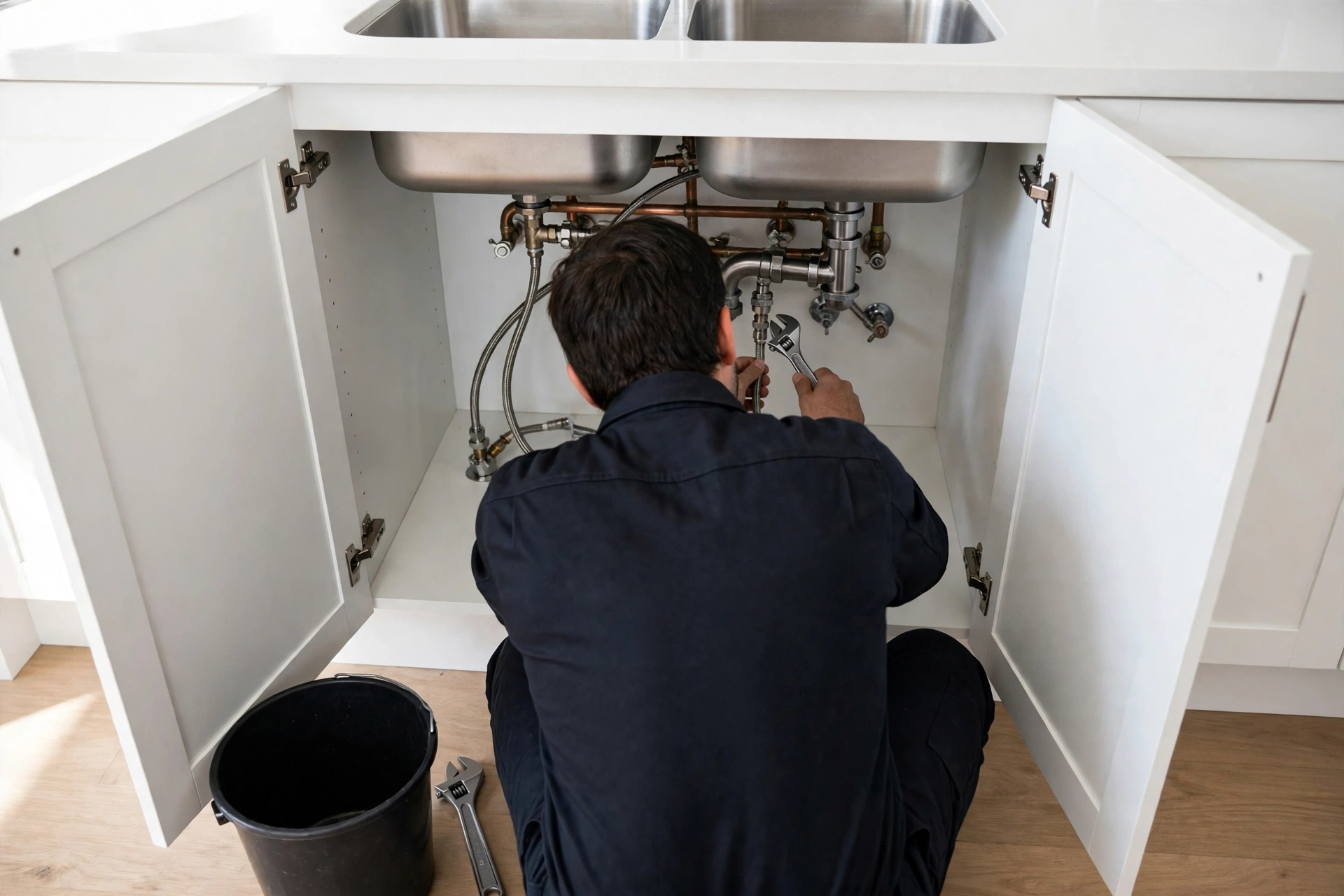
A professional kitchen sink installation is a short job with a fixed shape: the pro shuts off the water, disconnects the old sink, lifts it out, checks the opening and the plumbing underneath, sets the new sink in place, seals it, connects the water supply and the drain, reconnects the garbage disposal if there is one, and runs the water to check for leaks. On a clean replacement the whole job takes 2–4 hours, and the $200–$500 labor charge covers that work plus the trip. What the labor charge does not cover is the sink itself, the faucet, the disposal, or any plumbing the job uncovers — a corroded shut-off valve, a drain that needs rerouting, or pipes that need replacing. Those are the extras that move a $380 job toward $1,400, and they are priced per job, not by the hour.
| Task | Included in the typical $200–$500 labor? | Notes |
|---|---|---|
| Shutting off the water and disconnecting the old sink | Included | Water and drain disconnected, disposal disconnected where fitted |
| Removing the old sink | Included | Lifted out and set aside; disposal of the old sink is a separate line at $30–$150 |
| Checking the opening and the cabinet | Included | Opening measured, countertop edge checked, cabinet checked for water damage |
| Setting and sealing the new sink | Included | Sink set into the opening, sealed with silicone, clamped or supported from below |
| Connecting the water supply lines | Included | Hot and cold supply lines connected to the existing shut-off valves |
| Connecting the drain and trap | Included | Drain, trap, and tailpiece connected and checked for leaks |
| Reconnecting the garbage disposal | Included where one exists | Disposal reconnected to the new sink drain; a new disposal is a separate purchase |
| Reconnecting the faucet | Included where the faucet is reused | A new faucet is a separate purchase and is often fitted at the same visit |
| Leak test and run-through | Included | Water run through both basins, every connection checked before the pro leaves |
| Cleanup of the work area | Included | Cabinet wiped down, old parts gathered, packaging removed |
| The kitchen sink itself | Not included | You buy it: typically $150–$750, full range $50–$1,000 |
| The faucet | Not included | You buy it; a kitchen sink and faucet together run $600–$2,000 all in |
| The garbage disposal | Not included | You buy it; a sink, faucet, and disposal together run $800–$3,400 all in |
| Old sink removal and disposal | Not always included | $30–$150 where charged separately; $20–$300 across the full range |
| New supply lines or shut-off valves | Not included | Priced per job where the old ones are corroded or will not shut off |
| Pipe replacement or rerouting | Not included | $100–$350+ to replace existing pipes; $450–$1,800 to install new pipes |
| Countertop cutting | Not included | Priced per job; needed for a farmhouse sink or a different sink size |
| Cabinet modification | Not included | Priced per job where the cabinet must be cut or reinforced |
| Water damage repair under the sink | Not included | Priced per job where rot or a leak is found once the old sink comes out |
| Permit | Not included | Rarely needed for a like-for-like replacement; priced per job where required |
The sink itself is the biggest single line on the bill. A typical new kitchen sink costs $150–$750 before installation, and the full range runs $50–$1,000 — and that spread is the type and the material, not the store. A basic stainless steel drop-in sink can cost under $200; a composite undermount sink runs $300–$600; a fireclay farmhouse sink can cost $200–$3,500 for the sink alone. The labor to fit it runs $200–$500 in most markets, so the sink and the labor are roughly equal shares of a $380–$1,400 replacement — which is why comparing labor-only quotes without the sink price tells you almost nothing about the total. Buy the sink first, get the quote against that exact sink, and compare written quotes line by line: sink, labor, removal, parts, and any pipe work, each named separately.
How Much Does It Cost to Have Someone Install a Kitchen Sink by Scenario
The single biggest driver of what you actually pay is the scenario: a like-for-like replacement on existing plumbing is a short, predictable job priced inside the $380–$1,400 range, while a first-time installation in a new location is a half-day job that can involve a plumber, new pipes, and cabinet work, and is priced as custom work on top of that range. The table below gives the full project cost for each scenario — sink, labor, removal, and the likely extras — so the totals are comparable across scenarios instead of mixing labor numbers with all-in numbers. Every total in this table uses the same figures throughout: a typical sink at $150–$750, labor at $200–$500, and removal at $30–$150.
| Installation scenario | Sink | Labor | Removal | Likely extras | All-in total |
|---|---|---|---|---|---|
| Clean replacement, same size drop-in sink | $150–$750 | $200–$500 | $30–$150 | None | $380–$1,400 |
| Clean replacement, budget sink | $50–$200 | $200–$500 | $30–$150 | None | $280–$850 |
| Replacement with a new faucet fitted at the same visit | $150–$750 | $200–$500 | $30–$150 | Faucet $90–$600 | $600–$2,000 |
| Replacement with a new faucet and garbage disposal | $150–$750 | $200–$500 | $30–$150 | Faucet and disposal | $800–$3,400 |
| Replacement in an older kitchen, valve or pipe fixes | $150–$750 | $200–$500 | $30–$150 | Pipe work $100–$350+ | Above $380–$1,400 |
| Farmhouse sink, countertop and cabinet cut | $200–$3,500 | $200–$500 | $30–$150 | Countertop and cabinet work, priced per job | $1,000–$4,000+ |
| First-time installation, new location | $150–$750 | $200–$500 | None | New pipes $450–$1,800, plus cabinet work | Above $1,400; quoted per job |
| Undermount sink on a new countertop | $150–$1,000 | $200–$500 | $30–$150 | Countertop work where the cutout changes | $350–$1,500 |
Clean replacement ($380–$1,400 all in). A clean replacement is the cheapest kitchen sink job, because everything the installer needs is already there: the water supply lines, the shut-off valves, the drain, and an opening the new sink fits. The pro disconnects the old sink, lifts it out, sets the new one in, connects the water and drain, and tests for leaks — usually 2–4 hours on site. With a typical sink at $150–$750, labor at $200–$500, and removal at $30–$150, the project totals $380–$1,400, and the national average of $438 sits near the bottom of that range because most replacements use a mid-priced sink on working plumbing. A replacement with corroded supply lines or a seized shut-off valve lands near the top — and the difference is the plumbing, not the sink. The sink shares its water supply and drain with the faucet and the dishwasher, so a faucet that has been dripping or a dishwasher that drains slowly is often the first sign that the cabinet plumbing needs attention before a new sink goes in. For the faucet side of the same job, see our guide to how much will a plumber charge to install a faucet.
Replacement with a new faucet ($600–$2,000 all in). Most homeowners replace the faucet when they replace the sink, because the faucet is already disconnected and the cabinet is already open — and the combined job is cheaper than two separate visits. A kitchen sink and faucet together typically cost $600–$2,000 all in, against $380–$1,400 for the sink alone, so the faucet adds roughly $220–$600 to the project once its own price and the extra fitting time are counted. A faucet alone costs $90–$600 to install in most markets, with luxury models at $1,200 or more, so the combined quote is worth checking line by line: the faucet price and the extra labor should each be named, not folded into one number. If the faucet is the only thing being replaced and the sink stays, see our guide to kitchen faucet installation cost.
Farmhouse sink ($1,000–$4,000 all in). A farmhouse sink is the most expensive common kitchen sink to have installed, at $1,000–$4,000 including installation, because the job is not a swap: the front of the countertop and the cabinet must be cut so the apron front sits proud of the cabinet, and the cabinet often needs reinforcing to carry the weight of a fireclay or cast iron basin. The sink alone costs $200–$3,500, the labor runs above the standard $200–$500 once the cutting is counted, and the countertop work is priced per job. Get the countertop and cabinet work quoted in writing before you buy the sink — a farmhouse sink that does not fit the opening is a return, not a fitting.
First-time installation (quoted per job; above $1,400). A first-time installation costs more than a clean replacement because there is no sink plumbing to connect to: the pro has to run water lines, connect a drain, and fit a trap where none existed. New plumbing pipes alone run $450–$1,800, on top of the sink at $150–$750 and labor at $200–$500, so the project lands above the $380–$1,400 replacement range and is quoted per job. This is also the scenario where a sink is most often installed alongside a garbage disposal, because the disposal mounts to the sink drain — and a sink, faucet, and disposal together run $800–$3,400 all in. Get the itemized quote in writing before you buy the sink, and check whether a permit is required in your area for new plumbing.

Kitchen Sink Installation Cost by Sink Type
The type of sink changes the installation work, because different types mean different amounts of fitting. A drop-in sink drops into a cutout and seals from above; an undermount sink is glued and clamped underneath the countertop; a farmhouse sink needs the cabinet front cut; and a pedestal or vessel sink is a bathroom fitting, not a kitchen one, but is included here because homeowners compare them when they price a whole-house job. The table below gives the installed cost for each type, with the sink shown separately so the two are never confused. Where a type is priced per job rather than inside the standard $200–$500 labor range, the table says so.
| Sink type | Sink only | Installed total | Typical time on site | Notes |
|---|---|---|---|---|
| Drop-in / self-rimming | $60–$750 | $240–$1,250 | 2–3 hours | Easiest and cheapest to install; rim sits on the countertop |
| Undermount | $150–$1,000 | $250–$1,500 | 2–4 hours | Mounted under the countertop; needs a solid-surface or stone top |
| Farmhouse / apron-front | $200–$3,500 | $1,000–$4,000 | 4–8 hours | Cabinet front cut; cabinet reinforced for the weight |
| Bar sink | $100–$600 | $250–$1,000 | 2–3 hours | Small second sink; often fitted with the main kitchen sink |
| Utility sink | $100–$400 | $200–$500 | 1–3 hours | Laundry or garage sink; simplest plumbing of the types |
| Pedestal sink | $100–$500 | $300–$1,100 | 2–4 hours | Bathroom fitting; wall and floor fixings carry the basin |
| Vessel sink | $100–$800 | $250–$2,000 | 2–4 hours | Bathroom fitting; basin sits on top of the counter |
| Wall-mount sink | $100–$600 | $250–$1,050 | 2–4 hours | Bathroom or utility fitting; wall must carry the weight |
| Console sink | $150–$700 | $400–$1,250 | 2–4 hours | Bathroom fitting; legs and wall fixings share the load |
| Corner sink | $200–$800 | $480–$1,350 | 3–5 hours | Fitted into a corner cabinet; awkward access adds time |
Drop-in sink ($240–$1,250 installed). A drop-in sink costs $240–$1,250 installed, the cheapest kitchen sink job, because the sink drops into the existing cutout and seals from above — no countertop work, no cabinet cutting, and the same opening usually fits. The sink itself costs $60–$750, labor runs $200–$500, and the job takes 2–3 hours. The trade-off is the rim: it sits on top of the countertop, so crumbs and water collect around it and it needs re-sealing every few years. If the old sink was a drop-in of the same size, the new one is a straight swap and the job stays near the bottom of the $380–$1,400 replacement range.
Undermount sink ($250–$1,500 installed). An undermount sink costs $250–$1,500 installed, against $240–$1,250 for a drop-in, because the sink is mounted underneath the countertop and clamped and glued in place — which takes longer and needs a solid-surface, quartz, or granite top that can carry the fixings. The sink itself costs $150–$1,000, and the job takes 2–4 hours. The trade-off is the other way: the countertop edge is flush with the basin, so crumbs wipe straight into the sink and there is no rim to clean around. An undermount sink cannot be fitted to a laminate countertop, so check the countertop material before you buy — a laminate top means a drop-in sink, not an undermount.
Farmhouse sink ($1,000–$4,000 installed). A farmhouse sink costs $1,000–$4,000 installed, the most expensive common kitchen sink, because the apron front needs the countertop and the cabinet front cut, the cabinet usually needs reinforcing, and the sink alone costs $200–$3,500. The job takes 4–8 hours, at the top of the 1–8 hour range for sink installation, and the countertop and cabinet work is priced per job on top of the $200–$500 labor. Measure the cabinet before you buy — a standard farmhouse sink needs a 36-inch cabinet, and a smaller cabinet means a smaller sink or a cabinet rebuild.
Kitchen Sink Installation Cost by Material
The material decides the sink price, and the sink price is roughly half the project total — so the material decides the bill almost as much as the type does. Stainless steel is the cheapest common material and the easiest to fit; fireclay and copper are the most expensive and the heaviest, which adds labor. The table below gives the installed cost by material, using the same labor range of $200–$500 throughout so the materials are comparable.
| Sink material | Sink only | Installed total | Notes |
|---|---|---|---|
| Stainless steel | $100–$800 | $200–$1,500 | Cheapest common material; light, easy to fit, most common choice |
| Composite granite / quartz composite | $300–$600 | $300–$600 for the sink; $500–$1,100 installed | Heavy and hard-wearing; needs a solid fixing |
| Cast iron (enamel-coated) | $300–$900 | $200–$900 for the sink; $500–$1,400 installed | Very heavy; cabinet and countertop must carry the weight |
| Quartz | $800–$1,200 | $800–$1,200 for the sink; $1,000–$1,700 installed | Premium material; usually an undermount fitting |
| Fireclay | $200–$3,500 | $1,000–$4,000 installed as a farmhouse sink | The classic farmhouse material; heavy, needs cabinet work |
| Copper | $450–$4,000 | $400–$4,000 installed | Premium material; develops a patina; needs care with acidic foods |
| Glass | $400–$2,000 | $400–$2,000 installed | Bathroom vessel sinks; fragile, needs careful handling |
| Natural stone | $600–$2,500 | $800–$3,000 installed | Premium material; very heavy, needs a reinforced cabinet |
Stainless steel ($200–$1,500 installed). Stainless steel is the default kitchen sink material for a reason: the sink costs $100–$800, it is light enough to fit without cabinet work, it does not chip or crack, and it takes a drop-in or undermount fitting. A stainless steel sink at the bottom of its range with standard labor is the cheapest way to keep a replacement near the $380 end of the $380–$1,400 range. Check the gauge before you buy — an 18-gauge sink is thicker and quieter than a 22-gauge sink, and the price difference is small against the total.
Composite and cast iron ($500–$1,400 installed). Composite sinks cost $300–$600 for the sink and cast iron sinks cost $300–$900, and both are heavy enough that the fitting takes longer and the cabinet fixings matter more. A cast iron sink can weigh 100 pounds or more, so the cabinet must be sound and the countertop must carry the load — a cabinet with water damage underneath is a repair before it is a fitting. Both materials are hard-wearing and quiet, and both are a step up in price from stainless steel without reaching the premium materials.
Copper, quartz, and natural stone ($800–$4,000 installed). Copper sinks cost $400–$4,000 installed, quartz sinks $800–$1,200 for the sink alone, and natural stone sinks $600–$2,500 — and all three are premium choices where the sink is the design feature of the kitchen. The installation labor is the same $200–$500 in most cases, so the material is doing almost all of the work on the total: a copper farmhouse sink is a $1,000–$4,000 project because the sink is expensive, not because the fitting is. If the budget is tight, the material is the lever to pull — a stainless steel sink in the same size and type saves hundreds against the total without changing the labor at all.
Who Charges What: Plumber vs. Handyman vs. Home Depot vs. Lowes
The same kitchen sink can be fitted by four different routes, and the labor charge differs between them by more than $100 on the same job — but the cheapest labor is not always the cheapest project, because the routes differ on what is included. A licensed plumber charges $200–$500 in labor and can fix the plumbing in the same visit; a handyman charges less and is the cheapest labor route for a clean swap; a big-box installation through Home Depot or Lowe’s is priced as a flat service fee with the parts listed separately. The table below compares the routes on the numbers that actually decide the total.
| Route | Typical labor / fee | Removal | Parts | Scheduling | Best for |
|---|---|---|---|---|---|
| Local licensed plumber | $200–$500 labor; $50–$200 per hour | $30–$150 | Billed separately | A day or two | Corroded plumbing, first-time installs, code work |
| Handyman | $120–$250 | Often included | Billed separately | A day or two | Clean like-for-like swaps on a tight budget |
| Home Depot | $50–$200 per fixture, quoted per job | Varies; quoted per job | Kit sold separately | A few days to a week | One-stop purchase with a warranty |
| Lowe’s | $119–$250 typical labor, quoted per job | Varies; quoted per job | Kit sold separately | A few days to a week | One-stop purchase with a warranty |
| Appliance / fixture installer | $150–$350 | $30–$150 | Billed separately | A day or two | Clean swaps booked directly with a pro |
Local licensed plumber ($200–$500 labor). A licensed plumber is the most expensive labor route on a clean swap and the cheapest route on a difficult job, because the $200–$500 labor charge buys a pro who can fix whatever the job uncovers — a corroded valve, a drain that needs rerouting, a pipe that needs replacing — in the same visit, without a second booking. Plumbers charge $50–$200 per hour, and most replacements take 2–4 hours, so the labor lands inside the $200–$500 range on a standard job. For the faucet side of the same visit, see our guide to how much will a plumber charge to install a faucet. For the full Home Depot and Lowe’s breakdowns, see our Home Depot kitchen sink installation guide and Lowe’s kitchen sink installation guide.
Handyman ($120–$250). A handyman is the cheapest labor route for a clean like-for-like swap, at $120–$250 against a plumber’s $200–$500, and is the right call where the plumbing already works and nothing needs fixing. The trade-off is scope: a handyman cannot do plumbing work that needs a license, and a job that uncovers a corroded valve or a drain problem becomes a second booking with a plumber. If the shut-off valves turn freely and the drain is sound, a handyman saves $80–$250 on the labor; if either is in doubt, the plumber is the cheaper route overall.
Home Depot and Lowe’s (quoted per job). Neither big-box store posts a flat kitchen sink installation price: both use licensed independent contractors, and both quote the job after a free consultation and measurement. Home Depot’s plumbing fixture installation is generally cited at $50–$200 per fixture, and Lowe’s sink installation is typically cited at $119–$250 for the labor, with homeowners reporting $235 for a sink-only installation at Lowe’s — but both stores quote per job, so the number on your quote is the number that counts. The big-box route suits a one-stop purchase: the sink, the faucet, and the installation are bought together with a warranty on the work. For the full breakdowns, see our Home Depot and Lowe’s kitchen sink installation guides.
Kitchen Sink Installation Cost by Region
Sink installation labor follows the local labor market the same way a plumber’s hourly rate does — and the same standard replacement can cost noticeably more in a high-cost metro area than in a smaller market. The figures in this guide — a national average of $438, a typical range of $216–$663, and labor of $200–$500 — are the planning numbers, and the $50–$200 hourly range for plumbers shows the spread shoppers actually see. The sink costs the same wherever you live, so the only thing changing between regions is the labor and the extras, and the only reliable way to see your price is a written quote for your ZIP code.
| Region | Typical labor | Typical all-in replacement | Notes |
|---|---|---|---|
| Northeast (New York, Boston, Washington DC) | Toward the top of $200–$500 | Toward the top of $380–$1,400 | Highest labor market; plumbers toward $200 per hour |
| West Coast (California, Seattle, Portland) | Toward the top of $200–$500 | Toward the top of $380–$1,400 | Highest labor market; permit and code work more common |
| Midwest (Chicago, Minneapolis, Cleveland) | Around the middle of $200–$500 | Around the middle of $380–$1,400 | Mid-range labor market |
| South (Atlanta, Dallas, Charlotte, Nashville) | Around the middle of $200–$500 | Around the middle of $380–$1,400 | Mid-range labor market; lower in smaller markets |
| Southeast / Gulf Coast | Toward the bottom of $200–$500 | Toward the bottom of $380–$1,400 | Lower labor market |
| Mountain West (Denver, Phoenix, Salt Lake City) | Around the middle of $200–$500 | Around the middle of $380–$1,400 | Mid-range labor market |
| Rural / small-town markets | Toward the bottom of $200–$500 | Toward the bottom of $380–$1,400 | Lowest labor market; fewer pros, longer lead times |
What Drives the Total Cost of Having Someone Install a Kitchen Sink
The $200–$500 labor charge is the starting point, not the final price. Here is what moves the bill up or down, and by how much — and which of these drivers you can control before anyone is booked.
| Cost driver | Effect on the total project cost | Notes |
|---|---|---|
| Sink type | $240–$1,250 drop-in; $1,000–$4,000 farmhouse | Farmhouse is the most expensive type; drop-in is the cheapest |
| Sink material | $200–$1,500 stainless steel; $400–$4,000 copper | The material is roughly half the project total |
| Sink size and bowls | Single bowl cheapest; double bowl adds $50–$200 | A larger sink needs a larger opening and more labor |
| Installation scenario | $380–$1,400 replacement; quoted per job for a first-time install | Replacement is fixed-shape; new location is custom work |
| Faucet fitted at the same visit | Add $220–$600 | Sink and faucet together run $600–$2,000 all in |
| Garbage disposal fitted at the same visit | Add $200–$1,400 | Sink, faucet, and disposal together run $800–$3,400 all in |
| Region / ZIP code | $50–$200 per hour for plumbers | Lower in small-town markets, higher in major metros |
| Old sink removal | Add $30–$150 | $20–$300 across the full range |
| New supply lines / shut-off valves | Add parts and labor, priced per job | Most common extra on a replacement |
| Pipe replacement or rerouting | Add $100–$350+; new pipes $450–$1,800 | Needed where the drain or supply must move |
| Countertop cutting | Add cost, priced per job | Needed for a farmhouse sink or a different sink size |
| Cabinet modification | Add cost, priced per job | Needed where the cabinet must be cut or reinforced |
| Water damage under the sink | Add cost, priced per job | Found once the old sink comes out; repair before the new sink goes in |
| Who does the work | $120–$250 handyman; $200–$500 plumber | A handyman is cheaper on a clean swap; a plumber is cheaper on a difficult job |
| Scheduling urgency | No fee difference, but a wait | A plumber takes a day or two; a big-box store takes a few days to a week |
DIY vs. Hiring a Pro to Install a Kitchen Sink
| DIY | Hiring a local plumber | Hiring a handyman | |
|---|---|---|---|
| Sink cost | $150–$750 typical; $50–$1,000 full range | Same — you buy the sink either way | Same — you buy the sink either way |
| Labor | $0 | $200–$500 | $120–$250 |
| Faucet and disposal | Parts only, if you can do them | Priced per job, done by the pro | Priced per job, done by the handyman |
| Old sink removal | $0 if you haul it yourself | $30–$150 | Often included |
| Supply lines / shut-off valves | Parts only, if you can do them | Priced per job, done by the pro | Priced per job |
| Pipe work | Not a DIY job | $100–$350+ to replace; $450–$1,800 for new pipes | Referred to a plumber |
| Countertop cutting | Not a DIY job | Priced per job | Referred to a pro |
| All-in total, standard replacement | $150–$750 in parts, before disposal | $380–$1,400 | $300–$1,150 |
| All-in total, first-time installation | Not a DIY job | Quoted per job — above the standard range | Not a handyman job |
| Time required | 3–6 hours for a first-timer on a replacement | 2–4 hours on site | 2–4 hours on site |
| Tools needed | Adjustable wrench, screwdriver, level, bucket, towels, flashlight, silicone sealant | Included in the labor price | Included in the labor price |
| Plumbing safety | A bad seal leaks slowly into the cabinet — check for drips for a week | Pro leak-tests before leaving | Pro leak-tests before leaving |
| Water damage risk | A cross-threaded supply line can flood a cabinet | Licensed pro, insured, tested before leaving | Tested before leaving; check insurance |
| Warranty | None — mistakes are on you | 90 days to 1 year on the workmanship | Varies; get it in writing |
| Scheduling | Whenever you are free | A day or two | A day or two |
| Best for | A confident DIYer doing a like-for-like drop-in swap | Corroded plumbing, first-time installs, code work, or anyone who wants a warranty | A clean swap on a tight budget with sound plumbing |
Money-Saving Tips for Having Someone Install a Kitchen Sink
1. Buy the sink on sale — that is where the real money is. The sink is the most controllable cost, and a typical sink at $150–$750 goes on sale regularly, especially around holiday weekends. A saving on the sink is a saving on the total, and the labor does not change with the sale price — so a sale sink plus the same $200–$500 labor is a cheaper project than a full-price sink with discounted labor. A budget stainless steel drop-in sink at $50–$200 is the cheapest way to keep a standard job near $280–$850 all in. 2. Get three written quotes and compare them line by line. A local plumber runs $200–$500 in labor, a handyman runs $120–$250, Home Depot quotes $50–$200 per fixture, and Lowe’s typically quotes $119–$250 for the labor — so quotes for the same job can differ by $100 or more between providers. Compare the written quotes line by line against the $380–$1,400 replacement range: sink, labor, removal, parts, and any pipe work should each be named, so you are comparing the same job. 3. Fit the faucet and the disposal at the same visit. A kitchen sink and faucet together run $600–$2,000 all in, and a sink, faucet, and disposal together run $800–$3,400 — but fitting all three in one visit costs less in labor than three separate visits, because the cabinet is already open and the water is already off. If the faucet or the disposal is due for replacement within a year, do it now. For the disposal side, see our guide to how much should someone charge to install a garbage disposal. 4. Measure the opening before you buy. A standard kitchen sink opening is 33 inches wide for a double-bowl sink and 25 inches for a single-bowl sink — measure yours and compare it against the sink’s dimensions in the manual. A sink that is a fraction of an inch too wide will not fit, and the countertop cutting to make it fit is priced per job on top of the $200–$500 labor. Five minutes with a tape measure is the cheapest insurance on the whole job. 5. Check the shut-off valves before you book. If the valves under the sink turn easily and shut the water off completely, say so when you book — the pro can quote the standard $200–$500 labor instead of pricing for the worst case, and the job stays near the $380–$1,400 replacement range. If a valve will not turn off, expect a plumbing fix priced per job on top of that total, and budget for it now rather than discovering it on installation day. A photo of the cabinet sent with your booking gets you a tighter number. 6. Choose a drop-in sink if the budget is tight. A drop-in sink costs $240–$1,250 installed, against $250–$1,500 for an undermount and $1,000–$4,000 for a farmhouse — and on a like-for-like replacement the drop-in is the fastest job, at 2–3 hours, because it uses the existing cutout. The rim needs re-sealing every few years, but that is a ten-minute job against hundreds saved on the fitting. 7. Replace the supply lines and shut-off valves at the same time. New supply lines and shut-off valves are the parts most likely to fail next, and replacing them while the pro is already there costs far less in extra labor than a second visit. A valve that will not turn off is a separate fix, priced per job — but it is a fix worth doing now, while the cabinet is open and the water is off, rather than later, when it means a second visit and a second service charge. 8. Decide on removal deliberately, not by default. Old sink removal costs $30–$150 where it is charged separately, and $20–$300 across the full range — so check whether it is on the quote before you agree. If you can haul the old sink yourself to a municipal drop-off, the removal charge drops to zero and the project total falls by $30–$150. If you cannot, the charge is money well spent — but it should be a decision, not a default you only notice after the work is done. 9. Time the job around a sale, not around a leak. Sinks go on sale around holiday weekends, and a saving on a $150–$750 sink is the biggest single saving available on the whole project — bigger than any saving on the $200–$500 labor. Book the installation for a weekday morning rather than a weekend: weekend and after-hours calls carry a premium with many pros on top of the standard fee. And if the old sink is leaking, do not wait for a sale — a slow leak at a supply line rots a cabinet floor and a subfloor over months, and the floor repair costs far more than any sale saving. 10. Check the water efficiency of the faucet you fit with the sink. A water-efficient faucet uses less water every day the sink is used, and the saving compounds over the life of the sink. The EPA’s WaterSense program lists water-efficient faucets and fixtures that meet its efficiency criteria — a useful check when the faucet is being replaced at the same visit as the sink, and a saving that costs nothing extra at installation time.
Frequently Asked Questions
How much does it cost to have someone install a kitchen sink?
In 2026, having someone install a kitchen sink typically costs $380–$1,400 all in for a standard replacement, with the national average at $438, based on 1,438 verified projects. Labor alone usually runs $200–$500, the sink itself typically costs $150–$750, and old-sink removal adds $30–$150. The cheapest clean swap of a basic drop-in sink can land near $280, while a farmhouse sink that needs the countertop and cabinet cut can reach $1,000–$4,000 or more. A kitchen sink and faucet together typically cost $600–$2,000 all in, and a sink, faucet, and garbage disposal together run $800–$3,400. Prices vary by region, sink type, and site condition, so get an itemized local quote for an exact project price.
How much is labor only to install a kitchen sink?
Labor only to install a kitchen sink typically costs $200–$500 when a licensed plumber does the work, at $50–$200 per hour for 2–4 hours on site. A handyman charges less, typically $120–$250 for the same clean swap. The labor covers shutting off the water, disconnecting and removing the old sink, setting and sealing the new sink, connecting the water supply and drain, reconnecting the faucet and garbage disposal where they exist, and testing for leaks. It does not cover the sink itself ($150–$750 typically), the faucet, the disposal, old-sink removal where charged separately ($30–$150), or any pipe work ($100–$350+ to replace existing pipes, $450–$1,800 to install new pipes).
Does the price include the sink and the faucet?
It depends on the quote — and that is exactly what to check before you agree. An all-in quote of $380–$1,400 for a kitchen sink replacement includes the sink, the labor, and the removal; a labor-only quote of $200–$500 includes none of those. A kitchen sink and faucet together typically cost $600–$2,000 all in, so the faucet adds roughly $220–$600 to the project once its own price and the extra fitting time are counted. Always ask for the quote in writing with the sink, the faucet, the labor, the removal, and the parts each listed as its own line — and check whether the faucet is included before you compare two quotes, because a quote that includes the faucet is not comparable with one that does not.
How long does it take to install a kitchen sink?
A standard kitchen sink replacement takes 2–4 hours on site, including shutting off the water, removing the old sink, setting and sealing the new one, connecting the water supply and drain, and testing for leaks. Across all sink types the range is 1–8 hours: a drop-in sink takes 2–3 hours, an undermount sink takes 2–4 hours, and a farmhouse sink takes 4–8 hours because the countertop and cabinet must be cut. A first-time installation in a new location takes longer, because new pipes must be run — $450–$1,800 for new plumbing pipes — and the job is quoted per job. Scheduling takes a day or two with a local plumber or handyman, and a few days to a week through a big-box store.
Is it cheaper to have a handyman install a kitchen sink than a plumber?
Yes, on a clean swap: a handyman typically charges $120–$250 in labor against a plumber’s $200–$500, a saving of $80–$250 on the same job. The handyman is the right call where the plumbing already works and nothing needs fixing — a like-for-like drop-in replacement on sound shut-off valves and a sound drain. The plumber is the cheaper route overall where the job uncovers a problem, because a plumber can fix a corroded valve, a drain that needs rerouting, or a pipe that needs replacing in the same visit, while a handyman has to refer that work to a plumber and the job becomes a second booking. If the valves turn freely and the drain is sound, hire the handyman; if either is in doubt, hire the plumber.
The Bottom Line
For homeowners asking how much does it cost to have someone install a kitchen sink in 2026, budget $380–$1,400 all in for a standard replacement, with the national average at $438 — or $200–$500 for the labor alone if you are supplying the sink yourself. The typical clean-replacement example — a sink at $150–$750, labor at $200–$500, and removal at $30–$150 — totals $380–$1,400, and the national average of $438 sits near the bottom of that range because most replacements use a mid-priced sink on working plumbing. A kitchen sink and faucet together typically cost $600–$2,000 all in, and a sink, faucet, and garbage disposal together run $800–$3,400. A farmhouse sink costs more than any other common type, at $1,000–$4,000 installed, because the countertop and cabinet must be cut — and a first-time installation in a new location costs more than a standard replacement, because new pipes run $450–$1,800 and the job is quoted per job. The cheapest way to keep the bill down is to buy the sink on sale, choose a drop-in sink if the budget is tight, fit the faucet and the disposal at the same visit, measure the opening before you buy, check the shut-off valves before you book, and get three written quotes — a plumber, a handyman, and one more route — with the sink, the labor, the removal, and the parts each listed as its own line. And before you buy at all, check whether the sink you want fits the opening you have: the difference between a $380 replacement and a $4,000 farmhouse job is the sink type and the countertop, not the installer — and the difference between $200–$500 of labor and $380–$1,400 all in is the sink, the removal, and the parts, not the fitting.
Prices are typical 2026 US ranges for planning purposes and vary by region, sink type, material, and site condition; get itemized local quotes for an exact project price.

6 thoughts on “How Much Does It Cost to Have Someone Install a Kitchen Sink in 2026”