
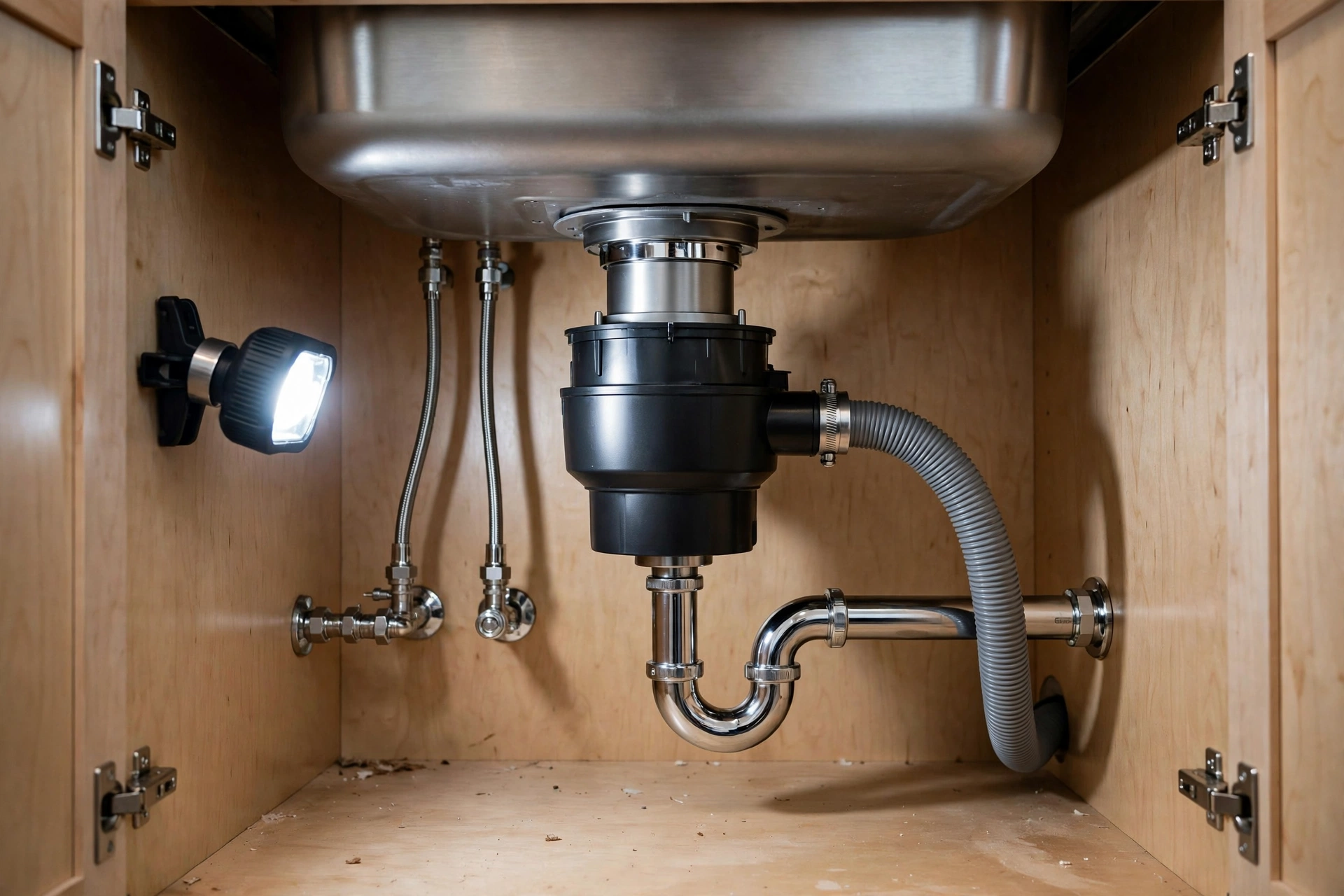
InSinkErator Garbage Disposal Installation Cost in 2026
The InSinkErator garbage disposal installation cost in 2026 typically runs $200–$650 installed for a standard replacement — that is, swapping an old InSinkErator for a new one where the plumbing and the electrical outlet are already in place. The disposal unit itself costs $70–$400 depending on the model, and professional labor runs $100–$250, so the national average lands around $400 for a complete installed job with a mid-range unit. A first-time install, where no disposal has ever been fitted, costs $350–$1,000, and can reach $1,400 if a new dedicated circuit has to be run from the electrical panel. The exact figure depends on which model you choose — a basic Badger 1 at $70–$100 is a very different bill from an Evolution Excel at $250–$400 — and on whether the drain lines up, the flange is sound, and an outlet is already waiting under the sink.
InSinkErator is the brand most American kitchens already have. It invented the garbage disposal in 1927, it supplies the Badger line that builders fit as standard in millions of new homes, and it makes the Evolution line that dominates the premium end of the shelf at Home Depot and Lowe’s. That ubiquity is part of the reason the installation cost is so predictable: plumbers have fitted thousands of them, the mounting system is standardized across the range, and a like-for-like replacement is one of the fastest jobs a plumber does. But “InSinkErator installation” is not one fixed price, because the brand sells two very different families of disposals — the budget Badger series and the quieter, longer-warrantied Evolution series — and the model you pick can change the total by $300 or more while the labor stays exactly the same. This guide breaks down the InSinkErator garbage disposal installation cost model by model, by horsepower, by install type, and by region, compares InSinkErator with Waste King and Moen, explains what the labor charge covers, and shows how to keep the bill down without ending up with a disposal that is too weak for your kitchen or too loud for an open-plan home.
If you already have a quote in hand, the first thing to check is whether it is an all-in installed price or a labor-only price. Some quotes bundle the disposal into the total and some do not, and a quote that looks expensive may simply include an Evolution model where the cheaper quote has a Badger. Our guide to How Much Should Someone Charge to Install a Garbage Disposal breaks down the full installed price the same way for every brand, and our guide to the labor cost to replace a garbage disposal explains exactly what the labor portion covers. If the disposal is part of a bigger kitchen project, our kitchen remodel cost calculator shows how a fixture swap like this fits into a full kitchen remodel budget.
Quick-answer table (typical 2026 InSinkErator garbage disposal installation cost):
| Item | Typical cost |
|---|---|
| Total installed, standard replacement | $200–$650 |
| National average, standard replacement | Around $400 |
| InSinkErator unit, budget (Badger) | $70–$200 |
| InSinkErator unit, premium (Evolution) | $150–$400 |
| Labor, licensed plumber | $100–$250 |
| Plumber hourly rate | $50–$100 per hour |
| Time on site, standard replacement | 1–2 hours |
| Labor, handyman | $80–$160 |
| Labor, big-box contractor (Home Depot / Lowe’s) | $120–$200 |
| Total installed, first-time install | $350–$1,000 |
| First-time install with a new circuit | Up to $1,400 |
| New GFCI outlet under the sink | $120–$400 |
| New dedicated circuit from the panel | $150–$500 |
| New sink flange / mounting assembly | $25–$75 |
| New drain trap or tailpiece | $25–$100 |
| Air switch, parts and labor | $50–$150 |
| Power cord kit (if unit sold without one) | $15–$30 |
| Warranty, Badger models | 1–2 years |
| Warranty, Evolution models | 4–7 years |
InSinkErator Models Compared: Badger vs. Evolution
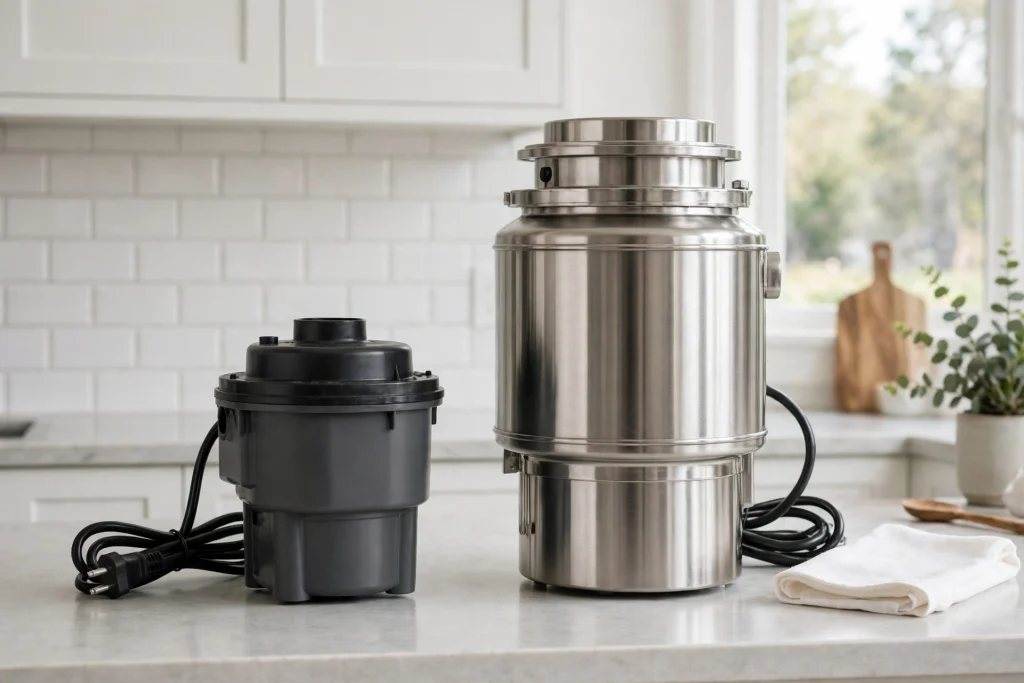
InSinkErator sells two families, and the difference between them is the single biggest factor in the InSinkErator garbage disposal installation cost. The Badger line is the budget workhorse: galvanized steel grind components, a basic single-stage grind, no sound insulation, and a short warranty. The Evolution line is the premium range: stainless steel grind components, multi-stage grinding, sound insulation, and warranties of up to 7 years. The labor to install either one is the same — $100–$250 — because the mounting system is identical, so every dollar of difference between a Badger and an Evolution job is in the unit itself. Here is the full model-by-model comparison for 2026:
| Model | Horsepower | Unit price | Warranty | Grind stages | Best for |
|---|---|---|---|---|---|
| Badger 1 | 1/3 HP | $70–$100 | 1 year | 1-stage | Light use, single-person household, rental property |
| Badger 5 | 1/2 HP | $80–$170 | 2 years | 1-stage | Standard family kitchen, the most common replacement |
| Badger 5XP | 3/4 HP | $130–$200 | 3 years | 1-stage | Heavier daily use on a budget |
| Evolution Compact | 3/4 HP | $150–$280 | 4 years | 2-stage MultiGrind | Smaller kitchens, quieter than Badger |
| Evolution Select Plus | 3/4 HP | $180–$300 | 5 years | 2-stage MultiGrind | Everyday family use with quieter operation |
| Evolution Excel | 1 HP | $250–$400 | 7 years | 3-stage MultiGrind | Large households, heavy daily use, open-plan kitchens |
| Evolution Septic Assist | 3/4 HP | $200–$350 | 4 years | 2-stage MultiGrind | Homes on a septic system |
Badger 1 — 1/3 HP, $70–$100, 1-year warranty ($170–$350 installed). The Badger 1 is the cheapest InSinkErator you can buy, and it is the model builders fit in new homes by the thousand. At $70–$100 for the unit plus $100–$250 in labor, a standard replacement lands at $170–$350 installed. It handles soft food scraps and light daily use in a one- or two-person household, but a 1/3-horsepower motor jams more easily on fibrous foods like celery and artichoke leaves, and it is the loudest disposal InSinkErator sells. The 1-year warranty is the shortest in the range. The Badger 1 makes sense in a rental property, a rarely used kitchen, or a tight-budget replacement where the only goal is a working disposal — but for a family kitchen, the step up to the Badger 5 costs roughly $10–$70 more for the unit and buys a noticeably stronger motor and an extra year of warranty, while the labor stays identical.
Badger 5 — 1/2 HP, $80–$170, 2-year warranty ($180–$420 installed). The Badger 5 is the most common InSinkErator replacement in American kitchens, and it is the default answer to “which disposal should I buy?” At $80–$170 for the unit plus $100–$250 in labor, a standard replacement lands at $180–$420 installed. A 1/2-horsepower motor handles normal daily food waste — vegetable peelings, small bones, coffee grounds — without jamming as often as the Badger 1, and it runs a little quieter. The 2-year warranty is modest, but the price is hard to argue with: the Badger 5 is frequently on sale at Home Depot and Lowe’s for under $100, which can bring a complete installed job to around $200–$300 in a low-cost market. If you want the lowest total installed price for a disposal that will genuinely serve a family kitchen, this is the model to beat. Our guide to garbage disposal installation cost at Home Depot shows how the big-box install program prices a Badger 5 replacement, and our guide to Lowe’s garbage disposal installation covers the same job at Lowe’s.
Badger 5XP — 3/4 HP, $130–$200, 3-year warranty ($230–$450 installed). The Badger 5XP is the strongest Badger, with a 3/4-horsepower motor and a 3-year warranty, at $130–$200 for the unit. Installed, a standard replacement runs $230–$450. It is the budget route to 3/4-horsepower power: it grinds tougher scraps than the Badger 5, but it still has the galvanized steel grind chamber and no sound insulation, so it is louder and shorter-lived than an Evolution at the same horsepower. Choose the 5XP if you want more power on a budget and you do not care about noise; choose an Evolution Compact instead if the kitchen is open-plan and the disposal runs while people are talking nearby.
Evolution Compact — 3/4 HP, $150–$280, 4-year warranty ($250–$530 installed). The Evolution Compact is the entry point to the Evolution line, and the cheapest way to get a quieter, stainless-steel, 2-stage grind. At $150–$280 for the unit plus $100–$250 in labor, a standard replacement runs $250–$530 installed. The Compact is physically smaller than other Evolution models — it is designed for kitchens where the cabinet space under the sink is tight — and it carries a 4-year warranty, double the Badger 5. The 2-stage MultiGrind system grinds food finer than a single-stage Badger, which means fewer jams and a drain that stays clearer. For a small or medium kitchen where noise matters and space is tight, the Compact is the sweet spot of the range.
Evolution Select Plus — 3/4 HP, $180–$300, 5-year warranty ($280–$550 installed). The Select Plus is the most popular Evolution model, and the one most homeowners land on when they replace a disposal deliberately rather than in an emergency. At $180–$300 for the unit plus $100–$250 in labor, a standard replacement runs $280–$550 installed. It has the same 3/4-horsepower motor and 2-stage grind as the Compact, but with better sound insulation and a 5-year warranty. The difference between the Select Plus and the Compact is mostly noise and warranty — about $30–$50 more for the unit — and in an open-plan kitchen that difference is worth paying, because the disposal runs while people are eating or talking a few feet away.
Evolution Excel — 1 HP, $250–$400, 7-year warranty ($350–$650 installed). The Evolution Excel is the flagship: a 1-horsepower motor, a 3-stage MultiGrind system that grinds food almost to liquid, the best sound insulation InSinkErator sells, and a 7-year warranty. At $250–$400 for the unit plus $100–$250 in labor, a standard replacement runs $350–$650 installed — the top of the overall $200–$650 range for an InSinkErator installation. The Excel is built for large households and heavy daily use, and it is the quietest residential disposal InSinkErator makes. The price premium over the Select Plus is real, but so is the difference: the 3-stage grind almost never jams, the motor is barely audible, and the 7-year warranty is the longest in the range. If you cook most nights, run the disposal daily, and have an open-plan kitchen, the Excel is the reason to spend the extra money — and remember the labor is the same, so the whole premium is in the unit.
Evolution Septic Assist — 3/4 HP, $200–$350, 4-year warranty ($300–$600 installed). If your home is on a septic system, the Septic Assist at $200–$350 for the unit is the right InSinkErator. It injects a measured dose of enzyme treatment with every use to help break down food waste in the tank, and a standard replacement runs $300–$600 installed. A standard disposal on a septic system is not a code violation everywhere, but it adds solid waste to the tank and means more frequent pump-outs — ask your septic service before you buy. The Septic Assist is the only InSinkErator designed for the job, and it costs roughly $50–$100 more than the comparable Select Plus for the enzyme system alone.
Badger vs. Evolution — which should you buy? The honest answer is that the labor is the same either way, so the choice is entirely about the unit. A Badger 5 at $80–$170 is the cheapest way to get a working disposal in a family kitchen, and it will serve well for a few years. An Evolution Select Plus at $180–$300 costs roughly $100–$130 more for the unit and buys a quieter motor, a stainless steel grind chamber, a 2-stage grind that jams less, and a 5-year warranty instead of 2. Over the life of the disposal, that extra $100–$130 is the cheapest money in the whole job — the labor alone is $100–$250, so buying the cheapest unit to save a hundred dollars while paying a plumber to fit it is a false economy if you will be replacing it again in three years. To see how the Badger, Power, and Advanced series compare in InSinkErator’s own words, the company’s built-to-last guide explains the motor and grind differences between its models and what each one is built to handle.
InSinkErator Installation Cost by Horsepower
Horsepower is the simplest way to compare models, and it tracks the unit price closely: more power costs more, while the labor stays flat at $100–$250 whatever the motor size. Here is how the total installed cost breaks down by horsepower for a standard replacement:
| Horsepower | Typical models | Unit price | Labor | Total installed |
|---|---|---|---|---|
| 1/3 HP | Badger 1 | $70–$100 | $100–$250 | $170–$350 |
| 1/2 HP | Badger 5 | $80–$170 | $100–$250 | $180–$420 |
| 3/4 HP | Badger 5XP, Evolution Compact, Select Plus, Septic Assist | $130–$350 | $100–$250 | $230–$600 |
| 1 HP | Evolution Excel | $250–$400 | $100–$250 | $350–$650 |
1/3 HP ($170–$350 installed). A 1/3-horsepower disposal is enough for soft scraps and light use in a one- or two-person household, but it is the weakest motor InSinkErator sells, and it jams the most. It makes sense in a rental, a guest kitchen, or a home where the disposal is used once a week. For a family that cooks daily, it is underpowered — and because the labor is the same, the saving over a 1/2 HP model is only $10–$70 on the unit.
1/2 HP ($180–$420 installed). A 1/2-horsepower disposal is the most common replacement in American kitchens, and the sweet spot for most households. It handles normal daily food waste, including small bones and vegetable peelings, without jamming as often as a 1/3 HP model, and it runs noticeably quieter. Most standard InSinkErator replacements fall in this range, and it is where the national average of around $400 installed sits for a mid-range job.
3/4 HP ($230–$600 installed). A 3/4-horsepower disposal is the category where most homeowners land when they replace a disposal deliberately rather than in an emergency. The extra power handles tougher scraps, the motor is quieter, and in the Evolution models the grind chamber is stainless steel, which lasts longer than the galvanized steel in the Badger line. The 3/4 HP range is the widest because it spans both families — a Badger 5XP at $130–$200 at the bottom and a Septic Assist at $200–$350 at the top — so check which model the quote names, not just the horsepower. If you cook most nights and run the disposal daily, the step up from 1/2 HP to 3/4 HP is worth it: the unit costs roughly $50–$130 more and the labor is exactly the same.
1 HP ($350–$650 installed). A 1-horsepower disposal is the premium end: the quietest, most powerful residential disposal InSinkErator makes, with a 3-stage grind and a 7-year warranty. These are built for large households or heavy daily use, and for open-plan kitchens where the disposal runs while people are talking nearby. The price premium over a 3/4 HP model is real — roughly $70–$220 more for the unit — but so is the difference in noise and in how rarely it jams. If the kitchen is open-plan, the quieter premium motor is the reason to spend the extra money.
Labor Cost to Install an InSinkErator Garbage Disposal
Labor is the most predictable part of the InSinkErator garbage disposal installation cost, because the mounting system is the same across the whole range — a Badger and an Evolution take the same time to fit. Who you hire is the single biggest driver of the labor figure, because each type of pro prices the same job differently:
| Pro type | Typical labor | Hourly rate | Time on site | Warranty | Best for |
|---|---|---|---|---|---|
| Licensed plumber | $100–$250 | $50–$100 per hour | 1–2 hours | Usually 90 days to 1 year | Urgent jobs, corroded plumbing, unusual drain setups |
| Handyman | $80–$160 | $40–$70 per hour | 1–2 hours | Varies, often 30–90 days | Simple like-for-like swaps on a tight budget |
| Big-box contractor (Home Depot / Lowe’s) | $120–$200 | Flat rate, not hourly | 1–2 hours | 1-year labor warranty | One-stop purchase with a warranty |
| Electrician (outlet or circuit work only) | $120–$500 | $50–$100 per hour | 1–2 hours | Varies by electrician | Adding an outlet or a new circuit |
Licensed plumber ($100–$250 labor). A local licensed plumber is the most common choice, and the labor range depends on the hourly rate — typically $50–$100 per hour — and on whether the job is billed hourly or as a flat rate. At $50 per hour for a one-hour swap, the labor lands near $100; at $100 per hour for a two-hour job with a corroded flange, it lands near $250. The plumber is the fastest option for an urgent job — a disposal that is leaking into the cabinet and needs to come out today — and the best option when the plumbing under the sink is unusual, corroded, or needs reconfiguration, because the plumber can price and fix the whole job in one visit. The warranty is whatever the plumber offers, usually 90 days to 1 year, so get it in writing before the work starts. For context on what plumbers charge across other jobs, see our guide to plumber cost per hour.
Handyman ($80–$160 labor). A handyman is the cheapest labor option for a straightforward swap, typically charging $40–$70 per hour for a job that takes 1–2 hours, which puts the labor at $80–$160. That saving is real, but it comes with limits. A handyman is a good fit when the old disposal comes off cleanly, the new one is the same size, the drain lines up, and the outlet is already there — a true like-for-like swap with no surprises. A handyman is not the right hire when the mounting ring is seized, the trap is corroded, the drain needs reconfiguring, or new electrical work is needed: most handymen are not licensed electricians, and in many jurisdictions they are not permitted to do electrical work at all. The warranty is also thinner — often 30 to 90 days, if one is offered in writing at all.
Big-box contractor ($120–$200 labor). Hiring through Home Depot or Lowe’s means the work is done by a licensed local third-party contractor, not by store employees, and the labor is a flat rate of $120–$200 for a standard replacement. The price is narrower than a plumber’s range because it is a set package price rather than an hourly rate, and it comes with a 1-year labor warranty — the strongest warranty of the three routes. Scheduling takes a few days to a week, because the contractor contacts you after you buy the disposal and add installation at checkout, so this is not the route for a leaking disposal that needs to come out today. The disposal unit is bought separately at $70–$400, and the same extras apply as with any pro: an outlet at $120–$400, a new flange at $25–$75, a new trap at $25–$100.
Which pro is cheapest? For a clean, simple swap, a handyman at $80–$160 is usually cheapest, a big-box contractor at $120–$200 sits in the middle, and a plumber at $100–$250 can be cheapest or most expensive depending on the hourly rate and how long the job takes. The right question is not only which quote is lowest, but which quote covers the job you actually have. A $80 handyman quote that does not include a corroded flange is not cheaper than a $200 plumber quote that does — it is just incomplete. Get each quote in writing, with the removal, the flange, the drain connection, and the leak test each listed, and compare like with like.
What the labor charge covers. A standard labor charge of $100–$250 covers disconnecting the power, removing the old disposal, cleaning the sink flange area, mounting the new InSinkErator on the flange, connecting the drain and the dishwasher hose, connecting the power cord or hardwiring, leak testing, a test run under load, cleanup, and haul-away of the old unit. It does not cover the disposal unit itself ($70–$400), a new flange ($25–$75), a new trap ($25–$100), an outlet ($120–$400), a new circuit ($150–$500), or an air switch ($50–$150). A written quote that lists what is included and what is separate is a quote you can trust.
InSinkErator Installation Cost by Install Type
“Installing an InSinkErator” is not one job. A like-for-like replacement, a first-time install, a plug-in swap, and a hardwired install are four different jobs with four different prices — and the install type matters more than the model you pick:
| Install type | Unit | Labor | Total installed |
|---|---|---|---|
| Standard replacement, plug-in (outlet exists) | $70–$400 | $100–$250 | $200–$650 |
| Standard replacement, hardwired | $70–$400 | $100–$250 | $200–$650 |
| First-time install, outlet exists | $70–$400 | $200–$400 | $350–$800 |
| First-time install, new GFCI outlet needed | $70–$400 | $250–$500 | $400–$1,000 |
| First-time install, new dedicated circuit needed | $70–$400 | $350–$700 | $500–$1,400 |
| Replacement with corroded flange / stuck unit | $70–$400 | $150–$350 | $250–$750 |
Standard replacement, plug-in ($200–$650 installed). This is the most common InSinkErator job: an old disposal comes off and a new one goes on where the plumbing and a switched outlet already exist. The labor is $100–$250 for 1–2 hours on site, and the total is set almost entirely by the model — a Badger 1 replacement lands near $200, an Evolution Excel near $650, and the national average sits around $400. If your old disposal is also an InSinkErator, the job is even simpler: the mounting assembly is standardized across the range, so the new unit often fits the existing flange, which can save a few minutes and sometimes the cost of a new flange.
Standard replacement, hardwired ($200–$650 installed). Some older kitchens have the disposal hardwired to a wall switch instead of plugged into an outlet. A hardwired replacement costs the same as a plug-in one — $200–$650 installed — because the electrician’s work is a straight swap of wires, but it is not a DIY job: you are working on a live circuit under a sink, inches from running water. If you are switching from hardwired to plug-in, or the other way around, add the cost of an outlet or a junction box, typically $120–$400.
First-time install, outlet exists ($350–$800 installed). If no disposal has ever been fitted but there is already a switched outlet under the sink, the job is a $350–$800 one. The labor runs $200–$400 because the sink drain opening has to be cut or adapted, the trap has to be reconfigured to meet the disposal’s drain outlet, and the dishwasher connection has to be made. The unit is the same $70–$400 as any other job. Before you commit to a first-time install, check whether the sink is compatible: a disposal needs a standard 3.5-inch drain opening, and a very shallow or unusually shaped sink may need an adapter or a different model.
First-time install, new GFCI outlet needed ($400–$1,000 installed). If there is no outlet under the sink, adding a GFCI-protected outlet costs $120–$400, and the total rises to $400–$1,000. The electrical work is usually done by an electrician, not the plumber, which can mean a second visit and a second trip fee. If there is an outlet nearby — on the wall behind the sink, or on the other side of the cabinet — the electrician can often extend it cheaply; if the nearest circuit is on the other side of the kitchen, the price climbs toward the top of the range.
First-time install, new dedicated circuit needed ($500–$1,400 installed). If the outlet needs a new dedicated circuit run from the electrical panel, that work alone costs $150–$500, and the total can reach $1,400. This is the most expensive InSinkErator installation, and it is the one most likely to need a permit — $20–$100 in most jurisdictions — because new circuit work is inspected. The upside is that a dedicated circuit is the correct, code-compliant way to power a disposal, and it is the setup every new-build kitchen has. If your panel has no spare capacity, the price can go higher still, because the panel itself may need work — get the electrician’s quote in writing before the plumber starts.
Replacement with a corroded flange or stuck unit ($250–$750 installed). This is the most common surprise in a replacement job. A disposal that has been leaking slowly for years rusts its mounting ring to the sink flange, and a ring that should twist off in minutes can take an hour of penetrating oil and careful force — or it can seize so badly that the flange has to be cut out and replaced at $25–$75. The extra labor is typically up to $100, pushing the labor toward $150–$350 and the total toward $250–$750. If the cabinet floor is stained or swollen, or the disposal is more than fifteen years old, mention it when you call so the pro brings the parts and prices the extra honestly instead of discovering it mid-job. Our guide to whether it is cheaper to replace a garbage disposal or remove it covers the case where the old unit is so far gone that removal alone is the cheaper option.
InSinkErator Installation Cost by Region
Labor is local, and the same one-hour InSinkErator swap costs noticeably more in a high-cost metro area than in a smaller market, because the plumber’s hourly rate follows local wages, fuel, insurance, and overhead. The national typical range of $200–$650 installed for a standard replacement breaks down roughly like this by region:
| Region | Plumber hourly rate | Typical labor | Total installed, Badger 5 | Total installed, Evolution Excel |
|---|---|---|---|---|
| Northeast (New York, Boston, Washington DC) | $80–$100 per hour | $200–$250 | $300–$420 | $450–$650 |
| West Coast (California, Seattle, Portland) | $75–$100 per hour | $180–$250 | $280–$420 | $430–$650 |
| Midwest (Chicago, Minneapolis, Cleveland) | $50–$80 per hour | $120–$220 | $220–$390 | $370–$620 |
| South (Atlanta, Dallas, Charlotte, Nashville) | $50–$75 per hour | $100–$200 | $200–$370 | $350–$600 |
| Southeast / Gulf Coast | $50–$70 per hour | $100–$180 | $200–$350 | $350–$580 |
| Mountain West (Denver, Phoenix, Salt Lake City) | $55–$85 per hour | $120–$240 | $220–$410 | $370–$640 |
| Rural / small-town markets | $45–$65 per hour | $100–$160 | $200–$330 | $350–$560 |
High-cost metros ($200–$250 labor). In the Northeast and on the West Coast, plumbers commonly charge $75–$100 per hour, so even a straightforward 1–2 hour swap lands at $180–$250 in labor, and a job with a corroded flange can push past $250. Trip charges are also more common in these markets — a $50–$100 service-call or trip fee that is sometimes folded into the labor and sometimes listed separately, so ask whether the quote includes it. A Badger 5 replacement in these markets typically runs $280–$420 installed, and an Evolution Excel $430–$650.
Mid-cost markets ($120–$240 labor). In the Midwest and the Mountain West, hourly rates of $50–$85 per hour put a standard replacement at $120–$240 in labor. A Badger 5 replacement runs $220–$410 installed, and an Evolution Excel $370–$640. These are the markets where the national typical range of $200–$650 fits most neatly, and where a flat-rate quote of $120–$200 from a big-box contractor is often competitive with an independent plumber.
Lower-cost markets ($100–$200 labor). In much of the South and in rural and small-town markets, plumbers charge $45–$75 per hour, so a standard replacement lands at $100–$200 in labor. A Badger 5 replacement runs $200–$370 installed, and an Evolution Excel $350–$600. A handyman in these markets can be cheaper still, at $80–$160, because handyman rates of $40–$70 per hour go further where the cost of living is lower. Even here, though, the extras are the same: a corroded unit can add up to $100 in extra labor, and an outlet adds $120–$400 wherever you live, because electrical work is priced by the electrician’s rate and the panel work, not by the local plumbing rate.
How to use these numbers. Regional ranges are a starting point, not a quote. The only number that matters for your kitchen is the written quote for your address, and the cheapest way to know whether it is fair is to get two: one from a plumber and one from a big-box contractor or a handyman. If both land inside the range for your region, the price is fair; if one is far outside it, ask what it includes that the other does not — and check which InSinkErator model each quote names, because a Badger 5 quote and an Evolution Excel quote for the same job can differ by $170–$230 on the unit alone.
InSinkErator vs. Waste King vs. Moen: Installation Cost Compared
InSinkErator is the biggest name in disposals, but it is not the only one. Waste King and Moen are the two other brands most commonly stocked beside it, and the installation cost differs between them — mostly because of the unit price and the warranty, not the labor, which is the same $100–$250 for all three:
| Brand | Comparable models | Unit price | Typical warranty | Total installed, standard replacement | Key difference |
|---|---|---|---|---|---|
| InSinkErator | Badger 5 / Evolution Select Plus | $80–$300 | 2–5 years | $200–$650 | Widest range, quietest premium models, standardized mounting |
| Waste King | L-1000 / L-8000 Legend | $70–$250 | 5–10 years (lifetime on some models) | $200–$600 | Permanent-magnet motor, faster spin, longer warranties, louder |
| Moen | GX50C / GX100C | $90–$300 | 5–10 years | $200–$600 | Universal mounting fits most existing flanges, quieter mid-range |
InSinkErator ($200–$650 installed). The advantage of InSinkErator is range: seven models from $70 to $400, so there is a disposal for every budget and every kitchen, and the mounting system is standardized across the range, which makes a like-for-like replacement the fastest job a plumber does. The Evolution models are the quietest disposals on the market, and the 7-year warranty on the Excel is the longest of any InSinkErator. The disadvantage is the warranty on the budget end: a Badger 1 carries only a 1-year warranty, and a Badger 5 only 2 years, where the competitors offer 5 years or more at the same price. If you buy a Badger, you are buying a cheap disposal with a short warranty; if you buy an Evolution, you are buying one of the best disposals made.
Waste King ($200–$600 installed). Waste King is the value challenger. Its disposals use a permanent-magnet motor that spins faster than InSinkErator’s induction motors — which means it grinds faster and jams less on fibrous food — and its warranties are longer: 5 to 10 years, with a lifetime warranty on some Legend models, at unit prices of $70–$250. A Waste King L-1000 at around $90–$150 is a genuine rival to the Badger 5 at a similar price with a much longer warranty. The trade-off is noise: Waste King disposals are louder than the Evolution line, and their mounting system is different from InSinkErator’s, so a replacement of an InSinkErator with a Waste King may need a new flange at $25–$75. Waste King is the better buy if warranty length and grind speed matter more to you than quiet operation.
Moen ($200–$600 installed). Moen entered the disposal market later, and its pitch is compatibility: the universal mounting system fits most existing sink flanges, including InSinkErator’s, which can make a swap faster and cheaper because the old flange often stays in place. Unit prices run $90–$300, with warranties of 5 to 10 years, and the mid-range GX models are quieter than a Badger at a similar price. Moen is the better buy if your old disposal is an InSinkErator and you want a quieter mid-range unit without paying Evolution prices — but the range is smaller, with fewer horsepower choices than InSinkErator’s seven-model lineup.
Which brand should you buy? If you want the quietest disposal and the widest choice, buy InSinkErator — an Evolution Select Plus at $180–$300 is the best all-round disposal in the comparison. If you want the longest warranty for the least money, buy Waste King — a 5- to 10-year warranty at $70–$250 is hard to beat. If you want a quiet mid-range unit that fits your existing InSinkErator flange, buy Moen. And whichever brand you choose, remember the labor is the same $100–$250 — the brand changes the unit price and the warranty, not the install bill. For the brand comparison in Waste King’s own terms, the company’s official site lists its motor and warranty differences model by model.
What Drives the InSinkErator Garbage Disposal Installation Cost
The total installed price of $200–$650 is not a random range. Six factors set where your job lands inside it, and knowing them before you call is how you avoid the most common surprise — a quote that starts at $200 and ends at $600:
1. The model you choose (up to $330 of difference). A Badger 1 at $70–$100 and an Evolution Excel at $250–$400 differ by up to $330 on the unit alone, while the labor is identical. The model is the single biggest cost driver, and it is entirely your choice — which is why you should decide on the model before you ask for quotes, not after. 2. Whether an outlet exists ($120–$400). The outlet is the single biggest extra after the disposal itself. If there is a switched, GFCI-protected outlet under the sink, the job stays in the $200–$650 replacement range. If there is no outlet, adding one costs $120–$400, and if it needs a new circuit from the panel, that is $150–$500 more. Before you call for quotes, open the cabinet and look: if there is an outlet, say so, and the quote stays honest. 3. Whether it is a replacement or a first-time install ($150–$750 of difference). A replacement is a $200–$650 job and a first-time install is a $350–$1,000 job, and most of the difference is the drain reconfiguration and the electrical work. If you are choosing between kitchens or sinks, the one that already has a disposal is always the cheaper one to upgrade. 4. The condition of the old unit (up to $100 extra labor). A disposal that has been leaking slowly for years rusts its mounting ring to the sink flange, and a ring that should twist off in minutes can take an hour of penetrating oil and careful force. The extra labor for a corroded or stuck unit is typically up to $100, plus $25–$75 if the flange has to be replaced. If the cabinet floor is stained or swollen, or the disposal is more than fifteen years old, mention it when you call. 5. The drain setup ($25–$150). The new disposal is rarely exactly the same height as the old one, and if its drain outlet sits lower than the trap, the trap has to be lowered or the tailpiece replaced — a $25–$100 job in parts and labor. A full drain reconfiguration, where the trap, the tailpiece, and the dishwasher connection all have to move, can add $50–$150 in labor. Deep farmhouse sinks and disposals with a low outlet are the combination most likely to need drain work. A photo of the drain setup sent with your quote request gets you a tighter number, because the pro can see the heights before arriving. 6. Where you live ($100–$150 of difference on labor alone). A plumber in New York or San Francisco charges $80–$100 per hour; a plumber in a small Southern town charges $45–$65 per hour. On a 1–2 hour job, that is a $100–$150 difference in labor for identical work, and it is the reason the same Badger 5 replacement can cost $200 in one market and $420 in another.
A real-world example. One homeowner’s standard replacement of a Badger 5 cost $130 for the unit plus $150 for the labor, for a $280 total — and the total reached $430 once a corroded flange and a misaligned trap were found, adding up to $100 in extra labor plus $50 in parts. That is the most common story in customer reports: the base price is real, and one small extra on top of it is normal. Budget the base price plus $100 for the most likely extra, and you will rarely be surprised.
DIY vs. Hiring a Pro to Install an InSinkErator Garbage Disposal
| DIY | Hiring a pro (plumber, handyman, or big-box contractor) | |
|---|---|---|
| InSinkErator unit cost | $70–$400 by model | Same — you buy the unit either way |
| Installation labor | $0 | $100–$250 (plumber) / $80–$160 (handyman) / $120–$200 (big-box) |
| Sink flange / mounting | $25–$75 in parts, if you can do it | $25–$75, done by the pro |
| Drain trap or tailpiece | $25–$100 in parts, if you can do it | $25–$100, done by the pro |
| Electrical outlet | Not a DIY job for most homeowners | $120–$400, done by the pro or an electrician |
| New circuit from the panel | Not a DIY job | $150–$500, done by an electrician |
| All-in total, standard replacement | $70–$400 in parts | $200–$650 |
| All-in total, first-time install | Not a DIY job | $350–$1,000 (up to $1,400 with a new circuit) |
| Time required | 2–4 hours for a first-timer on a swap | 1–2 hours on site for a replacement |
| Tools needed | Plumber’s putty, wrench, screwdriver, bucket, voltage tester | Included in the labor price |
| Plumbing safety | A bad seal leaks slowly into the cabinet — check for drips for a week | Pro leak-tests before leaving |
| Electrical safety | You work on a circuit under a sink — mistakes can cause shock | Licensed pro, breaker off, tested before leaving |
| Warranty | None — mistakes are on you | 90 days to 1 year (plumber) / 1 year (big-box) |
| Best for | A confident DIYer doing a like-for-like InSinkErator swap | First-time installs, electrical work, corroded units, or anyone who wants a warranty |
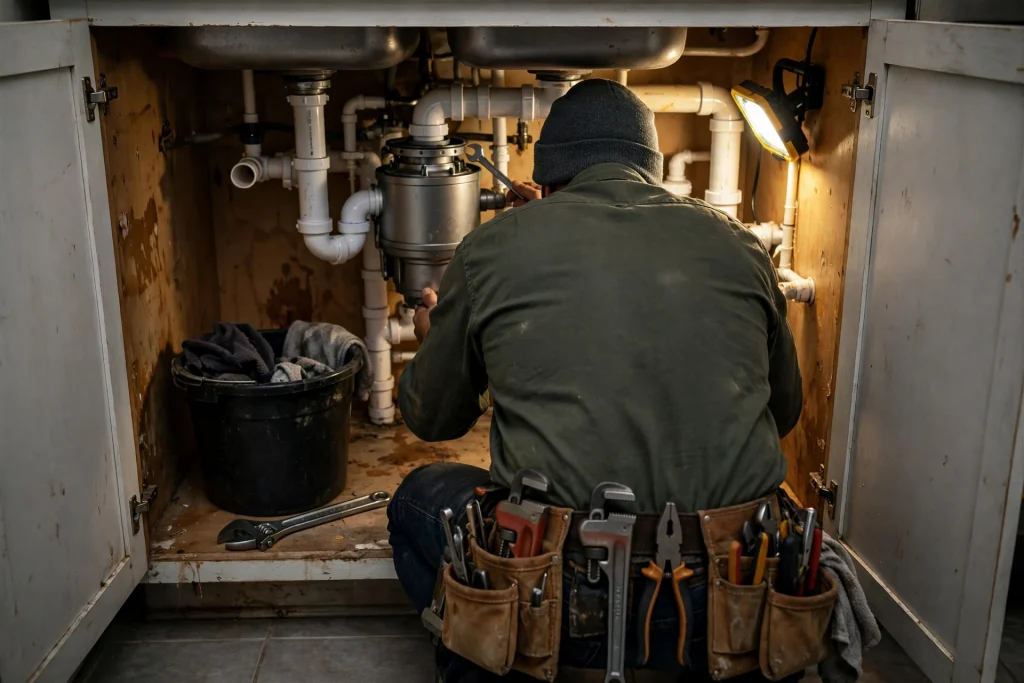
A like-for-like InSinkErator replacement is a fair DIY job. If an InSinkErator already exists, the flange fits, the drain lines up, and the outlet is there, a confident DIYer can swap it in 2–4 hours with basic tools: plumber’s putty for the flange, a wrench for the mounting ring, and a bucket for the water in the trap. InSinkErator’s standardized mounting system is the reason this job is so DIY-friendly: the new unit twists onto the same mounting assembly as the old one, and the instructions in the box are written for a homeowner. The saving is the whole labor charge — $100–$250 for a plumber, $80–$160 for a handyman, $120–$200 through a big-box contractor — and the risk is a slow leak at the flange or the drain connection, so check under the sink for drips every day for a week after the job. If the disposal is hardwired rather than plug-in, or the mounting ring is seized, stop and call a pro: a seized ring is how sinks get cracked, and a hardwired unit is how people get shocked.
A corroded unit is not a DIY job. The line between a fair DIY swap and a job for a pro is corrosion. A mounting ring that twists off cleanly is a DIY job; a ring that is rusted to the flange is a pro job, because the force needed to free it can crack the sink, and the flange underneath is often corroded too. The extra labor for a corroded or stuck unit is up to $100 — a small price against a cracked sink at $200–$600+ to replace. If the old disposal is more than fifteen years old, or the cabinet shows water stains, get a pro quote before you start, even if you plan to do the work yourself.
A first-time install is not a DIY job. Cutting the sink drain opening, reconfiguring the trap, adding a dishwasher connection, and — above all — adding an outlet under the sink are jobs for a licensed installer or electrician. A mistake inside a sink cabinet is a slow leak that rots the cabinet floor, or a shock risk inches from running water. The $100–$250 labor charge on a replacement, or the $350–$1,000 total on a first-time install, buys a license, insurance, a leak test, and a warranty.
The prep work you can do yourself. There are still useful ways to cut the labor bill without touching a wire or a drain. Clear out the sink cabinet so the pro can work without moving cleaning products — on hourly pricing, every minute of clearing is a minute you pay for. Buy the disposal yourself, on sale, so the pro charges labor only with no markup on the unit. Check whether there is an outlet under the sink before you call, and photograph the drain setup — a photo sent with your quote request gets you a tighter number. And run the old disposal one last time before the pro arrives, so you can describe exactly what is wrong with it: a jam, a leak, a hum with no spin, or a dead motor each point to a different fix.
Money-Saving Tips for InSinkErator Garbage Disposal Installation
1. Buy the disposal yourself, on sale. The unit is the most controllable cost, and a Badger 5 at $80–$170 goes on sale regularly at Home Depot and Lowe’s for under $100. A $50 saving on the unit is a $50 saving on the total — and buying it yourself means the pro charges labor only, with no markup on the fixture. 2. Check for an outlet before you call. If there is a switched, GFCI-protected outlet under the sink, say so when you call — the pro can quote the $100–$250 standard replacement instead of pricing for the worst case, and the job stays near the bottom of the $200–$650 range. A photo of the cabinet sent with your quote request gets you a tighter number. 3. Get three quotes: a plumber, a handyman, and a big-box contractor. A plumber runs $100–$250, a handyman $80–$160, and a big-box contractor $120–$200, so quotes for the same job can differ by $50–$150 between providers — especially on a job with unknown conditions, where different pros price the risk differently. Compare the written quotes line by line: removal, flange, drain, testing, and haul-away should each be named. 4. Pick the Badger 5, not the Evolution Excel, unless you need it. A Badger 5 at $80–$170 handles normal daily use for most households, and the Evolution Excel at $250–$400 costs roughly $170–$230 more for power and quiet most kitchens never use — while the labor is identical. Spend the difference on a better mounting assembly or an air switch instead. 5. But do not buy the cheapest model to save $50. The Badger 1 at $70–$100 saves only $10–$70 over the Badger 5, and it buys a weaker motor, a louder grind, and a 1-year warranty instead of 2. Over the life of the disposal, the Badger 5 is the cheapest money in the whole job. 6. Replace, don’t install fresh, where you have the choice. A replacement is a $200–$650 job and a first-time install is a $350–$1,000 job, and most of the difference is the electrical work at $120–$400. If you are choosing between kitchens or sinks, the one that already has a disposal is always the cheaper one to upgrade. 7. Bundle the disposal with other kitchen work. If the pro is already under the sink — replacing a faucet, fitting a new trap, or connecting a dishwasher — adding a disposal to the same visit costs far less in labor than a separate trip, because the trip and the cabinet setup are paid for once. Ask for a bundled price when you call. 8. Do not pay for a replacement you do not need. If the old disposal only jams, try the reset button on the bottom and the hex key in the center socket first — a jammed disposal is often a five-minute fix, not a $200–$650 replacement. If it hums but does not spin, the flywheel is stuck; if it does nothing at all, check the GFCI outlet and the breaker before you call anyone. A service call to unjam a disposal still costs labor, but it costs far less than a full replacement. 9. Keep the old flange if it is in good shape. A new sink flange and mounting assembly costs $25–$75, and on a like-for-like InSinkErator replacement the old one is often reusable, because the mounting system is standardized across the range. Ask the pro to check it before ordering a new one — and if it is corroded, replace it, because a new disposal on a bad flange will leak. 10. Time the job outside the busy season. Plumbers and installers are busiest in spring and early summer, when renovation season peaks. A fall or winter booking can mean a faster start date and occasionally a better price, especially for a first-time install that fills a half-day slot.
Frequently Asked Questions
How much does it cost to install an InSinkErator garbage disposal?
In 2026, InSinkErator garbage disposal installation typically costs $200–$650 installed for a standard replacement, with a national average around $400. The unit costs $70–$400 depending on the model — a Badger 1 at $70–$100, a Badger 5 at $80–$170, and an Evolution Excel at $250–$400 — and professional labor runs $100–$250. A first-time install, where no disposal has ever been fitted, costs $350–$1,000, and can reach $1,400 if a new dedicated circuit has to be run from the electrical panel.
Which InSinkErator model is best for the price?
For most households, the Badger 5 at $80–$170 is the best value: a 1/2-horsepower motor that handles normal daily use, a 2-year warranty, and a complete installed price of $180–$420. If you want a quieter disposal with a longer warranty, the Evolution Select Plus at $180–$300 is the best all-round buy — a 3/4-horsepower motor, a 2-stage grind, sound insulation, and a 5-year warranty, for a complete installed price of $280–$550. The Evolution Excel at $250–$400 is the best disposal InSinkErator makes, but the extra $170–$230 over the Badger 5 is only worth it for a large household, heavy daily use, or an open-plan kitchen.
Does InSinkErator installation include the disposal unit?
Not always — and that is the first thing to check on any quote. Some quotes bundle the unit and the labor into one all-in price of $200–$650, and some quote labor only at $100–$250, with the unit bought separately at $70–$400. A quote that looks expensive may simply include an Evolution model where the cheaper quote has a Badger. Always ask whether the quote includes the unit, and which model it names, because a Badger 5 quote and an Evolution Excel quote for the same job can differ by $170–$230 on the unit alone.
How long does it take to install an InSinkErator garbage disposal?
A standard replacement takes 1–2 hours on site, including removal of the old disposal, mounting the new one, reconnecting the drain and the dishwasher hose, connecting the power, and leak testing. A first-time install takes 2–4 hours, because the drain has to be reconfigured and an outlet may need to be added. A corroded or stuck unit can add up to an hour, pushing the labor toward the top of the $100–$250 range. Scheduling a plumber typically takes a day or two; scheduling through a big-box contractor takes a few days to a week, because the contractor contacts you after you buy the disposal and add installation at checkout.
Can I install an InSinkErator garbage disposal myself?
Yes, if it is a like-for-like replacement — an InSinkErator already exists, the flange fits, the drain lines up, and a switched outlet is already under the sink. InSinkErator’s standardized mounting system makes this one of the most DIY-friendly plumbing jobs, and a confident DIYer can do it in 2–4 hours, saving the whole $100–$250 labor charge. But a first-time install is not a DIY job: cutting the sink drain opening, reconfiguring the trap, and adding an outlet under the sink are jobs for a licensed installer or electrician. A corroded mounting ring is also a pro job, because the force needed to free it can crack the sink. If the disposal is hardwired rather than plug-in, call a pro — you are working on a live circuit inches from running water.
The Bottom Line
For the InSinkErator garbage disposal installation cost in 2026, budget $200–$650 installed for a standard replacement — a unit at $70–$400 plus labor at $100–$250 — with a national average around $400. The model you choose sets the bill more than anything else: a Badger 5 replacement lands at $180–$420 installed, an Evolution Select Plus at $280–$550, and an Evolution Excel at $350–$650, all with the same labor. A handyman can do the same swap for $80–$160 in labor, and a big-box contractor charges a flat $120–$200 with a 1-year labor warranty. A first-time install where no disposal existed before runs $350–$1,000 installed, and up to $1,400 if a new dedicated circuit has to be run from the panel. The cheapest way to keep the bill down is to buy the disposal yourself on sale, check for an outlet before you call, and get three written quotes — a plumber, a handyman, and a big-box contractor — with the removal, the flange, the drain work, and the leak test each listed as its own line. And before you book a replacement at all, try the reset button: a jammed disposal is often a five-minute fix, not a $200–$650 job.
Prices are typical 2026 US ranges for planning purposes and vary by region, disposal model, and site condition; get itemized local quotes for an exact project price.
6 thoughts on “InSinkErator Garbage Disposal Installation Cost in 2026”