
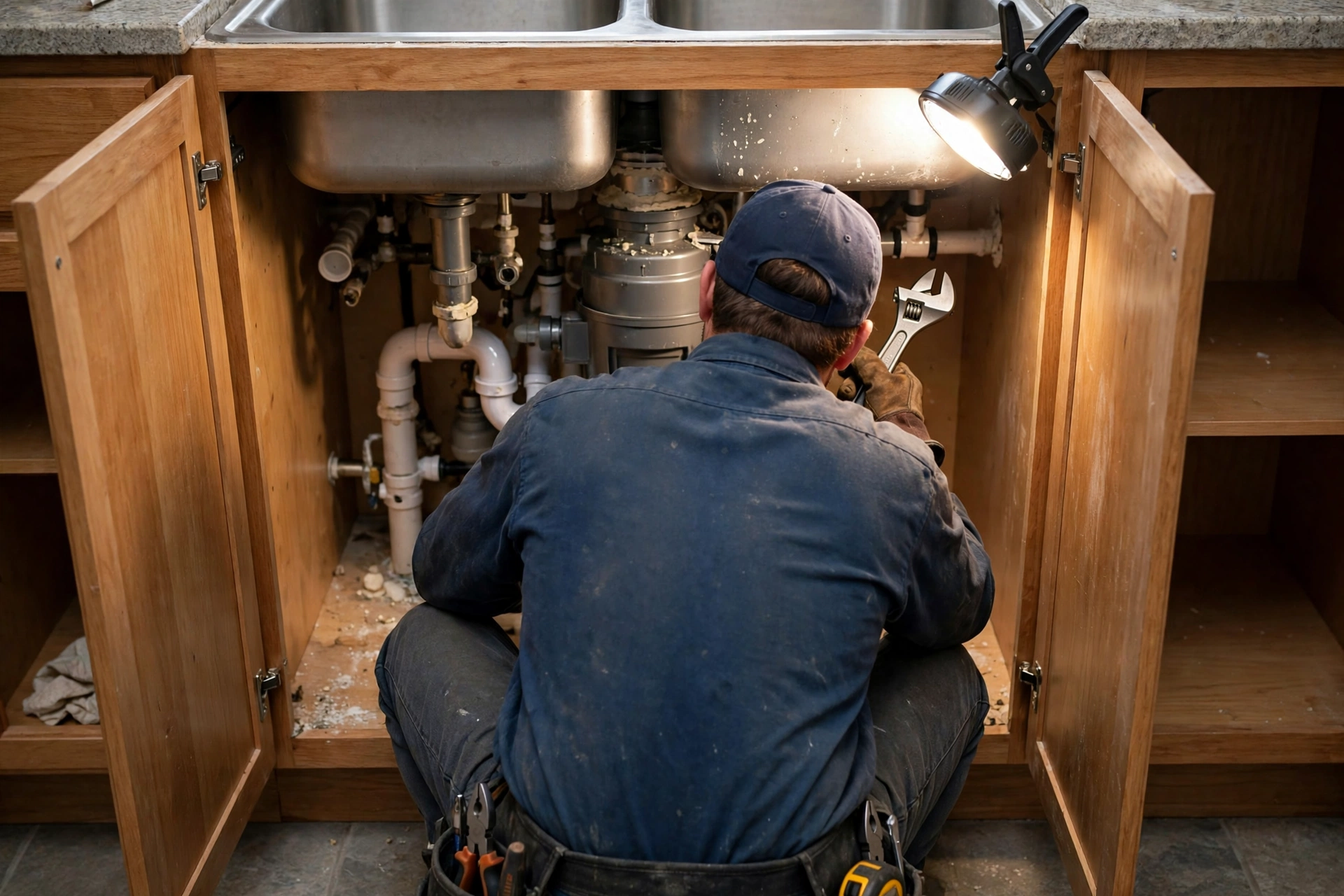
How Much Should Someone Charge to Install a Garbage Disposal in 2026?
How much should someone charge to install a garbage disposal? In 2026, a professional typically charges $200–$625 total installed to replace an existing garbage disposal, or $100–$250 for labor only if you supply the unit yourself. The disposal unit itself costs $75–$400 depending on horsepower and brand, and the whole job usually takes 30 minutes to 2 hours on site. The wide range exists because “install a garbage disposal” covers two very different jobs: swapping a dead unit where one already exists — a quick job with the drain and the power already in place — and a first-time install where there is no disposal at all, which typically costs $350–$1,000 because the plumber has to rework the drain and add electrical power.
The national averages tell the same story from different angles. Angi puts the average installed cost at around $550, while Thumbtack’s national average is about $194, with a typical range of $138–$272 — the difference is mostly that Thumbtack’s figures skew toward budget units and labor-only jobs, while Angi’s average includes premium units and full-service installs. HomeGuide puts a new retrofit installation at $250–$650. All three agree on the shape of the job: the unit is the cheapest part, the labor is the middle, and any electrical or drain work is what pushes the total up. A standard replacement on an existing setup lands near the bottom of the range; a first-time install with a new outlet lands near the top.
Before you call a plumber, it helps to know which job you actually have. If your sink already has a disposal — even a dead one — the mounting ring, the drain connections, and the power supply are already there, and the plumber is mostly swapping one unit for another. If your sink has never had a disposal, the plumber has to install a new mounting assembly, reconfigure the drain pipes to make room, and run power to the unit, which usually means adding a dedicated outlet or a new circuit at $150–$400. That one distinction is worth hundreds of dollars, and it is the first question any good plumber will ask. This guide breaks down the real 2026 cost of installing a garbage disposal, explains exactly what a fair charge looks like for a replacement and for a first-time install, shows disposal prices by horsepower and type, covers the electrical and drain work that adds cost, compares a plumber with a handyman and with doing it yourself, and shows how to keep the bill down — including why supplying your own unit and getting the quote itemized are the two biggest money-savers on this job.
Quick-answer table (typical 2026 garbage disposal installation):
| Item | Typical cost |
|---|---|
| Professional replacement, total installed | $200–$625 |
| Labor only (you supply the unit) | $100–$250 |
| First-time install (no existing unit), total | $350–$1,000 |
| Garbage disposal unit itself | $75–$400 |
| Plumber hourly rate | $50–$150 per hour |
| Time on site, standard replacement | 30 minutes–2 hours |
| Adding a dedicated outlet or new circuit | $150–$400 |
| DIY cost (unit only) | $50–$380 |
| DIY saving vs. hiring a pro | $100–$250 in labor |
How Much Should Someone Charge to Install a Garbage Disposal
The fair price for installing a garbage disposal depends first on whether a disposal already exists under the sink. A replacement and a first-time install are different jobs with different price tags, and quoting them the same way is how homeowners get surprised.
| Scenario | Unit | Labor | Typical total installed |
|---|---|---|---|
| Replacement, standard unit (existing mount and power) | $75–$200 | $100–$250 | $200–$625 |
| Replacement, premium 1 HP unit | $200–$400 | $100–$250 | $300–$625 |
| First-time install, outlet already under sink | $75–$400 | $150–$300 | $350–$650 |
| First-time install, needs new outlet or circuit | $75–$400 | $250–$500 | $350–$1,000 |
| Labor only, you supply the unit | You buy it ($50–$380) | $100–$250 | $150–$630 |
| Batch-feed disposal, replacement | $100–$350 | $100–$250 | $200–$600 |
| Two disposals, same visit (double-bowl sink) | $150–$800 | $150–$350 | $300–$1,000 |
Replacement of an existing disposal ($200–$625 installed). This is the most common job and the cheapest one. The plumber removes the old unit from its mounting ring, disconnects the drain and the dishwasher hose, fits the new unit onto the existing mount — or swaps the mount if the new unit uses a different one — reconnects the drain, and tests it. Because the power and the drain are already in place, the job takes 30 minutes to 2 hours, and labor runs $100–$250. The unit itself is $75–$400 by horsepower and brand, so the all-in total lands at $200–$625. The national averages sit inside this range: Angi’s average installed cost is around $550, Thumbtack’s national average is about $194 with a typical range of $138–$272, and HomeGuide puts a new retrofit at $250–$650. The spread between those averages is mostly about what is included — a budget continuous-feed unit with a quick swap sits near the Thumbtack end, while a premium 1 HP unit with a full-service install sits near the Angi end.
First-time install with an outlet already under the sink ($350–$650 installed). If your sink has never had a disposal but there is already a switched outlet in the cabinet, the job is still straightforward, just longer. The plumber installs the mounting assembly and sink flange, reconfigures the drain pipes to make room for the unit, connects the dishwasher drain hose if there is one, and plugs the unit in. Labor runs $150–$300 because the drain rework takes time, and the total lands at $350–$650 with the unit included.
First-time install needing a new outlet or circuit ($350–$1,000 installed). This is the expensive scenario: there is no power under the sink, so an electrician — or a plumber working with one — has to add a dedicated outlet or a new circuit, at $150–$400. Add the drain rework and the mounting work on top, and labor climbs to $250–$500, pushing the all-in total to $350–$1,000. The electrical work is the single biggest step-change in the price, and it is also the part most likely to be missing from a headline quote. If the quote you get does not mention power, ask: a disposal needs electricity, and a sink cabinet without an outlet is not a $200 job.
Labor only, you supply the unit ($100–$250). Many plumbers will install a disposal you bought yourself, charging labor only. For a standard replacement that is $100–$250, and it is the cheapest way to get professional work: a decent continuous-feed unit costs $80–$200 at a home center, so the all-in total with labor-only installation can be $180–$450, often less than a plumber-supplied package. The trade-off is warranty: the plumber warranties the labor, but the unit itself is covered by the manufacturer’s warranty, and if the unit is defective you deal with the store, not the plumber.
The comparison that puts it in perspective. A garbage disposal is one of the cheapest plumbing upgrades in a house, and the labor is a small job by plumbing standards — compare it with having a plumber fit a new toilet, where the labor alone runs higher and the fixture costs more. For the rate context behind these numbers, see our guide to plumber cost per hour, and for a similar fixture-install comparison, see how much a plumber charges to fit a new toilet.
Why Installing a Garbage Disposal Costs What It Does
A disposal swap looks simple from above the sink, and most of the work happens in a cramped cabinet where every connection has to be watertight. Understanding the five pieces of the job is the key to reading any quote — and to spotting the quote that is missing something.
The mounting assembly. Every disposal hangs from a mounting ring bolted to the sink drain opening, and the mounting assembly is specific to the brand and model. On a replacement, the plumber can often reuse the existing mount if the new unit is the same brand — which is one reason plumbers often recommend matching the old unit’s brand. If the mount has to be swapped, the plumber removes the old sink flange, cleans off the old plumber’s putty, seats the new flange, and tightens the mounting ring from below. It is fiddly work in a tight space, and it is the step most likely to leak if it is rushed.
The drain reconfiguration. A disposal sits between the sink drain and the trap, and it changes the geometry of the whole drain assembly. On a replacement, the existing pipes usually line up and the plumber only has to reconnect the discharge tube. On a first-time install, the plumber has to cut and refit the drain pipes — shortening the tailpiece, repositioning the trap, and sometimes adding a new dishwasher drain connection. That drain rework is the main reason a first-time install costs $350–$1,000 while a replacement costs $200–$625: the pipes have to be rebuilt, not just reconnected.
The electrical connection. A garbage disposal needs power, and how it gets it decides the price. The cleanest setup is a switched outlet under the sink with the disposal plugged in and controlled by a wall switch. If that outlet already exists, the electrical work is zero. If it does not, adding a dedicated outlet or a new circuit costs $150–$400, and it is usually electrician work, not plumber work — which is why a first-time install often involves two trades or a plumber who subcontracts the electrical part. Some disposals are hardwired instead of plugged in, which also needs an electrician. Either way, the power question is the first thing to settle before you accept a price.
The dishwasher connection. If you have a dishwasher, its drain hose connects to the disposal through a small inlet port, and the knockout plug inside that port has to be removed before the hose is attached — a small step that is easy to forget and causes the dishwasher to back up if it is missed. A plumber checks this as a matter of routine; it is one of the quiet advantages of hiring a pro over a first-time DIY install, where a missed knockout plug is the most common mistake.
Testing and cleanup. A professional install ends with the plumber running the disposal with cold water, checking every connection for leaks, running the dishwasher through a drain cycle if one is connected, and testing the wall switch or air switch. That testing is included in the $100–$250 labor charge, and it is what separates a finished job from a unit that is merely bolted in. A slow drip from a mounting flange or a discharge tube can rot a cabinet floor over months, so the leak check is not a formality — it is the point of the labor.
Cost Breakdown: What You’re Paying For
Here is how a typical garbage disposal replacement at $200–$625 breaks down. The unit is the most variable line, because the horsepower and brand you pick are entirely your choice — while the labor is the most predictable line, because a standard replacement takes 30 minutes to 2 hours.
| Cost component | Typical range |
|---|---|
| Garbage disposal unit, continuous-feed | $80–$200 |
| Garbage disposal unit, batch-feed | $100–$350 |
| Garbage disposal unit, premium 1 HP | $200–$400 |
| Plumber labor, standard replacement | $100–$250 |
| Plumber hourly rate | $50–$150 per hour |
| Mounting assembly and flange | Included in the unit price |
| Drain reconfiguration (first-time install) | $50–$200 in labor |
| Dedicated outlet or new circuit | $150–$400 |
| Dishwasher connection kit | $10–$30 |
| Power cord kit (if not included) | $10–$25 |
| Plumber’s putty and small parts | Included in labor |
| Typical all-in total, replacement, standard unit | $200–$450 |
| Typical all-in total, replacement, premium unit | $300–$625 |
| Typical all-in total, first-time install | $350–$1,000 |
A real-world example. Take the most common job: a standard continuous-feed unit at $80–$200, labor at $100–$250, and a dishwasher connection kit at $10–$30. Those parts add up to roughly $190–$480 before any extras — and in practice the all-in total lands at $200–$450 for a standard replacement, because the plumber’s labor price usually absorbs the small parts. The cheapest realistic version of this job is a budget unit at $50–$80 bought on sale with labor-only installation at $100–$150, at around $150–$230 all-in. The most expensive version is a premium 1 HP unit at $200–$400 with a first-time install needing a new circuit at $150–$400, at up to $1,000. The unit you pick and whether power already exists under the sink are the two choices that move the total most.
The labor math. A plumber charges $50–$150 per hour, and most charge a minimum service-call fee that covers the first hour — so a 30-minute swap still costs at least an hour of labor. A standard replacement takes 30 minutes to 2 hours, which is why labor lands at $100–$250: the first hour is the expensive one, and the second hour, when the job runs long, is cheaper. Get the quote in writing with the unit, the labor, and any electrical work each listed as its own line — a single lump-sum number hides exactly the items most likely to grow.
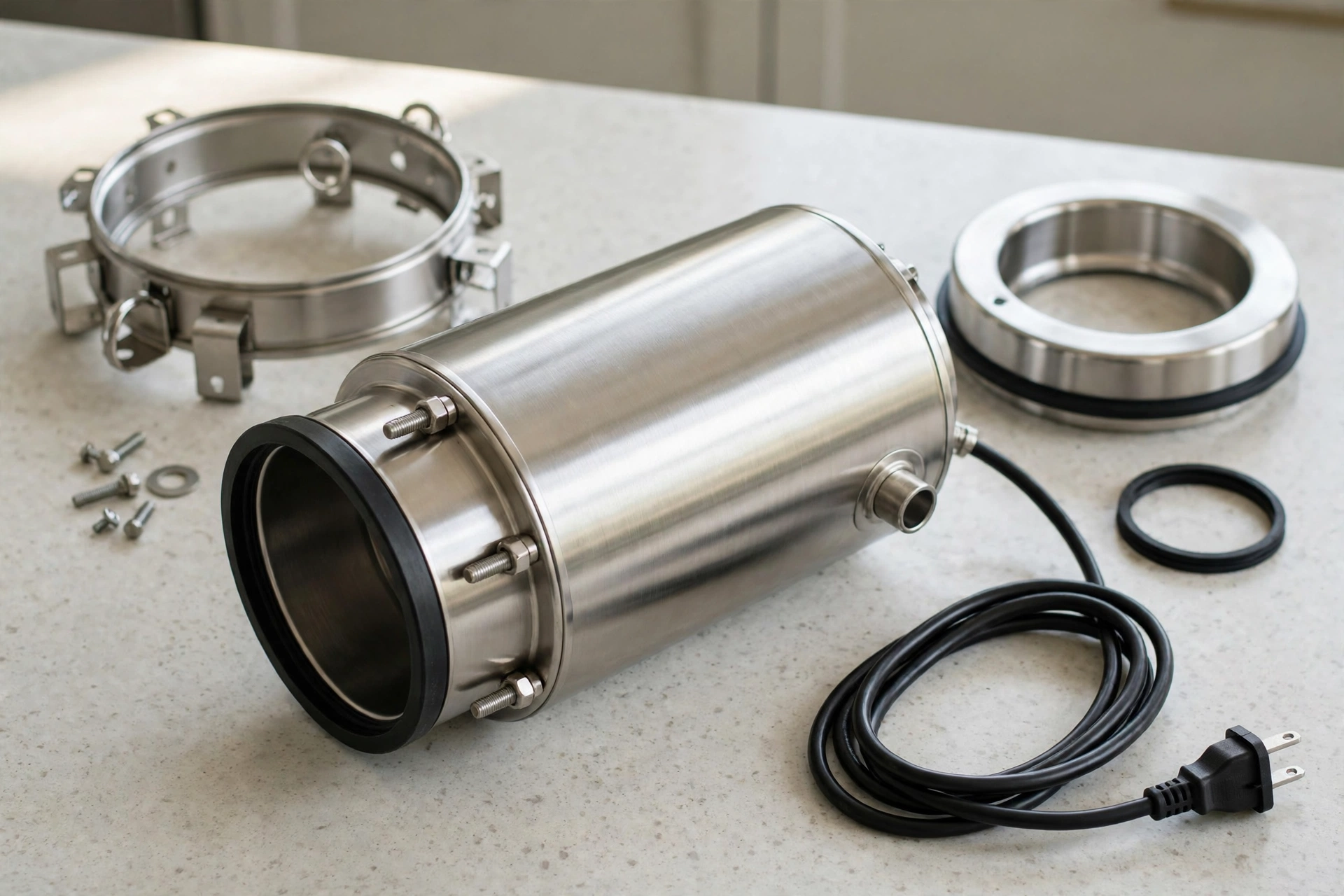
Garbage Disposal Prices by Size and Type
Disposals are sold by horsepower, and the horsepower you need depends on how much you cook and how many people you feed. Buying more power than you need wastes money; buying too little means jams and a short life. InSinkErator, which invented the garbage disposal in 1927, groups its models into Badger, Power and Advanced series by grind power and noise level — see their garbage disposal lineup to compare horsepower and features across the range.
| Disposal type | Horsepower | Typical unit price | Best for | Typical total installed |
|---|---|---|---|---|
| Budget continuous-feed | 1/3 HP | $50–$100 | Single person, light use | $150–$350 |
| Standard continuous-feed | 1/2 HP | $80–$200 | Most households, daily use | $200–$450 |
| Heavy-duty continuous-feed | 3/4 HP | $150–$300 | Large families, frequent cooking | $250–$550 |
| Premium continuous-feed | 1 HP | $200–$400 | Heavy use, fibrous foods, quiet operation | $300–$625 |
| Batch-feed | 1/2–3/4 HP | $100–$350 | Homes with small children (safer — only runs with the stopper in) | $200–$600 |
| Septic-safe disposal | 1/2–3/4 HP | $150–$350 | Homes on a septic system | $250–$600 |
1/3 HP ($50–$100). The cheapest disposals, fine for a single person or a couple who rarely cook at home. They jam more easily on fibrous foods like celery and artichokes, and they are louder than bigger units. For a rental or a light-use kitchen they are a fair choice, but for a family kitchen they are a false economy — a jammed disposal costs a service call that wipes out the saving.
1/2 HP ($80–$200). The sweet spot for most households. A 1/2 HP continuous-feed unit handles everyday food waste, including small bones and vegetable scraps, without jamming, and it is the size most plumbers install by default. If you are replacing a dead unit and do not know what size it was, a 1/2 HP unit is the safe replacement — it fits the same space and runs on the same circuit.
3/4 HP ($150–$300). The right size for a large family or a household that cooks most meals at home. The extra power grinds fibrous foods and small bones more reliably, and these units usually run quieter, with better sound insulation and stainless-steel grinding components that last longer. The price step from 1/2 HP to 3/4 HP is usually worth it if the disposal runs every day.
1 HP ($200–$400). Premium units for heavy use, with the quietest operation and the longest warranties — often 7 to 10 years. They are physically larger, so check the cabinet space before buying: a 1 HP unit may not fit under a shallow sink or alongside a deep trap. For most homes a 1 HP unit is more disposal than needed, but for a serious home cook it is the last disposal you will buy for a decade.
Batch-feed ($100–$350). Batch-feed disposals only run when the stopper is locked in place, which makes them the safest choice for homes with small children — nothing can be switched on accidentally. They cost more than the equivalent continuous-feed unit and they are slower, because food is loaded in batches, but for a family with toddlers the safety is worth the premium. Installation costs the same $100–$250 in labor as a continuous-feed unit.
Septic-safe disposals ($150–$350). If your home is on a septic system, a standard disposal can overload the tank with ground food waste. Septic-safe models inject a small dose of enzyme treatment with each use to help break down the waste, and they are the only type most septic installers recommend. Before installing any disposal on a septic system, check with your septic service provider — some older systems should not have a disposal at all, and a $250–$600 install that damages a septic field is a very expensive mistake.
Step by Step: What the Plumber Does
Knowing the sequence helps you judge a quote, prepare the cabinet, and understand why the job takes 30 minutes to 2 hours instead of ten minutes.
1. The plumber checks the existing setup. Before anything is unbolted, the plumber looks under the sink: what brand and size is the old unit, is the mounting ring reusable, is there a switched outlet or is the unit hardwired, and where does the drain run. This assessment sets the price of the whole job, because a same-brand replacement on a reusable mount is a quick swap, while a different-brand unit or a first-time install means new mounting hardware and drain work.
2. Power is turned off and the old unit is removed. The plumber switches off the disposal’s circuit at the breaker — or unplugs it — and disconnects the drain and the dishwasher hose. The old unit is unbolted from the mounting ring, which usually means supporting its weight with one hand while turning the locking ring with the other; a disposal weighs 10 to 20 pounds, and the cabinet gives no room to work. The old unit is removed and the mounting ring is inspected.
3. The mounting assembly is fitted. If the new unit matches the old mount, the plumber reuses it. If not, the old sink flange is removed, the old plumber’s putty is cleaned off, fresh putty is applied, and the new flange and mounting ring are seated and tightened from below. This is the step that decides whether the sink leaks: the flange has to be seated evenly, and the putty has to be compressed uniformly around the drain opening.
4. The drain is connected. The plumber connects the disposal’s discharge tube to the drain trap, refitting the pipes where the new unit sits differently from the old one. On a first-time install this is the longest step, because the tailpiece has to be shortened and the trap repositioned. The dishwasher drain hose is connected to the disposal’s inlet port, with the knockout plug removed first — the small step that, if missed, makes the dishwasher back up into the sink.
5. The power is connected and the unit is mounted. The disposal is lifted onto the mounting ring and locked in place, then plugged into the switched outlet or hardwired, depending on the setup. If a new outlet or circuit was needed, that work is done first, at $150–$400, and the disposal is connected last. The plumber checks that the unit sits level and that nothing presses against the cabinet walls.
6. Testing and the leak check. The plumber runs cold water, switches the disposal on, and feeds a small amount of food waste through it, checking every connection — the sink flange, the mounting ring, the discharge tube, and the dishwasher hose — for drips. The dishwasher is run through a drain cycle if one is connected. Run the cold water only while the disposal is grinding, and switch it off as soon as the grinding stops — the U.S. EPA’s WaterSense program recommends using water efficiently around the home, and a disposal needs running water only while it is actually grinding. A professional install is not finished until every joint has been watched under running water, because a slow drip inside a closed cabinet can rot the cabinet floor before anyone notices it.
What’s Included — and What’s Not
A garbage disposal installation quote covers the core work of mounting the unit and connecting the drain and the power. The trouble starts at the edges of that quote, where the items most likely to be needed — the new outlet, the drain rework, the disposal itself — are priced as extras. Before you book, know exactly where the line falls:
| Item | Standard replacement | Notes |
|---|---|---|
| Removing the old disposal | Included | Disposal of the old unit usually included; confirm |
| Mounting assembly and flange | Included | Reused if same brand; new mount is part of the unit price |
| Connecting the drain and trap | Included | Reconnection only on a replacement |
| Dishwasher hose connection | Included | Knockout plug removal included |
| Power connection (existing outlet) | Included | Plug-in or hardwire to existing supply |
| Testing and leak check | Included | Run with cold water, all joints checked |
| Cleanup | Included | Work area left clean |
| Workmanship warranty | Included (usually 1 year) | Covers defects in the installation |
| The disposal unit itself | Not included | Purchased separately, $75–$400 by type |
| Drain reconfiguration (first-time install) | Not included | $50–$200 in labor |
| Dedicated outlet or new circuit | Not included | $150–$400 extra, usually electrician work |
| Wall switch for the disposal | Not included | $50–$150 extra if no switch exists |
| Air switch (countertop button) | Not included | $75–$200 extra, popular where no wall switch fits |
| Septic-system check | Not included | Confirm with your septic provider first |
The three items most often missing. The unit itself, the electrical work, and the drain rework are the classic surprise charges on a garbage disposal installation. The unit at $75–$400 is often excluded from a labor-only quote — which is fair, as long as you know it. The new outlet or circuit at $150–$400 is genuinely unknowable until the plumber looks under the sink, which is why the quote should say in writing what happens if power is not already there. And the drain rework is the difference between a $200–$625 replacement and a $350–$1,000 first-time install. None of this is a scam — it is genuinely unknowable until the cabinet is opened — but it is why the range is wide, and why a quote that lists every line item is worth more than a quote that is merely cheaper.
Common Add-On Charges
Add-ons are where a $200 job becomes a $625 job — or a $1,000 job. Here is what each one typically costs and when you are likely to face it:
| Add-on | Typical cost | When it comes up |
|---|---|---|
| Dedicated outlet or new circuit | $150–$400 | First-time install with no power under the sink |
| Wall switch for the disposal | $50–$150 | No existing switch for the unit |
| Air switch (countertop button) | $75–$200 | No wall switch fits, or you want a cleaner look |
| Drain reconfiguration | $50–$200 | First-time install, or new unit sits differently |
| Dishwasher connection kit | $10–$30 | Connecting a dishwasher drain hose |
| Power cord kit | $10–$25 | Unit sold without a cord (many are) |
| Premium 1 HP unit upgrade | $120–$200 over standard | You want quieter, heavier-duty grinding |
| Septic-safe unit upgrade | $70–$150 over standard | Home on a septic system |
| Second disposal (double-bowl sink) | $150–$400 extra | Both bowls get a disposal on the same visit |
| Old unit haul-away fee | $0–$50 | Some plumbers charge; most include it |
Labor Costs by Region
A plumber’s rate is the biggest variable in the labor charge, and it follows local labor costs. The $50–$150 per hour national range is wide for exactly this reason: the same replacement job costs more in a high-cost metro area than in a smaller market.
| Region | Typical plumber rate | Typical replacement labor | Typical total installed |
|---|---|---|---|
| Northeast (Boston, New York) | $100–$150 per hour | $175–$250 | $300–$625 |
| West Coast (Los Angeles, Seattle) | $90–$150 per hour | $150–$250 | $275–$625 |
| Midwest (Chicago, Columbus) | $60–$110 per hour | $100–$200 | $200–$500 |
| South (Atlanta, Dallas, Houston) | $50–$100 per hour | $100–$175 | $175–$450 |
| Rural / small markets | $50–$80 per hour | $100–$150 | $150–$400 |
These are typical ranges, not quotes: a plumber in a high-cost city charges more because their own costs are higher, and the $100–$250 national labor range already reflects that spread. The unit price does not vary much by region — a 1/2 HP disposal costs about the same in Ohio as in California — so the regional difference in the total is almost entirely the labor rate. If you are planning a wider kitchen upgrade, our kitchen remodel cost calculator can put the disposal in the context of the whole project. For the rate context behind these numbers, see our guide to plumber cost per hour.
Plumber vs. Handyman vs. DIY for a Garbage Disposal
| Licensed plumber | Handyman | DIY | |
|---|---|---|---|
| Typical replacement total | $200–$625 installed | $150–$400 installed | $50–$380 (unit only) |
| Labor charge | $100–$250 | $75–$150 | $0 — your time |
| Time on site | 30 minutes–2 hours | 1–2 hours | 1–3 hours for a first-timer |
| Can do a first-time install | Yes | Sometimes — drain work only | Yes, with care |
| Can add a new outlet or circuit | No — electrician needed | No | No — electrician needed |
| Drain reconfiguration | Yes | Sometimes | Yes, with the right fittings |
| Dishwasher connection | Yes | Usually | Yes, if the knockout plug is removed |
| Workmanship warranty | Usually 1 year | Varies; often none | None — mistakes are on you |
| Insurance / liability | Licensed and insured | Varies — ask for proof | None |
| Best for | First-time installs and any job with electrical work | A simple same-brand swap | A same-brand swap if you are handy |
A replacement is the one plumbing job a handyman can fairly do. Swapping a disposal where the mount, the drain, and the power already exist is straightforward work, and a handyman at $75–$150 in labor is a fair budget option for it — as long as the new unit matches the old mount. But a first-time install, or any job that needs a new outlet or circuit, is plumber and electrician work: the drain rework and the electrical connection are where mistakes cause leaks and, in the case of the power, real danger. For the rate context, see our guide to plumber cost per hour.
DIY vs. Hiring a Pro to Install a Garbage Disposal
| DIY | Hiring a pro (plumber) | |
|---|---|---|
| Unit cost | $50–$380 by type | Same — you buy the unit either way, or the plumber supplies it |
| Labor cost | $0 | $100–$250 |
| All-in total, replacement | $50–$380 | $200–$625 |
| All-in total, first-time install | $50–$380 + fittings ($20–$50) | $350–$1,000 |
| Time required | 1–3 hours for a first-timer | 30 minutes–2 hours on site |
| Tools needed | Plumber’s putty, wrench, screwdriver, bucket, towels | Included in the labor price |
| Electrical work | Not a DIY job — hire an electrician ($150–$400) | Handled by the plumber’s electrician |
| Leak risk | Higher — mounting flange and discharge tube are the usual leaks | Low — every joint tested under running water |
| Warranty | Manufacturer’s warranty on the unit only | Usually 1-year workmanship warranty + manufacturer’s warranty |
| Best for | Same-brand replacement, handy homeowner | First-time install, any electrical work, or if you want it guaranteed |
A same-brand replacement is a fair DIY job. If the new disposal is the same brand and size as the old one, the mounting ring is already in place, the drain lines up, and the power is already connected — the job is mostly unbolting one unit and bolting in another, and a handy homeowner can do it in 1–3 hours with basic tools. The two mistakes to avoid are forgetting to remove the dishwasher knockout plug and under-tightening the mounting ring, which causes a slow leak at the sink flange. A first-time install is not a DIY job for most people. Reconfiguring the drain, seating a new sink flange, and adding power are three separate skills, and a leak inside a closed cabinet can rot the cabinet floor before anyone notices. If there is no outlet under the sink, the electrical work is not a DIY job at all — hire an electrician at $150–$400 and let the plumber do the rest. The $100–$250 you save by doing it yourself is real money, but it is only a saving if the job does not leak.
Money-Saving Tips for Installing a Garbage Disposal
1. Buy the unit yourself, on sale. The disposal is the most controllable cost, and a standard 1/2 HP continuous-feed unit at $80–$200 goes on sale regularly at home centers. Buying it yourself and hiring the plumber for labor only at $100–$250 is the cheapest way to get professional work — and it avoids the markup a plumber adds when they supply the unit. A budget 1/3 HP unit at $50–$100 is the cheapest way to keep a replacement near $150–$350 all-in. 2. Match the old unit’s brand. If the new disposal is the same brand as the old one, the mounting ring is usually reusable, which saves the plumber the fiddliest step of the job and can shave time off the $100–$250 labor charge. Take a photo of the old unit’s label before you shop, and check the mount compatibility before you buy. 3. Get the quote itemized. A quote that lists the unit, the labor, and any electrical work as separate lines is worth more than a quote that is merely cheaper. If the electrical work at $150–$400 is not in the quote, it is not in the price — and it will appear later as an extra. Ask in writing whether the price includes the unit, the drain work, and the power. 4. Check the power before you call. Open the cabinet and look: is there a switched outlet under the sink, or is the disposal hardwired? If there is an outlet, say so when you call — the plumber can quote a $200–$625 replacement instead of pricing for the worst case. If there is no power, say that too, so the quote includes the $150–$400 electrical work from the start. 5. Bundle it with other kitchen plumbing. If you are already having a plumber out for another job — a new faucet, a toilet, or a kitchen upgrade — adding a disposal swap to the same visit costs far less than a separate trip, because the service-call fee is paid once. For the wider project, our kitchen remodel cost calculator can help you budget the whole job. And if a toilet is on the same list, see how much Home Depot charges to install a toilet for a similar fixture-install comparison. 6. Choose 1/2 HP unless you need more. A 1/2 HP continuous-feed unit at $80–$200 handles everyday food waste for most households, and the step up to 3/4 HP at $150–$300 or 1 HP at $200–$400 is only worth it if the disposal runs every day for a large family or a serious cook. For most homes the 1/2 HP unit is the right size, and the money saved buys a better warranty instead. 7. Get two or three quotes for a first-time install. A plumber’s rate runs $50–$150 per hour, and the drain route on a first-time install is a judgment call — different plumbers will route it differently, and quotes for the same job can differ by $100–$200. A five-minute phone call to two more plumbers is the cheapest way to know whether the first quote is fair. 8. Do the prep work yourself. Clear the cabinet under the sink before the plumber arrives, put a bucket and towels under the trap, and know where the breaker is. A plumber who can start work the moment they arrive finishes sooner, and on a job billed at $50–$150 per hour that saved time is real money. 9. Keep the old unit’s paperwork. If the old disposal is still under warranty, the manufacturer may replace it free — and a warranty replacement with labor-only installation at $100–$250 is the cheapest disposal install there is. Check the warranty before you buy a new unit.
Frequently Asked Questions
How much should someone charge to install a garbage disposal?
In 2026, a professional should charge $200–$625 total installed to replace an existing garbage disposal, or $100–$250 for labor only if you supply the unit. The disposal unit itself costs $75–$400 by horsepower and brand — a standard 1/2 HP continuous-feed unit is $80–$200, a batch-feed unit is $100–$350, and a premium 1 HP unit is $200–$400. A first-time install where no disposal exists costs $350–$1,000, because of the drain rework and the electrical work. Adding a dedicated outlet or a new circuit costs $150–$400. A standard replacement takes 30 minutes to 2 hours, and a plumber charges $50–$150 per hour.
How long does it take to install a garbage disposal?
A standard replacement takes 30 minutes to 2 hours on site, including removing the old unit, fitting the mounting assembly, reconnecting the drain and the dishwasher hose, connecting the power, and testing for leaks. A first-time install takes longer — usually 2–4 hours — because the plumber has to install the mounting assembly from scratch, reconfigure the drain pipes, and add power if there is no outlet under the sink. Scheduling typically takes a few days, and longer if an electrician has to be booked for the new outlet or circuit.
Can I install a garbage disposal myself?
Yes, if it is a same-brand replacement and you are handy — the mounting ring, the drain, and the power are already in place, and the job is mostly unbolting one unit and bolting in another, taking 1–3 hours for a first-timer and costing $50–$380 for the unit alone, saving $100–$250 in labor. A first-time install is harder: the drain has to be reconfigured, a new sink flange seated, and power added, and the electrical work at $150–$400 is not a DIY job. The two most common DIY mistakes are forgetting to remove the dishwasher knockout plug and under-tightening the mounting ring, which causes a slow leak at the sink flange.
Do I need an electrician to install a garbage disposal?
Only if there is no power under the sink. If a switched outlet already exists in the cabinet, the plumber can plug the new disposal straight in and no electrician is needed. If there is no outlet, adding a dedicated outlet or a new circuit costs $150–$400 and is electrician work — a plumber is not licensed for it in most jurisdictions. Some disposals are hardwired rather than plugged in, which also needs an electrician. Check the cabinet before you call, so the quote includes the electrical work from the start instead of appearing as an extra.
Is a garbage disposal worth installing?
For most households, yes — a disposal costs $200–$625 installed as a replacement and makes the kitchen sink far easier to use, cutting down on food waste in the trash and the smells that come with it. It is one of the cheapest plumbing upgrades in a house, and a standard 1/2 HP unit at $80–$200 with $100–$250 in labor is a small job by plumbing standards. The exception is a home on a septic system, where a standard disposal can overload the tank — in that case, use a septic-safe model at $150–$350 and check with your septic service provider first, because some older systems should not have a disposal at all.
The Bottom Line
For a garbage disposal installation in 2026, a professional should charge a typical total of $200–$625 installed to replace an existing unit, or $100–$250 for labor only if you supply the unit yourself. The disposal itself costs $75–$400 — a standard 1/2 HP continuous-feed unit at $80–$200, a batch-feed unit at $100–$350, and a premium 1 HP unit at $200–$400 — and the job takes 30 minutes to 2 hours at a plumber’s rate of $50–$150 per hour. A first-time install where no disposal exists costs $350–$1,000, because the drain has to be reconfigured and power has to be added, and adding a dedicated outlet or a new circuit costs $150–$400. The two things that set the price more than anything else are whether a disposal already exists and whether power already exists under the sink: a same-brand replacement with an outlet in place is a $200–$450 job, while a first-time install with no power is a job that reaches $1,000. Doing it yourself saves $100–$250 in labor on a straightforward replacement, but the electrical work is never a DIY job. Buy the unit yourself on sale, match the old unit’s brand so the mount is reusable, check the power before you call, and get the quote itemized with the unit, the labor, and the electrical work each listed as its own line — that is how you know the price you are quoted is the price you will pay.
Prices are typical 2026 US ranges for planning purposes and vary by region, unit choice, and site condition; get itemized local quotes for an exact project price.
5 thoughts on “How Much Should Someone Charge to Install a Garbage Disposal in 2026”