
How Much Does a Plumber Charge to Fit a New Toilet in 2026?
How much does a plumber charge to fit a new toilet in 2026? For a standard like-for-like replacement, a plumber’s labor typically costs $150–$450, with the national average near $370 for a same-spot swap. Most homeowners pay $350–$800 all-in for the complete job — fixture plus labor — and most standard jobs land at $375–$500. The toilet itself is not included in the labor price, so the final bill depends on the fixture you choose: a basic two-piece toilet adds $100–$200, while a smart or bidet toilet can add $500–$2,000+. The single most important thing to understand is that plumbers price this job in two ways — a flat rate for a standard swap, or an hourly rate plus parts — and which one you get changes what you pay.
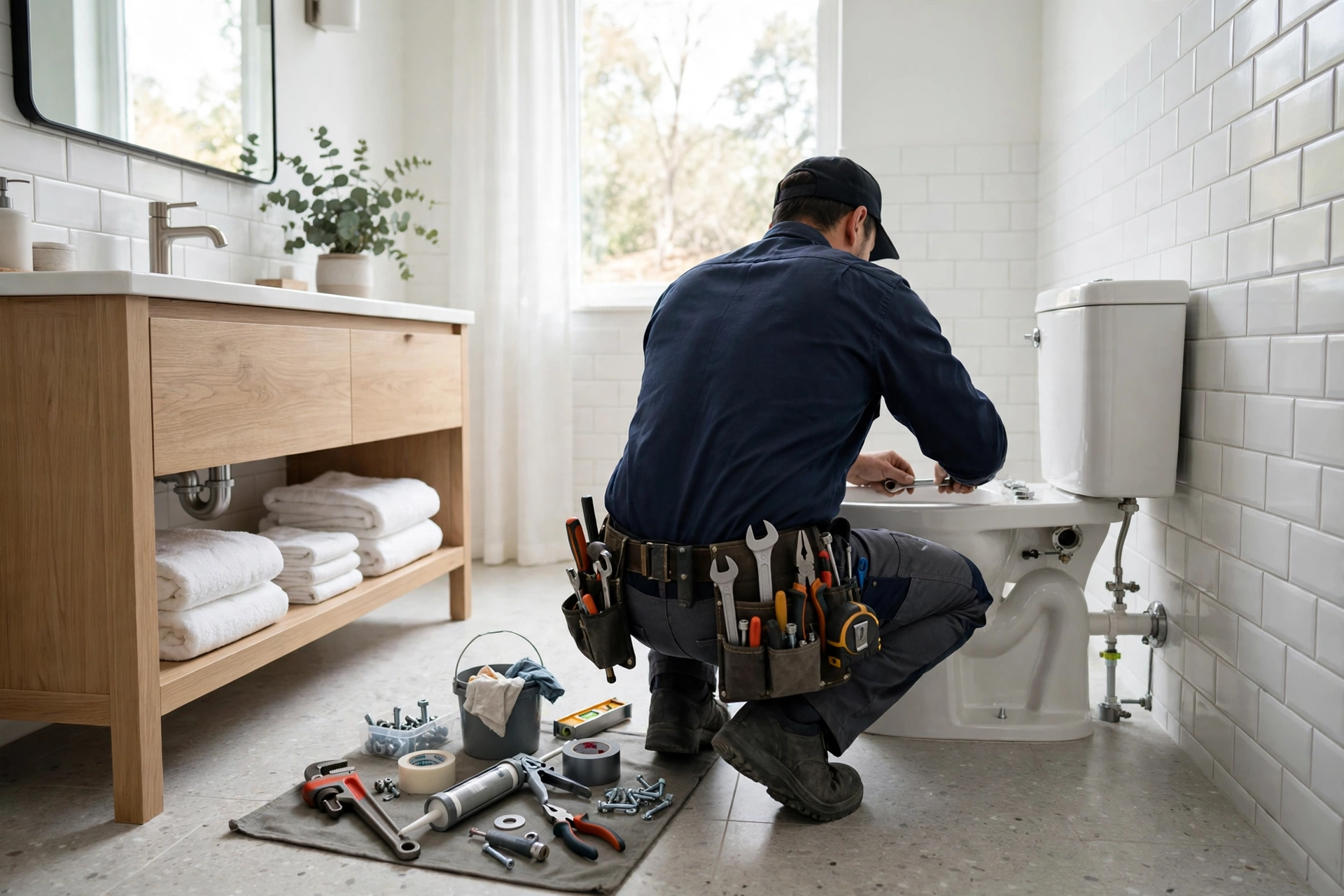
That distinction matters because a toilet fitting is one of the most predictable plumbing jobs in a house. There is no mystery inside the wall, no excavation, and no permit for a like-for-like swap in most areas. The plumber removes the old toilet, checks the flange and the shut-off valve, sets the new toilet on a fresh wax ring, connects the supply line, and tests for leaks. For a straightforward replacement that takes 45–90 minutes of actual work and 2–4 hours on site including travel, prep, and testing, the flat rate is usually the better deal for you. But if the flange is cracked, the subfloor is rotted, or the drain needs moving, the job stops being a standard swap — and the price follows the extra work, not the quote.
This guide breaks down the real 2026 cost of a plumber fitting a new toilet: labor by job type, total installed cost by toilet type, exactly what is included and what costs extra, the hourly rates and trip fees behind the numbers, and how hiring a plumber compares with Home Depot, Lowe’s, and doing it yourself. Every range below is a typical 2026 US figure, framed as “typical” or “average,” because your market and your bathroom set the final number.
Quick-answer table (typical 2026 plumber toilet installation costs):
| Item | Typical cost |
|---|---|
| Plumber labor to fit / replace a toilet | $150–$450 |
| National average labor, same-spot swap | Near $370 |
| Total installed (fixture + labor) | $350–$800 |
| Most standard jobs, all-in | $375–$500 |
| Plumber hourly rate | $75–$150 (up to $185+ in high-cost coastal cities) |
| Service call / trip fee | $75–$150 |
| Time on site, standard swap | 2–4 hours (45–90 minutes for the swap itself) |
| New toilet, basic two-piece | $100–$200 |
| New toilet, one-piece | $200–$400 |
| New toilet, comfort-height / elongated | $150–$350 |
| New toilet, smart / bidet | $500–$2,000+ |
| Cracked flange repair | $150–$200 |
| Rotted subfloor repair | $200–$500 |
| Relocated drain lines | $1,000+ |
| Shut-off valve replacement | $50–$100 |
| New supply line | $25–$75 |
| DIY, parts only (wax ring, bolts, supply line) | $50–$100 |
| Home Depot installation labor (comparison) | $179–$299 |
| Lowe’s installation labor (comparison) | Starts around $180; range $150–$400 |
How Much Does a Plumber Charge to Fit a New Toilet by Toilet Type
The toilet you choose is the single biggest driver of the total bill, because the fixture is a separate purchase on top of the labor. The plumber’s labor does not change much between a basic two-piece and a one-piece — the job is the same either way — but the fixture price does, and a smart toilet can add electrical work on top. Here is the full picture:
| Toilet type | Toilet price | Plumber labor | Typical total installed |
|---|---|---|---|
| Basic two-piece | $100–$200 | $150–$450 | $350–$800 (most $375–$500) |
| One-piece | $200–$400 | $150–$450 | $450–$800 |
| Comfort-height / elongated | $150–$350 | $150–$450 | $350–$800 |
| Smart / bidet toilet | $500–$2,000+ | $150–$450 | $800–$2,450+ |
Basic two-piece ($375–$500 most jobs). This is the entry point and the most common toilet replacement: a standard two-piece toilet — separate tank and bowl — at $100–$200 for the fixture, plus $150–$450 in labor. Most standard jobs with a basic two-piece land at $375–$500 all-in, because the labor for a straightforward swap clusters near the $370 average. Two-piece toilets are the cheapest to buy, the easiest to find in stock, and the simplest to install, which is why most replacements land in this range.
One-piece ($450–$800 installed). A one-piece toilet — tank and bowl molded as a single unit — costs $200–$400 for the fixture, plus the same $150–$450 in labor. One-piece toilets are easier to clean, with no seam between tank and bowl for grime to collect, and they look more modern. They are also heavier and bulkier to carry and set, which is why some plumbers charge toward the top of the labor range for them. If the bathroom is up a flight of stairs or the toilet has to be carried a long way, ask whether the quote covers the lifting.
Comfort-height / elongated ($350–$800 installed). Comfort-height toilets — a taller seat, usually 17–19 inches, designed to be easier to sit on and stand up from — and elongated bowls cost $150–$350 for the fixture, plus $150–$450 in labor. This is the category where most homeowners land when they replace a toilet deliberately rather than in an emergency: the extra height and the longer bowl are genuinely more comfortable, and the price premium over a basic round-front two-piece is modest. Measure your bathroom before you buy — an elongated bowl needs about two more inches of clearance in front than a round bowl.
Smart / bidet toilet ($800–$2,450+ installed). A smart toilet or bidet toilet costs $500–$2,000+ for the fixture, plus $150–$450 in labor — and possibly more if an electrician has to add a GFCI outlet, because a smart toilet needs power within about 3 feet of the fixture. This is the category where the standard labor range is most likely to fall short: the plumbing part is the same, but the electrical requirement is a separate trade. Check the manufacturer’s installation instructions — Kohler’s own Smart Toilet Installation Instructions specify a properly grounded GFCI-protected receptacle — before you book. If you are choosing a new toilet for water efficiency as well as comfort, look for the EPA’s WaterSense label, which marks toilets that use 1.28 gallons per flush or less.
How a Plumber Prices a Toilet Installation
Plumbers charge for a toilet fitting in one of two ways, and knowing which one you are getting is the difference between a fair price and a surprise bill.
Flat rate (most common for a standard swap). For a like-for-like replacement in the same spot, most plumbers quote a flat rate of $150–$450 for the labor. The flat rate covers removal of the old toilet, the new wax ring and floor bolts, setting the new toilet, connecting the supply line, and leak testing. The national average for this flat-rate swap is near $370, and reported averages cluster tightly around it — one major cost guide puts the range at $224–$533 with an average of $374. A flat rate protects you: if the swap takes the plumber 45 minutes or three hours, you pay the same price. Always ask what the flat rate includes before you agree to it — in particular, whether removal and disposal of the old toilet, the wax ring, and the supply line are included or extra.
Hourly rate plus parts. Some plumbers, especially on jobs with unknown conditions, charge $75–$150 per hour plus parts, with the rate climbing to $185+ in high-cost coastal cities. At that rate, a standard swap that takes 2–4 hours on site costs roughly the same as the flat rate — $150–$450 — but the clock keeps running if the flange is bad or the floor needs work. Hourly pricing is fair when the job is genuinely uncertain, but for a straightforward swap you should prefer a flat-rate quote, because it puts the risk of a slow job on the plumber, not on you.
The service call / trip fee. Many plumbers charge a $75–$150 service call or trip fee just to come out, and whether it is included in the flat rate or added on top varies by plumber. Some waive it if you hire them for the job; some apply it toward the total; some charge it on top of the labor. Ask before you book: “Is the trip fee included in the $370, or is it extra?” A $370 quote with a $75 trip fee on top is a $445 job, and that is the kind of difference that turns a good quote into a mediocre one.
Emergency and after-hours rates. A toilet that is leaking onto the floor at 10 p.m. is an emergency call, and emergency rates run roughly 1.5 to 2 times the standard rate. If the job can wait until morning, it usually should — a standard swap booked during normal hours at $150–$450 is a very different bill from the same swap at emergency rates. If water is actively leaking, turn off the shut-off valve behind the toilet and mop up; that buys you the night.
If you want the full picture on what plumbers charge per hour across job types, our guide to plumber cost per hour breaks down hourly rates, trip fees, and flat-rate jobs in detail.
What’s Included — and What’s Not
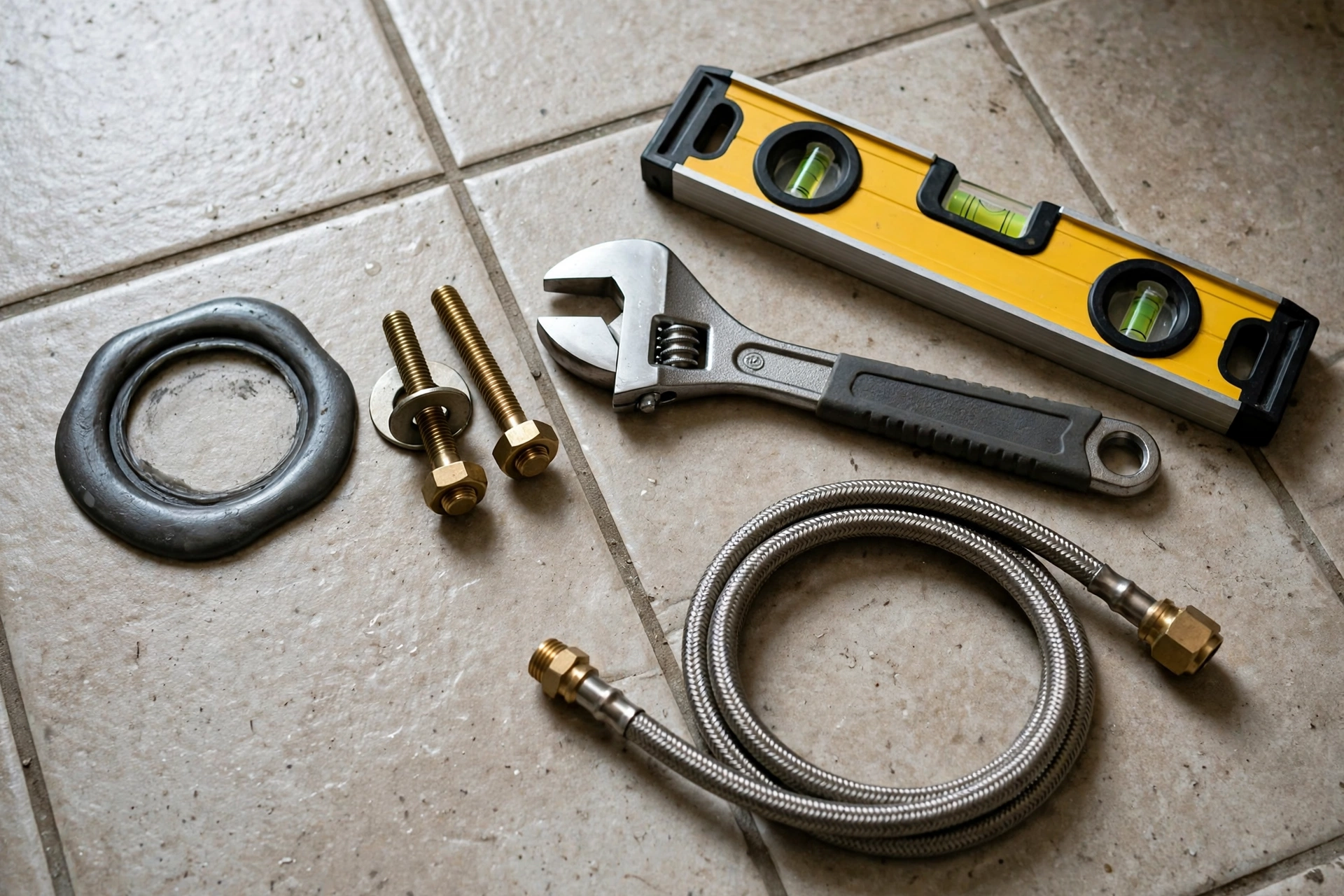
The standard labor price covers the core work of a straightforward replacement. The trouble starts at the edges of that package, where the items most likely to be needed on an older bathroom — a corroded flange, a seized shut-off valve, a damaged floor — are priced as extras. Before you book, know exactly where the line falls:
| Item | Standard labor price | Notes |
|---|---|---|
| Removal of old toilet | Included | Standard labor covers removing the existing toilet |
| Disposal / haul-away of old toilet | Usually included; sometimes a separate charge | Confirm in writing — some plumbers charge $25–$30 separately |
| New wax ring and floor bolts | Included | Standard installation parts are part of the labor price |
| Setting the new toilet | Included | Leveling, bolting down, and seating on the wax ring |
| Connecting the supply line | Included | Connection to existing plumbing |
| Leak testing | Included | Plumber tests for leaks before leaving |
| Cleanup | Included | Work area left clean |
| The toilet itself | Not included | Purchased separately, $100–$400 typical |
| Flange repair or replacement | Not included | $150–$200 extra |
| Shut-off valve replacement | Not included | $50–$100 extra |
| New supply line | Not included | $25–$75 extra if the old one is not reusable |
| Subfloor repair if rot or damage is found | Not included | $200–$500 extra |
| Drain relocation | Not included | $1,000+ extra |
| Smart toilet electrical work (GFCI outlet) | Not included | Electrician required if no outlet within 3 feet |
| Plumbing or structural modifications | Not included | Priced per job |
| Drain clearing | Not included | Priced per job |
The three items most often missing. Flange repairs, shut-off valve replacement, and subfloor damage are the classic surprise charges on a toilet installation. The flange — the ring that bolts the toilet to the floor drain — is hidden under the old toilet, so nobody knows its condition until the old toilet comes off. If it is corroded or cracked, the plumber will not set a new toilet on a bad flange, and the $150–$200 repair becomes a change order on the spot. If your shut-off valve is old, seized, or dripping, that is another $50–$100. And if the subfloor under the toilet is rotted from a slow leak, the $200–$500 repair can dwarf the installation itself. None of this is a scam — it is genuinely unknowable until the old toilet is lifted — but it is why the $350–$800 all-in range is wider than the $150–$450 labor range, and why you should budget for at least one extra before you book.
Common Add-On Charges
Add-ons are where a $370 average labor charge becomes a $500+ total — or more. Here is what each one typically costs and when you are likely to face it:
| Add-on | Typical cost | When it comes up |
|---|---|---|
| Cracked flange repair | $150–$200 | Corroded, cracked, or broken flange found under the old toilet |
| Shut-off valve replacement | $50–$100 | Old valve seized, dripping, or corroded |
| New supply line | $25–$75 | Old supply line worn, kinked, or the wrong length for the new toilet |
| Old toilet removal / disposal (if not included) | $25–$30 | Plumbers who price haul-away separately |
| Rotted subfloor repair | $200–$500 | Subfloor damaged by a long slow leak under the old toilet |
| Relocated drain lines | $1,000+ | Moving the toilet to a new position in the bathroom |
| GFCI outlet for a smart toilet | Varies; electrician required | No electrical outlet within 3 feet of the toilet |
| Drain clearing | Varies by job | Clogged or slow drain discovered during the swap |
A real-world example. A standard swap quoted at $370 for labor, with a basic two-piece toilet at $150, comes to $520 all-in — right in the middle of the $375–$500 range most standard jobs land in. Add a cracked flange at $175 and the total reaches $695, still inside the $350–$800 all-in range but at the top of it. That is the most common story in customer reports: the labor price is real, and one small repair on top of it is normal. Budget the labor price plus $50–$200 for the most likely extra, and you will rarely be surprised.
The drain relocation trap. Moving a toilet to a new position is not a toilet installation — it is a plumbing remodel. Relocating drain lines costs $1,000+, because it means cutting into the floor, rerouting the drain, and often moving the water supply as well. If your quote jumps past $1,000 for what you thought was a swap, ask whether the toilet is moving. If it is staying in the same spot, the job should be in the $350–$800 range, and a quote far above that deserves a second opinion.
Materials vs. Labor Breakdown for a Plumber Toilet Installation
On a toilet installation, the fixture is often the bigger share of the bill — which is the opposite of most plumbing jobs, where labor dominates. Here is how a typical basic two-piece replacement at $375–$500 all-in breaks down:
| Cost component | Typical range |
|---|---|
| New toilet, basic two-piece | $100–$200 |
| Plumber labor | $150–$450 (average near $370) |
| Wax ring, floor bolts, standard parts | Included in labor |
| Old toilet removal and disposal | Usually included; $25–$30 if charged separately |
| Most likely add-on (flange or valve) | $50–$200 |
| Typical all-in total, basic two-piece | $375–$500 |
| Typical all-in total with one add-on | $425–$700 |
Labor runs $150–$450 for the installation alone, and it is the most predictable part of the bill: a standard swap is a 45–90-minute job at a flat rate, and the rate is set by your market, not by the hour. The fixture price is the more variable part — a basic two-piece at $100–$200 versus a smart toilet at $500–$2,000+ — because the toilet you pick is entirely your choice. The add-ons are the least predictable part, because they depend on what the plumber finds under the old toilet.
If the toilet replacement is part of a bigger bathroom project, our guide to the 10×10 bathroom remodel cost shows how a fixture swap fits into a full remodel budget, and our guide to bathroom remodel cost per square foot covers the per-square-foot math across bathroom sizes. Before you commit to a scope, run the numbers through our bathroom remodel cost calculator — it will show how a fixture swap fits into the total project cost before you sign a contract.
What Affects the Cost of a Plumber Fitting a Toilet
No two plumber toilet installation quotes are identical, because the price is built from your market, your toilet, and the condition of your bathroom. These are the factors that move it most:
Your local market. The $150–$450 labor range is wide for exactly this reason: the same standard swap costs more in a high-cost metro area than in a smaller market, because the plumber’s rate follows local labor costs. In high-cost coastal cities the hourly rate can reach $185+, and the flat rate follows it upward. The $370 average is a national figure — your zip code sets the real number.
The condition of the flange. The flange is the single most common source of extra cost, at $150–$200 to repair or replace. It is also the most common reason a job takes longer than the quoted 45–90 minutes: a corroded flange has to be cut out and replaced before the new toilet can be set. If your old toilet has been rocking, leaking at the base, or smelling of sewer gas, expect the flange to need attention.
The shut-off valve and supply line. An old shut-off valve that will not turn, or turns and then drips, has to be replaced — $50–$100. A supply line that is kinked, corroded, or the wrong length for the new toilet’s inlet is another $25–$75. These are cheap parts with real labor attached, and they are the most common “while we’re here” charges on an older bathroom.
Subfloor damage. If the subfloor under the old toilet is rotted from a slow leak, the plumber cannot set a new toilet on it. Subfloor repair runs $200–$500 depending on how much subfloor has to be cut out and replaced, and it can turn a 45–90-minute swap into a multi-hour job.
Smart toilet electrical needs. A smart or bidet toilet needs a GFCI-protected outlet within about 3 feet. If there is no outlet near the toilet, an electrician has to add one, and that is a separate trade from the plumber doing the installation. Check for the outlet before you buy the toilet, not after the plumber arrives.
Whether the toilet is moving. A like-for-like swap in the same spot is a $350–$800 job. Moving the toilet means relocating drain lines at $1,000+, and the price stops being a toilet installation and starts being a remodel. Confirm the toilet is staying put before you compare quotes.
How many quotes you get. Plumbers’ flat rates for the same swap can vary by $100–$200 in the same city. Two quotes for the same scope — same toilet, same spot, same condition — are the cheapest way to know whether a $450 quote is a fair price in your market or the top of the range.
Plumber vs. Home Depot vs. Lowe’s vs. DIY
| Independent plumber | Home Depot | Lowe’s | DIY | |
|---|---|---|---|---|
| Typical labor, basic installation | $150–$450 | $179–$299 (flat rate) | Starts around $180; range $150–$400 | $0 (your time) |
| National average labor | Near $370 | — | — | — |
| Total installed, basic two-piece | $350–$800 (most $375–$500) | $279–$499 | Similar to Home Depot | $150–$300 |
| Who does the work | The plumber you hire, or their crew | Licensed local third-party contractor | Licensed local third-party contractor | You |
| Toilet included? | No — buy separately, or the plumber supplies it | No — buy separately, $100–$400 typical | No — buy separately | No — you buy it |
| Labor warranty | Varies by plumber | 1 year | 1 year | None |
| Scheduling | Often faster; sometimes same-week or next-day | Typically a few days to a week | Similar — a few days to a week | Whenever you are free |
| Time on site | 2–4 hours (45–90 minutes for the swap itself) | About 90 minutes to 2–4 hours | About 90 minutes to 2–4 hours | 2–4 hours for a first-timer |
| How you book | Call or book directly | Add installation at checkout or at the Service Desk | Add installation at checkout or at the Service Desk | — |
| Best for | The cheapest labor, or a job with complications | A one-stop buy-and-install with a warranty | A one-stop buy-and-install with a warranty | A straightforward like-for-like swap by a confident DIYer |
When a plumber wins. An independent plumber’s labor runs $150–$450, and at the low end — $150–$200 for a straightforward swap — a local plumber can undercut both retailers. A plumber also wins when the job is complicated: a rotted subfloor, a flange that needs rebuilding, or a drain that needs clearing. The retailer model is built for standard swaps; a plumber is built for everything else. A plumber is also usually faster to schedule — often same-week or next-day, against a few days to a week for the retailers.
When Home Depot wins. You want to buy the toilet and the installation in one transaction, with a vetted contractor and a one-year labor warranty, and you do not want to find and vet a plumber yourself. At $179–$299 for labor, the Home Depot price sits in the middle of a plumber’s $150–$450 range, not at the top of it. Our full guide to how much Home Depot charges to install a toilet breaks down that route in detail, including what its standard package covers and what costs extra.
When Lowe’s wins. The two retailers are near-identical on this service: both use licensed third-party contractors, both charge a flat rate, both back the work with a one-year labor warranty, and both require you to buy the toilet separately. Lowe’s installation starts around $180, with a reported range of $150–$400 depending on extras — essentially the same service at a similar price. Choose whichever store has the toilet you want in stock, or whichever quotes lower for your zip code.
When DIY wins. A toilet installation is one of the most DIY-friendly plumbing jobs in a house: the parts cost $50–$100 — a wax ring at $5–$15, floor bolts, and a supply line — and a straightforward swap is a 2–4-hour job for a first-timer. The saving is real — $150–$300 all-in against $350–$800 through a plumber. But a mistake on a wax ring seal means water in your subfloor, and there is no warranty to fall back on when you did it yourself.
DIY vs. Hiring a Pro for a Toilet Installation
| DIY | Hiring a pro (plumber) | |
|---|---|---|
| Toilet cost | $100–$200 basic two-piece; $200–$400 one-piece | Same — you buy the toilet either way |
| Labor cost | $0 (your time) | $150–$450 |
| Parts (wax ring, bolts, supply line) | $50–$100 | Included in the labor price |
| All-in total, basic two-piece | $150–$300 | $350–$800 (most $375–$500) |
| Time required | 2–4 hours for a first-timer; 90 minutes with experience | 2–4 hours on site; 45–90 minutes for the swap itself |
| Tools needed | Adjustable wrench, level, putty knife, sponge, bucket, new wax ring ($5–$15) | Included in the labor price |
| Flange repair | You do it — $150–$200 in parts and time if the flange is bad | $150–$200, done by the plumber |
| Leak testing | You test it — mistakes are on you | Professional testing, with a warranty from many plumbers |
| Heavy lifting | You lift a 60–100 lb toilet, twice | The plumber does it |
| Best for | A straightforward like-for-like swap by a confident DIYer | Any job with a bad flange, floor damage, or a smart toilet |
A toilet installation is one of the most DIY-friendly plumbing jobs in a house: the parts cost $50–$100 — a wax ring at $5–$15, floor bolts, and a supply line — and a straightforward swap is a 2–4-hour job for a first-timer. When DIY wins: the job is a like-for-like replacement, the flange is in good shape, the shut-off valve works, the floor is solid, and you are comfortable lifting a 60–100 lb toilet and setting it straight down onto a wax ring without rocking it. The saving is real — $150–$300 all-in against $350–$800 through a plumber. When a pro wins: the flange is corroded, the subfloor is rotted, the shut-off valve is seized, or the toilet is a smart model that needs electrical work. A mistake on a wax ring seal means water in your subfloor, and there is no warranty to fall back on when you did it yourself.
Money-Saving Tips for a Plumber Toilet Installation
1. Get two or three plumber quotes for the same scope. Labor for the same swap can vary by $100–$200 in the same city. A five-minute phone call to two plumbers is the cheapest way to know whether a $450 quote is a fair price in your market or the top of the range. 2. Ask for a flat rate, not an hourly rate, on a standard swap. A flat rate of $150–$450 puts the risk of a slow job on the plumber. On an hourly rate of $75–$150, the clock keeps running if the flange is bad or the floor needs work. 3. Ask whether the trip fee is included. A $75–$150 service call on top of a $370 labor quote is a $445 job. Some plumbers waive the trip fee if you hire them, or apply it toward the total — ask before you book. 4. Check the flange and valve yourself first. If the toilet rocks, if there is water staining on the floor around the base, or if the shut-off valve will not turn, expect a $150–$200 flange repair or a $50–$100 valve replacement. Knowing before the plumber arrives means you can budget for it. 5. Keep the toilet standard. A standard two-piece toilet at $100–$200 is the cheapest fixture and the cheapest install. A smart toilet at $500–$2,000+ adds fixture cost and possibly electrical work on top. 6. Buy the toilet yourself. A plumber who supplies the fixture may mark it up. Buying the same toilet at a retailer for $100–$200 and paying only for labor keeps the $350–$800 total at the low end. 7. Replace the supply line and valve while the toilet is off. If the valve is old or the supply line is worn, replacing them during the installation costs $25–$100 in parts and a few minutes of the plumber’s time. Replacing them later means another $75–$150 service call. 8. Do not buy a smart toilet without checking for an outlet. A smart toilet at $500–$2,000+ needs a GFCI outlet within about 3 feet. If there is no outlet, an electrician adds to the job. Check for the outlet before you buy the toilet. 9. Time the job outside the busy season. Plumbers are busiest in spring and early summer. A fall or winter booking can mean a faster start date — often same-week or next-day — and occasionally a better price. 10. Do the old-toilet haul yourself if it is charged separately. In markets where haul-away and disposal is a separate $25–$30 charge, you can save it by disposing of the old toilet yourself — most municipalities accept porcelain at a transfer station or a bulk pickup.
If the toilet replacement is part of a larger bathroom update, our guide to how much it costs to tile a 10×10 bathroom shows what the flooring side of the project typically runs, so you can budget the whole room at once.
Frequently Asked Questions
How much does a plumber charge to fit a new toilet?
For a standard like-for-like replacement, a plumber’s labor typically costs $150–$450, with the national average near $370 for a same-spot swap. Most homeowners pay $350–$800 all-in for the complete job — fixture plus labor — and most standard jobs land at $375–$500. The toilet itself is not included in the labor price: a basic two-piece toilet adds $100–$200, a one-piece adds $200–$400, and a smart or bidet toilet adds $500–$2,000+.
How long does it take a plumber to fit a new toilet?
A standard swap takes 45–90 minutes of actual work, and 2–4 hours on site including prep, removal of the old toilet, and leak testing. Scheduling is usually fast — often same-week or next-day — because a plumber books directly rather than through a retailer’s contractor network. A job with a flange repair, subfloor damage, or a smart toilet’s electrical work takes longer.
Does a plumber charge by the hour or a flat rate to install a toilet?
Both, depending on the plumber. Most plumbers quote a flat rate of $150–$450 for a standard same-spot swap, which is usually the better deal for you because the price does not rise if the job runs long. Some plumbers charge $75–$150 per hour plus parts, with rates up to $185+ in high-cost coastal cities. Ask for a flat rate on a straightforward swap, and ask whether the $75–$150 service call or trip fee is included in the quote or added on top.
Is the toilet included in a plumber’s installation price?
No. The toilet is purchased separately, either by you or supplied by the plumber. A typical new toilet costs $100–$400 — a basic two-piece $100–$200, a one-piece $200–$400, a comfort-height or elongated model $150–$350, and a smart or bidet toilet $500–$2,000+. The labor price covers removal of the old toilet, a new wax ring and floor bolts, setting the new toilet, connecting the supply line, and leak testing.
What extra charges should I expect when a plumber fits a toilet?
The most common extras are a cracked flange repair at $150–$200, a shut-off valve replacement at $50–$100, a new supply line at $25–$75, and rotted subfloor repair at $200–$500. Moving the toilet to a new position means relocating drain lines at $1,000+. None of these can be known until the old toilet is lifted, so budget the labor price plus $50–$200 for the most likely extra.
The Bottom Line
For a plumber fitting a new toilet in 2026, budget $150–$450 for the labor on a standard same-spot replacement, with the national average near $370. Most homeowners pay $350–$800 all-in for the complete job — fixture plus labor — and most standard jobs land at $375–$500. The toilet itself is a separate purchase — $100–$200 for a basic two-piece, $200–$400 for a one-piece, $150–$350 for a comfort-height or elongated model, and $500–$2,000+ for a smart or bidet toilet. Get two or three flat-rate quotes for the same scope, ask whether the $75–$150 trip fee is included, check the flange and the shut-off valve before the plumber arrives, and budget $50–$200 for the most likely extra. If the job is a straightforward swap, a local plumber is often the cheapest route — labor at the low end of the $150–$450 range can undercut both Home Depot at $179–$299 and Lowe’s at around $180 — and a plumber is the better hire when the flange is bad, the subfloor is rotted, or the drain needs moving.
Prices are typical 2026 US ranges for planning purposes and vary by region, toilet choice, and site condition; get itemized local quotes for an exact project price.

1 thought on “How Much Does a Plumber Charge to Fit a New Toilet in 2026?”