
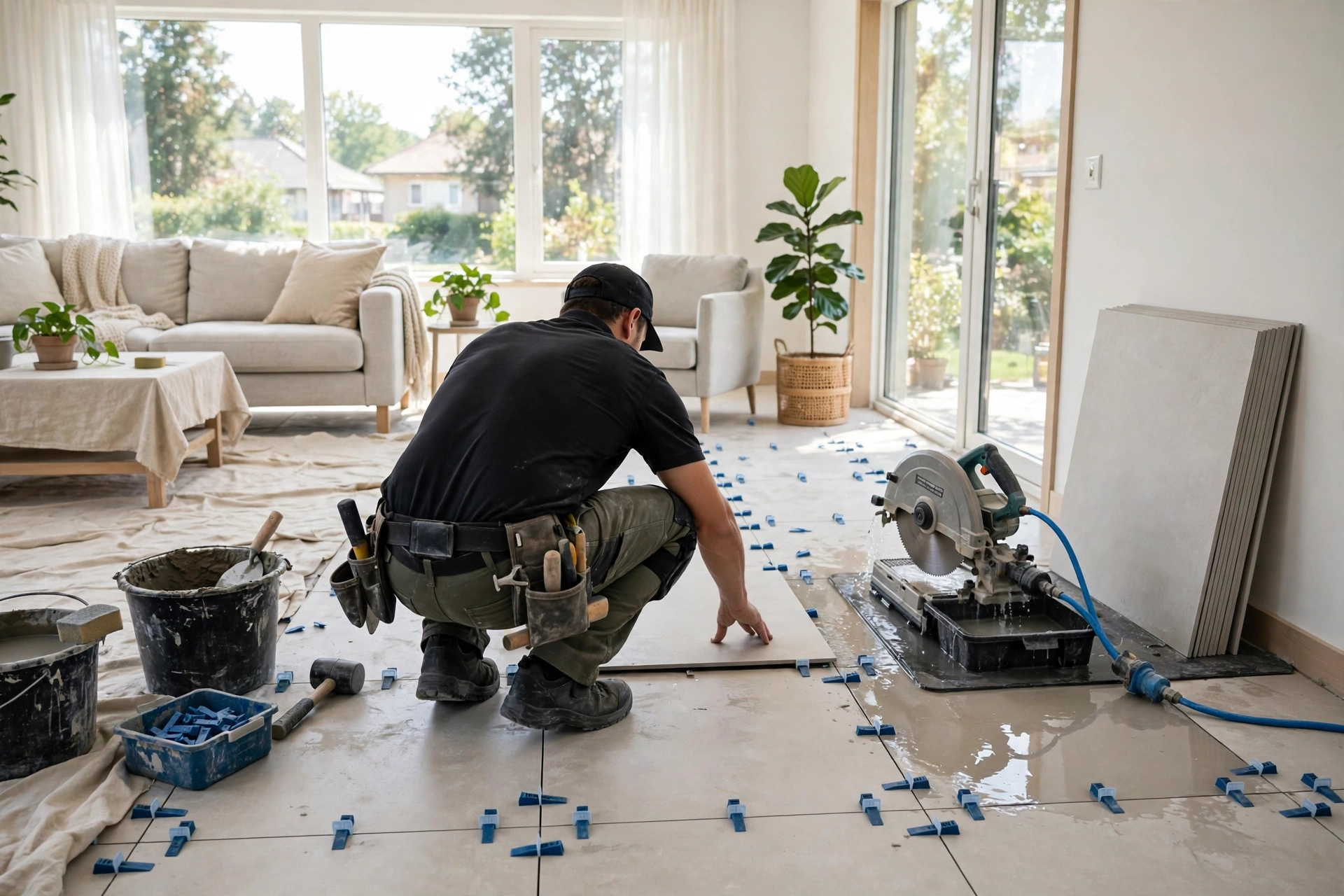
Tile Installation Cost Per Square Foot Labor Only in 2026?
Tile installation cost per square foot labor only in 2026 is $4–$8 per square foot for standard ceramic or porcelain floor tile, with a national average of about $7 per square foot. That figure covers the installer’s work alone — setting the tile, cutting it, grouting it, and cleaning up — and it does not include the tile itself, thinset, grout, or backer board. Wall tile and backsplash labor runs higher at $10–$20 per square foot, and shower or tub-surround tile labor is higher still at $15–$25 per square foot, because vertical work and waterproofing are slower and more skilled. A standard 200-square-foot floor project typically runs $800–$2,800 in labor alone, depending on the tile type, the layout, and how much of the job is floor versus wall or shower work.
Labor-only pricing matters because it is how most professional tilers actually quote. When you buy tile from a flooring store or a big-box retailer, the tile price and the installation price are separate line items, and the labor line is the one that varies most from job to job. Two homeowners can buy the exact same porcelain tile and get labor quotes $1,000 apart, because one floor is a wide-open living room and the other is a bathroom full of cuts, corners, and a shower to waterproof. This guide breaks down tile installation labor by surface — floor, wall, backsplash, and shower — compares tile types, shows labor totals by project size, explains what labor-only pricing does and does not include, and shows how to keep the labor bill down without hiring the cheapest installer you can find.
For background on proper tile installation standards, substrate preparation, and grout-joint requirements, the Tile Council of North America publishes the industry-standard installation handbook and consumer guidance at tilecouncil.org.
Quick-answer table (typical 2026 tile installation labor-only cost):
| Item | Typical labor-only cost |
|---|---|
| Floor tile labor (ceramic/porcelain) | $4–$8 per sq ft |
| National average tile labor | About $7 per sq ft |
| Wall / backsplash tile labor | $10–$20 per sq ft |
| Shower / tub-surround tile labor | $15–$25 per sq ft |
| Natural stone or mosaic tile labor | About 50% above standard rates |
| Standard 200 sq ft project, labor only | $800–$2,800 |
| Pro installer hourly rate | $60–$120 per hour |
| Minimum job charge (most installers) | $200–$400 |
| Regional labor variation | 20–40% above or below the average |
Tile Installation Cost Per Square Foot Labor Only by Surface
The surface being tiled is the single biggest driver of labor-only pricing. A flat, open floor is the fastest surface to tile, so it carries the lowest rate. A vertical wall is slower, because every tile has to be held, leveled, and supported while the thinset sets. A shower is the slowest of all, because the waterproofing behind the tile is skilled work that cannot be rushed:
| Surface | Typical labor-only rate | What drives the rate |
|---|---|---|
| Floor tile (ceramic/porcelain) | $4–$8 per sq ft | Open area, fast setting, few cuts |
| Wall tile / backsplash | $10–$20 per sq ft | Vertical work, gravity, more cuts |
| Shower / tub-surround walls | $15–$25 per sq ft | Waterproofing, small cuts, wet-area detail |
| Shower floor (mosaic/small tile) | $15–$25 per sq ft | Small tiles, slope to drain, many grout lines |
| Countertop or niche / accent work | $15–$30 per sq ft | Custom cuts, edge finishing, small area |
Floor tile ($4–$8 per sq ft). This is the baseline rate and the one most homeowners are quoted first. A crew can lay large areas of floor tile quickly in an open room, with long runs of uncut tile and a steady rhythm. The $4 end of the range is a straightforward ceramic or porcelain floor in a large, open, square room with a flat subfloor; the $8 end is a room with more cuts, a diagonal or herringbone layout, or a floor that needs leveling first. At the national average of about $7 per square foot, a 200-square-foot living-room floor costs roughly $1,400 in labor alone.
Wall and backsplash tile ($10–$20 per sq ft). Wall tile labor runs roughly double floor labor, and the reason is gravity: every tile has to be buttered, placed, leveled, and held until it grips, and the installer works upward in small sections instead of laying long runs. A kitchen backsplash is a small area — often 20–30 square feet — so even at $10–$20 per square foot the labor bill is only $200–$600, and most installers apply their $200–$400 minimum job charge to small jobs like this.
Shower and tub-surround tile ($15–$25 per sq ft). Shower labor is the most expensive standard tile work, and the price reflects the waterproofing, not just the tile setting. The installer has to install backer board, apply a liquid or sheet waterproofing membrane, seal every corner and penetration, and only then set the tile — and the tile itself is mostly small cuts around the valve, the showerhead, the niche, and the drain. A standard tub surround has about 60 square feet of wall, so shower labor typically runs $900–$1,500; a walk-in shower with 80–100 square feet of wall runs $1,200–$2,500 in labor alone.
Why published ranges sometimes look wider. If you check national cost guides, you will see wider figures — HomeGuide lists floor tile labor at $8–$20 per square foot, and HomeAdvisor lists labor at $3–$15 per square foot. Those ranges are not wrong; they are wider because they fold in stone and mosaic work, high-cost metro markets, and jobs with heavy prep work. The $4–$8 floor range in this guide is the typical rate for standard ceramic or porcelain floor tile in a straightforward job, which is the job most homeowners actually buy.
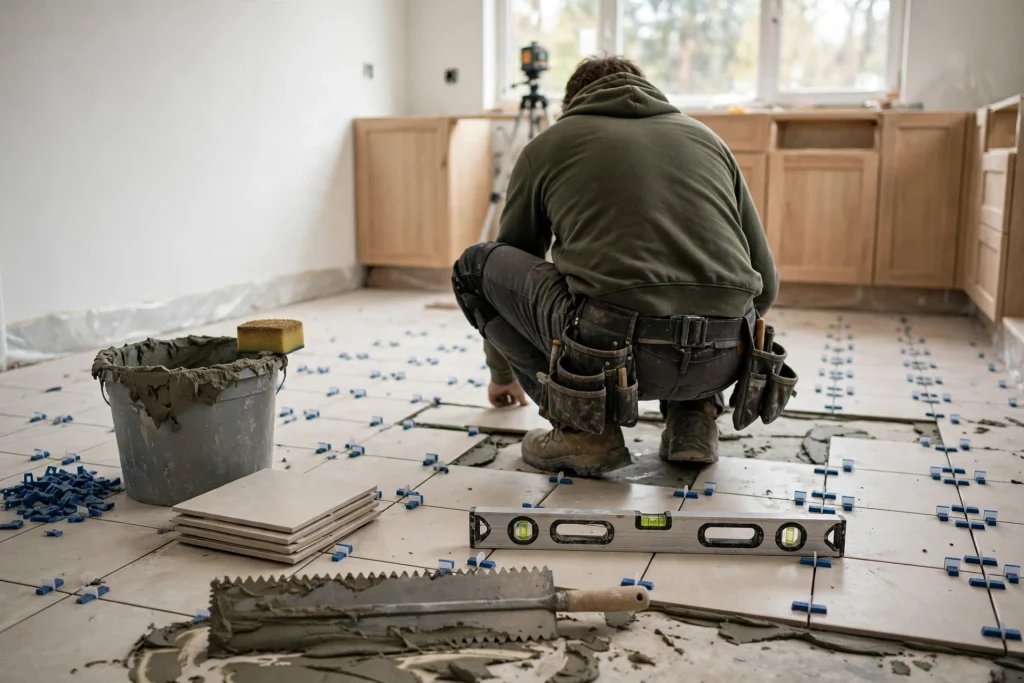
Tile Installation Labor Cost by Tile Type and Location
Tile type changes the labor rate because some tiles are harder to cut, heavier to handle, or slower to set. Natural stone and mosaic are the two big labor multipliers — each pushes the standard rate roughly 50% higher:
| Tile type | Floor labor per sq ft | Wall labor per sq ft | Shower labor per sq ft |
|---|---|---|---|
| Ceramic | $4–$7 | $10–$18 | $15–$22 |
| Porcelain | $4–$8 | $10–$20 | $15–$25 |
| Large-format porcelain (24×24) | $6–$10 | $12–$22 | $18–$28 |
| Natural stone (marble, travertine, slate) | $6–$12 | $15–$30 | $22–$38 |
| Mosaic / penny tile | $6–$12 | $15–$30 | $22–$38 |
| Wood-look plank tile | $5–$9 | — | — |
Ceramic ($4–$7 per sq ft floor labor) is the cheapest tile to install: light, easy to cut with a standard wet saw, and cheap to replace if a tile chips. It is the budget choice for floors and a good choice for walls, but not the best tile for a shower floor, where standing water demands porcelain or stone.
Porcelain ($4–$8 per sq ft floor labor) is the most common tile installed in American homes, and the $4–$8 range is the standard rate for the trade. Porcelain is denser and harder than ceramic, so it takes slightly longer to cut, but the difference is small on a floor job — and it is the tile most installers recommend for bathrooms and kitchens.
Large-format tile ($6–$10 per sq ft floor labor) costs more to install because the tiles are heavy, the floor must be flatter, and a single lippage mistake is far more visible than with small tiles. A 24×24-inch tile also needs a leveling-clip system, which adds time to every tile.
Natural stone ($6–$12 per sq ft floor labor) is the premium labor job: stone chips during cutting, needs sealing before and after grouting, and demands a perfectly flat substrate. On walls and in showers, stone labor runs $15–$30 and $22–$38 per square foot respectively, roughly 50% above the standard rates.
Mosaic and penny tile ($6–$12 per sq ft floor labor) are slow for the opposite reason: hundreds of tiny tiles, each one set by hand or on a mesh sheet that has to be aligned perfectly. Mosaic is the right tile for a shower floor, where the many grout lines give bare feet grip — but use it there or as an accent, not across a whole room.
Location changes the rate by 20–40%. Labor is a local price. In high-cost metro areas — the Northeast corridor, the San Francisco Bay Area, Seattle, and Los Angeles — tile labor can run 20–40% above the national average, pushing standard floor labor toward $6–$11 per square foot. In smaller markets and lower-cost regions, the same job can come in 20–40% below the average, closer to $3–$6 per square foot. The tile itself costs roughly the same everywhere; the labor is what moves. Always get quotes from installers who work in your zip code, and compare them against the national average rather than against a price you saw quoted in another state.
If you are comparing a retail installer’s per-square-foot price, see our guide to how much Lowe’s charges per square foot to install tile — big-box installation pricing follows the same labor ranges, with the retailer’s markup and scheduling on top.
Tile Installation Labor Cost by Project Size
Labor-only totals scale with area, but not perfectly — small jobs cost more per square foot, and large jobs cost less, because every job carries fixed costs that do not shrink with the room:
| Project | Tiled area | Typical labor-only cost |
|---|---|---|
| Kitchen backsplash | 20–30 sq ft | $200–$600 (often the $200–$400 minimum) |
| Small bathroom floor | 50 sq ft | $200–$400 |
| Standard bathroom floor + shower | About 160 sq ft tiled | $1,600–$3,200 |
| Standard 200 sq ft floor project | 200 sq ft | $800–$2,800 |
| Living room / open floor | 300 sq ft | $1,200–$2,400 |
| Large open floor | 500 sq ft | $2,000–$4,000 |
| Whole main floor | 1,000 sq ft | $4,000–$8,000 |
| Tiling a 1,700 sq ft home | 1,700 sq ft | $6,800–$13,600 |
The 200-square-foot project ($800–$2,800 in labor). A standard 200-square-foot project is the most commonly quoted tile job — a living room, a large kitchen, or a master bedroom floor. The low end, $800, is a straightforward porcelain floor at $4 per square foot in an open room. The high end, $2,800, reflects a job where part of the 200 square feet is wall or shower tile at $10–$25 per square foot, or where the tile is natural stone or mosaic at roughly 50% above the standard rate. At the national average of about $7 per square foot, the same project costs roughly $1,400 in labor. When you get a quote, check which end of the range your job sits at — and why.
Small jobs and the minimum charge. Most installers have a minimum job charge of roughly $200–$400, and it applies to every small job: a backsplash, a bathroom floor, a laundry-room floor, a tiled entry. The minimum exists because the installer still has to load tools, drive to the site, set up the wet saw, and clean up — and those fixed costs do not shrink with the room. A 50-square-foot bathroom floor at $4–$8 per square foot would price at $200–$400 on area alone, so the minimum rarely adds anything; but a 25-square-foot backsplash at $10–$20 per square foot would price at $250–$500, and the minimum keeps it from falling below $200–$400. If you have two or three small tile jobs, bundle them into one visit — you pay the minimum once instead of three times.
Large jobs and the volume discount. On a 1,000-square-foot floor, the per-square-foot rate often drops toward the $4–$6 end of the range, because the crew can work in long, uninterrupted runs with very few cuts per square foot. A 1,700-square-foot whole-home tile job prices at roughly $6,800–$13,600 in labor alone at $4–$8 per square foot — see our full breakdown of the cost to tile a 1,700 sq ft home for the materials, prep, and total project math on a job that size. Some installers quote small or unusual jobs by the hour instead of by the square foot; pro tile installer hourly rates typically run $60–$120 per hour.
What Labor-Only Tile Installation Includes — and What It Does Not
“Labor only” is a precise term, and it is worth knowing exactly what it covers before you sign a quote. A labor-only price typically includes the installer’s time and skill, and it typically excludes everything the installer has to buy:
| Item | Included in labor-only price? | Typical cost if separate |
|---|---|---|
| Tile setting, cutting, and grouting | Yes | — |
| Layout planning and dry-fitting | Yes | — |
| Thinset and grout application | Yes (labor) | Materials $0.50–$2 per sq ft |
| Tile material | No | $1–$20+ per sq ft |
| Thinset, grout, and sealant (materials) | No | $0.50–$2 per sq ft |
| Backer board (material + install) | Sometimes | About $2 per sq ft |
| Waterproofing membrane (material + install) | Sometimes | $200–$600 per shower |
| Old-tile removal | No | $200–$800 per room |
| Subfloor leveling or repair | No | $100–$500+ |
| Cleanup and haul-away | Usually yes | — |
What is included. The labor-only rate covers the installer setting the tile: spreading thinset, placing and leveling each tile, cutting around fixtures and edges, grouting, wiping down, and cleaning up. It also covers the layout work — deciding where the first tile goes so the cuts fall evenly on both sides of the room.
What is not included. The tile itself is never included in a labor-only price, and neither are the setting materials: thinset, grout, spacers, and sealant typically add $0.50–$2 per square foot in materials. Backer board and waterproofing sit in a gray area — some installers include them in the labor rate, some list them as separate line items. Old-tile removal is almost always separate at $200–$800 per room, and subfloor leveling or repair is separate too, because the installer cannot price it until the old floor comes up.
The question to ask every installer. Before you accept a labor-only quote, ask: “Does this include thinset, grout, backer board, and waterproofing — or do I supply those?” Two quotes at $6 and $8 per square foot can be the same price once the materials are counted, if the $6 quote excludes materials and the $8 quote includes them. Get the quote itemized — labor, materials, removal, and prep on separate lines — and compare the totals, not the headline rate.
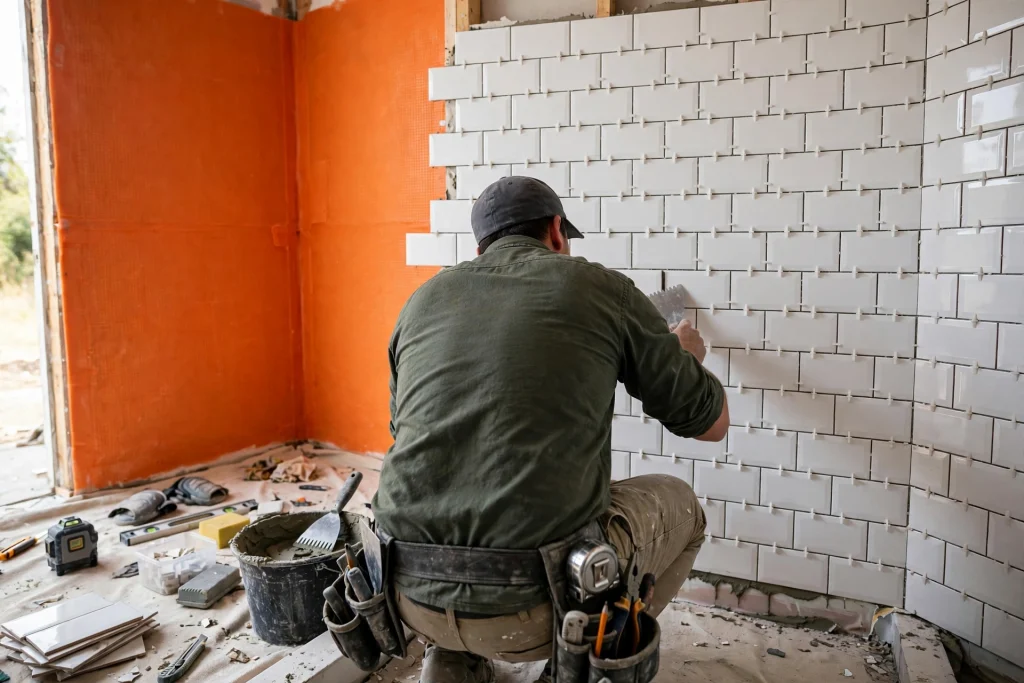
Shower and Wet-Area Tile Labor: Why It Costs $15–$25 Per Square Foot
Shower tile labor is the most expensive standard tile work, and it is the job where hiring the cheapest installer is the riskiest decision you can make. The $15–$25 per square foot rate reflects three things that floor tile work does not have: waterproofing, small cuts, and zero tolerance for error.
The waterproofing is the job. Tile and grout are not waterproof — water passes through grout, and the membrane behind the tile is what keeps your walls dry. A proper shower waterproofing system costs $200–$600 in materials and adds a full day to the schedule: the membrane goes on, it cures, and only then does the tile go up. The installer is paid for that day, and the rate reflects it. A shower quote with no waterproofing line item is not a bargain — it is a shower that will leak.
The cuts are the work. A shower wall has a valve, a showerhead, a niche, and corners — and nearly every tile on a shower wall needs at least one cut. Small tiles, mosaic shower floors, and accent strips are all hand work. That is why shower labor runs $15–$25 per square foot while a floor in the same house runs $4–$8: the installer sets far fewer square feet per hour in a shower, and every square foot takes more skill.
Shower labor by the numbers. A standard tub surround has about 60 square feet of wall, so labor typically runs $900–$1,500. A walk-in shower with 80–100 square feet of wall plus a tiled floor runs $1,200–$2,500 in labor alone. Add a built-in niche ($200–$500 in labor and materials) or a shower bench ($300–$700), and the total climbs further — these are custom pieces, not part of the per-square-foot rate. For the full picture of a bathroom tile job, including the floor and the materials, see our guide to how much it costs to tile a 10×10 bathroom — the shower is usually the largest single labor line in that room.
When shower labor is worth every dollar. A leaking shower rots framing and subfloor, and the repair means tearing out the tile you just paid for — often $3,000–$7,000 to fix a $1,500 labor saving. Shower tiling is the one tile job where the installer’s waterproofing experience matters more than the per-square-foot rate. Ask how many showers the installer has waterproofed, what membrane system they use, and whether the work carries a warranty. If the answers are vague, pay more for the installer who answers clearly.
What Affects Tile Installation Labor Cost
No two tile labor quotes are identical, because the price is built from your room, your tile, and your local market. These are the factors that move it most:
Room shape and cuts. A square, open room is the cheapest floor to tile: long runs of uncut tile and a fast rhythm. An L-shaped room, a hallway, or a room with many doorways forces dozens of cuts, and every cut costs time. Bathrooms are the extreme case — a 100-square-foot bathroom floor can take nearly as long as a 200-square-foot living-room floor, because nearly every tile on the perimeter needs a cut around the toilet, the vanity, or the tub.
Subfloor and wall condition. A flat, sound subfloor keeps floor labor near the $4 end of the range. A floor that needs leveling compound, a rotted section under an old tub, or shower walls that are out of plumb all add labor and materials that only show up after the old tile comes off. A quote with no allowance for subfloor work is a quote that may grow — ask the installer to inspect the subfloor before quoting, not after demolition starts.
Old-tile removal. Removing old tile costs $200–$800 extra per room, depending on how the old tile was set. Tile glued to a sound backer board comes off cleanly; tile set in a thick mortar bed — common in older homes — has to be chipped out, and the subfloor underneath often needs repair. Get removal quoted as its own line item.
Tile size. Very small tiles (mosaic, penny) and very large tiles (24×24 and up) both cost more to install than standard 12×12 or 12×24 tile. Small tiles mean more grout lines and more handling; large tiles mean leveling clips, heavier lifting, and a flatter substrate.
Local labor rates. The 20–40% regional variation is the largest single factor on a big job. A 500-square-foot floor at the national average of $7 per square foot costs about $3,500 in labor; in a high-cost metro at 30% above the average, the same floor costs about $4,550 — a $1,050 difference for the identical tile and the identical room. Get at least two local itemized quotes, and compare the same scope.
How labor-only tile compares with other flooring. Tile labor is not the cheapest flooring labor: laminate flooring installation labor typically runs lower per square foot, because laminate clicks together without thinset, grout, or curing time — see our guide to laminate flooring installation cost labor only for the comparison. Tile costs more to install because it is a wet trade with curing times and permanent setting materials — but it also lasts decades longer than laminate in wet areas, which is why kitchens and bathrooms are still tiled.
DIY vs. Hiring a Pro for Tile Installation
| DIY | Hiring a pro | |
|---|---|---|
| Labor cost | $0 (your time) | $4–$8 per sq ft (floor); $10–$25 per sq ft (wall/shower) |
| Materials (tile + setting) | $1.50–$22+ per sq ft | Same — you supply or the pro supplies |
| 200 sq ft floor, all-in | $300–$4,400 materials + tools | $800–$2,800 labor + materials |
| Time required | A weekend for a small floor; a week for a large one | 1–2 days for 200 sq ft floor; 3–5 days with a shower |
| Tools needed | Wet saw rental ($50–$100/day), trowels, level, spacers | Included in the labor price |
| Waterproofing | You install it — mistakes are on you | Professional membrane, installer warranty |
| Quality risk | Lippage, uneven grout lines, cracked tile | Low with an experienced installer |
| Warranty | None | Installer warranty varies by contractor |
| Best for | A small, straight-lay floor with basic tile | Any shower, stone, large-format, or herringbone job |
Tiling a floor is one of the more approachable DIY jobs: the floor is flat, the area can be small, and ceramic tile is forgiving to cut. A confident DIYer can tile a 200-square-foot floor for the cost of materials alone — roughly $300–$1,600 for standard ceramic or porcelain plus thinset and grout — and save the $800–$1,600 a pro would charge in labor. When DIY wins: the job is a floor-only install, the tile is basic ceramic or porcelain in a straight lay, the subfloor is flat and sound, and you have a weekend to spare. Rent the wet saw rather than buying one, and buy 10% extra tile for cuts and mistakes.
When a pro wins: the job includes shower walls, natural stone, large-format tile, or a herringbone pattern. Waterproofing a shower is skilled work with no margin for error, and stone and large-format tile are too expensive to learn on. A common middle path is to DIY the floor and hire a pro for the shower walls, which captures most of the saving while keeping the risky work in professional hands.
Money-Saving Tips on Tile Installation Labor
1. Choose standard-size porcelain in a straight lay. Porcelain at $4–$8 per square foot in labor is the cheapest professional tile job, and a straight grid lay is the cheapest pattern. The same floor in herringbone or large-format tile costs 20–30% more in labor for the same tile. 2. Tile a large area in one job. The $200–$400 minimum job charge and the fixed setup costs are spread across more square feet on a big job, so the effective per-square-foot rate falls. If the kitchen and the living room both need tile, do them together instead of as two separate visits. 3. Bundle your small jobs into one visit. A backsplash, a laundry floor, and an entryway tiled in a single visit pay the installer’s minimum charge once instead of three times — a saving of $400–$800. 4. Do the demolition yourself. Old-tile removal costs $200–$800 per room when the installer does it. If the old tile comes off cleanly, removing it yourself and hauling the debris saves that entire line item — but stop and call the installer if you find a rotted subfloor underneath. 5. Keep the layout simple in cut-heavy rooms. In a bathroom, a straight lay with standard tile keeps labor near the low end of the range. Save the mosaic for the shower floor, where you need the grip, and use larger tile on the walls and floor. 6. Buy your own tile — but let the pro buy the setting materials. Tile is easy to price-shop yourself, and you can catch a sale. Thinset, grout, and backer board are better bought by the installer, who knows the right products for your tile and substrate and will warranty the installation. 7. Get two itemized quotes and compare the same scope. Labor, materials, removal, waterproofing, and backer board on separate lines — a $5-per-square-foot quote that excludes thinset, grout, and waterproofing is not cheaper than a $7-per-square-foot quote that includes them. 8. Schedule in the off-season. Tile installers are busiest in spring and summer. A fall or winter booking can mean a faster start date and occasionally a better rate, especially on a large floor job where the crew can work uninterrupted. 9. Do not hire the cheapest quote without checking the scope. A quote 30% below the others usually leaves something out — waterproofing, backer board, removal, or grout sealing. The missing line item shows up later as a change order, and it always costs more than it would have in the original quote.
Frequently Asked Questions
How much does tile installation cost per square foot labor only?
For standard ceramic or porcelain floor tile, labor-only installation typically costs $4–$8 per square foot, with a national average of about $7 per square foot. Wall and backsplash labor runs $10–$20 per square foot, and shower or tub-surround labor runs $15–$25 per square foot. Natural stone and mosaic tile push each range roughly 50% higher. These rates cover the installer’s work only — the tile, thinset, grout, and backer board are extra.
How much is labor to tile a 200 sq ft floor?
A standard 200-square-foot floor project typically runs $800–$2,800 in labor alone. A straightforward porcelain floor at $4–$8 per square foot costs $800–$1,600 in labor; the top end of the range applies when part of the job is wall or shower tile at $10–$25 per square foot, or when the tile is natural stone or mosaic. At the national average of about $7 per square foot, the same project costs roughly $1,400 in labor.
What is the average labor cost to install tile per square foot?
The national average tile installation labor cost is about $7 per square foot for standard floor tile. That average blends low-cost markets, where floor labor can run $3–$6 per square foot, and high-cost metros, where it can run $6–$11 per square foot — a regional variation of roughly 20–40% in either direction. Wall and shower work averages far higher, at $10–$20 and $15–$25 per square foot respectively, so a job that mixes floor and shower work will average well above $7 overall.
Does tile installation labor include materials?
No — a labor-only price covers the installer’s time and skill: setting, cutting, grouting, and cleanup. The tile itself ($1–$20+ per square foot) and the setting materials — thinset, grout, and sealant at roughly $0.50–$2 per square foot — are extra. Backer board (about $2 per square foot) and waterproofing ($200–$600 per shower) are sometimes included and sometimes listed separately, so always ask the installer what the labor rate covers before you accept the quote.
Is it cheaper to install tile yourself or hire a pro?
DIY is cheaper on labor alone — you pay $0 for your own time versus $4–$8 per square foot for a floor or $15–$25 per square foot for a shower — but the saving comes at the cost of your time and any warranty. DIY makes sense for a small, straight-lay floor with basic tile and a sound subfloor. Hire a pro for any job that includes shower walls, natural stone, large-format tile, or a herringbone pattern, because the waterproofing has no margin for error and the materials are too expensive to learn on.
The Bottom Line
Tile installation cost per square foot labor only in 2026 is $4–$8 per square foot for standard ceramic or porcelain floor tile, with a national average of about $7 per square foot. Wall and backsplash labor runs $10–$20 per square foot, shower and tub-surround labor runs $15–$25 per square foot, and natural stone or mosaic tile pushes each range roughly 50% higher. A standard 200-square-foot project costs $800–$2,800 in labor alone, with the top end reflecting wall, shower, or premium-tile work. Budget for the extras labor-only pricing excludes — tile at $1–$20+ per square foot, setting materials at $0.50–$2 per square foot, old-tile removal at $200–$800 per room, and waterproofing at $200–$600 per shower — and remember that most installers have a $200–$400 minimum job charge and charge $60–$120 per hour for small or hourly work. Regional rates vary 20–40% around the national average, so get two itemized local quotes, compare the same scope, and never hire the cheapest shower quote without confirming the waterproofing is in it.
Prices are typical 2026 US ranges for planning purposes and vary by region, tile choice, and site condition; get itemized local quotes for an exact project price.
1 thought on “Tile Installation Cost Per Square Foot Labor Only in 2026?”