
Laminate Flooring Installation Cost Labor Only in 2026: What Installers Charge
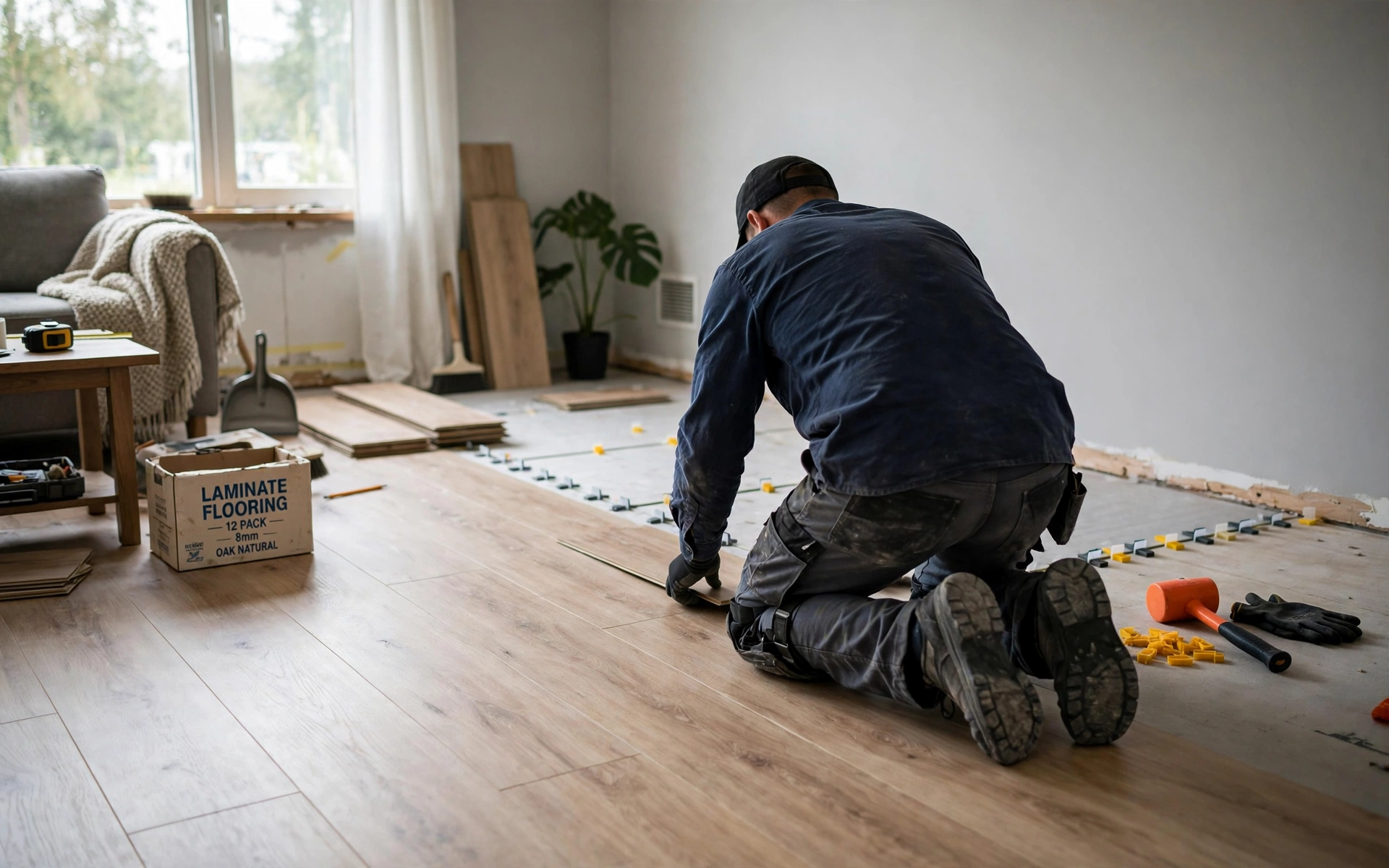
Laminate flooring installation cost labor only in 2026 typically runs $2–$5 per square foot for basic rooms — that is the price of the installer’s work alone, with you supplying the laminate, underlayment, and trim yourself. A straightforward 200–300 square foot room therefore costs roughly $500–$900 in labor only, while a 500-plus square foot area runs $1,500 or more. The exact rate depends on the install method: floating click-lock laminate is the cheapest to lay at $1.50–$3.50 per square foot, glue-down laminate runs $3–$6 per square foot, and complex work such as stairs or herringbone and chevron patterns jumps to $5.50–$9 per square foot.
The reason this number matters is that most flooring quotes bundle material and labor into one all-in price, which hides what you are actually paying for the work. When you buy the laminate yourself — from a retailer, a discounter, or a clearance sale — and hire an installer for labor only, you can see the workmanship line item clearly and compare installers fairly. This guide breaks down the labor-only price by install method and room size, explains what a labor-only quote includes and what is billed separately, shows how installers price their work, and explains how to read and compare labor quotes so you do not pay for the same line item twice.
For context on what professional installation should involve, the National Wood Flooring Association publishes installer guidance and consumer resources at nwfa.org. And if you want to understand why a quoted labor rate is higher than an installer’s hourly wage, the US Bureau of Labor Statistics reports the median wage for flooring installers at $54,390 per year, or $26.15 per hour, as of May 2025 — see the BLS Occupational Outlook Handbook. The gap between that wage and a $50–$85 per hour loaded labor rate is overhead: insurance, tools, vehicle, travel time, and the installer’s business costs.
Quick-answer table (typical 2026 labor-only laminate installation cost):
| Item | Typical cost |
|---|---|
| Labor only, basic rooms | $2–$5 per sq ft |
| Floating click-lock laminate labor | $1.50–$3.50 per sq ft |
| Glue-down laminate labor | $3–$6 per sq ft |
| Complex work (stairs, herringbone/chevron) | $5.50–$9 per sq ft |
| Loaded labor rate | $50–$85 per hour |
| Hourly repair work | $50–$70 per hour, plus materials |
| 200–300 sq ft room, labor only | $500–$900 |
| Full installed price (material + labor) | $3–$8 per sq ft |
Laminate Flooring Installation Cost Labor Only by Install Method
The install method is the single biggest driver of the labor-only rate, because it decides how fast the crew can work and how much skill the job demands:
| Install method | Labor per sq ft | Best for | What affects the pace |
|---|---|---|---|
| Floating click-lock | $1.50–$3.50 | Open rooms, standard planks | Fastest method; 300–500 sq ft per day per installer in open areas |
| Standard labor-only (basic rooms) | $2–$5 | Most straightforward installs | The most common quoted range for typical rooms |
| Glue-down | $3–$6 | Concrete slabs, commercial spaces | Adhesive application and handling slow the crew down |
| Stairs, herringbone/chevron, tight cuts | $5.50–$9 | Feature areas, patterned layouts | Slow, precise cutting; 200–350 sq ft per day or less in cut-up rooms |
Floating click-lock laminate is the cheapest labor-only install because the planks snap together and float over the underlayment without adhesive or nails. An experienced installer can lay 300–500 square feet per day in an open area, which is why the per-square-foot rate is the lowest. Most residential laminate sold today is click-lock, so this is the rate most homeowners will actually be quoted.
Glue-down laminate costs more in labor — typically $3–$6 per square foot — because every plank must be glued to the subfloor, the adhesive has to be spread evenly, and the installer cannot rush the set time. It is more common over concrete slabs and in commercial settings than in a typical living room.
Stairs and patterned layouts are a different job entirely. Herringbone and chevron patterns require every plank to be cut at an angle and fitted precisely, and stairs involve nosings, risers, and far more cuts per square foot than a flat floor. Labor of $5.50–$9 per square foot reflects that the crew’s daily output drops sharply — in cut-up rooms, expect 200–350 square feet per day per installer, and less on a staircase.
When you compare quotes, always check which method the installer assumed. A $1.50-per-square-foot quote for a herringbone hallway is not a bargain — it is a quote for a different job than the one you are asking for.
Laminate Flooring Installation Cost Labor Only by Room Size
Labor-only cost grows with room size, but the per-square-foot rate usually improves on larger jobs because measuring, setup, and travel are spread over more area:
| Room | Square feet | Labor only |
|---|---|---|
| Small bedroom or office | 100–200 | $300–$600 |
| Bedroom or living room | 200–300 | $500–$900 |
| Large living room | 300–400 | $700–$1,200 |
| Open-plan main floor | 400–500 | $900–$1,500 |
| Whole floor or large area | 500+ | $1,500+ |
A 12-by-12-foot room is 144 square feet, so it falls in the smallest band at roughly $300–$600 for labor only — see our full breakdown of how much it costs to laminate a 12×12 room for the material side of that same project. The table above is labor only; add $1–$5 per square foot for the laminate itself if you have not bought it yet.
Small-room warning. On a single small bedroom, minimum job charges often apply, and the fixed costs of travel, setup, and measuring can push the effective per-square-foot rate above $5 even for a basic click-lock install. If a small-room quote looks high per square foot, ask for the fixed-cost breakdown before assuming you are being overcharged — and consider bundling two or three rooms into one visit to spread those costs.
Large-job advantage. On a 500-plus square foot job, installers can work in long uninterrupted runs with fewer cuts per square foot, and the per-square-foot rate typically lands toward the lower end of the range. This is the main reason whole-floor jobs price better per square foot than one room at a time.
For a whole-house example at that scale, see how much it costs to install 1,000 square feet of laminate flooring.
What’s Included in a Labor-Only Quote — and What Costs Extra
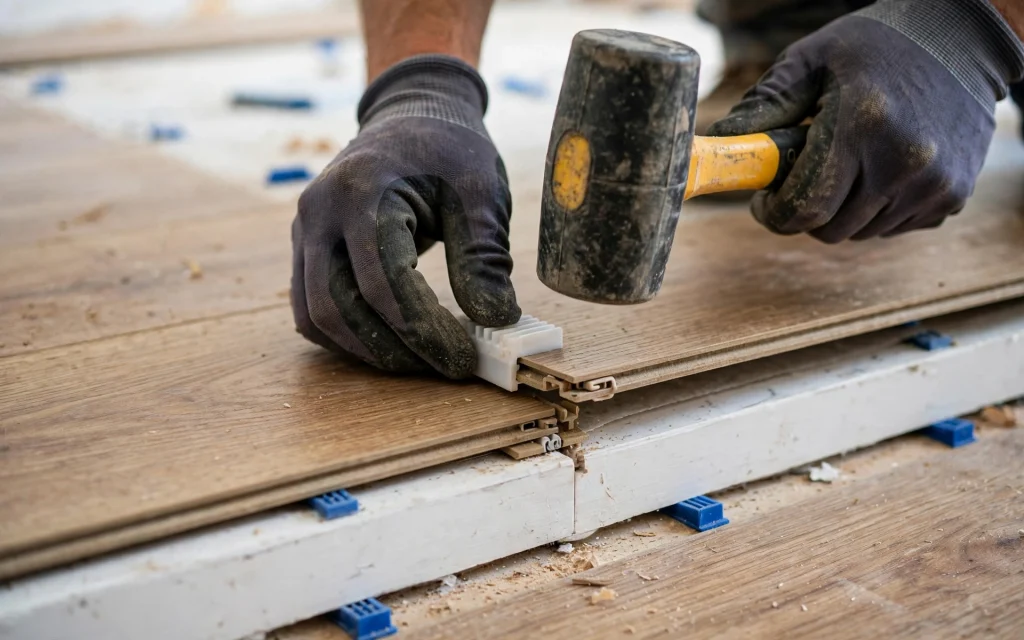
A labor-only quote covers the installer’s work — laying the floor. Almost everything else is a separate line item, and this is where labor-only quotes most often surprise homeowners:
| Line item | Usually included in labor-only? | Typical cost if extra |
|---|---|---|
| Laying the laminate planks | Yes | Covered by the $2–$5 per sq ft labor rate |
| Underlayment | Often extra | $0.50–$1.50 per sq ft |
| Old floor removal and haul-away | Extra | $1–$3 per sq ft |
| Subfloor leveling and repairs | Extra | Quoted after inspection |
| Trim, baseboards, and transitions | Extra | Quoted by the job |
| Furniture moving | Extra | Quoted by the job |
| Minimum job charge | Applies on small rooms | Varies by installer |
Underlayment is the most common surprise. Many labor-only quotes assume you have already bought underlayment, or they list it as a separate $0.50–$1.50 per square foot charge. Some laminate comes with attached underlayment, which avoids the issue entirely — check your product before you ask for a quote, and ask the installer whether underlayment is in their number or not.
Old floor removal at $1–$3 per square foot is a real line item, not a rounding error. Pulling up glued-down flooring or tile costs more than lifting loose carpet, and haul-away is usually charged on top of removal. If your quote has no removal line, confirm in writing whether the old floor will be gone when the installers leave.
Subfloor work is always quoted after inspection. No installer can price leveling or repairs sight unseen, so a quote with no subfloor line item is a quote that may grow once the old floor comes up. Uneven concrete, damaged plywood, or squeaky subfloors need fixing before laminate goes down, and that work is billed separately.
Three questions that protect your budget. First, does the quote include underlayment, or do I supply it? Second, does it include removal and haul-away of the old floor? Third, are trim, transitions, and baseboards included, or are they quoted separately? Get the answers in writing — a labor-only quote that omits all three can easily grow by $1–$3 per square foot before the job is done.
How Installers Price Labor: Per Square Foot vs. Per Day vs. Hourly
Installers use three main pricing models for labor-only work, and each one suits a different kind of job:
| Pricing model | How it works | Typical rate | Best for |
|---|---|---|---|
| Per square foot | Fixed rate multiplied by measured area | $2–$5 per sq ft for basic rooms | Standard rooms; the easiest quotes to compare |
| Per day (crew-day) | Flat day rate for the installer or crew | 300–500 sq ft per day in open areas; 200–350 sq ft per day in cut-up rooms | Large open areas where output is predictable |
| Hourly | Charged by the hour | $50–$85 per hour loaded; repair work $50–$70 per hour plus materials | Small repairs, tricky fixes, and jobs too small to price by the square foot |
Per square foot is the standard for whole rooms and the easiest model to compare across installers — get every quote in dollars per square foot, on the same measured area, and the comparison is honest. Watch out for quotes that use different measurements: one installer may measure the room’s footprint while another adds a waste allowance of 5–10 percent for cuts. Ask whether the quoted area includes waste.
Per day pricing makes sense on large open areas where the installer can predict output: 300–500 square feet per day per installer in open areas, or 200–350 square feet per day in cut-up rooms. A per-day quote should state how many installers are on the crew and how many days the job is expected to take.
Hourly pricing is common for small repairs and fiddly work that cannot be priced by the square foot — replacing a few damaged planks, fixing a buckled section, or working around unusual obstacles. The loaded labor rate of $50–$85 per hour covers the installer’s wage plus overhead, insurance, tools, and travel; hourly repair work typically runs $50–$70 per hour plus materials.
Why the loaded rate is higher than the wage. The BLS median wage for flooring installers is $26.15 per hour, but that is an employee’s wage — not what a homeowner pays. An independent installer’s $50–$85 per hour loaded rate has to cover self-employment taxes, liability insurance, vehicle and fuel, tools and saw blades, measuring and quoting time, and the gaps between jobs. A quote at the low end of the loaded range is not automatically a better deal than one at the high end; compare what is included before you compare the number.
Labor Cost by Region and Market
Labor-only laminate rates follow local labor markets, so the same room can price differently in different parts of the country. The $2–$5 per square foot range for basic rooms is a national typical range — where your job lands inside it depends on your market:
| Market | Where labor lands in the $2–$5 range |
|---|---|
| High-cost metros (New York, San Francisco, Boston, Los Angeles) | Toward the top of the range |
| Mid-size cities and suburbs | Middle of the range |
| Smaller markets and rural areas | Toward the bottom of the range |
The loaded labor rate tells the same story: $50–$85 per hour depending on market, with high-cost metros at the upper end and smaller markets at the lower end. Two practical consequences follow. First, a quote that looks high against the national range may be perfectly normal in a high-cost city — compare against local installers, not against a national average. Second, if you live near a metro boundary, an installer based in a lower-cost neighboring town may quote less than one based downtown, though travel charges can erase the difference.
Season matters too. Spring and summer are the busiest seasons for flooring installers, and lead times stretch. If your schedule is flexible, asking about off-season availability can sometimes produce a better quote and a faster booking.
What Drives Your Labor-Only Quote
No two labor-only quotes are identical, because the price is built from your house, your product, and your local market. These are the factors that move it most:
Install method. The gap between floating click-lock at $1.50–$3.50 per square foot and complex patterned work at $5.50–$9 per square foot is the single largest swing in any labor-only quote. The method explains most of the difference between two quotes for the same rooms.
Total square footage. Larger jobs usually get a better effective per-square-foot rate because the fixed costs of measuring, travel, and crew setup are spread wider. This is why bundling rooms beats installing one room at a time.
Room shape and obstacles. Hallways, closets, stairs, and rooms with many doorways take more cutting and more time, which pushes labor toward the $5 end of the basic range — or into the $5.50–$9 complex range. Wide-open rectangular rooms are the cheapest to install.
Subfloor condition. A flat, sound subfloor keeps labor near the $2 end of the range. Uneven concrete, damaged plywood, or a floor that needs leveling adds labor and materials that only show up after the old floor comes up.
Old-floor removal. Removing glued-down flooring, tile, or multiple layers of old flooring costs more than pulling up loose carpet. Removal at $1–$3 per square foot is a real line item on a whole-home job.
Product thickness and plank size. Thick 12 mm planks and wide-format planks take more effort to cut and fit than thin 7 mm planks, and some products need special blades or handling. Tell the installer exactly which product you bought before they quote.
Local installer rates. Labor rates follow your market, and the loaded rate of $50–$85 per hour varies widely by city. A quote in a high-cost metro will run higher than the same job in a smaller market, even for the identical product.
Labor-Only vs. Full Installed Price: How the Two Compare
The cleanest way to judge a labor-only quote is to put it next to the full installed price and check that the two add up:
| Cost component | Typical range |
|---|---|
| Laminate material | $1–$5 per sq ft |
| Labor only | $2–$5 per sq ft |
| Full installed price (material + labor) | $3–$8 per sq ft |
| Labor share of the total bill | Roughly 20–50% |
On most mid-range jobs, labor accounts for roughly 20–50% of the total bill — the share is smallest when you choose premium material and largest when you choose budget laminate. That is exactly why buying the material yourself can save money: if you find quality laminate at $1–$2 per square foot and pay $2–$5 per square foot for labor, your all-in cost lands near the bottom of the $3–$8 installed range instead of the middle.
If you would rather have one company handle material and installation together, compare our guide to how much Lowe’s charges to install laminate flooring — Lowe’s all-in price runs $2–$6 per square foot, with labor at $1.25–$2.50 per square foot, and the comparison shows what a bundled quote looks like against a labor-only one.
When labor-only wins: you found the laminate at a good price, you already own the material, or you want to compare installers on workmanship alone. When a full installed price wins: you want one warranty covering material and labor, you do not want to manage ordering and delivery, or the retailer’s bundled labor rate beats what local installers charge. Either way, compare the all-in totals — a cheap labor rate with expensive material is not a bargain, and a low all-in price with thin laminate is not one either.
If you are weighing laminate against a similar budget-friendly hard surface, compare our guide to vinyl plank flooring installation cost — vinyl plank is fully waterproof and its labor-only rates run close to laminate’s. And if bedrooms are on your list, see our guide to carpet installation cost for a bedroom for the softer, quieter alternative.
DIY vs. Hiring a Pro for Laminate Installation
| Hire a pro (labor only) | DIY | |
|---|---|---|
| Labor cost | $2–$5 per sq ft | $0 (your time) |
| Material | You supply: $1–$5 per sq ft | You supply: $1–$5 per sq ft |
| Tools | Included in the labor rate | Buy or rent: saw, spacers, tapping block, pull bar |
| Speed | 300–500 sq ft per day in open areas | Slower, especially on the first room |
| Warranty | Installer’s workmanship warranty (varies) | None |
| Best for | Stairs, patterns, whole-home jobs, tight deadlines | Simple rectangular rooms, confident DIYers |
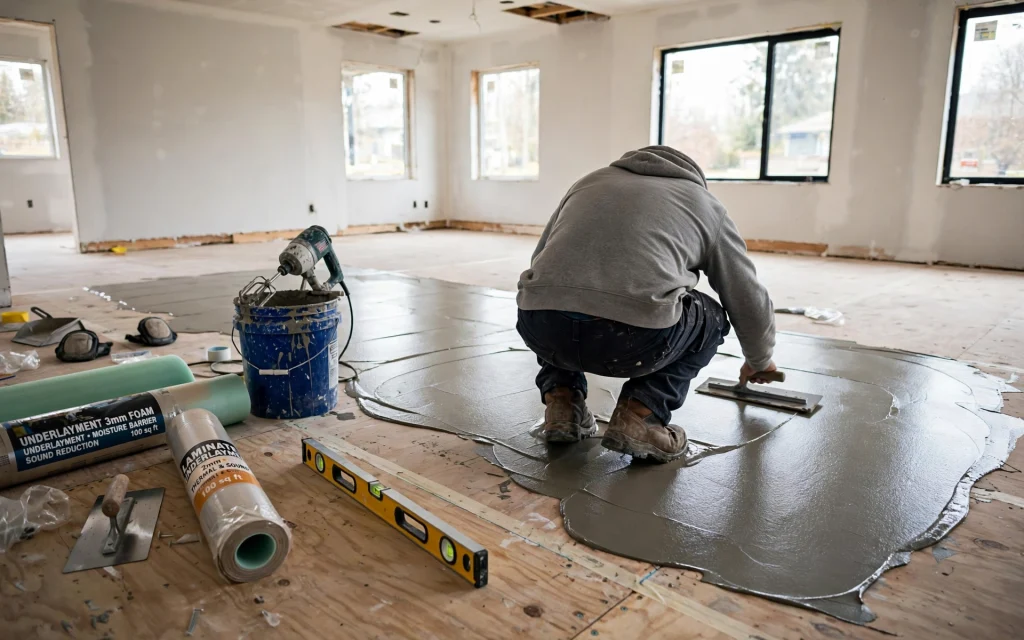
Laminate is one of the more DIY-friendly floors thanks to click-lock planks, and on a simple rectangular room a careful DIYer can save the full $2–$5 per square foot of labor. The trade-off is time and risk: your first room will take far longer than a pro’s 300–500 square feet per day, and a bad first row, a poorly cut transition, or a missing expansion gap is visible forever — with no warranty to fall back on.
When hiring a pro wins: stairs, herringbone or chevron patterns, rooms with many doorways, a whole-home job on a deadline, or any floor where the subfloor needs work first. When DIY wins: a single simple rectangular room, you already own the tools, and your time is worth less than the labor rate. A sensible middle ground is to DIY the easy bedrooms and hire a pro for the stairs, hallways, and patterned areas.
Money-Saving Tips
1. Get three labor-only quotes in dollars per square foot. Same measured area, same install method, same product — then the numbers are comparable. A quote that is far below the $2–$5 range usually omits something, not a bargain. 2. Buy the laminate yourself — but buy it before you get quotes. Installers price differently by product thickness and plank size, and a quote given for one product does not transfer to another. 3. Bundle rooms into one job. One measuring visit, one delivery, and one crew setup spread the fixed costs across more square feet — the per-square-foot rate drops on bigger jobs, and minimum job charges hurt less. 4. Ask what is actually included. Underlayment at $0.50–$1.50 per square foot, removal at $1–$3 per square foot, and trim are the classic surprise charges. Get them in writing before you accept the quote. 5. Keep the old floor if you can. If your existing floor is flat and sound, some laminate can float over it — skipping removal saves $1–$3 per square foot. Confirm with the installer first; not every old floor is a suitable base. 6. Supply the underlayment and trim yourself. These are commodity items you can often buy cheaper than the installer’s markup, as long as the installer confirms the products are compatible with your laminate. 7. Avoid the complex-rate trap. If your heart is set on a herringbone feature wall or patterned hallway, get that area quoted separately at the $5.50–$9 complex rate — do not let a single blended rate hide it, and do not let a cheap basic rate pretend it covers pattern work. 8. Time it for the off-season if you can. Flooring demand peaks in spring and summer. A flexible schedule can mean faster booking and occasionally a better quote.
Frequently Asked Questions
How much does laminate flooring installation cost labor only?
Typically $2–$5 per square foot for basic rooms in 2026. That works out to roughly $300–$600 for a 100–200 sq ft room, $500–$900 for a 200–300 sq ft room, and $1,500 or more for 500-plus sq ft. Floating click-lock installs run $1.50–$3.50 per square foot, glue-down runs $3–$6 per square foot, and complex work such as stairs or herringbone patterns runs $5.50–$9 per square foot.
What is included in a labor-only laminate installation quote?
The installer’s work laying the planks. Underlayment ($0.50–$1.50 per sq ft), old floor removal ($1–$3 per sq ft), subfloor leveling and repairs, trim and transitions, and furniture moving are usually extra. Always ask for an itemized quote that lists each of these separately.
Is labor-only installation cheaper than a full installed price?
Usually, if you buy the material well. The full installed price runs $3–$8 per square foot (material $1–$5 plus labor $2–$5), and labor is roughly 20–50% of the total bill. If you find quality laminate at $1–$2 per square foot and pay $2–$5 per square foot for labor, your all-in cost lands near the bottom of the installed range. But a bundled quote can win if the retailer’s material price or labor rate beats what you can arrange separately.
How long does it take to install laminate flooring?
An experienced installer lays 300–500 square feet per day in open areas, or 200–350 square feet per day in cut-up rooms with many doorways and closets. Most single rooms are finished in a day, and a whole-home install usually takes a few days, depending on the number of rooms, the amount of cutting, and whether old flooring has to come out first.
Why do labor-only quotes vary so much between installers?
Because the quotes may not cover the same work. Differences in install method, whether underlayment and removal are included, how the area is measured, minimum job charges on small rooms, and local labor rates all move the number. Compare quotes line by line — material, labor, underlayment, removal, trim — rather than comparing a single headline figure.
Do installers charge extra for stairs and patterns?
Yes. Stairs, herringbone, and chevron layouts are priced as complex work at $5.50–$9 per square foot, well above the $2–$5 basic-room rate, because every plank needs precise angled cuts and the crew’s daily output drops sharply. Get patterned areas quoted separately so the premium is visible.
The Bottom Line
For labor-only laminate flooring installation in 2026, budget $2–$5 per square foot for basic rooms — $300–$600 for a 100–200 sq ft room, $500–$900 for a 200–300 sq ft room, and $1,500 or more for 500-plus sq ft. Floating click-lock work runs $1.50–$3.50 per square foot, glue-down runs $3–$6 per square foot, and stairs or patterned layouts run $5.50–$9 per square foot. Remember that a labor-only quote covers the work of laying the floor: underlayment at $0.50–$1.50 per square foot, old-floor removal at $1–$3 per square foot, subfloor repairs, trim, and furniture moving are usually extra. Get three quotes in dollars per square foot for the same measured area and the same install method, get every extra in writing, and compare the all-in total — material plus labor — against the $3–$8 per square foot full installed price before you commit.
Prices are typical 2026 US ranges for planning purposes and vary by region, product grade, and site condition; get itemized local quotes for an exact project price.


2 thoughts on “Laminate Flooring Installation Cost Labor Only in 2026: What Installers Charge”