
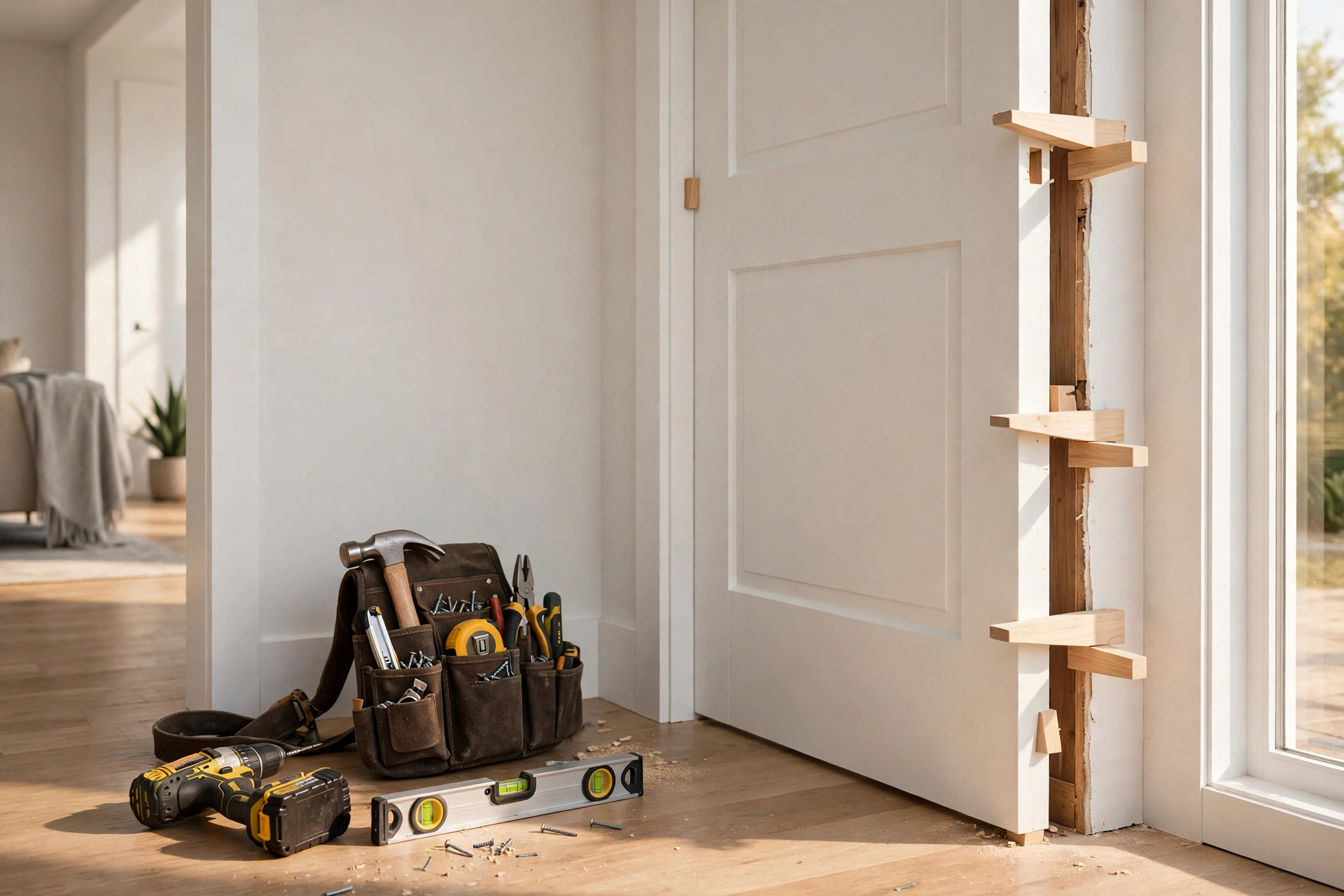
How Much Does a Carpenter Charge to Install a Door in 2026
Wondering how much does a carpenter charge to install a door in 2026? For a standard pre-hung interior door in an existing rough opening, carpenter labor typically runs $120–$260 — a one-to-two-hour job. Hanging a slab door in an existing frame costs more ($200–$570) because every hinge must be mortised and fitted by hand, while pocket doors and exterior doors run $300–$1,000+ for the extra framing and weatherproofing work. Most independent carpenters quote per job, but their hourly math is $40–$90+/hr for finish carpenters and $30–$80/hr for handymen.
These are labor-only numbers — the door itself, hardware, trim, and paint add on top. A typical total project cost (door + labor + hardware + trim) lands around $250–$600 for a basic interior door and $800–$2,000+ for an entry door. This guide breaks down exactly what carpenters charge by door type, how hourly rates differ between handymen and finish carpenters, which extras inflate the bill, and when a big-box install program beats hiring a carpenter.
Quick-answer table (typical carpenter labor, 2026):
| Job | Typical labor cost |
|---|---|
| Pre-hung interior door (existing opening) | $120–$260 |
| Slab interior door (fit into existing frame) | $200–$570 |
| Pre-hung exterior / entry door | $300–$650 |
| Sliding patio door | $400–$800 |
| Pocket door | $300–$1,000+ |
| Bi-fold or double closet doors | $200–$450 |
| Framing changes (new opening / resizing) | +$250–$400 |
| Hourly rates: handyman / finish carpenter | $30–$80 / $40–$90+ per hour |
How Much Does a Carpenter Charge to Install a Door: Labor by Door Type
The door type is the single biggest driver of the quote, because it decides how many hours of skilled labor the job needs. A pre-hung door arrives already assembled in its frame — the carpenter shims it into the rough opening, levels it, and secures it. A slab is just the door blank, so the carpenter must mortise hinges, bore for the lockset, and fit it precisely to the old frame.
| Door type | Typical labor (2026) | Typical job time |
|---|---|---|
| Pre-hung interior, existing rough opening | $120–$260 | 1–2 hours |
| Pre-hung interior, new or resized opening | $370–$660 | 3–5 hours |
| Slab interior, existing frame | $200–$570 | 2–4 hours |
| Pre-hung exterior (entry, with weatherstripping) | $300–$650 | 2–4 hours |
| Sliding patio door (replace in existing opening) | $400–$800 | 3–5 hours |
| French doors (pair, interior) | $300–$600 | 3–5 hours |
| Bi-fold closet doors | $150–$300 | 1–2 hours |
| Pocket door (new track in wall) | $300–$1,000+ | 4–8 hours |
Pre-hung ($120–$260) is the cheapest carpenter install because the unit is square from the factory. The carpenter’s skill shows in the shimming — a poorly shimmed door swings open on its own or binds, and straightening that later costs as much as the original install.
Slab ($200–$570) costs more in labor because it trades a factory frame for custom fitting. If your old frame is in great shape, the slab-only door is cheaper to buy but more expensive to install — net savings are often zero. Slab makes sense when the frame is irreplaceable (old-growth trim, custom molding) or when you’re matching doors throughout a house.
Pocket doors ($300–$1,000+) span the widest range because the price depends on wall access. A pocket door going into an unfinished wall during a remodel is a half-day job; tearing into finished drywall, relocating electrical or plumbing, and patching the wall back can double it. Always ask whether the quote includes drywall repair — many don’t.
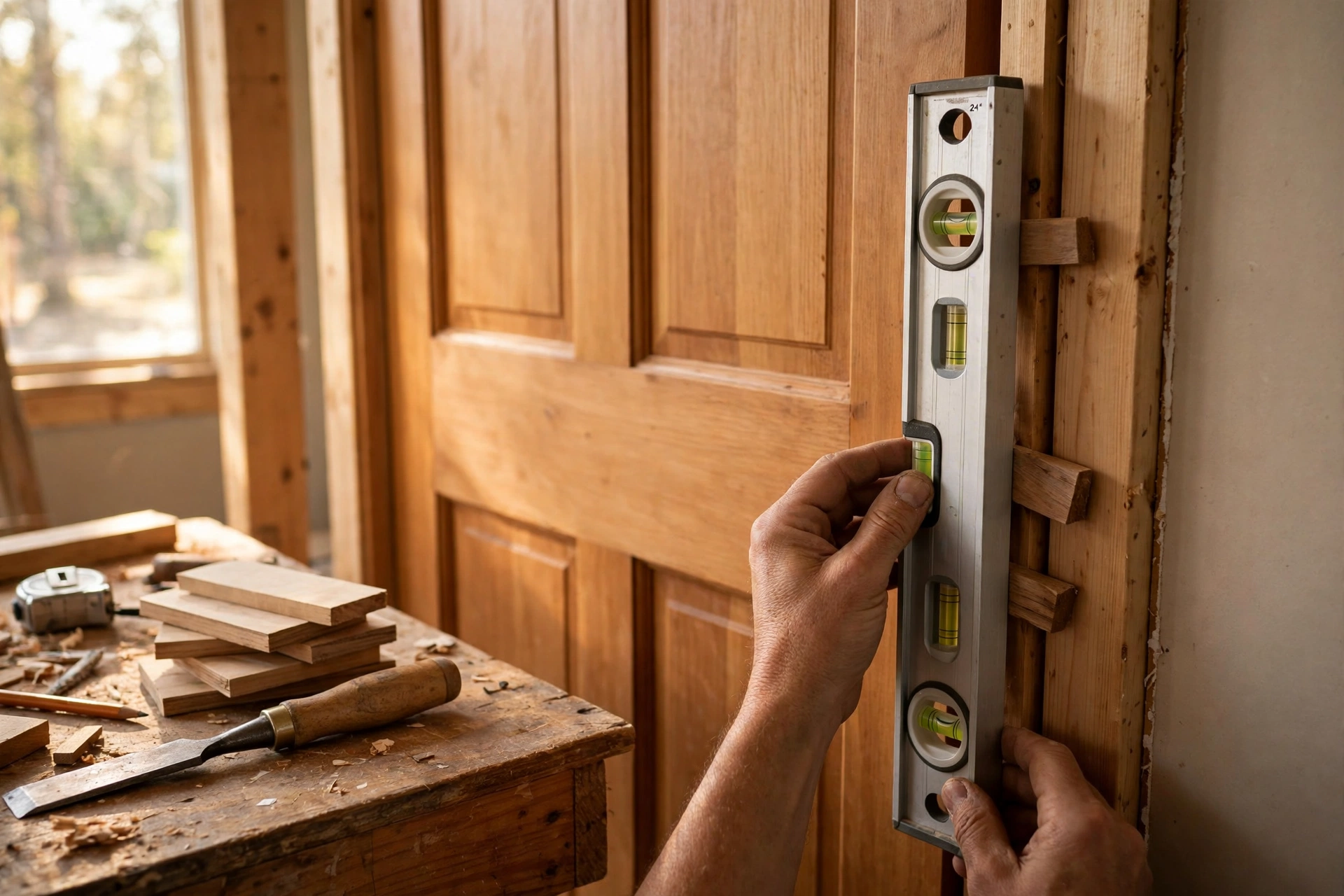
Carpenter Hourly Rates: Handyman vs. Finish Carpenter
Most carpenters quote door installs as a flat fee, but that flat fee is built on an hourly rate. Knowing the tiers tells you whether a quote is fair:
| Who you hire | Typical hourly rate | Best for |
|---|---|---|
| Handyman / general carpenter | $30–$80/hr | Simple pre-hung swaps in standard openings |
| Finish carpenter (door & trim specialist) | $40–$90+/hr | Slab hangs, exterior doors, out-of-square frames |
| General contractor (subs out the carpentry) | $60–$120/hr | Whole-room projects where the door is one line item |
Handymen ($30–$80/hr) handle straightforward pre-hung replacements well. They usually quote a half-day minimum, so a single interior door often costs the same as the labor table’s $120–$260 flat range — and bundling 3–4 doors in one visit can cut the per-door price by a third.
Finish carpenters ($40–$90+/hr) are the specialists for anything finicky: slabs in existing frames, old houses where nothing is square, and exterior doors that must seal tight. The U.S. Bureau of Labor Statistics carpenter wage data shows median carpenter pay around $27–$29/hr, which is why billed retail rates run higher — you’re paying for the business, the tools, the insurance, and the guarantee, not just the hours. For comparison with other trades’ hourly math, our electrician outlet repair cost guide shows a similar gap between trade wages and what customers pay per visit.
Minimum charges matter: most carpenters won’t roll the truck for less than $100–$150, so a single “quick” door still lands near the $120 low end of the labor table.
Interior vs. Exterior Door Installation Costs
Exterior doors cost more to install than interior doors for reasons beyond weight — they have to keep weather out:
| Interior door | Exterior door | |
|---|---|---|
| Typical labor | $120–$260 | $300–$650 |
| Typical door cost | $50–$200 | $200–$2,000+ |
| Weatherproofing | None needed | Sill pan, flashing, sealant ($30–$80 in materials) |
| Security | Simple latch | Deadbolt + strike-plate reinforcement |
| Skill sensitivity | Low-medium | High — leaks and air gaps are expensive mistakes |
| Typical job time | 1–2 hours | 2–4 hours |
An exterior door installed badly doesn’t just stick — it leaks. Water intrusion behind a bad install rots the sill and subfloor, turning a $400 install into a $2,000+ repair within a few years. This is the one door category where paying the finish-carpenter rate ($40–$90+/hr) over the handyman rate is almost always worth it.
Extra Costs: Hardware, Trim, Framing & Disposal
The labor quote is only part of the bill. These extras show up on most real projects:
| Extra | Typical cost |
|---|---|
| Interior lockset / knob hardware | $10–$60 |
| Deadbolt (exterior) | $25–$150 |
| New trim / casing (per door, installed) | $100–$200 |
| Painting or priming the door | $75–$200 |
| Threshold + weatherstripping (exterior) | $20–$60 |
| Framing changes (new or resized opening) | $250–$400 |
| Old door disposal | $50–$100 |
| Drywall patching (pocket door jobs) | $100–$300 |
Trim ($100–$200 per door) is the surprise line item: a “simple door swap” becomes a trim project when the old casing cracks during removal or the new frame needs wider casing to cover the gap. Disposal ($50–$100) applies when the carpenter hauls the old door away — dump fees and time both count. Ask upfront whether the quote includes hardware installation; some carpenters charge $15–$30 per lockset on top of the hang.
Cost Drivers: What Actually Moves the Price
Six factors decide whether your job lands at the low or high end of every range above:
1. Door type. Pre-hung in an existing opening is the floor; slab hangs and pocket doors are the ceiling. The type you choose moves the labor quote more than anything else. 2. Who you hire. A handyman at $30–$80/hr undercuts a finish carpenter at $40–$90+/hr on simple jobs, but the finish carpenter earns the premium on slabs, old houses, and exterior doors. 3. Opening condition. A square, plumb rough opening makes a pre-hung job fly. Old houses with settled, out-of-square openings can add 1–2 hours of shimming and planing per door. 4. New openings. Cutting a door into a wall where none existed — or widening an opening — adds $250–$400 for framing alone, plus drywall, paint, and possibly an engineer’s header for load-bearing walls. 5. Hardware and trim. A $20 knob versus a $150 smart deadbolt, reusing trim versus replacing it — these decisions add or subtract $100–$350 per door on top of labor. 6. Location. Labor rates run 20–40% above national averages in major coastal metros and 10–20% below in rural markets. Everything in this guide is a national 2026 average.
Pre-Hung vs. Slab Doors: Which Is Cheaper to Install?
The classic decision — and the total math is closer than most people expect:
| Pre-hung door | Slab door | |
|---|---|---|
| Typical door cost | $80–$300 (interior) | $50–$200 (interior) |
| Typical carpenter labor | $120–$260 | $200–$570 |
| Typical total (interior) | $200–$560 | $250–$770 |
| Frame condition needed | New frame included | Existing frame must be square and solid |
| Best for | Replacing whole unit, new openings | Keeping existing trim/frame, matching doors |
For a straightforward interior replacement, pre-hung usually wins on total cost — the cheaper labor outweighs the pricier door. Slab only wins when the existing frame and trim must be preserved. If your existing frame is out of square, by the way, the carpenter’s slab labor quote will reflect it — planing and shimming a slab into a crooked frame is where those $500+ quotes come from.
Carpenter vs. Big-Box Door Installation Programs
Big retailers sell door installation too, and the comparison matters:
| Independent carpenter | Big-box install program | |
|---|---|---|
| Typical interior door install | $120–$260 labor | $150–$350 installed (varies by program) |
| Who does the work | The person you hired | A contracted third-party installer |
| Scheduling | Flexible, often same-week | 1–3 week wait typical |
| Quality control | You vet the carpenter directly | Varies by local contractor |
| Quote detail | Itemized by the person doing the work | Bundled, less negotiable |
Big-box programs trade flexibility for convenience — one call, door + install handled. For the full price breakdown, see our Home Depot door installation cost guide and our Lowe’s interior door installation cost guide. A local carpenter usually wins on scheduling, negotiability, and accountability — especially for slabs and tricky openings — while the big-box programs make sense if you’re already buying the door there and want one point of contact.
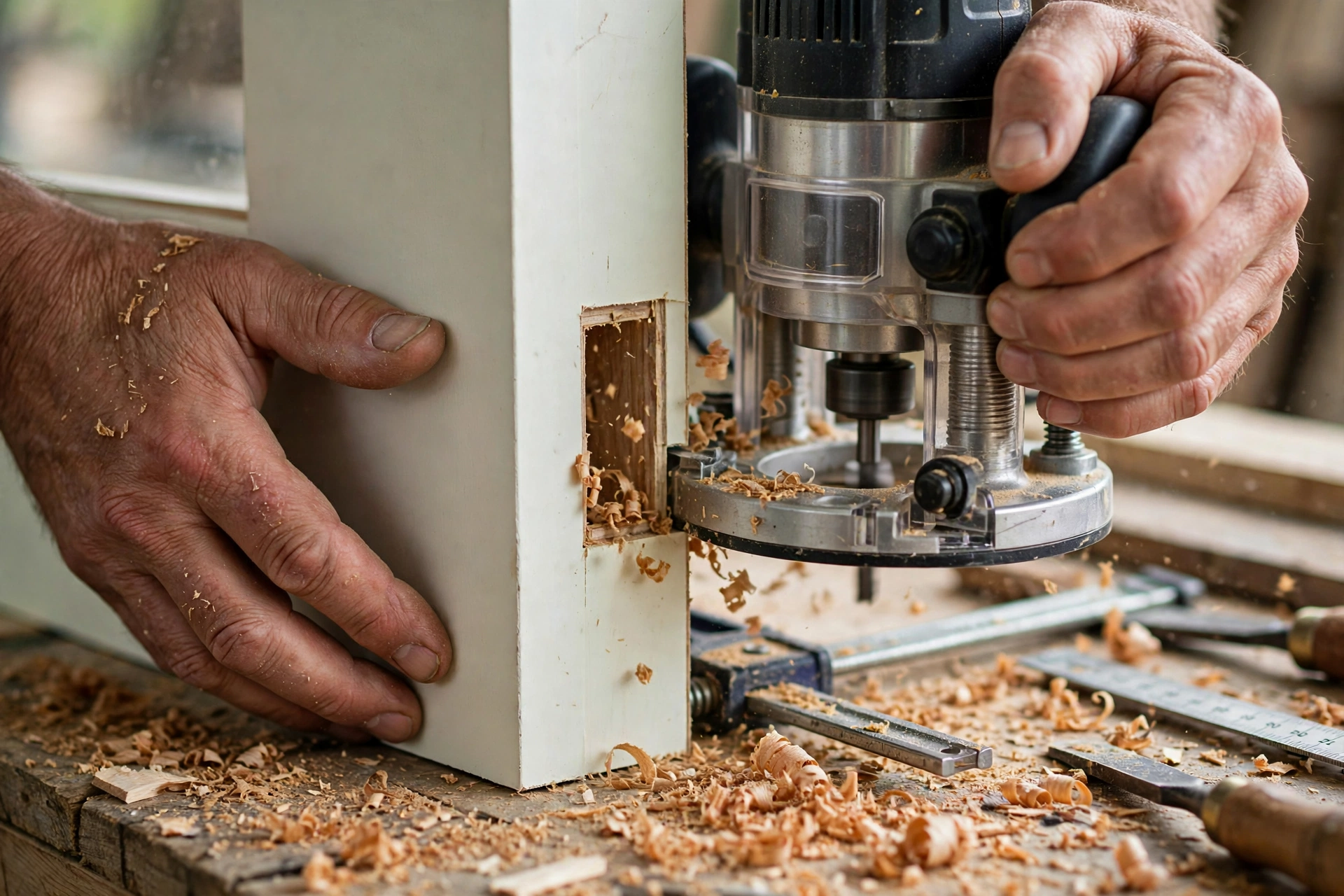
DIY vs. Hiring a Carpenter
A pre-hung interior door is one of the more DIY-friendly carpentry jobs — if the opening cooperates:
| DIY | Pro carpenter | |
|---|---|---|
| Pre-hung interior, square opening | ✅ Doable ($80–$300 in materials) — shim, level, nail, case it; a Saturday project with basic tools | $120–$260 — 1–2 hours, guaranteed square |
| Slab in existing frame | ⚠️ Doable with a router, hinge template, and patience — but a miscut mortise ruins the door | $200–$570 — mortising and fitting done right |
| Exterior door | ❌ Weatherproofing mistakes rot sills; deadbolt alignment affects security | $300–$650 — flashed, sealed, and secure |
| Pocket door | ❌ Wall surgery, track leveling, drywall repair — one of the hardest carpentry installs | $300–$1,000+ — and often worth every dollar |
| Old house, out-of-square opening | ⚠️ Planing, scribing, and shimming take real experience | Finish carpenter ($40–$90+/hr) earns it here |
The honest take: hang a pre-hung interior door yourself if you own a level, shims, and a Saturday — the materials are cheap and mistakes are forgiving. Pay a pro for slabs, exterior doors, and anything in an old house where the opening isn’t square. For exterior doors specifically, the weatherproofing and security stakes make the $300–$650 install money well spent.
Money-Saving Tips
- Bundle multiple doors. A carpenter charging a $100–$150 minimum does 3–4 pre-hung doors in one visit — per-door labor often drops 25–40% on multi-door jobs.
- Choose pre-hung over slab for replacements. The $80–$180 cheaper door is usually outweighed by $80–$310 cheaper labor — pre-hung wins on total cost in most cases.
- Buy the door yourself. Retailers and wholesalers beat carpenter-marked-up doors by 10–25%; just confirm the size and swing direction before ordering.
- Keep the existing frame when it’s sound. If the frame is square and the trim is good, a pre-hung swap (or even a slab hang) avoids the $250–$400 framing charge.
- Reuse hardware and trim. A $20 knob and existing casing in good shape save $100–$260 per door versus all-new.
- Get 3 itemized quotes. Door install quotes vary wildly — three quotes reveal who’s charging a $300 minimum for a $150 job and who breaks out hardware, trim, and disposal separately.
- Schedule interior doors any time, exterior doors in dry weather. Rushing an exterior install between storms invites callbacks; a dry-weather slot lets the sealant cure properly.
Frequently Asked Questions
How long does it take a carpenter to install a door?
A pre-hung interior door takes 1–2 hours for an experienced carpenter; a slab hang takes 2–4 hours because of mortising and fitting; exterior doors take 2–4 hours; pocket doors take 4–8 hours including wall work. Add time for painting, trim replacement, and any framing changes.
Is it cheaper to hire a carpenter or use a big-box install program?
A local carpenter’s labor ($120–$260 for a standard interior pre-hung) usually beats or matches big-box programs, which typically bundle install at $150–$350 with less flexible scheduling. Carpenters win on negotiability and accountability; big-box programs win on convenience when you’re buying the door there anyway. Compare our Home Depot door installation and Lowe’s interior door installation guides for the detailed numbers.
Can a carpenter install a door in an existing frame?
Yes — that’s a slab hang, and it’s exactly what finish carpenters are for. Typical labor is $200–$570 because every hinge must be mortised and the door planed to fit the old frame. It only works if the existing frame is square and solid; if the frame is rotted or badly out of square, a pre-hung unit at $120–$260 labor is usually cheaper overall.
Do carpenters supply the door, or do I buy it?
Either works. Many carpenters will source the door and mark it up 10–25% — you save money buying it yourself from a retailer or lumberyard. If you buy it, confirm the rough-opening size, swing direction, and jamb depth with the carpenter first; an incorrectly sized door is a non-returnable mistake.
What should I ask a carpenter before hiring them to install a door?
Ask these five things: (1) Is the quote flat-rate or hourly, and what’s the minimum charge? (2) Does it include hardware installation, trim/casing, and old-door disposal? (3) For exterior doors — does the quote include flashing, sill pan, and weatherproofing? (4) Are you licensed and insured? (5) What’s the warranty on the install if the door binds or drafts within the first year?
The Bottom Line
How much does a carpenter charge to install a door in 2026? Labor runs $120–$260 for a pre-hung interior door (1–2 hours), $200–$570 for a slab hung in an existing frame, $300–$650 for a pre-hung exterior door, and $300–$1,000+ for pocket doors. Hourly rates sit at $30–$80/hr for handymen and $40–$90+/hr for finish carpenters, with most jobs quoted flat plus a $100–$150 minimum. Framing changes add $250–$400, and hardware, trim, painting, and disposal typically add $150–$400 on top of labor. Total project cost (door + labor + extras) lands around $250–$600 for a basic interior door and $800–$2,000+ for an entry door. For simple interior swaps, a handyman or even DIY is fine — but exterior doors, slab hangs, and old-house openings earn the finish-carpenter rate every time.
Prices are typical 2026 US planning benchmarks gathered from contractor pricing data and national cost-guide ranges; your actual cost depends on region, door type (pre-hung vs. slab vs. pocket), opening condition, hardware and trim choices, and whether framing changes are needed. Always get at least three written, itemized quotes — including one from a licensed, insured carpenter — before committing. For context on trade wages behind these rates, see the U.S. Bureau of Labor Statistics carpenter wage data.
3 thoughts on “How Much Does a Carpenter Charge to Install a Door: 2026 Labor Guide”