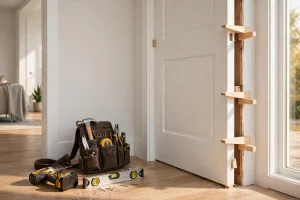
How Much Does an Interior Door Replacement Cost in 2026
If you’re trying to figure out the interior door replacement cost in 2026, here is the short answer: most homeowners pay $150–$400 per door all-in — door, labor, and hardware included. A basic hollow-core door swap costs as little as $150–$250, a solid-core upgrade lands at $225–$400, and a premium solid-wood door can reach $350–$800 installed. The door material drives most of the price, but labor, hardware, trim, and paint move the total more than most people expect.
Replacing an interior door means swapping out the door unit — and usually its frame, hinges, and lockset — for a new one in the same opening. It is one of the cheapest high-impact updates in a home: a new door tightens up drafts, cuts noise between rooms, and modernizes a hallway for less than the cost of repainting a room. This guide breaks down the full interior door replacement cost by material, door style, and room, plus labor, extras, and the DIY math — so you can budget the whole project, not just the door.
Quick-answer table (typical 2026 costs):
| Project | Typical cost |
|---|---|
| Standard hollow-core replacement (pre-hung, installed) | $150–$250 |
| Solid-core replacement (installed) | $225–$400 |
| Solid-wood replacement (installed) | $350–$800 |
| Slab-only replacement (existing frame kept) | $150–$300 |
| Bedroom door replacement | $180–$300 |
| Bathroom door replacement | $180–$300 |
| Closet door replacement | $120–$380 |
| Pocket door replacement | $350–$900 |
| Old door removal (per door) | $40–$80 |
| Old door disposal (per door) | $25–$50 |
| Whole house (10 doors, pre-hung swap) | $1,500–$4,000 |
Interior Door Replacement Cost by Material and Door Type
Material is the single biggest lever in the total. A hollow-core door is mostly cardboard honeycomb wrapped in veneer — light and cheap. Solid-core doors have an engineered-wood core that feels and sounds like real wood. Solid wood is exactly what it sounds like: heavier, more expensive, and easier to trim or repair. The table shows door-only prices versus the typical total once labor, hardware, and basic trim work are added.
| Door type | Door-only price | Typical total installed |
|---|---|---|
| Hollow-core pre-hung (most common) | $60–$150 | $150–$250 |
| Hollow-core slab | $30–$80 | $150–$300 |
| Solid-core pre-hung | $120–$250 | $225–$400 |
| Solid-core slab | $80–$180 | $230–$400 |
| Solid-wood pre-hung | $200–$500 | $350–$800 |
| Solid-wood slab | $150–$400 | $350–$900 |
| Bi-fold closet doors (pair) | $70–$200 | $120–$380 |
| Bypass/sliding closet doors (pair) | $100–$250 | $150–$450 |
| Pocket door (new track in wall) | $150–$400 | $350–$900 |
| French door pair (interior) | $250–$600 | $400–$900 |
Hollow-core ($150–$250 installed) is the budget standard — what most builders put in tract homes. It does the job for closets and low-traffic rooms, but it sounds thin when it closes and dents easily. If your quote is under $150 per door installed, it is almost certainly a hollow-core swap in an existing, square opening.
Solid-core ($225–$400 installed) is the sweet spot for most replacements. It feels like real wood, dampens sound between bedrooms and living areas noticeably, and costs far less than solid wood. Bedrooms, bathrooms, and home offices are where the upgrade pays for itself — it is the most common choice for a “replace all the doors in the house” project.
Solid wood ($350–$800 installed) is the premium option: heavier, fully paintable and stainable, trimmable on all four edges, and repairable for decades. Pine and poplar sit at the low end; oak, maple, and cherry push the top. Solid wood makes sense for front-of-house doors and whenever you are matching existing woodwork.
Pre-hung vs. slab matters as much as material. A pre-hung door arrives already mounted in its own frame — the installer removes the old unit, shims the new one into the rough opening, and cases it. A slab is just the door blank, fitted into your existing frame. Slab doors cost less to buy but more to install: hanging one means mortising hinges, boring for the lockset, and planing the door to fit. For a full material-plus-labor breakdown of that trade-off, see our guide on how much a carpenter charges to install a door. As a rule of thumb, pre-hung wins on total cost unless the existing frame and trim are worth preserving.
Pocket, bi-fold, and French doors are the specialty styles. Bi-folds and bypass doors are the economical closet options ($120–$380 and $150–$450 installed). Pocket doors, which slide into the wall cavity, run $350–$900 because the job includes a new track and often drywall patching — they are a space-saving upgrade, not a cost-saving one. Interior French-door pairs ($400–$900) are the design-forward choice for offices and dining rooms.
Interior Door Replacement Cost by Room
Where the door goes changes the spec — and the price. Bathrooms need solid, lockable doors (moisture and privacy); closets just need to look right and open smoothly.
| Room | Typical door spec | Typical total installed |
|---|---|---|
| Bedroom | Solid-core pre-hung with privacy lockset | $180–$300 |
| Bathroom | Solid-core with lock; sometimes louvered for venting | $180–$300 |
| Closet (standard swing door) | Hollow-core pre-hung | $150–$250 |
| Closet (bi-fold pair) | Hollow-core bi-fold | $120–$380 |
| Laundry / pantry | Hollow-core or louvered for airflow | $150–$280 |
| Home office | Solid-core for sound control, lock optional | $180–$350 |
| Whole house (10 doors) | Mixed, mostly solid-core | $1,500–$4,000 |
Bedroom and bathroom doors ($180–$300) sit in the middle of the range because most homeowners choose solid-core with a privacy lockset. Bathrooms sometimes add a louvered bottom panel to keep air moving to the bath fan — that adds $20–$40 to the door price.
Closet doors ($120–$380) are the cheapest replacement on a per-door basis when they are simple hollow-core bi-folds, but wide closets needing custom-height sliding doors push toward the top of the range. One money tip: if the closet opening is a standard 48-inch width, off-the-shelf bi-fold pairs keep the door-only price under $200.
Whole-house replacement ($1,500–$4,000 for 10 doors) is where bundling pays. Contractors drop the per-door labor 20–40% on multi-door jobs because setup, travel, and the minimum charge get spread across the day. A 10-door house with builder-grade hollow-core pre-hungs can come in near $1,500; the same house in solid-core lands around $2,500–$4,000.
Cost Drivers: What Moves Your Quote
Two identical-looking doors can produce very different invoices. These six factors decide where in every range above your project lands:
1. Door material. Hollow-core to solid-core to solid wood spans $150–$800 per door installed — the single largest swing. 2. Framing condition. A square, solid rough opening makes a pre-hung swap a 1–2 hour job. A damaged, rotted, or out-of-square frame adds $50–$200 in carpentry repair per door — common in older homes. 3. Hardware. A basic privacy knob is $10–$25; a lever set runs $25–$60; a smart lock on an interior door adds $100–$250. Upgrading hinges from contractor brass to oil-rubbed bronze adds about $15–$30 per door. 4. Trim and casing. Reusing the existing trim costs nothing; new casing, mitered and installed, adds $100–$200 per door. Wide or custom profiles push the top of that range. 5. Paint and finishing. Factory-primed doors still need two finish coats: budget $75–$200 per door for professional painting. Unfinished solid-wood doors that need staining cost more to finish than pre-primed ones. 6. Removal and disposal. Pulling the old door and hauling it away typically costs $40–$80 for removal and $25–$50 for disposal per door — sometimes rolled into the install quote, sometimes a line item. Always ask.
Labor itself usually runs $100–$250 per door for a standard pre-hung swap when quoted separately — built on carpenter and handyman hourly rates of roughly $30–$90/hr depending on skill level and market. The U.S. Bureau of Labor Statistics carpenter wage data (median around $27–$29/hr) shows why retail install rates run higher: you are paying for the business, tools, insurance, and the guarantee behind the hours. For context on installer pricing, our carpenter door installation labor guide breaks down flat-rate versus hourly quotes.
Regional labor swings every number above by 20–40%: coastal metros and high-cost cities pay more, rural and low-cost markets pay less. If your quote is well outside these ranges, geography is usually the explanation.
Energy and separation note: for doors between conditioned living space and an unconditioned garage or basement, a solid-core door with weatherstripping improves the thermal and sound separation. The U.S. Department of Energy’s Energy Saver guide to doors explains how door construction and sealing affect heat transfer — worth reading before speccing a door on that boundary.
Retailer Installation Programs: Home Depot and Lowe’s
Big-box stores sell both the door and the install, which is convenient when you want one point of contact. Their programs use contracted local installers, with scheduling that typically takes 1–3 weeks, and installed pricing usually lands in the $200–$500 per door range for a standard interior pre-hung — door included. Local contractors often beat that on multi-door jobs and negotiate more easily, but the retailer route simplifies buying and scheduling in one step.
For the full numbers: see our Home Depot door installation cost guide and our Lowe’s interior door installation cost guide, which break down each program’s pricing, scheduling, and what the quote actually includes.
DIY vs. Hiring a Pro
Replacing a pre-hung interior door in an existing, square opening is one of the more DIY-friendly home-improvement jobs. Keeping an old frame (slab fit) or cutting a pocket-door track is not.
| Project | DIY | Pro |
|---|---|---|
| Hollow-core pre-hung swap, square opening | ✅ $60–$150 in materials — shim, level, nail, case it; a Saturday project with basic tools | $150–$250 — 1–2 hours, guaranteed square and true |
| Solid-core pre-hung swap | ✅ $120–$250 in materials — same process, heavier door; a helper makes it much easier | $225–$400 — worth it if you value your weekend |
| Slab fit into existing frame | ⚠️ Doable with a router, hinge template, and patience — but a miscut hinge mortise ruins the door | $150–$300 labor + door — the safe choice for most homeowners |
| Bi-fold / bypass closet doors | ✅ Usually the easiest install of all — track and pivot hardware, a couple of hours | $120–$380 — often unnecessary unless the opening needs repair |
| Pocket door | ❌ Wall surgery, track leveling, drywall and paint repair | $350–$900 — and usually worth every dollar |
The honest take: DIY a pre-hung swap if you own a level, shims, and a free afternoon — materials are cheap and mistakes are forgiving. Hire a pro for slab fits (the mortising and planing need real practice), pocket doors, and any opening that is not square — an out-of-plumb frame will make a self-installed door swing open on its own or bind within months. If you go DIY, measure the rough opening — not the old door — and confirm the swing direction and jamb depth before you buy; an incorrectly sized door is usually non-returnable.
Money-Saving Tips
- Bundle doors into one job. A contractor’s minimum charge and setup cost get spread across the day — per-door labor often drops 20–40% on multi-door projects.
- Choose pre-hung over slab for replacements. The slab’s cheaper door price is usually wiped out by its higher install labor; pre-hung wins on total cost unless the existing frame must be preserved.
- Upgrade only where it matters. Put solid-core doors on bedrooms, bathrooms, and offices; use hollow-core for closets, pantries, and laundry rooms. The mixed approach saves $75–$150 per door where sound control is irrelevant.
- Buy the doors yourself. Retailers and lumberyards typically beat contractor-marked-up doors by 10–25% — just confirm rough-opening size, swing direction, and jamb depth before ordering.
- Reuse trim and hardware when they are in good shape. Existing casing and hinges in good condition save $100–$260 per door versus all-new.
- Get 3 itemized quotes. Door install quotes vary wildly — three quotes reveal who is padding the labor, who breaks out removal and disposal separately, and who quotes hollow-core when you asked for solid-core.
- Skip the finish on pre-primed doors if you can paint. A factory-primed door plus your own two coats of paint saves $75–$200 per door over paying the installer to finish it.
Frequently Asked Questions
How much does it cost to replace an interior door, including labor?
Most homeowners pay $150–$400 per door including door, labor, and basic hardware in 2026. A basic hollow-core swap costs $150–$250, a solid-core upgrade $225–$400, and a solid-wood door $350–$800. Old-door removal adds $40–$80 and disposal $25–$50 per door when billed separately.
Is it cheaper to replace a slab or the whole pre-hung unit?
The whole pre-hung unit is usually cheaper on total cost. A slab door costs less to buy ($30–$180) but far more to install ($150–$300 labor) because every hinge must be mortised and the door planed to fit — so a slab replacement totals roughly the same as a pre-hung ($150–$300). Pre-hung wins unless you are preserving an existing frame and trim you cannot match.
How long does it take to replace an interior door?
A pro replaces a standard pre-hung interior door in 1–2 hours per door, including trim. A slab fit takes 2–4 hours; a pocket door takes 4–8 hours with wall work. A DIY pre-hung swap in a square opening takes a competent homeowner most of a Saturday for the first door, then 1–2 hours each after that.
Can I replace an interior door without replacing the frame?
Yes — that is a slab replacement. It works if the existing frame is square, solid, and the right size. Labor runs $150–$300 because the installer must mortise hinges, bore the lockset, and plane the door to fit. If the frame is damaged or badly out of square, a full pre-hung replacement at $150–$400 is usually cheaper and gives a better result.
Should I replace all my interior doors at once?
If more than two or three doors need replacing, yes — bundling is the single best way to cut per-door cost. Contractors routinely discount per-door labor 20–40% on multi-door jobs, and a whole-house run (10 doors) typically lands at $1,500–$4,000 depending on material. Replacing one door at a time means paying a minimum charge on every visit.
The Bottom Line
How much does an interior door replacement cost in 2026? Expect $150–$400 per door installed (door + labor + hardware) for most projects: $150–$250 for a basic hollow-core pre-hung swap, $225–$400 for a solid-core upgrade, $350–$800 for solid wood, $120–$380 for closet doors, and $350–$900 for pocket doors. Bedroom and bathroom replacements typically land at $180–$300. Budget an extra $40–$80 for removal and $25–$50 for disposal per door when billed separately, plus $100–$200 if you are replacing trim and $75–$200 for professional painting. Whole-house projects (10 doors) run $1,500–$4,000. Pre-hung units win on total cost for most replacements, solid-core is the best value upgrade, and bundling multiple doors into one job is the fastest way to bring the per-door price down.
Prices are typical 2026 US planning benchmarks based on national contractor pricing patterns and published cost-guide ranges; your actual cost depends on region, door material, opening condition, hardware and trim choices, and whether framing repairs are needed. Always get at least three written, itemized quotes from licensed and insured contractors before committing.