
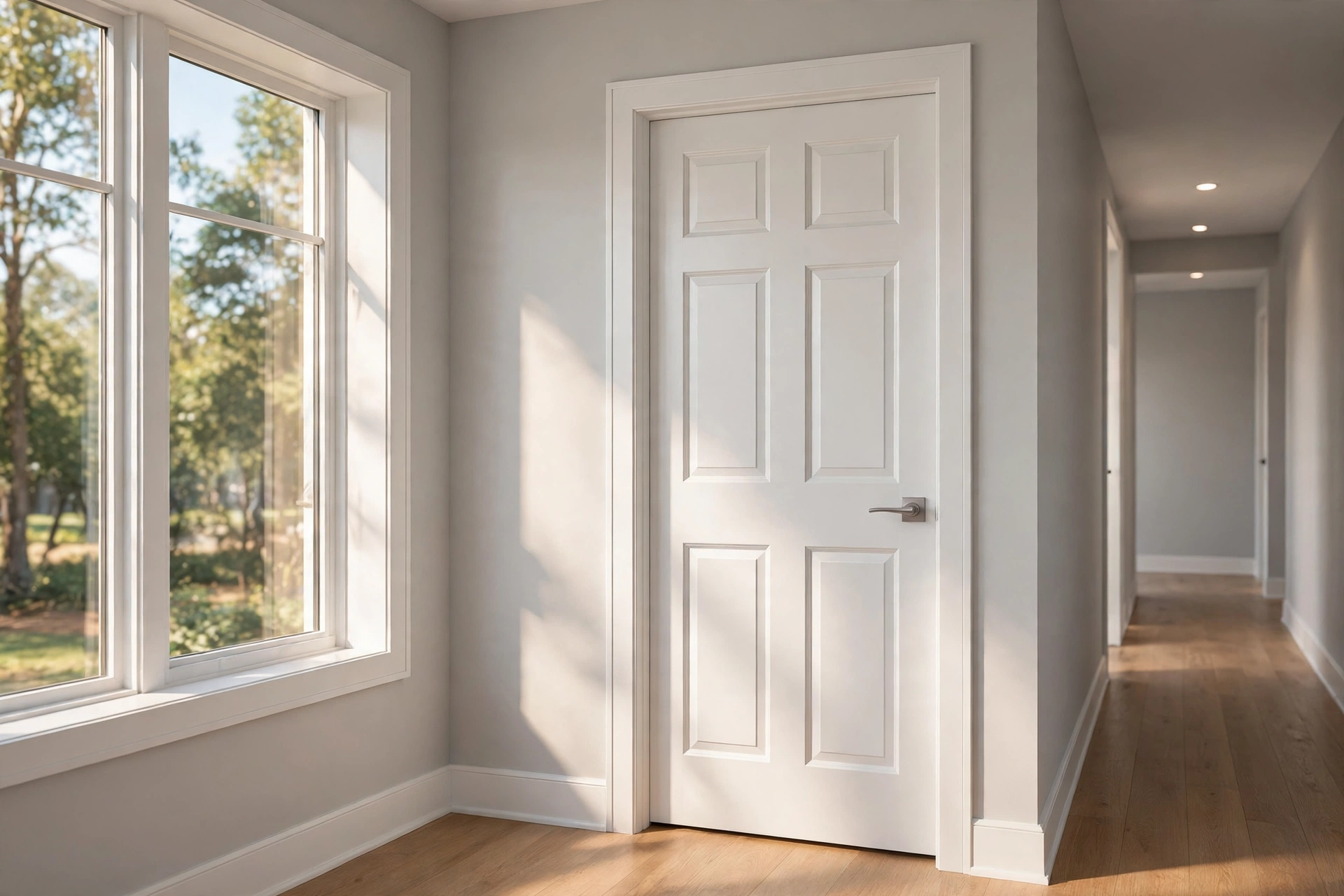
What Does Lowe’s Charge to Install an Interior Door?
So what does Lowe’s charge to install an interior door in 2026? A typical all-in job through Lowe’s installation program runs $300–$1,500+ per door, depending on the door type. A basic pre-hung hollow-core door usually lands at $300–$700 installed, a solid-core pre-hung door at $500–$1,000+, and double French doors or barn doors at $700–$1,500+. A professional measuring visit costs $30–$50, and work is done by licensed, insured independent installers backed by a one-year labor warranty.
The biggest misconception is that Lowe’s has one flat installation price. It doesn’t — Lowe’s quotes each job individually through local independent installers, so the door you pick, the condition of your existing frame, and your local labor market all move the final number. This guide breaks down exactly what each door type costs installed, what’s included in the quote, what shows up as extras, how Lowe’s process works, and how it compares to the competition — so you can tell a fair quote from a padded one.
Quick-answer table (typical Lowe’s costs, 2026):
| Job | Typical all-in cost |
|---|---|
| Basic hollow-core slab on existing frame | $150–$400 |
| Standard pre-hung hollow-core interior door | $300–$700 |
| Pre-hung solid-core interior door | $500–$1,000+ |
| Double interior French doors | $700–$1,500+ |
| Barn or sliding closet door | $400–$1,100+ |
| Professional measuring visit | $30–$50 |
| Old door removal and haul-away | $20–$50 per door |
Lowe’s installation services cover interior doors of every common style — standard passage doors, pre-hung units, French doors, barn doors, closet sliders, and bifolds — and the company notes on its door installation services page that independent installers handle interior projects as well as exterior ones, with a one-year labor warranty standard on installation work.
Lowe’s Interior Door Installation Cost by Door Type
The door itself is the single biggest variable. Hollow-core doors are light, cheap, and fast to hang; solid-core doors cost more for the slab and take more muscle. Specialty doors (French, barn) add hardware and labor.
| Door type | Typical door unit cost | Typical installed labor | Typical all-in range |
|---|---|---|---|
| Hollow-core slab (door only) | $30–$80 | $120–$180 | $150–$400 |
| Hollow-core pre-hung | $70–$150 | $100–$300 | $300–$700 |
| Solid-core slab (door only) | $80–$200 | $120–$200 | $250–$600 |
| Solid-core pre-hung | $160–$400+ | $100–$300 | $500–$1,000+ |
| Interior French doors (double, pre-hung) | $300–$800+ | $300–$600 | $700–$1,500+ |
| Barn door with hardware kit | $150–$600 | $150–$400 | $400–$1,100+ |
| Bifold closet door | $25–$150 | $75–$200 | $150–$400 |
Hollow-core ($150–$700 installed) is the budget workhorse: a molded composite or hardboard skin over a honeycomb core. Light enough for one person to hang, cheap to buy, and perfectly fine for bedrooms and closets where sound blocking doesn’t matter. A slab swapped into an existing frame is the cheapest installed door in the Lowe’s program; a pre-hung install costs more because you’re paying for a new frame, hinges, and more install time.
Solid-core ($250–$1,000+ installed) costs roughly double because the door itself is heavier and pricier — a molded composite or wood-veneer slab with a solid particleboard or MDF core. The payoff is real: noticeably better sound dampening and a heft that feels like quality. Worth it for bedrooms, home offices, and bathrooms; overkill for a linen closet.
French doors ($700–$1,500+ installed) are two swinging doors with glass lites, almost always sold pre-hung. The unit costs more, the install takes longer (two doors to level and align), and the glass lites mean careful handling. They look fantastic between a living room and a home office — but confirm the quote includes both door slabs and the wider rough-opening work if your doorway isn’t already sized for a double unit.
Barn and sliding doors ($400–$1,100+ installed) sit in the middle on the door itself, but the rolling hardware kit and track mounting add labor. Mounting the track demands a rock-solid header or stud connection — an installer who skips that step leaves you with a door that sags. This is one style where Lowe’s pro installation earns its keep over a DIY attempt.
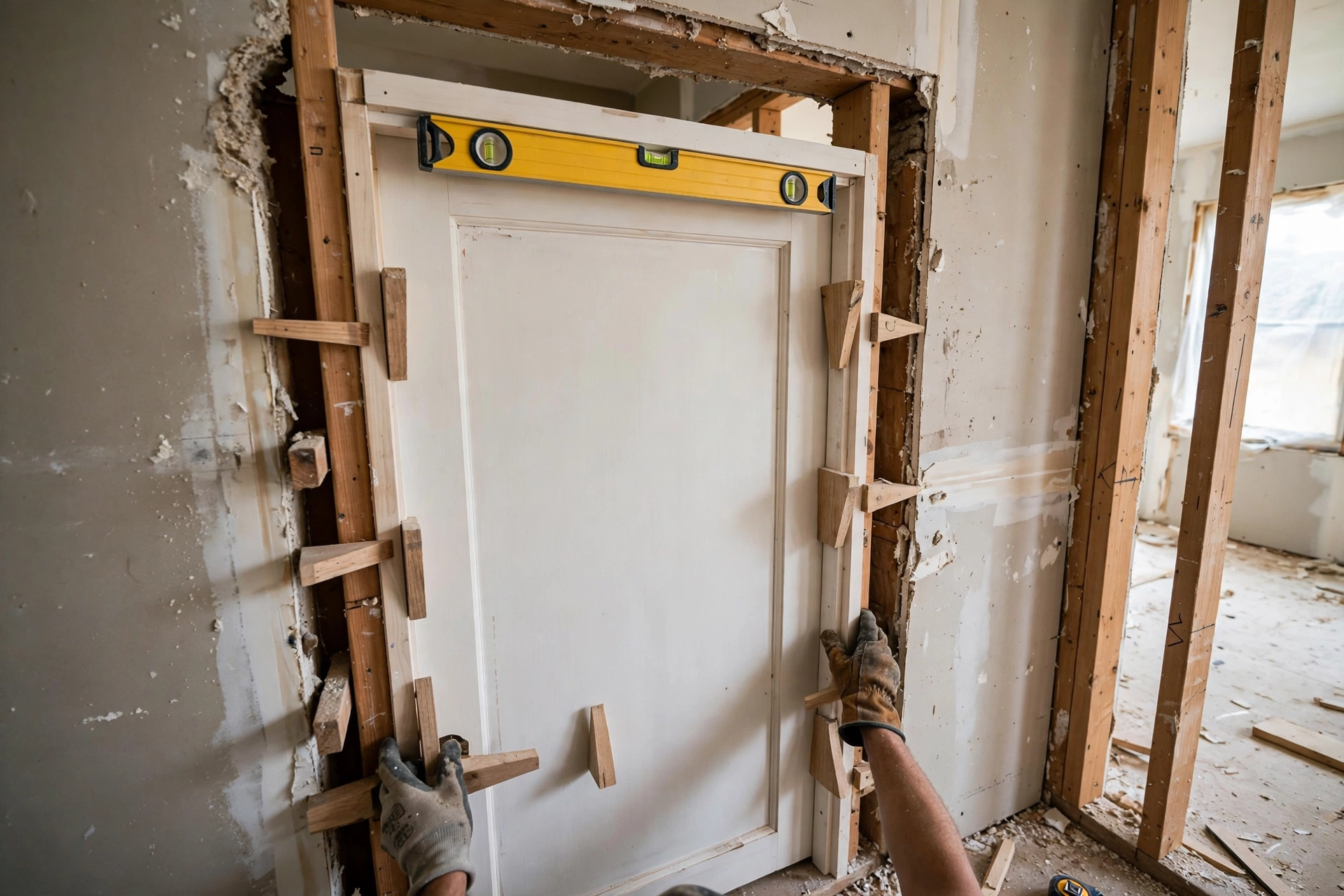
Pre-Hung vs. Slab: How the Door Style Changes Labor Cost
The slab-vs-pre-hung choice shapes the labor bill more than most people expect. A slab is just the door panel; a pre-hung door arrives already mounted in its own frame with hinges attached.
| Pre-hung door | Slab door | |
|---|---|---|
| What you get | Door + frame + hinges, pre-assembled | Just the door panel |
| Best for | New openings or damaged/rotted frames | Existing frames in good condition |
| Typical install time | 30–60 minutes per door | 60–120 minutes per door |
| Typical labor (Lowe’s installer) | $100–$300 | $120–$180 |
| Skill level required | Moderate — shim, level, secure | High — mortise hinges, bore lockset |
The counterintuitive part: a slab can cost more in labor than a pre-hung, even though the door itself is cheaper. Hanging a slab means mortising hinge pockets, boring the lockset hole, and planing the door to fit the existing frame — fiddly carpentry that eats time. A pre-hung unit drops into the rough opening, gets shimmed level, and gets nailed off.
So when does each win? If your existing frame is square, solid, and the right size, a slab replacement is the cheapest total job ($150–$400). If the frame is damaged, out of square, or you’re cutting a new doorway, the pre-hung route is faster and usually ends up cheaper overall once labor is counted. When in doubt, the $30–$50 measuring visit is exactly when the installer tells you which route your opening needs.
What’s Included — and What Costs Extra
A Lowe’s installation quote typically covers the door, standard installation labor, and basic supplies. Several common items are priced separately, and knowing them keeps the final invoice from surprising you:
| Item | Typical cost | Usually included? |
|---|---|---|
| Professional measuring visit | $30–$50 | No — separate service call |
| Door removal and haul-away | $20–$50 per door | Sometimes — confirm in writing |
| New interior trim/casing per door | $50–$200 | No — extra |
| Lockset, knobs, or levers | $30–$120 per door | No — you pick and pay separately |
| Painting or staining the new door | $50–$150 per door | No — installer hangs, doesn’t finish |
| Frame repair or re-framing | $100–$400 | No — quoted if the opening needs it |
| Widening or resizing the opening | $300–$800+ | No — structural work, separate quote |
Three things to nail down before you sign:
1. The measuring fee. Lowe’s charges $30–$50 for the in-home measure. Ask explicitly whether it’s credited toward the installation if you go ahead — policies vary by market and installer, and getting the answer in writing avoids an argument later. 2. Hardware and finish. A “door installation” quote almost never includes the knob or the paint. Budget $30–$120 for a decent lockset and either DIY the paint or add $50–$150 per door for finishing. 3. Haul-away. Old door disposal at $20–$50 per door is easy to overlook when you’re replacing six doors. If the installer charges it, that’s $120–$300 on a whole-house refresh — worth asking about upfront, since municipal bulk pickup may take them free.
How Lowe’s Interior Door Installation Works
Lowe’s doesn’t send store employees to hang your doors — the work goes to professional independent installers who are licensed where required, insured, and background-checked. The standard flow:
1. Pick your door. Browse in-store or online. Standard interior passage doors are the quickest path; special orders (odd sizes, custom styles) add 1–3 weeks of lead time before installation can even be scheduled. 2. Schedule the measure. A $30–$50 visit where the installer measures each opening, checks the frames for square and rot, and notes anything unusual (out-of-plumb walls, nonstandard rough openings, missing headers for barn doors). 3. Get the written quote. The installer prices the job: door, labor, and any extras like trim, haul-away, or frame repair. This is your moment to compare — get the line items, not just a lump sum. 4. Installation day. A standard pre-hung interior door takes about 30–60 minutes to hang; a full day covers roughly 4–8 doors depending on type and complications. Slab replacements run longer per door. 5. Warranty. Lowe’s installation work carries a one-year labor warranty as standard, on top of whatever manufacturer warranty the door itself has. Keep the paperwork — if a door starts sticking or a hinge loosens in month eight, that’s a warranty call, not a new bill.
Total timeline from first store visit to finished doors: typically 1–3 weeks for stock doors, longer for special orders. If you’re on a deadline (a move-in date, a rental turnover), order the doors before you book the installer.
Lowe’s vs. Home Depot: Door Installation Compared
The other big-box program worth comparing is Home Depot’s. Both retailers run the same basic model — you buy the door from them, and a vetted local independent installer does the work — so the differences are in the details rather than the concept:
| Lowe’s | Home Depot | |
|---|---|---|
| Installer model | Independent local pros | Independent local pros |
| Measuring fee | $30–$50 | Similar professional measure fee |
| Typical all-in range | $300–$1,500+ per door | Comparable — see our full breakdown |
| Labor warranty | 1-year labor warranty standard | Warranty included (terms vary by job) |
| Door brands | ReliaBilt, JELD-WEN, others | Masonite, JELD-WEN, others |
Neither chain publishes a fixed per-door installation price, because local labor rates genuinely differ — a quote in Dallas won’t match one in Seattle. The practical move is to get a written quote from Lowe’s and compare it against the other program using our how much will Home Depot charge to install a door guide, which breaks down Home Depot’s door installation costs the same way. Whichever you pick, the line items to compare are identical: measuring fee, door price, labor, hardware, trim, haul-away, and warranty terms. The cheapest headline number isn’t the cheapest job if one quote buries $200 of trim work the other includes.
Cost Drivers: What Actually Moves the Price
Six factors decide whether your quote lands at $300 or $1,500 per door:
1. Door type and core. Hollow-core vs. solid-core is the single biggest swing — the slab alone jumps from $30–$80 to $80–$400+, and the heavier door takes more install time. 2. Pre-hung vs. slab. Pre-hung costs more in materials but installs faster; slab is cheaper to buy but needs hinge mortising and lockset boring. Damaged frames force the pre-hung route regardless. 3. Opening condition. A square, solid existing frame means a quick slab swap. Rotted jambs, out-of-plumb walls, or a rough opening that needs reframing adds $100–$400 before the door even goes in. 4. Hardware and trim. A $30 knob vs. a $120 lever set, plus $50–$200 for new casing per door — these “small” choices add up fast across multiple doors. 5. Quantity. Installers often discount per-door labor on multi-door jobs since the trip, setup, and measuring are spread across the project. Replacing six doors at once costs noticeably less per door than six separate visits. 6. Local labor market. This is why Lowe’s won’t quote a national flat rate. The same pre-hung install can vary by $100–$200 between markets — which is also why three written quotes matter.
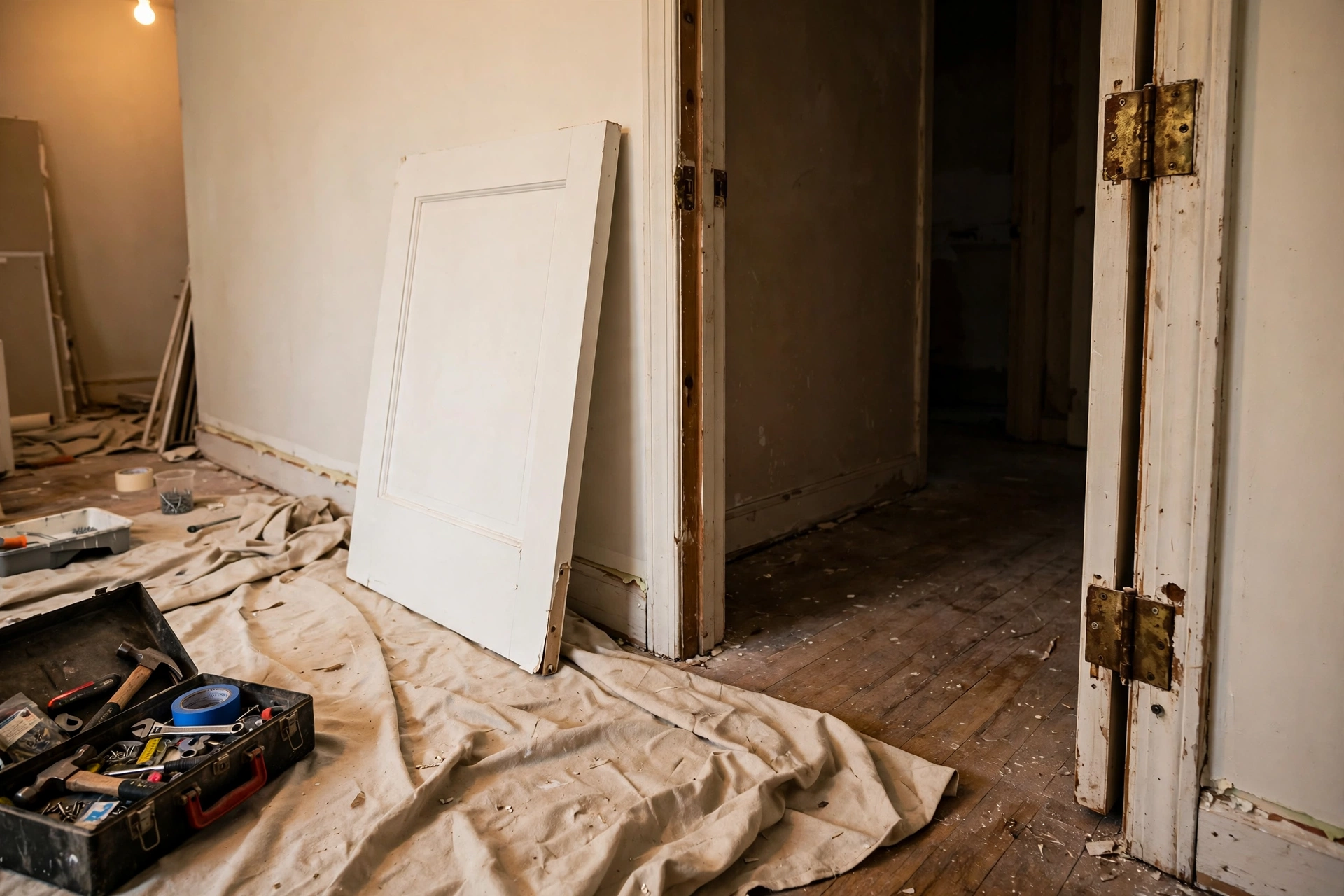
DIY vs. Lowe’s Pro Installation
Hanging an interior door is one of the more DIY-accessible carpentry jobs — but “accessible” and “worth your Saturday” are different questions:
| DIY | Lowe’s pro | |
|---|---|---|
| Pre-hung hollow-core, standard opening | ✅ Doable ($70–$150 door + $20 in shims/caulk) — 1–2 hours for a first-timer | $300–$700 — done in under an hour, warranted |
| Slab on existing frame | ⚠️ Needs hinge-mortising, lockset boring, planing — mistakes mean a new door | $150–$400 — the fiddly work is their problem |
| Solid-core pre-hung | ⚠️ Heavy (50–80 lbs) — genuinely a two-person job | $500–$1,000+ — crew handles the weight |
| French doors or barn doors | ❌ Alignment and track mounting are unforgiving | $400–$1,500+ — measured right, mounted solid |
| Multiple doors (whole house) | ❌ Days of work; inconsistent gaps and latches | Per-door labor often discounted; one-day job |
The honest math: a single pre-hung hollow-core in a clean opening is a satisfying DIY win that saves you roughly $100–$300 in labor. But slab fitting is where DIY budgets go to die — one mis-bored lockset hole and you’ve bought a second $80 door. And anything heavy, double, or track-mounted justifies the pro: a French door pair that’s 1/8 inch out of alignment will annoy you every single day, and Lowe’s one-year labor warranty means misalignment is their callback, not your problem.
Money-Saving Tips
- Do all your doors at once. The measuring visit, trip charge, and setup get spread across the job — per-door labor typically drops 10–20% on multi-door projects versus one-off visits.
- Keep the existing frames if they’re sound. A slab swap at $150–$400 beats a pre-hung install at $300–$700 every time the frame is square and rot-free. The measuring visit tells you which camp you’re in.
- Choose hollow-core where it doesn’t matter. Closets, pantries, and laundry rooms don’t need sound blocking — save the solid-core premium for bedrooms, bathrooms, and the home office.
- Buy hardware separately and skip the upsell. A quality passage knob is $30–$60 at retail; installer-supplied hardware often carries a markup. Hand the installer the knobs you bought and pay labor only.
- Ask about the measuring fee credit. Some installers apply the $30–$50 measure toward the job when you proceed. It costs nothing to ask, and it’s the easiest $50 you’ll save on the project.
- Paint the doors yourself. At $50–$150 per door for professional finishing, a $40 gallon of paint and a Saturday covers six doors. Hang first, paint after — or pre-paint slabs before the installer arrives.
- Get the haul-away question answered early. At $20–$50 per door, disposal on a six-door job is real money. Many municipalities take old doors in bulk pickup free — check before you pay the installer for it.
- Refreshing the whole room? Doors and windows are priced per opening the same way — our window replacement cost for one window guide breaks down per-opening pricing if your project includes both.
Frequently Asked Questions
Will Lowe’s install an interior door I didn’t buy from them?
Generally, no. Lowe’s installation program is tied to doors purchased through Lowe’s — the quote, the warranty, and the installer’s scheduling all run through their system. If you already own the door, a local handyman or carpenter is the cheaper and simpler route, typically $100–$300 in labor for a standard hang.
How long does Lowe’s interior door installation take?
The hang itself is quick: roughly 30–60 minutes per pre-hung door and 60–120 minutes per slab. The full timeline is longer — expect 1–3 weeks from the measuring visit to installation day for stock doors, since scheduling the independent installer takes time. Special-order doors add their manufacturing lead time on top.
Is the $30–$50 measuring fee refunded if I buy the installation?
It depends on the market and the installer — some credit the measuring fee toward the final invoice when you proceed, others treat it as a standalone service charge. Ask before the visit and get the answer in writing on the quote. Either way, the measure is worth it: it catches nonstandard openings and frame problems before they become change orders.
Are Lowe’s door installers actual Lowe’s employees?
No — they’re professional independent installers: licensed where your state requires it, insured, and background-checked, contracted through Lowe’s installation program. That’s standard across the big-box installation programs. The upside for you is the one-year labor warranty that comes standard with Lowe’s installation services, which a random Craigslist handyman won’t offer.
What’s cheaper: Lowe’s or a local handyman?
For a single basic door, a handyman is often cheaper — $100–$300 in labor if you supply the door, versus $300–$700 all-in through Lowe’s. What Lowe’s buys you is convenience (one call, they source the door), vetted and insured installers, and the one-year labor warranty. For multi-door jobs, whole-house refreshes, or anything you’re not confident DIY-ing, the Lowe’s premium is usually worth it. Get both quotes and compare the line items.
The Bottom Line
What does Lowe’s charge to install an interior door? In 2026, expect $300–$1,500+ per door all-in. A standard pre-hung hollow-core door runs $300–$700 installed, a solid-core pre-hung runs $500–$1,000+, and French or barn doors run $700–$1,500+. The cheapest path is a slab swap into a sound existing frame at $150–$400. Budget a $30–$50 measuring visit up front, and remember the quote usually excludes hardware ($30–$120), trim ($50–$200), finishing ($50–$150), and haul-away ($20–$50) — confirm each line item in writing. Work is done by licensed, insured independent installers with a one-year labor warranty standard, and the whole process typically takes 1–3 weeks from measure to finished doors. Get the written quote, compare it line-by-line against the competition, and you’ll know exactly where your money goes.
Prices are typical 2026 US planning benchmarks for Lowe’s installation-program work, gathered from installer pricing data and national cost-guide ranges; Lowe’s does not publish fixed per-door installation prices, so your actual quote depends on the door type, your local labor market, the condition of the existing opening, and which extras (hardware, trim, finishing, haul-away) you include. Always get the quote in writing with line items — including one comparison quote from an independent local carpenter or the competing big-box program — before committing. Installation is performed by licensed (where applicable), insured, background-checked independent installers with a one-year labor warranty standard.
3 thoughts on “What Does Lowe’s Charge to Install an Interior Door? 2026 Guide”