
How Much Does Home Depot Charge to Put in a Ceiling Fan in 2026?
How much does Home Depot charge to put in a ceiling fan? In 2026, Home Depot ceiling fan installation labor typically runs $100–$300, and the typical total installed — fan plus labor — lands at $150–$500. A basic replacement of an old fan can be as low as $75–$150 in labor, while a job that needs new wiring adds $200–$400 or more, and a complex job with new wiring, a new circuit, and a high ceiling can run up to $2,000. The fan itself is a separate purchase on top of the labor, typically $50–$600 depending on the type and size. Home Depot does not send its own employees to install your fan: the work is done through Home Depot Pro Referral, a network of licensed, background-checked local independent pros, and you book and get a quote through homedepot.com or in store.
The reason the range is wide is the same reason it is wide when you hire an electrician directly: the price depends almost entirely on what is already in your ceiling. A fan-for-fan swap on an existing fan-rated box is a one-to-two-hour job, so the labor sits at the bottom of the range. Converting a light fixture to a fan means swapping the ceiling box for a fan-rated one, which pushes the labor up. And if there is no wiring in the ceiling at all — no fixture, no box, no switch — the job becomes new electrical work and the total jumps well past $500. Before you book, the single most useful thing you can do is look at your ceiling and work out which of those three scenarios you are in, because the scenario sets the price more than the fan or the installer does.
A ceiling fan is one of the cheapest comfort upgrades in a house: it can make a room feel about 4 degrees cooler in summer, let you raise the thermostat without losing comfort, and reverse in winter to push warm air back down. The U.S. Department of Energy’s own ceiling fans guide explains how to use a fan in both seasons and why blades should sit 7 to 9 feet above the floor. This guide breaks down exactly what Home Depot charges in 2026, how the Pro Referral booking process works step by step, what the service includes and what costs extra, how the price changes by scenario and by fan type, and how Home Depot compares with hiring an electrician directly or a handyman — including when the big-box route is the better deal and when it is not. For the labor rates behind these numbers, see our guide to what electricians charge to install a ceiling fan and the electrician rates they are built on.
Quick-answer table (typical 2026 Home Depot ceiling fan installation costs):
| Item | Typical cost |
|---|---|
| Home Depot installation labor | $100–$300 |
| Typical total installed, fan + labor | $150–$500 |
| Basic replacement, labor only | $75–$150 |
| Fan-for-fan swap, labor | $100–$300 |
| Light fixture to fan, labor | $150–$400 |
| New wiring, added cost | $200–$400+ |
| No existing wiring, total | $500–$2,000 |
| Complex job, maximum | Up to $2,000 |
| Ceiling fan itself | $50–$600 |
| High / vaulted ceiling, extra | $50–$200 |
| Outdoor fan installation, extra | $50–$150 |
| Electrician hired directly, typical total | $146–$360 |
| Electrician hourly rate | $50–$130 per hour |
| Handyman hourly rate | $50–$80 per hour |
| Time on site, simple swap | 1–2 hours |
| Time on site, conversion or new wiring | 2–4 hours |
How Much Does Home Depot Charge to Put in a Ceiling Fan by Scenario
Your ceiling decides your price. There are three scenarios, and the labor roughly doubles at each step — because each step adds work that the previous one did not need. Here is the full picture:
| Scenario | Home Depot labor | Fan (if supplied by you) | Typical total installed |
|---|---|---|---|
| Fan-for-fan swap (existing fan, fan-rated box) | $100–$300 | $50–$600 | $150–$500 |
| Basic replacement, simplest case | $75–$150 | $50–$600 | $150–$300 |
| Light fixture to fan (existing wiring, new fan-rated box) | $150–$400 | $50–$600 | $250–$550 |
| No existing wiring (new wiring + box + switch) | $400–$900 | $50–$600 | $500–$1,500 |
| No existing wiring + new circuit from panel | $600–$1,200 | $50–$600 | $800–$2,000 |
| Second / third fan on the same visit | $75–$150 each | $50–$600 each | $125–$300 each |
| Outdoor / patio fan installation | $150–$400 | $100–$600 | $250–$800 |
| High / vaulted ceiling fan installation | $150–$450 | $50–$600 | $200–$700 |
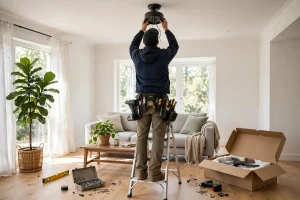
Fan-for-fan swap ($150–$500 installed). This is the cheapest scenario and the one most homeowners are in. An old ceiling fan is already hanging from a fan-rated ceiling box with wiring and a switch in place, so the pro removes the old fan, disconnects the wires, mounts the new fan to the same box, reconnects the wiring, balances the blades, and tests it. The job takes 1–2 hours on site, and labor runs $100–$300. In the simplest cases — a straightforward swap with easy ceiling access — the labor can be as low as $75–$150, which is how a basic replacement can come in near the bottom of the $150–$500 installed range. With a basic fan at $50–$100, the all-in total can stay near $150–$250; with a premium fan at $300–$600, the total climbs toward the top of the range. If your existing fan wobbles, check the box before you buy: a fan-rated box is braced to hold a moving, vibrating fan, and a swap onto a box that was never rated for a fan is not a swap at all — it is a conversion.
Light fixture to fan conversion ($250–$550 installed). This is the second scenario: a light fixture hangs where you want the fan, so the wiring and the switch already exist, but the ceiling box was built for a light — a light weighs a few pounds and never moves, while a fan weighs 15–50 pounds and vibrates constantly. The pro has to remove the light, replace the standard ceiling box with a fan-rated box, and then mount and wire the fan. Labor runs $150–$400, and the job takes 2–3 hours. If the existing switch is a single light switch and you want separate fan and light control, a new switch or a fan-speed control adds to the bill. This is also the scenario where a remote-controlled or smart fan earns its keep: a remote avoids the extra cost of running a second switch leg through the wall, because the receiver lives in the fan canopy and no new wiring is needed. For the labor rate behind these numbers, see our guide to what electricians charge to install a ceiling fan.
No existing wiring ($500–$2,000 installed). This is the expensive scenario: a room with no ceiling fixture at all — no box, no wiring, no switch — and the pro has to create the whole circuit. Running new wiring adds $200–$400 or more to the job, and if the existing circuits cannot take the load or there is no convenient source, a new circuit from the electrical panel adds further cost. Add the fan-rated box, a new wall switch, and the fan installation itself, and labor runs $400–$900 for a wiring-only job or $600–$1,200 if a new circuit is needed. The total lands at $500–$2,000, and it reaches the top of that range when the ceiling is finished and the pro has to open drywall to fish wires — drywall patching and repainting are usually a separate cost. A permit is also most likely in this scenario. If you are adding fans to several rooms with no wiring, do them all in one visit: the pro is already opening the panel and running wire, and each additional fan costs far less than the first.
Multiple fans on one visit. This is the best money-saving fact in the whole guide. The first fan carries the trip and scheduling overhead; the second and third fans on the same visit only cost the incremental labor, typically $75–$150 each for a swap. If you need three fans replaced, booking them as one job instead of three separate visits can save hundreds of dollars in repeated trip charges alone. Always ask for a multi-fan price when you book — most pros quote it happily, because a three-fan visit is a better job for them too.
Outdoor / patio fans ($250–$800 installed). An outdoor-rated fan — damp-rated for a covered porch, wet-rated for an exposed location — costs more to buy and slightly more to install, because the wiring has to be weatherproof and the box has to be rated for exterior use. An outdoor fan adds $50–$150 to the installation cost compared with an equivalent indoor fan. Never install an indoor-rated fan outdoors: humidity and rain will corrode the motor, and the warranty will not cover it.
High / vaulted ceilings ($200–$700 installed). A fan on a high or vaulted ceiling adds $50–$200 to the installation, because the pro needs a taller ladder or scaffolding, a longer downrod, and more time working overhead. Blades should sit 7 to 9 feet above the floor, so on a high ceiling the downrod length matters as much as the fan itself — and a fan mounted too close to a vaulted ceiling will not move air properly.
How Much Does Home Depot Charge by Fan Type
The fan you buy is the second-biggest lever on the total, after the scenario. A basic fan and a premium smart fan do the same job — move air — but the fixture price differs by a factor of ten, and the installation labor differs too, because heavier and larger fans take longer to mount and balance.
| Fan type | Fan price | Installation labor | Typical total installed |
|---|---|---|---|
| Basic builder-grade (42–44 in, no light) | $50–$100 | $100–$300 | $150–$400 |
| Standard with light kit (52 in) | $100–$250 | $100–$300 | $200–$500 |
| Large / great-room fan (60–72 in) | $200–$400 | $150–$400 | $350–$700 |
| Smart fan (Wi-Fi / app / voice control) | $250–$600 | $150–$400 | $400–$900 |
| Outdoor damp-rated (covered porch) | $100–$300 | $150–$400 | $250–$600 |
| Outdoor wet-rated (exposed) | $200–$600 | $150–$400 | $350–$800 |
| Low-profile / hugger (low ceilings) | $75–$200 | $100–$300 | $175–$400 |
| Dual-motor / designer fan | $300–$600 | $200–$450 | $500–$1,000 |
Basic builder-grade ($150–$400 installed). A basic 42–44-inch fan with no light kit costs $50–$100 for the fixture, plus $100–$300 in labor for a swap. This is the cheapest installed ceiling fan and the right choice for a bedroom or a rental where the fan just needs to move air quietly. The trade-off is a smaller motor, fewer speeds, and a pull chain instead of a remote — but for a straightforward swap, nothing beats it on price.
Standard with light kit ($200–$500 installed). This is the range most homeowners actually land in. A standard 52-inch fan with an integrated light kit costs $100–$250, plus $100–$300 in labor, and it replaces both the old fan and the room’s main light in one fixture. The 52-inch size suits most bedrooms and living rooms (rooms up to about 400 square feet), and the light kit means the pro wires both the fan motor and the light — usually to the same switch, or to separate controls if you pay for a new switch. When the typical $150–$500 installed range is quoted, it is this category — a standard fan with a light kit on an existing fan-rated box — that sits closest to the middle of the range.
Large / great-room fans ($350–$700 installed). A 60–72-inch fan for a great room or a vaulted living room costs $200–$400 for the fixture, plus $150–$400 in labor. The labor is higher because the fan is heavier, the blades are longer, and the mount usually needs a downrod and extra bracing — and on a high ceiling the pro works from a taller ladder or scaffolding, which adds time and a $50–$200 high-ceiling surcharge. Size the fan to the room: a 52-inch fan in a 500-square-foot great room will look lost and move too little air, and an oversized fan in a small bedroom will feel like a wind tunnel.
Smart fans ($400–$900 installed). A smart fan with Wi-Fi, app control, and voice-assistant support costs $250–$600 for the fixture, plus $150–$400 in labor. The labor is higher because the pro also has to pair the fan with your home network and test the app and voice controls — and because a smart fan usually replaces a standard switch with a compatible control. One advantage of a smart or remote-controlled fan is that it avoids the extra cost of running a second switch leg through the wall for separate fan and light control. Buy the smart fan for the convenience, not for the savings: the energy difference between a smart fan and a standard ENERGY STAR fan is small.
Outdoor fans ($250–$800 installed). A damp-rated fan for a covered porch costs $100–$300, and a wet-rated fan for an exposed location costs $200–$600, plus $150–$400 in labor, which includes the $50–$150 outdoor premium. The labor is higher because exterior wiring has to be weatherproof and the box has to be exterior-rated. Check the rating before you buy: a damp-rated fan under a roof is fine, but a damp-rated fan in the open rain will fail, and an indoor-rated fan outdoors is a fire and corrosion risk.
Low-profile / hugger fans ($175–$400 installed). A hugger fan mounts flush to the ceiling and costs $75–$200, plus $100–$300 in labor. It is the right choice for ceilings under 8 feet, where a standard fan on a downrod would hang too low — fan blades should sit 7 to 9 feet above the floor. The trade-off is less airflow than a downrod fan of the same size, because the blades sit closer to the ceiling.
Dual-motor / designer fans ($500–$1,000 installed). A dual-motor or designer fan costs $300–$600 for the fixture, plus $200–$450 in labor. These are statement pieces — two fan heads on one mount, sculptural blades, designer finishes — and the labor is higher because they are heavier, more complex to assemble, and harder to balance. Budget for the top of the labor range and ask the pro to confirm the ceiling box can carry the weight before you buy.
How Home Depot Ceiling Fan Installation Works
Home Depot does not employ the installers who fit your fan. The service runs through Home Depot Pro Referral: Home Depot matches your job with a licensed, background-checked local independent pro, and that pro does the work. That distinction matters, because the person who turns up is a local tradesperson, not a Home Depot store employee — and the quality of the job depends on that pro, just as it would if you hired an electrician directly. Here is how the booking works, step by step.
Step 1: Choose your fan. You can buy the fan from Home Depot or supply one you already own. Buying from Home Depot in the same trip is the convenient route — the store carries fans from $50–$600 — and the pro can confirm the fan suits the room before you commit. If you already have a fan, confirm it is complete: motor housing, blades, mounting bracket, downrod if needed, and any remote receiver.
Step 2: Request a quote. Book through homedepot.com or in store. You describe the job — swap, light-to-fan conversion, or no existing wiring — the room, the ceiling height, and the fan you want installed. Photos of the ceiling fixture help the pro quote accurately instead of pricing for the worst case.
Step 3: Get matched with a local pro. Home Depot Pro Referral matches the job with a licensed, background-checked independent pro in your area. The pro confirms the quote, which should spell out the labor, the fan-rated box if one is needed, any switch work, and any permit. Get the quote in writing before the work starts, with the box and the switch spelled out.
Step 4: The installation visit. The pro turns off the circuit at the breaker, removes the existing fixture or fan, and inspects the ceiling box. A fan-rated box is braced to a joist or mounted on a fan-rated brace bar and is stamped or labeled for fan support — it has to hold a moving, vibrating load of 15–50 pounds. A standard light box is not rated for that load, and hanging a fan from it is the single most common cause of a wobbling, noisy, or eventually falling fan. If the box is not fan-rated, it gets replaced, and that is what turns a swap into a conversion. The fan is assembled on the floor, then lifted to the ceiling, hung from the mounting bracket, and wired: black to black (fan motor), blue to black or to a separate switch leg (light kit), white to white (neutral), and green or bare copper to ground. A remote receiver, if the fan has one, is tucked into the canopy at this stage.
Step 5: Balancing and testing. A new fan almost always wobbles a little on first spin-up, and the pro balances it by adjusting blade screws and, if needed, adding a small balancing weight to a blade. Then the fan is tested at every speed, the light kit is tested, the wall switch and remote are tested, and the pro checks that the fan runs quietly with no clicking or humming. This is also when a bad switch or a loose connection shows up.
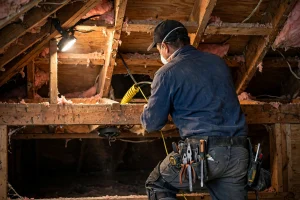
Step 6: New wiring adds a full second phase. If there is no wiring in the ceiling, the pro has to find a power source — usually a nearby circuit or the electrical panel — run cable through the ceiling and walls, install a fan-rated box, cut in a switch box, and wire the switch. On a finished ceiling this means fishing wire through joists and possibly cutting small access holes in the drywall, which is why the job takes 2–4 hours and costs $500–$2,000. A permit is usually required for new wiring, and the work may need an inspection before the drywall is closed up.
What Home Depot’s Ceiling Fan Installation Includes — and What It Doesn’t
A standard Home Depot ceiling fan installation covers the core work of mounting and wiring the fan on an existing fan-rated box. The trouble starts at the edges of that quote, where the items most likely to be needed — a fan-rated box, a new switch, a permit — are priced as extras. Before you book, know exactly where the line falls:
| Item | Standard installation | Notes |
|---|---|---|
| Removal of old fan or light fixture | Included | Standard installation includes removing the existing fixture |
| Disposal / haul-away of old fan | Usually included | Confirm in writing — some pros charge a small disposal fee |
| Mounting the new fan | Included | Assembly, hanging, and securing to the ceiling box |
| Wiring the fan motor and light kit | Included | Connections to the existing wiring |
| Balancing the blades | Included | Blade adjustment and balancing weights as needed |
| Testing at all speeds + light | Included | Full function test before the pro leaves |
| Cleanup | Included | Work area left clean |
| Workmanship warranty | Varies by pro | Ask the pro — coverage differs between independent pros |
| The ceiling fan itself | Not included | Purchased separately, $50–$600 by type |
| Fan-rated ceiling box replacement | Not included | Extra; the most common change order on a conversion |
| New wall switch, dimmer, or fan control | Not included | Extra; a remote fan can avoid a second switch leg |
| New wiring run | Not included | $200–$400+ extra |
| New circuit from the panel | Not included | Extra; pushes complex jobs toward $2,000 |
| Permit | Not included | Extra where required for new wiring |
| High-ceiling surcharge (vaulted / 12 ft+) | Not included | $50–$200 extra |
| Outdoor fan premium | Not included | $50–$150 extra |
| Drywall patching and repainting | Not included | Priced per job if wire fishing needs access holes |
| Smart-home pairing and setup | Sometimes included | Confirm — some pros charge extra for app/voice setup |
The three items most often missing. The fan-rated box, the switch, and the permit are the classic surprise charges on a ceiling fan installation booked through Home Depot. The box is hidden in the ceiling, so nobody knows whether it is fan-rated until the old fixture comes down — and a box replacement is the most common change order on a conversion. If your existing switch is a single light switch and you want separate fan and light control, that is another extra charge — unless you choose a remote-controlled or smart fan, which avoids the cost of running a second switch leg through the wall. And if the job needs new wiring, a permit is usually required and is rarely included in the headline quote. None of this is a scam — it is genuinely unknowable until the ceiling is opened — but it is why the $150–$500 installed range is wider than the $100–$300 labor range, and why you should get the quote in writing with the box and switch spelled out.
Who actually does the work. This is the one thing to understand before you book: the installer is a licensed, background-checked local independent pro matched through Home Depot Pro Referral, not a Home Depot employee. That has two consequences. First, the warranty on the workmanship comes from the pro, not from Home Depot, so ask what it covers and for how long — coverage varies between pros, where a licensed electrician hired directly usually offers a 1-year workmanship warranty. Second, the quality of the job depends on the individual pro, so check the pro’s reviews and confirm the license and insurance before the visit, just as you would with any electrician you hired yourself.
Common Add-On Charges
Add-ons are where a $100 swap becomes a $400 conversion — or a $2,000 wiring job. Here is what each one typically costs and when you are likely to face it:
| Add-on | Typical cost | When it comes up |
|---|---|---|
| Fan-rated ceiling box replacement | $50–$150 | Existing box is a standard light box, not rated for a fan |
| New wall switch or dimmer | $50–$150 | Single switch needs to become separate fan/light control |
| Fan-speed / smart wall control | $75–$200 | Upgrading to a dedicated fan-speed or smart control |
| New wiring run | $200–$400+ | No wiring in the ceiling; run from a nearby circuit |
| New circuit from the panel | $150–$600 | No nearby circuit can take the load |
| Permit | $20–$100 | New wiring or a new circuit; required by most local codes |
| High-ceiling surcharge | $50–$200 | Vaulted ceilings or ceilings 12 feet and higher |
| Outdoor fan premium | $50–$150 | Damp- or wet-rated fan with weatherproof wiring |
| Downrod extension | $20–$75 | High ceiling needs a longer downrod to bring blades to 7–9 feet |
| Drywall patching and repainting | $100–$500+ | Access holes cut to fish new wiring through a finished ceiling |
| Remote control receiver | $25–$75 | Fan has no remote and you want one added |
| Light kit (if fan bought without one) | $30–$100 | Adding a light kit to a fan-only model |
Materials vs. Labor Breakdown for a Home Depot Ceiling Fan Installation
On a ceiling fan installation, labor is usually the bigger share of the bill for a swap — which is the opposite of a fixture-heavy job like a toilet replacement, where the fixture dominates. Here is how a typical mid-range installation at $200–$500 installed breaks down:
| Cost component | Typical range |
|---|---|
| Ceiling fan, standard with light kit | $100–$250 |
| Installation labor (fan-for-fan swap) | $100–$300 |
| Fan-rated box replacement (if needed) | $50–$150 |
| New switch or fan control (if needed) | $50–$150 |
| Small parts (wire nuts, screws, mounting hardware) | Included in labor |
| Old fan removal and disposal | Included in labor |
| Typical all-in total, basic fan swap | $150–$250 |
| Typical all-in total, standard fan with light kit | $200–$500 |
| Typical all-in total, light-to-fan conversion | $250–$550 |
| Typical all-in total, no existing wiring | $500–$2,000 |
Labor runs $100–$300 for a swap and $150–$400 for a conversion, and it is the most predictable part of the bill: the pro’s rate sits in the same range as an electrician’s $50–$130 per hour, and a swap is a 1–2-hour job. The fan price is the more variable part — a basic fan at $50–$100 versus a premium or smart fan at $300–$600 — because the fan you pick is entirely your choice. The add-ons are the least predictable part, because they depend on what the pro finds in your ceiling: a standard light box that needs replacing, a switch that needs upgrading, or no wiring at all.
A real-world example. A standard fan with a light kit at $100–$250, plus swap labor at $100–$300, comes to $200–$500 all-in — and that is the most common story: the fan costs about as much as the labor, and the total lands near the middle of the $150–$500 typical range. The total reaches $500–$2,000 once new wiring at $200–$400+ or a new circuit enters the picture, which is why the first question to answer is always whether wiring already exists in the ceiling.
What Affects the Cost of a Home Depot Ceiling Fan Installation
No two ceiling fan installation quotes are identical, because the price is built from your ceiling, your fan, and your local market. These are the factors that move it most:
Whether wiring already exists. This is the single biggest factor, and it swamps everything else: a swap at $100–$300 in labor, a conversion at $150–$400, and new wiring at $500–$2,000 total. Before you book, look at the ceiling: if a fan or a light already hangs there, you are in the cheap half of the range; if the ceiling is bare, budget for the expensive half.
The ceiling box. A fan-rated box costs $50–$150 to install, and it is the most common extra on a light-to-fan conversion. A fan that weighs 15–50 pounds and vibrates constantly needs a box braced to a joist; a light box does not have that bracing, and no licensed pro will hang a fan from one. If your home was built before ceiling fans were common in every bedroom, expect the box to need replacing.
Ceiling height. A standard 8-foot ceiling is a one-ladder job. A vaulted ceiling or a ceiling 12 feet or higher adds a $50–$200 surcharge, because the pro needs a taller ladder or scaffolding, a longer downrod ($20–$75), and more time working overhead. Blades should sit 7 to 9 feet above the floor, so on a high ceiling the downrod length matters as much as the fan itself — and a fan mounted too close to a vaulted ceiling will not move air properly.
The fan you pick. A basic fan at $50–$100 keeps the all-in total at $150–$250, while a standard fan with a light kit at $100–$250 pushes it to $200–$500, and a premium or smart fan at $300–$600 takes the total past $400–$900 before a single extra is added. The fan is the lever with the biggest effect on the final number after the wiring scenario.
Your local market. The $50–$130 per hour electrician rate is wide for exactly this reason: the same swap costs more in a high-cost metro area than in a smaller market, because the local pro’s rate follows local labor costs. Home Depot Pro Referral matches you with a local pro, so the local market sets the real number — a swap in a high-cost city can sit at the top of the $100–$300 labor range before any work begins.
How many fans you install at once. The first fan carries the trip and scheduling overhead; each additional fan on the same visit costs only $75–$150 in incremental labor. Three fans booked as one visit can save hundreds of dollars against three separate visits. This is the cheapest saving in the guide, and it requires no skill at all — just one booking instead of three.
Outdoor vs. indoor. An outdoor fan adds $50–$150 to the installation compared with an equivalent indoor fan, because the wiring has to be weatherproof and the box has to be exterior-rated. A damp-rated fan under a roof is fine, but a damp-rated fan in the open rain will fail, and an indoor-rated fan outdoors is a fire and corrosion risk.
Permits and inspections. New wiring usually needs a permit at $20–$100, and some jurisdictions require an inspection before the drywall is closed. A swap or a conversion on existing wiring rarely needs a permit. Ask the pro whether a permit is included in the quote or billed separately — and be wary of any pro who offers to skip a required permit, because unpermitted electrical work can void your homeowner’s insurance.
Regional cost differences. Pro rates follow local labor markets, and the same fan installation can cost 30–40% more in a high-cost metro than in a lower-cost region:
| Region | Typical pro rate | Typical swap labor | Typical installed total |
|---|---|---|---|
| Northeast (Boston, New York, DC) | $90–$130 per hour | $200–$300 | $250–$500 |
| West Coast (Los Angeles, San Francisco, Seattle) | $85–$130 per hour | $200–$300 | $250–$500 |
| Midwest (Chicago, Columbus, Kansas City) | $60–$100 per hour | $100–$250 | $150–$400 |
| South (Atlanta, Dallas, Charlotte) | $50–$90 per hour | $100–$250 | $150–$400 |
| Mountain West (Denver, Phoenix, Salt Lake City) | $65–$110 per hour | $100–$275 | $150–$450 |
| Rural / small-town markets | $50–$80 per hour | $100–$225 | $150–$350 |
These are typical ranges, not quotes: your zip code sets the real number, and a rural pro who drives 40 minutes to reach you may charge more for the trip even at a lower hourly rate. Get the quote in writing for your address before you commit.
Home Depot vs. Hiring an Electrician Directly vs. a Handyman
| Home Depot (Pro Referral) | Licensed electrician, hired directly | Handyman | |
|---|---|---|---|
| Typical swap labor | $100–$300 | $150–$300 | $100–$250 |
| Basic replacement labor | $75–$150 | $150–$300 | $100–$250 |
| Typical conversion labor | $150–$400 | $200–$400 | $150–$350 |
| New wiring | $500–$2,000 total | $500–$1,500+ total | Usually will not take the job |
| Hourly rate | Pro rate, ~$50–$130 per hour | $50–$130 per hour | $50–$80 per hour |
| Typical total installed | $150–$500 | $146–$360 | $100–$250 (swap) |
| Who does the work | Licensed, background-checked local independent pro | The electrician you chose | The handyman you chose |
| How you book | homedepot.com or in store | Phone or online, direct | Phone or online, direct |
| Fan purchase | Buy in store in the same trip | You supply, or the electrician supplies | You supply |
| Can replace a ceiling box | Yes — fan-rated box and bracing | Yes — fan-rated box and bracing | Sometimes — confirm before booking |
| Can run new wiring / new circuit | Yes — licensed for electrical work | Yes — licensed for electrical work | No — not licensed for new circuits |
| Permit handling | Yes — the pro pulls the permit if required | Yes — pulls the permit if required | Usually no |
| Workmanship warranty | Varies by pro — ask before booking | Usually 1 year | Varies; often none |
| Insurance / liability | Licensed and insured pro | Licensed and insured | Varies — ask for proof |
| Time on site, swap | 1–2 hours | 1–2 hours | 1–2 hours |
| Best for | One-stop shopping: buy the fan and book the install together | Conversions, new wiring, high ceilings, smart fans | A simple fan-for-fan swap on a sound fan-rated box |
When Home Depot wins. Home Depot wins on convenience: you buy the fan and book the installation in the same trip, through homedepot.com or in store, and the Pro Referral match puts a licensed, background-checked local pro on the job without you having to vet electricians yourself. The labor is competitive too — $100–$300 for a swap against an electrician’s $150–$300 — and the basic replacement at $75–$150 in labor can undercut a direct electrician hire at the low end. If you are already in the store buying the fan, booking the install there is the simplest route to a finished job. For the rate context behind the comparison, see our guide to what electricians charge to install a ceiling fan and the electrician rates they are built on.
When an electrician hired directly wins. Any job that touches wiring beyond a straight swap — a light-to-fan conversion, a fan-rated box replacement, a new switch leg, new wiring, or a new circuit — is electrician work, and a direct hire gives you one advantage Home Depot does not: you choose the electrician, you check their reviews, and you know exactly who is coming. The workmanship warranty is also clearer — usually 1 year from a licensed electrician, where the warranty from a Pro Referral pro varies and must be confirmed before booking. For a complex job that could run toward $2,000, that clarity matters, and getting two or three direct quotes can save hundreds of dollars on the same job.
When a handyman wins. A handyman charges $50–$80 per hour and $100–$250 for a ceiling fan installation — cheaper than both Home Depot and an electrician at the low end, and often available faster. For a straightforward fan-for-fan swap on a confirmed fan-rated box, where no wiring changes are needed, a handyman is a fair budget option and the saving is real. The trade-off is that a handyman usually offers no 1-year workmanship warranty and may not be licensed for electrical work. Before you book a handyman, confirm two things: that the ceiling box is already fan-rated (have them check it before they start, not after the old fan is down), and that they carry liability insurance. If either answer is no, book Home Depot or hire the electrician.
DIY vs. Home Depot for a Ceiling Fan Installation
| DIY | Home Depot (Pro Referral) | |
|---|---|---|
| Fan cost | $50–$600 by type | Same — you buy the fan either way |
| Labor cost | $0 (your time) | $100–$300 (swap); $150–$400 (conversion) |
| Basic replacement labor | $0 | $75–$150 |
| Parts (mount, wire nuts, screws) | $20–$50 | Included in the labor price |
| Fan-rated box replacement | $50–$150 in parts, if you can do it | Extra, done by the pro |
| All-in total, basic fan swap | $70–$150 | $150–$500 |
| All-in total, standard fan with light kit | $120–$300 | $200–$500 |
| All-in total, no existing wiring | Not a DIY job | $500–$2,000 |
| Time required | 2–4 hours for a first-timer; 1–2 hours with experience | 1–2 hours on site |
| Tools needed | Ladder, screwdriver, wire strippers, voltage tester, drill | Included in the labor price |
| Electrical safety | You work on live-capable wiring — mistakes can cause fire or shock | Licensed pro, breaker off, tested before leaving |
| Heavy lifting overhead | You lift a 15–50 lb fan above your head on a ladder | The pro does it |
| Warranty | None — mistakes are on you | Varies by pro — ask before booking |
| Best for | A straightforward fan-for-fan swap by a confident DIYer | Any conversion, new wiring, high ceiling, or smart fan |
A ceiling fan installation is one of the more DIY-friendly electrical jobs in a house — but it is still electrical work, and it is done on a ladder with your arms above your head. The parts cost $20–$50 — a mounting bracket, wire nuts, and screws — and a straightforward swap is a 2–4-hour job for a first-timer. When DIY wins: the job is a fan-for-fan swap, the ceiling box is confirmed fan-rated, the wiring is in good shape, and you are comfortable turning off the breaker, testing the wires dead with a voltage tester, and lifting a 15–50 lb fan overhead on a ladder. The saving is real — $70–$150 all-in for a basic fan against $150–$500 through Home Depot. When Home Depot wins: the box needs replacing, the job is a light-to-fan conversion, there is no wiring, the ceiling is high, or the fan is a smart model. A loose wire nut or a fan hung from a light box is a fire risk and a falling-fan risk, and there is no warranty to fall back on when you did it yourself. If you have any doubt about the box or the wiring, pay the $100–$300 and book the pro.
Money-Saving Tips for a Home Depot Ceiling Fan Installation
1. Install all your fans in one visit. The first fan carries the trip and scheduling overhead; each additional fan on the same visit costs only $75–$150 in incremental labor. Three fans as one job can save hundreds of dollars against three separate visits. This is the single biggest saving in the guide. 2. Know your scenario before you book. If a fan or a light already hangs in the ceiling, say so when you book — the pro can quote a swap at $100–$300 or a conversion at $150–$400 instead of pricing for the worst case. A photo of the ceiling fixture sent with your quote request gets you a tighter number. 3. Buy the fan yourself, on sale. The fan is the second-biggest cost, and a standard fan with a light kit at $100–$250 goes on sale regularly at Home Depot. A $50 saving on the fixture is a $50 saving on the total — and buying the fan yourself means the pro charges labor only, with no markup on the fixture. 4. Check the box before the pro arrives. If the old fan wobbles or the fixture is a light, expect a $50–$150 fan-rated box replacement. Knowing before the pro arrives means you can budget for it instead of approving a change order on the spot. 5. Choose a remote-controlled or smart fan instead of a new switch. If you want separate fan and light control but your wall has only one switch, a remote-controlled fan avoids the $50–$150 cost of running a second switch leg through the wall. The remote receiver lives in the canopy, and no new wiring is needed. 6. Get two or three quotes for anything beyond a swap. For a conversion or new wiring, a pro’s rate runs $50–$130 per hour, so quotes for the same job can differ by $100–$300 between companies. Compare the Home Depot Pro Referral quote with one or two direct electrician quotes — a five-minute phone call is the cheapest way to know whether the first quote is fair. 7. Do not buy a smart fan for the energy savings. A smart fan at $250–$600 costs $150–$350 more than a standard fan with a light kit, and the energy difference is small. Buy the smart fan for the app and voice control, not for the payback — and buy an ENERGY STAR fan if efficiency is the goal, since ENERGY STAR fans move air about 20% more efficiently than standard models. 8. Time the job outside the busy season. Pros are busiest in spring and early summer, when renovation season peaks. A fall or winter booking can mean a faster start date and occasionally a better price, especially for a multi-fan job that fills a half-day slot. 9. Replace the switch while the pro is already there. If the wall switch is old, cracked, or a single switch you want split into fan and light control, replacing it during the installation costs $50–$150 in parts and a few minutes of the pro’s time. Replacing it later means another trip charge.
Frequently Asked Questions
How much does Home Depot charge to put in a ceiling fan?
In 2026, Home Depot ceiling fan installation labor typically runs $100–$300, and the typical total installed — fan plus labor — lands at $150–$500. A basic replacement can be as low as $75–$150 in labor, while a job that needs new wiring adds $200–$400 or more, and a complex job with new wiring, a new circuit, and a high ceiling can run up to $2,000. The fan itself is a separate purchase, typically $50–$600 depending on the type. The work is done by a licensed, background-checked local independent pro through Home Depot Pro Referral, and you book through homedepot.com or in store.
Does Home Depot install ceiling fans themselves, or do they use contractors?
Home Depot uses contractors. The installation is done through Home Depot Pro Referral, which matches your job with a licensed, background-checked local independent pro — not a Home Depot store employee. That means the quality of the job depends on the individual pro, so check the pro’s reviews and confirm the license and insurance before the visit, just as you would with any electrician you hired yourself. The workmanship warranty comes from the pro, not from Home Depot, so ask what it covers and for how long before you book.
How long does Home Depot ceiling fan installation take?
A simple fan-for-fan swap takes 1–2 hours on site, including removal of the old fan, mounting, wiring, balancing, and testing. A light-to-fan conversion takes 2–3 hours, because the ceiling box has to be replaced with a fan-rated box. A job with no existing wiring takes 2–4 hours, and longer if a new circuit has to be run from the panel or drywall has to be opened to fish wires. Booking and matching with a pro typically takes a few days — same-day installation is rarely available.
Is it cheaper to have Home Depot install a ceiling fan or hire an electrician directly?
They are close. Home Depot labor runs $100–$300 for a swap, against an electrician’s $150–$300, and the typical total installed through Home Depot is $150–$500, against $146–$360 for an electrician hired directly. Home Depot wins on convenience — buy the fan and book the install in one trip — and a basic replacement at $75–$150 in labor can undercut a direct hire. A direct hire wins on clarity: you choose the electrician, and the workmanship warranty is usually a clear 1 year, where the Pro Referral pro’s warranty varies and must be confirmed. For a complex job that could run toward $2,000, get both quotes and compare.
Do I need a permit to install a ceiling fan?
Usually not for a swap or a conversion on existing wiring. A permit, at $20–$100, is usually required when the job involves new wiring or a new circuit from the panel, and some jurisdictions require an inspection before the drywall is closed up. Ask the pro whether a permit is included in the quote or billed separately — and be wary of any pro who offers to skip a required permit, because unpermitted electrical work can void your homeowner’s insurance.
The Bottom Line
For a Home Depot ceiling fan installation in 2026, budget $100–$300 in labor, with a typical installed total of $150–$500 including the fan. A basic replacement can be as low as $75–$150 in labor, a light-to-fan conversion runs $150–$400 in labor, and a job with no existing wiring adds $200–$400 or more and lands at $500–$2,000 — with the most complex jobs running up to $2,000. The fan itself is a separate purchase — $50–$100 for a basic fan, $100–$250 for a standard fan with a light kit, and $300–$600 for a premium or smart fan. The scenario sets the price more than anything else: check whether wiring and a fan-rated box already exist in your ceiling before you book, get the quote in writing with the box and the switch spelled out, and install every fan you need in a single visit — each additional fan on the same visit costs only $75–$150 in incremental labor. Remember that the installer is a licensed, background-checked local independent pro matched through Home Depot Pro Referral, not a Home Depot employee, so confirm the pro’s license, insurance, and workmanship warranty before the visit. A high or vaulted ceiling adds $50–$200, an outdoor fan adds $50–$150, and a remote-controlled or smart fan can save you the cost of a second switch leg. If the job is a straightforward swap, the Home Depot route is a fair deal with one-stop convenience; if there is no wiring at all, get the Home Depot quote and two direct electrician quotes, because the same job can differ by hundreds of dollars between companies.
Prices are typical 2026 US ranges for planning purposes and vary by region, fan choice, and site condition; get itemized local quotes for an exact project price.