
Ceiling Drywall Repair Cost in 2026
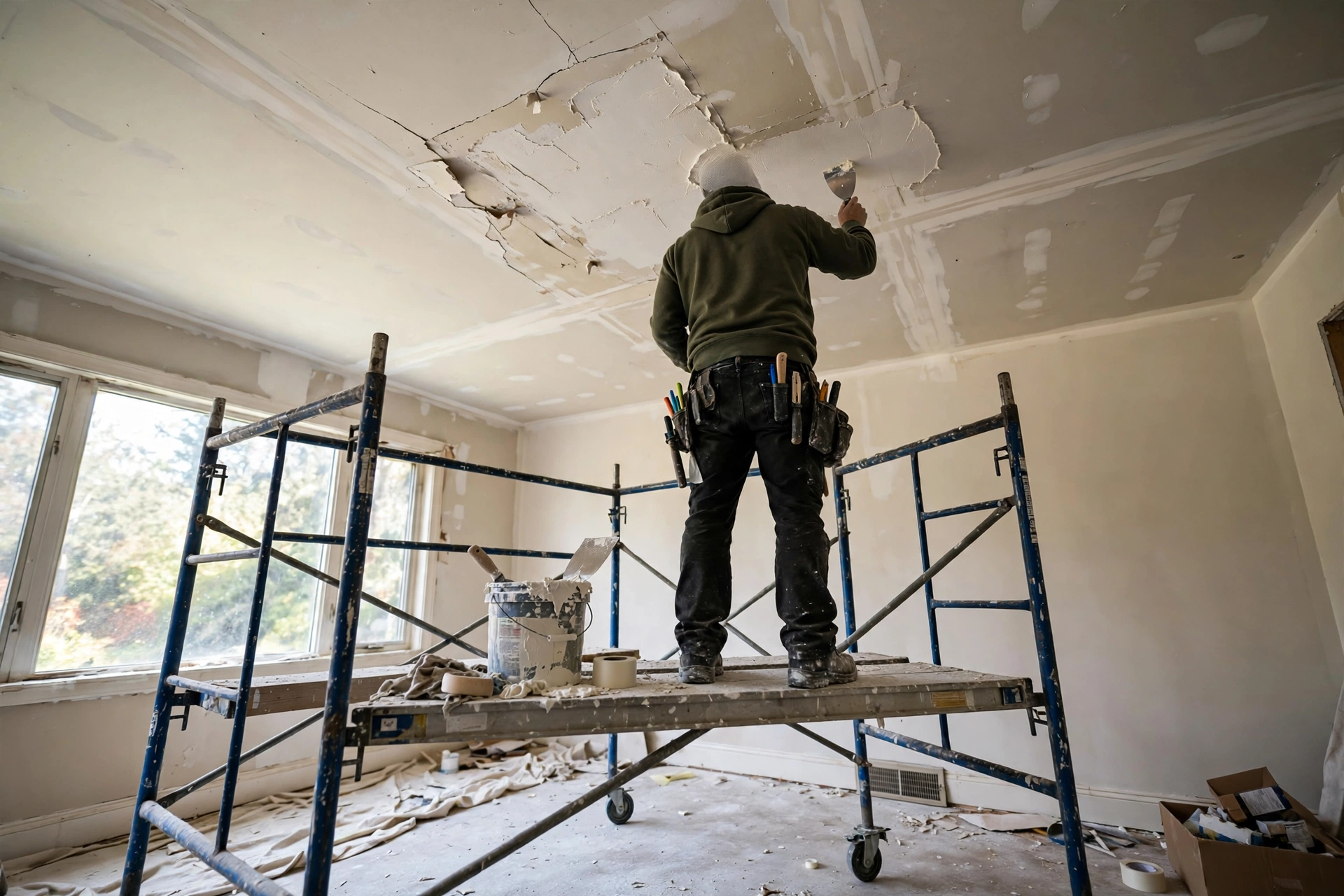
Ceiling drywall repair cost runs higher than wall repair at every size — and the reasons are physical, not arbitrary. Overhead work is slower, gravity fights every coat of compound, and light rakes across ceilings so every imperfection shows. In 2026, expect $200–$1,500 for a typical ceiling drywall repair: $100–$400 for small patches and cracks, $400–$900 for medium holes, and $500–$2,500+ when water damage or mold is involved. This guide covers what each repair type costs, why ceilings carry a premium over walls, and where the money actually goes.
Quick-answer table (typical total cost, 2026):
| Repair type | Typical total cost |
|---|---|
| Nail pops, hairline cracks, small dents | $100–$250 |
| Small hole or stain (patch + blend) | $150–$400 |
| Medium hole, corner bead, or seam repair | $250–$600 |
| Large hole or multiple damaged areas | $400–$1,200 |
| Water damage (cutout + replace) | $500–$1,600 |
| Water damage with mold remediation | $1,200–$2,500+ |
| Full ceiling replacement (room) | $1,500–$3,500+ |
Why Ceilings Cost More Than Walls
The same patch on a ceiling typically costs 25–100% more than on a wall. Four reasons:
1. Overhead labor is slower. Taping, mudding, and sanding above your head takes roughly twice as long per square foot as wall work. Contractors price this in. 2. Setup is heavier. Ladders, scaffolding, or stilts are standard; for high or vaulted ceilings, equipment rental adds $50–$200 per day. 3. Texture matching is harder. Ceiling textures (knockdown, orange peel, popcorn) catch light differently than walls, and blending a patch invisibly is the most skilled part of the job. 4. Sagging is structural. A sagging ceiling isn’t cosmetic — it can mean failed fasteners or waterlogged board, and a saturated section carries real collapse risk.
For the general drywall-repair numbers these build on, see our drywall repair cost per square foot guide.
Repair Cost by Damage Type
Nail pops and hairline cracks: $100–$250
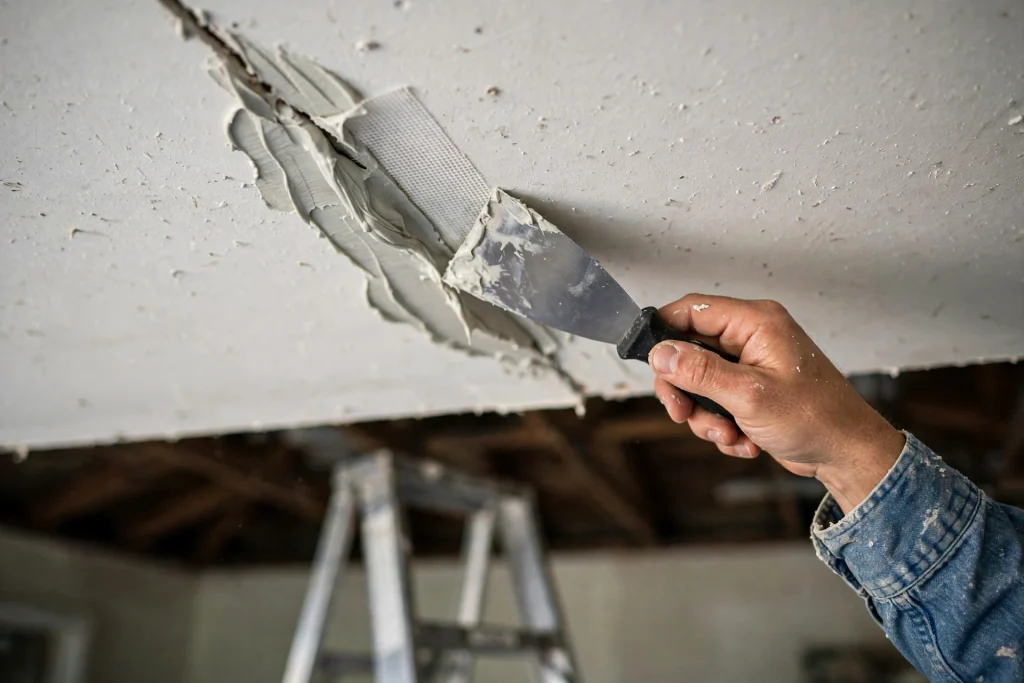
The cheapest ceiling repairs. Nail pops get re-secured with screws and skimmed; hairline cracks at seams get tape and compound. Because of minimum service fees ($125–$200 is typical), these jobs only make sense bundled with other work or as part of a larger visit.
Small holes and stains: $150–$400
A small hole gets a mesh or California patch, compound, sanding, and paint. A water stain on firm, dry board gets a stain-blocking primer and paint. The patch is quick; the blend is the work — ceiling paint must often be extended across the whole ceiling for an invisible repair.
Medium holes, corner bead, and seams: $250–$600
Holes too big for a mesh patch need a cut-out with backing strips, a new piece of board, tape, and multiple compound coats. Overhead, this is a two-visit job (patch day + sand/finish day) because compound sags if rushed. Corner bead and failing seams fall in the same range.
Large holes and multiple areas: $400–$1,200
At this size the job is essentially small-scale installation done upside down. Per-square-foot math starts to apply — roughly $2–$6 per sq ft for mid-range patch work — plus texture and paint. If half the ceiling is damaged, compare against full replacement.
Water damage: $500–$1,600
Ceiling water damage is judged more strictly than wall damage: a sagging or bulging section gets cut out immediately rather than risk a collapse. Costs run $500–$1,600 for a typical cutout-and-replace, including drying time (framing must read below ~15% moisture before re-hanging) and texture matching. Our full breakdown is in drywall repair cost from water damage. If the damage came from a plumbing leak above, the source repair is a separate budget line — see plumber cost per hour.
Full ceiling replacement: $1,500–$3,500+
When damage is widespread — or when a popcorn ceiling is coming off anyway — replacing the whole ceiling is often cheaper per square foot than a patchwork of repairs. New drywall installed on a ceiling runs roughly $2–$3.75 per sq ft, plus texture ($0.80–$2.00 per sq ft) and paint.
Texture Matching: The Invisible-Repair Tax
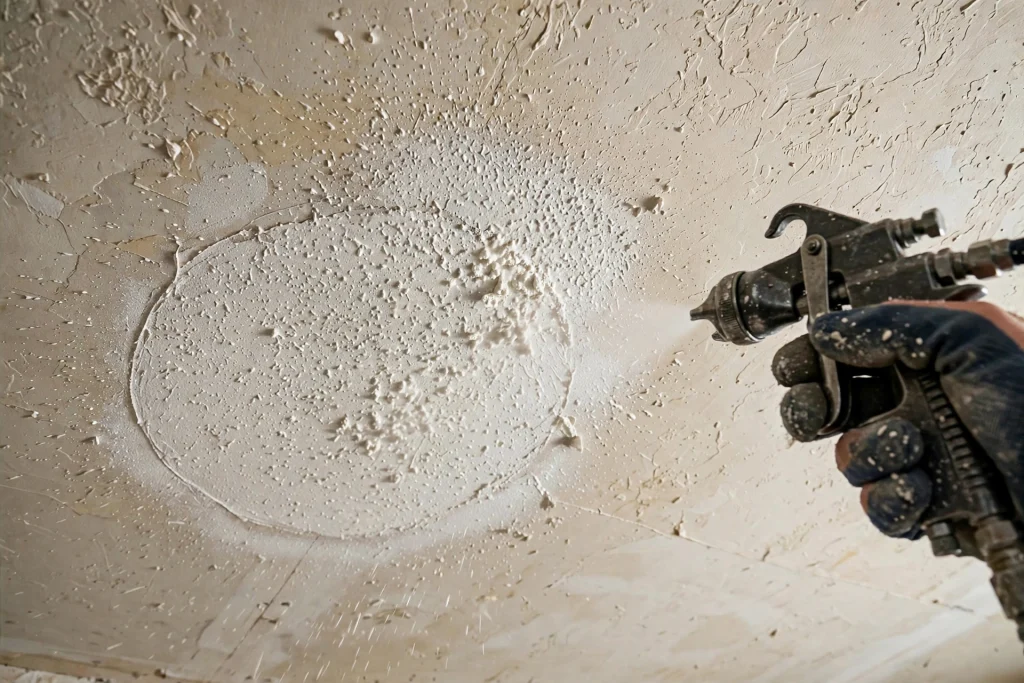
Texture is where ceiling repairs get expensive — and where cheap quotes reveal themselves:
| Ceiling texture | Matching difficulty | Typical added cost |
|---|---|---|
| Smooth / flat | Easiest | Included in most quotes |
| Orange peel | Moderate | +$50–$150 |
| Knockdown | Harder | +$100–$250 |
| Popcorn (acoustic) | Hardest | +$150–$400 |
| Skip trowel / custom | Specialist work | +$200–$400+ |
A patch that is structurally perfect but visibly different from the surrounding ceiling is a failed repair. Texture matching requires the same product, the same application method, and often repainting the entire ceiling — budget $1–$3 per sq ft for primer and paint, or run the numbers through a house painting cost calculator for the paint portion.
What Drives Ceiling Drywall Repair Cost
| Driver | Effect | Notes |
|---|---|---|
| Ceiling height | Biggest access lever | Standard 8 ft is baseline; vaulted/high ceilings add scaffolding rental |
| Damage size | Small = minimum fee, large = area pricing | Under ~10 sq ft, the $125–$200 minimum dominates |
| Texture type | +$50–$400 | Popcorn and knockdown cost the most to match |
| Water or mold involvement | +$500–$2,500 | Drying, leak repair, and remediation are separate line items |
| Sagging / structural issues | +$200–$800 | Re-fastening or sistering joists before the drywall goes back |
| Paint scope | +$1–$3 per sq ft | Full-ceiling repaint is often needed for an invisible blend |
| Access (furniture, fixtures) | +$50–$200 | Moving furniture, protecting floors, working around lights/fans |
DIY vs. Pro: Ceilings Are the Hard Mode
| DIY | Pro | |
|---|---|---|
| Small stain, seal + paint | Good DIY — $30–$80 | $200–$450 — worth it for a perfect blend |
| Nail pops, hairline cracks | Good DIY — Doable with basic tools | $100–$250 — mostly the minimum fee |
| Small patch | Possible, but overhead finishing is hard | $150–$400 |
| Texture matching | Very hard to get invisible | This is what you’re paying the pro for |
| Water damage / sagging | Collapse risk — don’t DIY | $500–$1,600 |
| Mold over ~10 sq ft | No | Remediation + repair; see the EPA on when pros are required |
| High or vaulted ceilings | Scaffolding + overhead work | Yes — safety and speed |
The honest DIY test: if you can tape and finish a wall patch invisibly, you can attempt a small ceiling patch — and discover it is about twice as hard. For typical pro rates, see what drywall contractors charge per hour.
Money-Saving Tips
- Bundle every ceiling fix into one visit. Nail pops, cracks, and stains in the same room share one minimum fee, one compound batch, and one paint session.
- Fix the water source first. A ceiling stain with an active leak above it is a repair you’ll pay for twice. Find and fix the leak, then repair the drywall.
- Ask whether paint is included. Most drywall quotes cover patch, tape, and sand only. A full-ceiling repaint for blending adds $1–$3 per sq ft — get it in writing before comparing quotes.
- Consider full replacement for widespread damage. Three or four large patches with texture matching can cost more than re-drywalling the whole ceiling.
- Photograph water damage for insurance. Sudden leaks are usually covered; slow leaks usually aren’t. Photos of the source and damage protect a claim.
Frequently Asked Questions
How much does it cost to repair a drywall ceiling?
In 2026, ceiling drywall repair costs $200–$1,500 for typical jobs: $100–$400 for small patches and cracks, $400–$900 for medium repairs, and $500–$2,500+ with water damage or mold. Full ceiling replacement runs $1,500–$3,500+.
Why is ceiling drywall repair more expensive than walls?
Overhead labor is roughly twice as slow, scaffolding or stilts are usually needed, texture matching is harder because light rakes across ceilings, and sagging sections carry collapse risk. The same patch typically costs 25–100% more on a ceiling than on a wall.
Can I patch a ceiling hole myself?
Small patches are possible for an experienced DIYer, but overhead finishing is much harder than wall work and texture matching is very difficult to get invisible. Water damage, sagging, mold, and high ceilings should go to a pro.
How much does it cost to fix a water-stained ceiling?
A stain on firm, dry board: $200–$450 for stain-blocking primer and paint. If the board is soft or sagging, it becomes a cutout-and-replace job at $500–$1,600, plus the leak repair itself.
Does ceiling drywall repair include painting?
Usually not — most quotes cover cutting, patching, taping, and sanding only. Primer and paint add $1–$3 per sq ft, and an invisible blend often requires repainting the entire ceiling. Confirm the paint scope in writing.
The Bottom Line
Ceiling drywall repair costs $200–$1,500 in 2026 for most jobs — $100–$400 for small patches, $400–$900 for medium repairs, and $500–$2,500+ when water or mold is involved. The ceiling premium is real: overhead labor, scaffolding, and texture matching all cost more than the same work on a wall. Bundle every fix into one visit, fix leaks before drywall, and confirm paint scope in writing. For the room-level economics when damage is widespread, compare with our guide to how much it would cost to drywall a 12×12 room.
Prices are typical 2026 US planning benchmarks gathered from contractor pricing data and industry sources; your actual cost depends on ceiling height, damage size and type, texture matching, water or mold involvement, paint scope, and regional labor rates. Always get at least three written, itemized quotes — including one from a licensed, insured contractor — before committing. For mold guidance, see the EPA; for board products, see USG.
3 thoughts on “Ceiling Drywall Repair Cost: 2026 Guide”