
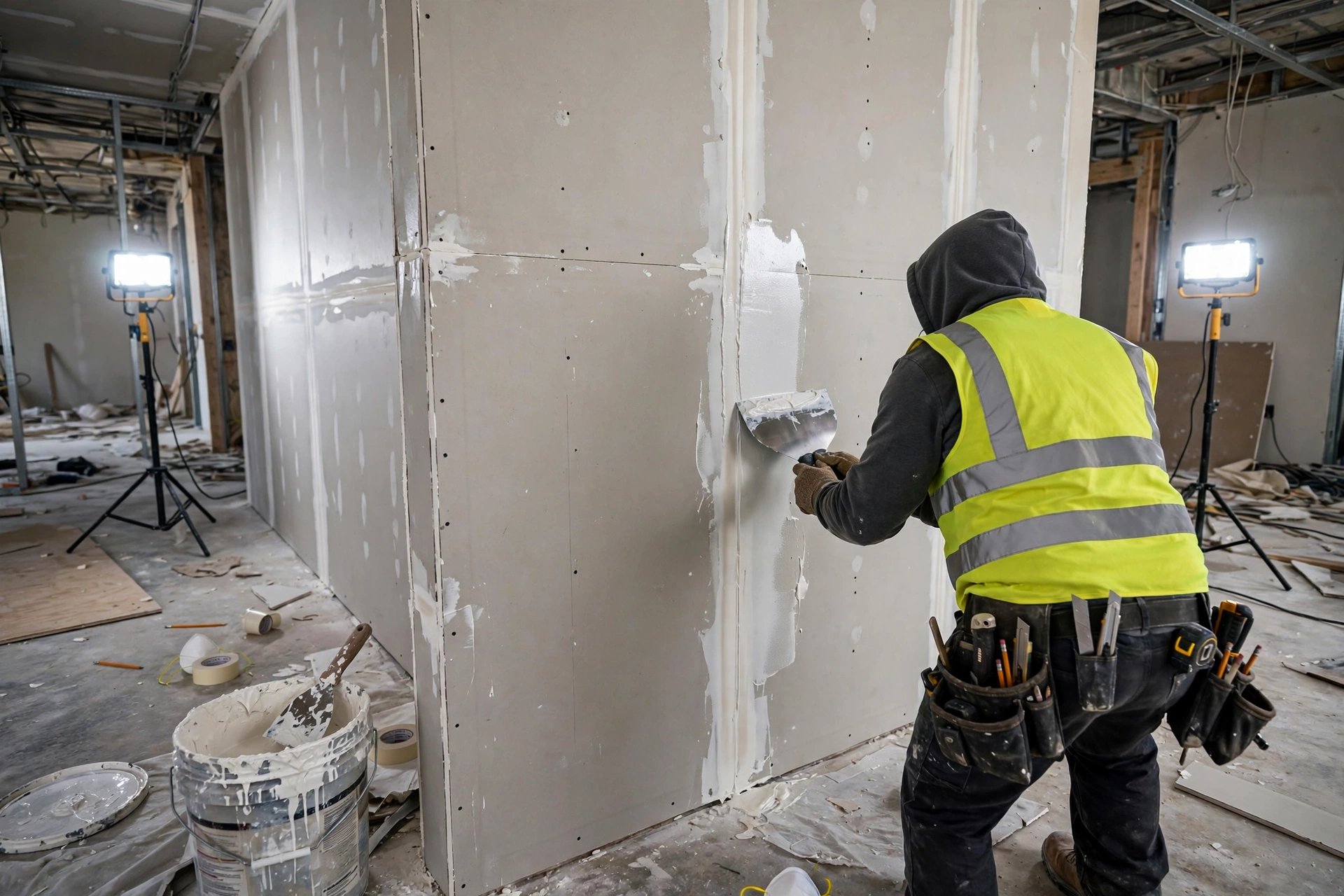
What Do Drywall Contractors Charge Per Hour in 2026?
What do drywall contractors charge per hour? In 2026, most homeowners pay $40–$100 per hour for drywall work, with a typical billed rate of $60–$90 per hour for a professional drywall contractor. A general handyman handling simple patches charges $50–$80 per hour, a specialized drywall contractor runs $65–$100 per hour, and emergency or after-hours work costs $80–$120+ per hour. Small jobs almost always carry a minimum service fee — usually $150–$400 — so a 30-minute patch still costs more than half an hour of labor.
Quick-answer table (billed hourly rates, 2026):
| Who you hire | Typical hourly rate | Best for |
|---|---|---|
| General handyman | $50–$80 | Nail pops, small holes, simple patches |
| Drywall contractor (hang + finish) | $40–$100 | Rooms, additions, full-wall work |
| Specialized drywall finisher | $65–$100 | Taping, mudding, Level 5 smooth finishes |
| Emergency / after-hours | $80–$120+ | Burst-pipe damage, urgent repairs |
| Ceiling specialist | $60–$100 | Overhead work, texture matching |
These are billed rates — what the business charges you — not what the worker takes home. That distinction matters, because it explains why quotes vary so much and why the cheapest hourly rate is not always the cheapest job. This guide breaks down what drives the rate, when hourly pricing helps or hurts you, and how hourly quotes compare with per-sheet and per-square-foot pricing.
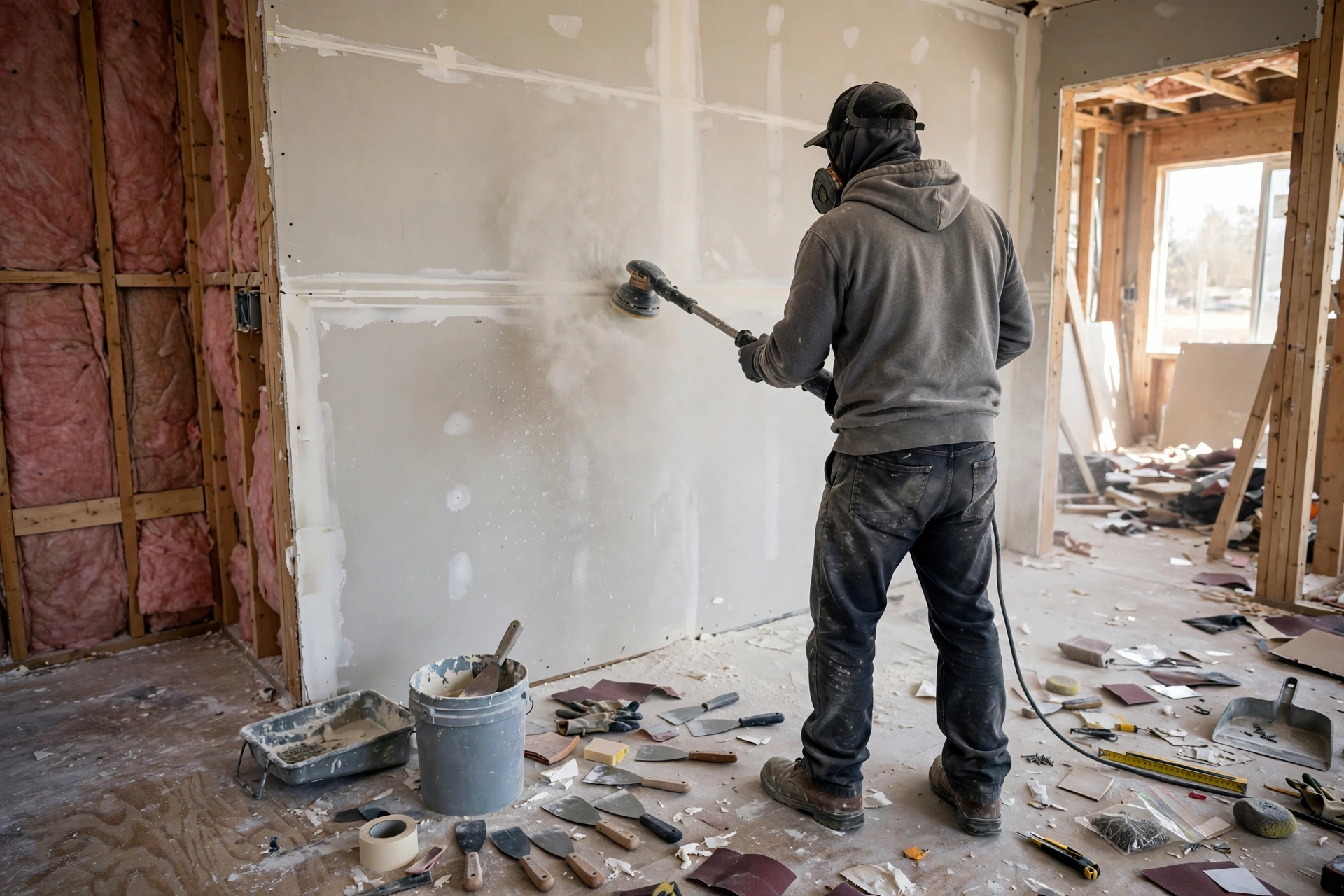
Hourly Rates by Contractor Type
Handyman: $50–$80 per hour
A handyman is the right call for small, simple drywall work: nail pops, hairline cracks, doorknob holes, and patches under a few inches. Handymen carry lower overhead than specialty crews, so their rates run lower — but they are generalists. For a patch in a highly visible wall, or work that needs texture matching, a drywall specialist’s finish is usually worth the premium.
Drywall contractor: $40–$100 per hour
A dedicated drywall contractor handles hanging, taping, mudding, and sanding as their core trade. The wide range reflects experience, crew size, and region: a two-person crew in a lower-cost market may bill near the bottom, while an established contractor in a metro or coastal market bills near the top. For room-sized work, most contractors prefer per-sheet or per-square-foot pricing (see below) because it gives both sides a fixed number — hourly billing shows up mainly for repairs and uncertain-scope jobs.
Finishing specialist: $65–$100 per hour
Finishing — taping, mudding, sanding, and blending seams invisible — is the skill that determines how your wall looks. A specialist finisher commands a higher rate because a bad finish means visible seams, flashing under paint, and rework. If you hang the boards yourself and hire out only the finish (a popular hybrid approach), expect to pay finishing-specialist rates for the mud-and-tape phase.
Emergency and after-hours: $80–$120+ per hour
Water damage does not wait for business hours. After-hours, weekend, and emergency calls carry a premium of roughly 50% over standard rates, plus a minimum call-out fee. If the damage is active — a leak still running — stop the water first, then call; paying emergency rates for drywall work while the wall is still getting wet wastes money.
Billed Rate vs Worker Wage: Why the Numbers Differ
You may see figures online saying drywall finishers earn $22–$36 per hour. That is a wage — what an employed finisher is paid — not what a contractor bills you. The billed rate covers:
- The worker’s wage and payroll taxes
- Workers’ compensation and liability insurance
- Truck, fuel, tools, and equipment (stilts, sanders, lifts)
- Materials (joint compound, tape, corner bead, screws)
- Travel and setup time between jobs
- Office, scheduling, and warranty overhead
- Business profit
A solo contractor billing $75 per hour is not pocketing $75 per hour. After materials, insurance, vehicle, and unpaid admin time, the effective take-home is far lower. This is why two quotes at very different hourly rates can both be fair — one contractor may include materials and a warranty in the rate while the other bills them separately. Always compare all-in totals, not headline rates.
Minimum Service Fees: The Number That Matters Most on Small Jobs
For small repairs, the hourly rate is almost irrelevant — the minimum service fee decides the bill. A contractor who drives to your house, sets up, patches a hole, waits for compound to dry, returns to sand, and cleans up has spent half a day on your job even if the patch itself took 30 minutes. Typical minimums:
| Job type | Typical minimum fee |
|---|---|
| Small patch (handyman) | $150–$250 |
| Small patch (drywall specialist) | $200–$400 |
| Small repair with texture matching | $300–$500 |
| Repair requiring a return visit for sanding | $350–$650 |
If a contractor quotes $60 per hour but has a $350 minimum, a one-hour patch costs $350 — not $60. Ask for the minimum before you ask for the rate. For more on how minimums shape small-job pricing, see our guide to drywall repair cost per square foot, where we explain why per-square-foot figures mislead on small repairs.
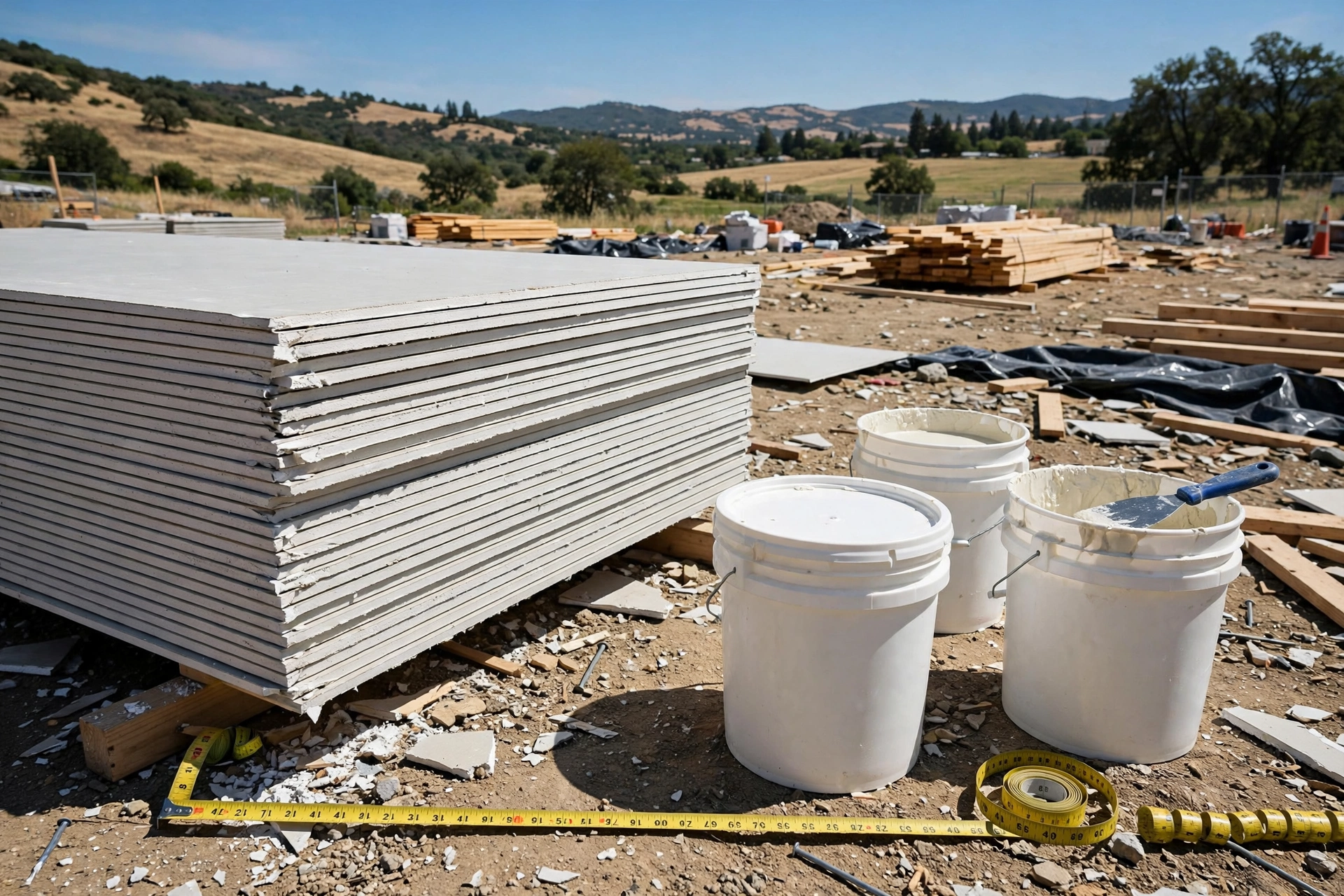
Hourly vs Per-Sheet vs Per-Square-Foot Pricing
Contractors price drywall three ways, and the method usually depends on job size:
| Pricing method | Typical rate | Used for | Watch out for |
|---|---|---|---|
| Hourly | $40–$100/hr | Small repairs, uncertain scope, punch lists | Open-ended total; minimums apply |
| Per sheet | $30–$70/sheet hung + finished | Rooms, additions, known sheet counts | Sheet size matters (4×8 vs 4×12) |
| Per square foot | $1.50–$3.50/sq ft installed | Whole rooms, whole houses, large areas | Measured on wall/ceiling surface, not floor area |
Hourly makes sense when the scope is genuinely uncertain — opening a wall to find hidden water damage, for example. Per-sheet is the clearest method for a room: a standard 12×12 bedroom needs about 18 sheets, so you can multiply and compare bids directly. Per-square-foot is standard for large jobs because it scales cleanly. If a contractor insists on hourly billing for a straightforward room-sized job, ask for a not-to-exceed cap in writing — otherwise the meter runs while compound dries.
For a worked example of per-sheet and per-square-foot pricing on a real room, see how much it would cost to drywall a 12×12 room — a standard 12×12 bedroom runs $850–$1,980 professionally finished.
Cost Drivers That Push the Hourly Rate Up or Down
| Driver | Effect on rate | Notes |
|---|---|---|
| Location | ±25–40% | Metro and coastal markets bill highest; rural and Southern markets lowest |
| Ceiling work | +25–50% | Overhead work is slower and needs lifts or stilts |
| Finish level | +$0.50–$1.20/sq ft | Level 5 smooth finish costs far more than Level 3 texture-ready |
| Texture matching | +$100–$400/job | Orange peel, knockdown, and popcorn matching is skilled, slow work |
| Height / access | +15–30% | Vaulted ceilings, stairwells, tight access slow every step |
| Damage type | Varies | Water damage and mold add removal, drying, and disposal |
| Urgency | +50%+ | Same-day and after-hours premiums |
| Job size | Lower per-hour on big jobs | Contractors discount large, predictable jobs |
Ceilings deserve a special note: overhead drywall work is physically harder, slower, and requires scaffolding or lifts. Expect ceiling rates at the top of every range, and budget $1–$2 per sq ft extra for ceiling texture alone. Texture matching is the other budget-killer: blending a patch into 20-year-old orange peel so it disappears takes a specialist’s eye and often two visits.
DIY vs Hiring a Pro
| Factor | DIY | Pro |
|---|---|---|
| Cost (small patch) | $10–$55 (patch kit + compound) | $150–$400 (minimum fee) |
| Cost (12×12 room) | $300–$500 (materials only) | $850–$1,980 |
| Time (small patch) | 1–2 hours + drying | 1–2 visits |
| Time (12×12 room) | 5–10 days | 2–3 days |
| Finish quality | Visible seams likely on first attempts | Invisible seams, matched texture |
| Tools needed | $50–$150 (taping knives, mud pan, sander) | Included |
| Best for | Nail holes, dents, hidden areas | Visible walls, ceilings, texture, large areas |
DIY drywall is genuinely doable for small, low-visibility repairs — a patch kit, a YouTube tutorial, and patience will fix a doorknob hole. Where DIY falls apart is finishing: taping and mudding seams so they disappear under paint takes practice, and a first-timer’s seams usually show. The smart hybrid is to hang the boards yourself and hire a finisher for the tape-and-mud phase — you save on labor while the visible result is professional. Note that drywall finishing is followed by painting, so budget for that too — see our guide to interior house painting cost per square foot and the house painting cost calculator.
Money-Saving Tips
- Bundle small repairs into one visit. Three patches in one trip cost far less than three separate minimum fees — walk the house and list every dent, crack, and nail pop before calling.
- Ask for the minimum first, the rate second. On small jobs the minimum is the price; the hourly rate only matters on larger work.
- Get per-sheet or per-square-foot pricing for rooms. Fixed pricing removes the risk of a slow job inflating an hourly bill.
- Do the prep yourself. Moving furniture, clearing the room, and removing outlet covers saves the contractor’s billable time.
- Hang it yourself, hire the finish. The hybrid approach cuts a 12×12 room’s cost roughly in half while keeping a pro finish.
- Schedule off-peak. Late fall and winter are slower for drywall crews; quotes run 10–15% lower than spring and summer.
- Fix the water source before the drywall. Patching over an active leak guarantees a repeat job — plumbing first, drywall second.
- Compare all-in totals. A $50/hr quote with a $400 minimum and materials extra is worse than a $80/hr quote with a $200 minimum and materials included.
Frequently Asked Questions
What do drywall contractors charge per hour in 2026?
Most drywall contractors bill $40–$100 per hour in 2026, with a typical rate of $60–$90 per hour. Handymen charge $50–$80 per hour for simple patches, specialized finishers $65–$100 per hour, and emergency or after-hours work $80–$120+ per hour. Small jobs also carry a minimum service fee of $150–$400, which usually matters more than the hourly rate.
Is it cheaper to pay a drywall contractor hourly or per square foot?
For small repairs, hourly (with a minimum) is standard and fair. For rooms and larger areas, per-sheet ($30–$70/sheet) or per-square-foot ($1.50–$3.50/sq ft installed) pricing is usually cheaper and safer, because the total is fixed — an hourly job can grow if drying time, texture matching, or hidden damage slows the work. Ask for a not-to-exceed cap if the job must be hourly.
Why do drywall contractors charge so much for a small patch?
A small patch still requires travel, setup, the patch itself, drying time, a return trip to sand, and cleanup — often half a day of the contractor’s time for 30 minutes of visible work. The $150–$400 minimum covers that full cycle. Bundling every patch in the house into one visit is the best way to spread the minimum across more work.
What is the difference between a drywall installer’s wage and the billed rate?
A drywall finisher’s wage is typically $22–$36 per hour — what an employee is paid. The billed rate of $40–$100 per hour covers the wage plus payroll taxes, insurance, vehicle, tools, materials, travel, scheduling, and profit. Comparing a wage figure to a billed quote is apples to oranges.
How much does it cost to drywall a 12×12 room?
A standard 12×12 bedroom with 8-foot ceilings costs $850–$1,980 professionally hung and finished to Level 4, including materials. DIY materials run $300–$500. See the full breakdown in our guide to how much it would cost to drywall a 12×12 room.
The Bottom Line
Drywall contractors charge $40–$100 per hour in 2026, with most homeowners paying $60–$90 per hour for a professional crew. For small repairs, the $150–$400 minimum service fee matters more than the hourly rate — bundle your patches into one visit. For rooms and larger jobs, insist on per-sheet or per-square-foot pricing so the total is fixed before work starts. And remember the finish is what you actually see: paying a specialist finisher’s rate for the tape-and-mud phase is the cheapest insurance against visible seams.
Prices are typical 2026 US planning benchmarks gathered from contractor pricing data and industry sources; your actual cost depends on your location, the contractor’s experience, ceiling height, finish level, texture matching, damage type, and urgency. Always get at least three written, itemized quotes — including one from a licensed, insured contractor — before committing. For board types and finish-level standards, see the Gypsum Association and USG.
3 thoughts on “What Do Drywall Contractors Charge Per Hour? 2026 Rates”