
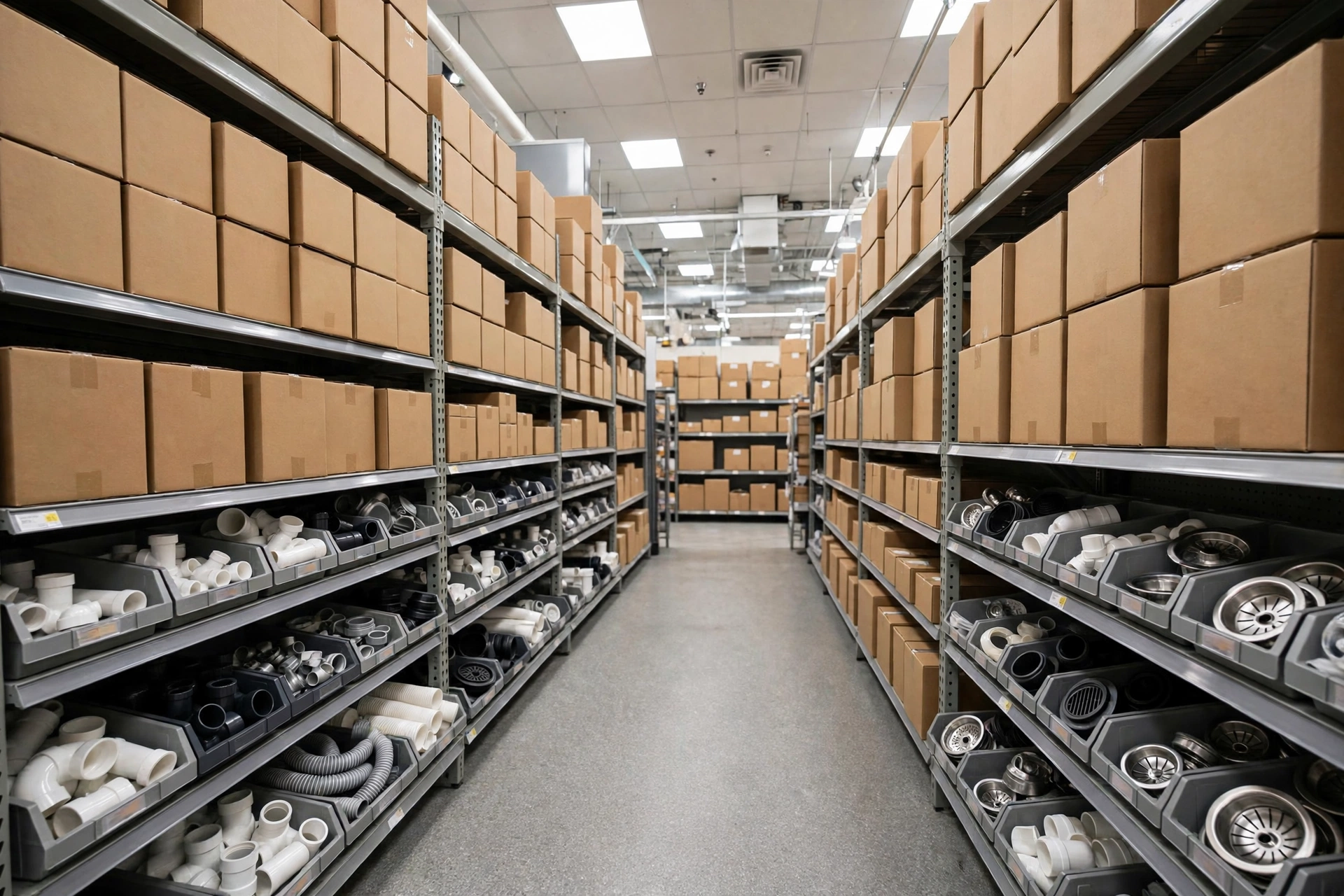
Garbage Disposal Installation Cost at Home Depot in 2026
Garbage disposal installation cost Home Depot shoppers should budget for in 2026 is $120–$200 for labor on a standard replacement — that is, swapping out an old disposal for a new one where the plumbing and the electrical outlet are already in place. The disposal unit itself is bought separately, typically $75–$400 depending on horsepower and brand, so a complete job with a mid-range unit usually lands at $200–$625 installed. Some Home Depot listings show a lower starting labor price, around $104–$128, but the current typical range for a standard replacement is $120–$200, and the exact number depends on your location and the independent contractor Home Depot assigns to the job.
The single most important thing to understand before you book is that there is no single nationwide “Home Depot price” for this job. Home Depot does not employ the installers and publishes no fixed national rate: the work is done by a licensed local third-party contractor, and your price is the flat-rate quote for your area and your disposal. That is both the appeal and the catch of the Home Depot route. On the plus side, you get a one-stop purchase — buy the disposal, add installation at checkout, and a vetted local pro does the work, backed by a 1-year labor warranty. On the minus side, the “Home Depot price” is really the local contractor’s flat rate, and it can vary by market and by what the standard package covers. A first-time install where no disposal existed before, a missing electrical outlet, or a corroded drain connection can push the bill well past the quoted base price. A first-time install typically runs $350–$1,000, and adding an outlet or a new circuit costs another $150–$400. This guide breaks down the real 2026 cost by disposal type, explains exactly how the Home Depot program works, shows what is included and what costs extra, compares the Home Depot route with Lowe’s and with an independent plumber, and shows how to keep the bill down without ending up with a disposal that leaks or jams on day one.
If you want the full picture of what a plumber charges for this kind of work outside the big-box programs, see our guide to how much someone should charge to install a garbage disposal — it breaks down the same job as a straight plumber’s quote. If the disposal is part of a bigger kitchen project, the numbers here fit into a wider budget: our kitchen remodel cost calculator shows how a fixture swap like this fits into a full kitchen remodel. And if you are comparing the two big-box programs, the pattern is the same one we found at the other store — see our guide to Lowe’s garbage disposal installation for how the same contractor model works at Lowe’s.
Quick-answer table (typical 2026 Home Depot garbage disposal installation costs):
| Item | Typical cost |
|---|---|
| Home Depot installation labor, standard replacement | $120–$200 |
| Home Depot installation labor, lower starting-price listings | Around $104–$128 |
| Lowe’s installation labor (comparison) | $120–$200 |
| Garbage disposal unit, budget | $75–$125 |
| Garbage disposal unit, mid-range | $125–$250 |
| Garbage disposal unit, premium / high-horsepower | $250–$400 |
| Total installed, standard replacement with a mid-range unit | $200–$625 |
| Total installed, first-time install (no existing disposal) | $350–$1,000 |
| Adding an electrical outlet or new circuit | $150–$400 |
| Independent plumber, labor for the same replacement | $100–$300 |
| Time on site, standard replacement | 1–2 hours |
| Time on site, first-time install | 2–4 hours |
| Labor warranty | 1 year |
The Garbage Disposal Installation Cost Home Depot Charges by Disposal Type
The disposal you choose is the single biggest driver of the total bill, because the unit itself is a separate purchase on top of the installation labor. The labor does not change much between a budget 1/3-horsepower model and a premium 1-horsepower model — the installer does the same job either way — but the fixture price does, and a high-horsepower or batch-feed model can add electrical work on top. Here is the full picture:
| Disposal type | Unit price | Installation labor | Typical total installed |
|---|---|---|---|
| Budget, 1/3 HP, continuous feed | $75–$125 | $120–$200 | $200–$325 |
| Standard, 1/2 HP, continuous feed | $125–$200 | $120–$200 | $245–$400 |
| Mid-range, 3/4 HP, continuous feed | $150–$250 | $120–$200 | $270–$450 |
| Premium, 1 HP, continuous feed | $250–$400 | $120–$200 | $370–$600 |
| Batch feed (with stopper switch) | $200–$400 | $120–$200 | $320–$600 |
| Septic-safe model | $150–$300 | $120–$200 | $270–$500 |
| First-time install, any type | $75–$400 | $200–$600+ | $350–$1,000 |
Budget, 1/3 HP ($200–$325 installed). This is the entry point and the cheapest Home Depot garbage disposal installation: a basic 1/3-horsepower continuous-feed disposal at $75–$125 for the unit, plus $120–$200 in labor. A 1/3 HP model handles soft food scraps and light daily use in a one- or two-person household, but it jams more easily on fibrous foods and it is louder than a bigger motor. If your only goal is a working disposal at the lowest possible all-in price, this is it — but for a family kitchen, the standard 1/2 HP model is usually the better buy for the extra $50 or so.
Standard, 1/2 HP ($245–$400 installed). A 1/2-horsepower continuous-feed disposal — the most common replacement in American kitchens — costs $125–$200 for the unit, plus $120–$200 in labor. It handles normal daily food waste, including small bones and vegetable peelings, without jamming as often as a 1/3 HP model, and it runs noticeably quieter. Most standard replacements fall in this range, and it is the sweet spot for most households: enough power for everyday use, a price that keeps the total under $400, and a wide choice of models in stock at Home Depot from InSinkErator, Moen, and Waste King.
Mid-range, 3/4 HP ($270–$450 installed). A 3/4-horsepower disposal costs $150–$250 for the unit, plus $120–$200 in labor. This is the category where most homeowners land when they replace a disposal deliberately rather than in an emergency: the extra power handles tougher scraps, the motor is quieter, and the grind chamber is usually stainless steel, which lasts longer than the galvanized steel in budget models. If you cook most nights and run the disposal daily, the step up from 1/2 HP to 3/4 HP is worth it — the unit costs roughly $25–$50 more and the labor is the same.
Premium, 1 HP ($370–$600 installed). A 1-horsepower disposal costs $250–$400 for the unit, plus $120–$200 in labor. These are the quietest, most powerful residential disposals — multi-stage grinding, sound insulation, and stainless steel throughout — and they are built for large households or heavy daily use. The price premium over a 3/4 HP model is real, but so is the difference in noise and in how rarely it jams. If the kitchen is open-plan and the disposal runs while people are talking nearby, the quieter premium motor is the reason to spend the extra money.
Batch feed ($320–$600 installed). A batch-feed disposal — one that only runs when the stopper is inserted and turned — costs $200–$400 for the unit, plus $120–$200 in labor. Batch-feed models are the safest option where small children are in the kitchen, because the disposal cannot run while the drain is open, and they are the only type allowed by code in some areas. The labor is the same as a continuous-feed install; the extra cost is entirely in the unit.
Septic-safe ($270–$500 installed). If your home is on a septic system, a septic-safe disposal at $150–$300 for the unit, plus $120–$200 in labor, is the right choice. These models inject a measured dose of enzyme treatment with every use to help break down food waste in the tank. A standard disposal on a septic system is not a code violation everywhere, but it adds solid waste to the tank and means more frequent pump-outs — ask your septic service before you buy.
Garbage Disposal Unit Prices by Brand at Home Depot
Home Depot stocks the three big disposal brands side by side, and the brand you pick moves the total almost as much as the horsepower does. Here is what each brand typically costs on the shelf in 2026, and what you get for the money:
| Brand and model line | Horsepower | Typical unit price | Best for |
|---|---|---|---|
| InSinkErator Badger 1 | 1/3 HP | $75–$100 | Budget replacement, light use |
| InSinkErator Badger 5 | 1/2 HP | $100–$150 | The most common replacement |
| InSinkErator Badger 5XP | 3/4 HP | $150–$200 | Everyday family kitchens |
| InSinkErator Evolution Compact | 3/4 HP | $200–$275 | Quieter operation, smaller body |
| InSinkErator Evolution Excel | 1 HP | $300–$400 | Premium, quietest, multi-stage grind |
| Moen GX50C | 1/2 HP | $125–$175 | Reliable mid-range, easy install |
| Moen GX75C | 3/4 HP | $150–$225 | Quieter mid-range with sound shield |
| Moen GX100C | 1 HP | $200–$300 | Premium power at a mid-range price |
| Waste King L-1000 | 1/2 HP | $75–$125 | Cheapest 1/2 HP option |
| Waste King L-2600 | 1/2 HP | $100–$150 | Budget with a longer warranty |
| Waste King L-8000 | 1 HP | $150–$250 | Cheapest 1 HP option |
InSinkErator is the brand most Home Depot stores stock deepest, and the Badger line is the default replacement in American kitchens: the Badger 1 at $75–$100 is the cheapest working disposal you can buy, the Badger 5 at $100–$150 is the 1/2 HP workhorse, and the Evolution series at $200–$400 is where the quiet motors and stainless-steel grind chambers live. To see how the different series compare — Badger, Power, and Advanced — InSinkErator’s own built-to-last guide explains the motor and grind differences between its models and what each one is built to handle.
Moen disposals sit in the same price bands — $125–$300 across the GX series — and their main selling point is the universal mounting system, which fits most existing sink flanges without an adapter, and a sound shield that keeps the 3/4 HP and 1 HP models noticeably quieter than a Badger of the same power. If your existing disposal is a Moen, a like-for-like Moen swap can be the fastest install of all, because the mounting assembly often does not need to come off the sink.
Waste King is the value pick: the L-1000 at $75–$125 is the cheapest 1/2 HP disposal on the shelf, and the L-8000 at $150–$250 is the cheapest 1 HP disposal Home Depot sells. Waste King models also tend to carry longer warranties than the budget Badger models — some up to 10 years or even lifetime on the motor — which makes them a strong buy if you plan to stay in the house. The trade-off is noise: Waste King disposals are typically louder than an InSinkErator Evolution or a Moen GX at the same horsepower.
The brand matters less than the horsepower. A 1/2 HP disposal from any of the three brands does the same job in a normal kitchen, and the labor charge is the same $120–$200 whichever brand you hand the installer. Pick the brand whose mounting system matches your sink, whose warranty length you like, and whose noise level you can live with — and spend the money you save on a better mounting assembly or an air switch instead of a fancier badge.
How Home Depot’s Garbage Disposal Installation Program Works
Understanding the process matters as much as understanding the price, because garbage disposal installation at Home Depot is not a retail purchase — it is a referral to a contractor, and the experience follows the contractor’s process, not the store’s checkout.
You buy the disposal first. The disposal is not included in the installation price. You buy it online or in-store — Home Depot stocks InSinkErator, Moen, and Waste King alongside its own house-brand options — and add professional installation at checkout, or speak with an associate at the Service Desk about adding it to your purchase. A budget model starts at $75–$125, a standard 1/2 HP model at $125–$200, and a premium 1 HP model at $250–$400. Home Depot’s own installation services page lists the installation programs it offers and how to add them to a purchase.
Home Depot does not employ the installers. The work is performed by a network of local, independent, third-party contractors who are licensed, insured, and background-checked before they are authorized to take on Home Depot jobs. Home Depot vets the contractor and stands behind the work, but the person who shows up at your door works for the local contractor, not for Home Depot. That is why the experience and the price vary by market — and why the $120–$200 labor range is a range, not a fixed price.
Scheduling takes a few days to a week. After you purchase the disposal and add installation, a licensed Home Depot installer contacts you to schedule the visit. Same-day installation is rarely available; scheduling typically happens within a few days to a week, depending on the contractor’s availability in your area. A standard replacement takes 1–2 hours on site, including removal of the old disposal and connection of the new one to the existing plumbing and power. A first-time install takes 2–4 hours, because the drain has to be reconfigured and an outlet may need to be added.
The labor is backed by a 1-year warranty. Home Depot backs its installation work with a 1-year labor warranty against defects in the installation. Keep the paperwork: if the disposal leaks at the sink flange or the drain connection, or the mounting fails within that year, the warranty is your recourse, and it is one of the genuine advantages over hiring an unvetted handyman. The disposal unit itself carries the manufacturer’s warranty separately — typically 2 to 10 years depending on the model, with premium models at the long end.
There is no fixed nationwide price. Home Depot does not maintain a single nationwide rate for garbage disposal installation. Pricing varies by region, installer availability, and job complexity, which is why the ranges in this guide are wide — a labor price starting around $104–$128 in one market’s listing can be $150–$200 in another, and a first-time install can run from $350 to $1,000 depending on what the sink cabinet needs. Get the quote for your zip code before you commit, and get it in writing.
What’s Included — and What’s Not
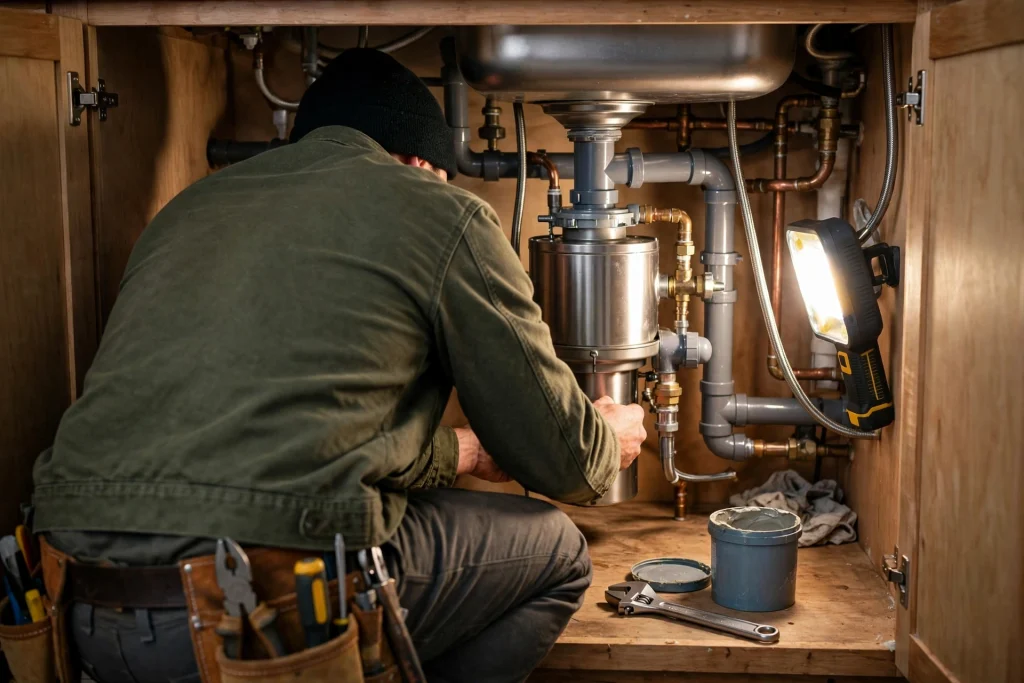
A standard replacement quote covers the core work of swapping one disposal for another on existing plumbing and power. The trouble starts at the edges of that quote, where the items most likely to be needed — a new outlet, a drain reconfiguration, a corroded trap — are priced as extras. Before you book, know exactly where the line falls:
| Item | Standard replacement package | Notes |
|---|---|---|
| Removal of old disposal | Included | Standard installation includes removing the existing disposal |
| Disposal / haul-away of old disposal | Included in most markets | Confirm in writing — a local dump fee may apply in some areas |
| Mounting the new disposal to the sink flange | Included | New mounting assembly and sink flange where the old one is reusable |
| Connecting the drain and dishwasher hose | Included | Connection to the existing drain trap and dishwasher drain |
| Connecting the power cord or hardwire | Included | Only where a suitable outlet or junction already exists under the sink |
| Leak testing | Included | Installer tests for leaks before leaving |
| Cleanup | Included | Work area left clean |
| 1-year labor warranty | Included | Covers defects in the installation |
| The disposal unit itself | Not included | Purchased separately, $75–$400 by type |
| New sink flange / mounting assembly | Sometimes included | $25–$75 extra if the old flange is corroded or the wrong size |
| New drain trap or tailpiece | Not included | $25–$100 extra if the old trap is corroded or misaligned |
| Electrical outlet under the sink | Not included | $150–$400 extra if no outlet exists |
| New circuit from the panel | Not included | $150–$400 extra if the outlet needs a dedicated circuit |
| Air switch (countertop switch) | Not included | $50–$150 extra, parts and labor |
| Plumbing or structural modifications | Not included | Priced per job |
| Drain clearing | Not included | Priced per job |
The three items most often missing. The electrical outlet, the drain reconfiguration, and the sink flange are the classic surprise charges on a garbage disposal installation. The outlet is hidden under the sink, so nobody knows whether one exists — or whether it is switched, GFCI-protected, and in working order — until the installer opens the cabinet. If there is no outlet, adding one costs $150–$400, and if it needs a new circuit from the panel, that is the same $150–$400 range on top of the base labor. The drain is the second surprise: the new disposal is rarely exactly the same height as the old one, and if the trap no longer lines up, a new trap or tailpiece at $25–$100 becomes a change order on the spot. And if the sink flange is corroded or the mounting ring is seized, that is another $25–$75. None of this is a scam — it is genuinely unknowable until the old disposal comes off — but it is why the $200–$625 all-in range is wider than the $120–$200 labor range, and why you should budget for at least one extra before you book.
Common Add-On Charges
Add-ons are where a $120 labor job becomes a $400 bill — or a $1,000 first-time install. Here is what each one typically costs and when you are likely to face it:
| Add-on | Typical cost | When it comes up |
|---|---|---|
| New electrical outlet under the sink | $150–$400 | No outlet exists under the sink, or the existing one is unswitched or not GFCI-protected |
| New circuit from the electrical panel | $150–$400 | The outlet needs a dedicated circuit, or the panel has no spare capacity on a nearby circuit |
| Air switch (countertop or sink-top switch) | $50–$150 | You want a safe, convenient switch instead of a wall switch |
| New sink flange / mounting assembly | $25–$75 | Old flange corroded, seized, or the wrong size for the new disposal |
| New drain trap or tailpiece | $25–$100 | Old trap corroded or misaligned with the new disposal’s outlet height |
| Dishwasher drain connection kit | $15–$50 | Dishwasher hose needs a new connection or the knockout plug was never removed |
| Power cord kit (if disposal sold without one) | $15–$30 | Disposal is hardwire-ready and you want a plug-in cord instead |
| Old disposal removal / disposal fee | Usually included | Markets where a local dump fee applies to haul-away |
| Drain clearing | Varies by job | Slow or clogged drain discovered during the swap |
| Sink replacement (if the sink is damaged) | $200–$600+ | Corroded or cracked sink found when the old disposal is removed |
A real-world example. One homeowner’s standard replacement cost $120 for the labor plus a $150 mid-range disposal, for a $270 total — and the total reached $420 once a new outlet was added, because the old disposal had been hardwired and there was no switched outlet under the sink. That is the most common story in customer reports: the base price is real, and one small electrical extra on top of it is normal. Budget the base labor plus $150–$400 for the most likely extra, and you will rarely be surprised.
Materials vs. Labor Breakdown for a Home Depot Garbage Disposal Installation
On a disposal installation, the unit and the labor are roughly equal shares of the bill — which is different from a toilet installation, where the fixture usually dominates. Here is how a typical standard replacement with a mid-range 1/2 HP disposal at $245–$400 installed breaks down:
| Cost component | Typical range |
|---|---|
| Garbage disposal, 1/2 HP standard | $125–$200 |
| Installation labor (Home Depot, standard replacement) | $120–$200 |
| New sink flange / mounting assembly | Included, or $25–$75 if replaced |
| Drain trap or tailpiece | Included, or $25–$100 if replaced |
| Power cord kit (if needed) | $15–$30 |
| Dishwasher drain connection kit (if needed) | $15–$50 |
| Old disposal removal and haul-away | Usually included |
| Typical all-in total, budget 1/3 HP | $200–$325 |
| Typical all-in total, standard 1/2 HP | $245–$400 |
| Typical all-in total, premium 1 HP | $370–$600 |
| Typical all-in total, first-time install | $350–$1,000 |
The unit price is the most controllable line — a budget disposal at $75–$125 against a premium model at $250–$400 — because the disposal you pick is entirely your choice. And the outlet at $150–$400 is the line most likely to be forgotten in a quote, because it is hidden under the sink until the installer opens the cabinet.
Home Depot vs. Lowe’s vs. an Independent Plumber
All three routes get the same job done, but the price, the process, and the warranty are different. Here is the honest comparison for a standard replacement:
| Home Depot | Lowe’s | Independent plumber | |
|---|---|---|---|
| Labor, standard replacement | $120–$200 | $120–$200 | $100–$300 |
| Total installed, mid-range unit | $200–$625 | $200–$625 | $175–$700 |
| Disposal unit | Bought separately, $75–$400 | Bought separately, $75–$400 | You supply it, or the plumber supplies it with markup |
| Who does the work | Licensed local third-party contractor | Licensed local third-party contractor | The plumber you hire directly |
| Scheduling | A few days to a week | A few days to a week | Often same week, sometimes same day |
| Time on site, standard replacement | 1–2 hours | 1–2 hours | 1–2 hours |
| Labor warranty | 1 year | 1 year | Varies — usually 90 days to 1 year |
| First-time install total | $350–$1,000 | $350–$1,000 | $300–$900 |
| Outlet or circuit work | $150–$400 extra | $150–$400 extra | $150–$400 extra, or done by an electrician the plumber brings |
| Best for | One-stop purchase with a warranty | One-stop purchase with a warranty | Urgent jobs, unusual plumbing, or a plumber you already trust |
Home Depot ($120–$200 labor). The Home Depot route is the one-stop option: buy the disposal and the installation in one transaction, and a vetted contractor does the work under a 1-year labor warranty. Some Home Depot listings show a lower starting labor price around $104–$128, but the current typical range is $120–$200. If you already shop at Home Depot and want the purchase and the installation handled together, this is the simplest route. For the same model on a different fixture, see our guide to how much Home Depot charges to install a toilet.
Lowe’s ($120–$200 labor). The Lowe’s route is the same model with the same labor range: $120–$200 for a standard replacement, with the disposal bought separately at $75–$400. The experience is nearly identical — a licensed local contractor, a 1-year labor warranty, scheduling in a few days to a week — and the same extras apply: an outlet at $150–$400, a drain reconfiguration at $25–$100. If both stores are near you, get a quote from each and take the cheaper one; the difference is usually the local contractor’s rate, not the store. Our guide to Lowe’s garbage disposal installation breaks down the Lowe’s program in the same detail.
Independent plumber ($100–$300 labor). A local plumber charges $100–$300 in labor for the same replacement — a wider range, because it depends on the plumber’s hourly rate and on whether the job is billed flat-rate or by the hour. Our guide to plumber cost per hour puts the typical rate at $75–$150 per hour, so a 1–2 hour replacement lands in that $100–$300 labor band. The plumber is the fastest option for an urgent job — a leaking disposal that needs to come out today — and the best option when the plumbing under the sink is unusual, corroded, or needs reconfiguration, because the plumber can price the whole job in one visit instead of referring the electrical work to someone else. The trade-off is that there is no big-box warranty behind the work: the warranty is whatever the plumber offers, usually 90 days to 1 year, so get it in writing. If you already have a plumber you trust, the independent route is often the cheapest and the fastest; if you do not, the Home Depot or Lowe’s route buys you a vetted contractor and a 1-year warranty.
Replacement vs. First-Time Install
The difference between swapping a disposal and installing one where none existed is the difference between a $200–$625 job and a $350–$1,000 job. Here is why:
| Replacement (disposal already exists) | First-time install (no existing disposal) | |
|---|---|---|
| Home Depot labor | $120–$200 | $200–$600+ |
| Disposal unit | $75–$400 | $75–$400 |
| Typical total installed | $200–$625 | $350–$1,000 |
| Sink flange and mounting | Usually reusable | New, $25–$75 |
| Drain reconfiguration | Rarely needed | Usually needed, $25–$100 |
| Electrical outlet | Usually exists | Often missing, $150–$400 |
| New circuit from the panel | Rarely needed | Sometimes needed, $150–$400 |
| Dishwasher drain connection | Usually exists | Needs to be added, $15–$50 |
| Air switch | Optional, $50–$150 | Often added, $50–$150 |
| Time on site | 1–2 hours | 2–4 hours |
| Permit | Rarely required | Sometimes required for new electrical work |
Replacement ($200–$625 installed). When a disposal already exists, the plumbing and the power are already in place: the sink flange is there, the drain trap lines up, and there is an outlet under the sink. The installer removes the old unit, mounts the new one on the existing flange, reconnects the drain and the dishwasher hose, plugs it in, and tests for leaks. The whole job takes 1–2 hours, and the only extras likely to appear are a corroded flange at $25–$75 or a misaligned trap at $25–$100. This is the $120–$200 labor job that the Home Depot price refers to.
First-time install ($350–$1,000 installed). When no disposal has ever been fitted, the installer has to build the whole setup from scratch: cut the sink drain opening to fit the new flange, install the mounting assembly, reconfigure the drain trap to meet the disposal’s outlet, add a dishwasher drain connection, and — most expensively — provide power. Most kitchens without a disposal have no outlet under the sink at all, and adding one costs $150–$400, with a new circuit from the panel at the same $150–$400 range if the nearby circuits cannot take the load. The job takes 2–4 hours, and a permit may be required for the new electrical work. Before you book a first-time install, open the sink cabinet and look: if there is no outlet, budget the $150–$400 electrical extra from the start, and ask the installer whether the quote includes it or whether an electrician has to be booked separately.
The comparison that puts it in perspective. A disposal replacement at $200–$625 is one of the cheapest plumbing jobs in a kitchen — comparable to a faucet swap and far cheaper than a toilet installation, where the fixture alone can cost $100–$400 (see our guide to how much Home Depot charges to install a toilet). The first-time install at $350–$1,000 is a different job entirely, and most of the difference is the electrical work, not the plumbing.
What Pushes the Cost Up
No two garbage disposal quotes are identical, because the price is built from your sink cabinet, your drain, and your electrical setup. These are the factors that move it most:
No outlet under the sink. This is the single biggest factor after the disposal itself. A replacement where the outlet already exists is a $120–$200 labor job; a first-time install where an outlet has to be added is a $350–$1,000 job, and most of the difference is the $150–$400 electrical work. Before you call for quotes, open the cabinet and look for an outlet — and check whether it is switched and GFCI-protected. It is the first question a good installer will ask, and it can move the quote by hundreds of dollars.
Drain height and alignment. The new disposal is rarely exactly the same height as the old one, and if the drain outlet sits lower than the trap, the trap has to be lowered or the tailpiece replaced. A straight swap where everything lines up stays near the bottom of the $200–$625 range; a drain that needs reconfiguring adds $25–$100 in parts and time. Deep farmhouse sinks and disposals with a low outlet are the combination most likely to need drain work.
Corrosion under the sink. A sink cabinet that has been leaking slowly for years hides corroded traps, seized mounting rings, and rotted cabinet floors. The installer cannot see any of it until the old disposal comes off — and a corroded trap at $25–$100, a seized flange at $25–$75, or a damaged sink that needs replacing at $200–$600+ can each become a change order on the spot. If the cabinet floor is stained or swollen, mention it when you call so the installer brings the parts.
Disposal horsepower and features. A budget 1/3 HP disposal at $75–$125 keeps the total near $200–$325; a premium 1 HP model at $250–$400 pushes it toward $370–$600. Batch-feed models and septic-safe models sit in the same premium band. The labor does not change — the unit does — so the disposal you pick is the most controllable cost on the whole job.
Your local market. The $120–$200 Home Depot labor range is wide for exactly this reason: the same replacement costs more in a high-cost metro area than in a smaller market, because the local contractor’s rate follows local labor costs. An independent plumber’s $100–$300 labor range is wider still. Get the quote in writing for your address before you commit, and compare it with one independent plumber’s quote — the five-minute phone call is the cheapest way to know whether the Home Depot price is fair in your market.
Dishwasher connection. If the disposal has to connect to a dishwasher, the installer has to knock out the disposal’s drain plug and connect the dishwasher hose — a small job when the hose is in good shape, and a $15–$50 kit plus time when it is cracked or the wrong length. A dishwasher hose that has been leaking is also the most common source of the musty smell under a sink, so ask the installer to check it while the cabinet is open.
Permits and Code Requirements
A disposal replacement is simple plumbing and electrical work, but the code still has something to say about it — especially when new wiring is involved.
A permit is rarely required for a replacement. Swapping one disposal for another on existing plumbing and power is a like-for-like replacement, and most jurisdictions do not require a permit for it. A first-time install that needs a new outlet or a new circuit is different: new electrical work usually requires a permit, typically $20–$100 where required, and possibly an inspection. Ask your installer whether the permit is included in the quote or billed separately — and be wary of any installer who offers to skip a required permit, because unpermitted electrical work can void your homeowner’s insurance.
The outlet must be GFCI-protected. A receptacle under a kitchen sink must be protected by a ground-fault circuit interrupter (GFCI) under the National Electrical Code, because it sits inches from water and drain connections. If the existing outlet is not GFCI-protected, the installer or electrician should fit a GFCI receptacle or a GFCI breaker as part of the job — and if the quote does not mention it, ask. It is a small part, but it is the difference between a safe installation and one that should never have been signed off.
The disposal must be on a switched circuit. A continuous-feed disposal needs a wall switch or an air switch that controls its power, so it cannot run unexpectedly. A batch-feed disposal is switched by its stopper instead. Either way, the switch is a code and safety requirement, not a preference — and an air switch at $50–$150 is the neatest option on a kitchen island or a sink with no wall nearby, because it mounts on the countertop and needs no new wall wiring.
The drain must have a proper trap and vent. The disposal discharges into the sink drain through a trap, and the trap must be vented so the drain does not siphon dry and let sewer gas into the kitchen. On a first-time install, the installer has to confirm the venting is adequate — and if the sink is an island sink with no wall vent, an air admittance valve may be needed. This is one of the reasons a first-time install is a $350–$1,000 job and not a $200–$625 one: the drain has to be built correctly, not just connected.
The dishwasher connection needs an air gap or a high loop. Where the dishwasher drains through the disposal, local code usually requires either an air gap fitting on the sink or a high loop in the drain hose, to stop dirty water flowing back into the dishwasher. If your dishwasher hose runs flat along the cabinet floor, ask the installer to fit a high loop while the cabinet is open — it costs nothing in parts and it is the correct installation.
DIY vs. Hiring a Pro for a Garbage Disposal
| DIY | Hiring a pro (Home Depot contractor or plumber) | |
|---|---|---|
| Disposal unit cost | $75–$400 by type | Same — you buy the unit either way |
| Installation labor | $0 | $120–$200 (Home Depot) / $100–$300 (plumber) |
| Sink flange / mounting | $25–$75 in parts, if you can do it | $25–$75, done by the installer |
| Drain trap or tailpiece | $25–$100 in parts, if you can do it | $25–$100, done by the installer |
| Electrical outlet | Not a DIY job for most homeowners | $150–$400, done by the installer or an electrician |
| All-in total, standard replacement | $75–$400 in parts | $200–$625 |
| All-in total, first-time install | Not a DIY job | $350–$1,000 |
| Time required | 2–4 hours for a first-timer on a swap | 1–2 hours on site for a replacement |
| Tools needed | Plumber’s putty, wrench, screwdriver, bucket, voltage tester | Included in the labor price |
| Plumbing safety | A bad seal leaks slowly into the cabinet — check for drips for a week | Installer leak-tests before leaving |
| Electrical safety | You work on a circuit under a sink — mistakes can cause shock | Licensed pro, breaker off, tested before leaving |
| Warranty | None — mistakes are on you | 1-year labor warranty (Home Depot) |
| Best for | A confident DIYer doing a like-for-like swap | First-time installs, electrical work, or anyone who wants a warranty |
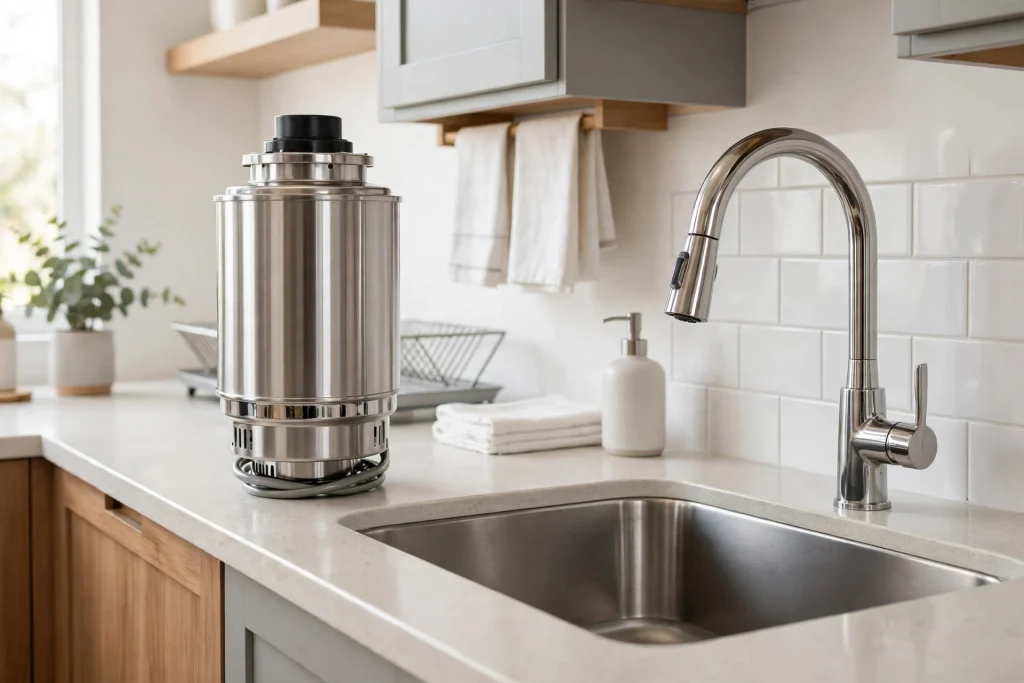
A like-for-like replacement is a fair DIY job. If a disposal already exists, the flange fits, the drain lines up, and the outlet is there, a confident DIYer can swap a disposal in 2–4 hours with basic tools: plumber’s putty for the flange, a wrench for the mounting ring, and a bucket for the water in the trap. The saving is the $120–$200 labor charge, and the risk is a slow leak at the flange or the drain connection — so check under the sink for drips every day for a week after the job. If the disposal is hardwired rather than plug-in, or the mounting ring is seized, stop and call a pro: a seized ring is how sinks get cracked.
A first-time install is not a DIY job. Cutting the sink drain opening, reconfiguring the trap, adding a dishwasher connection, and — above all — adding an outlet under the sink are jobs for a licensed installer or electrician. A mistake inside a sink cabinet is a slow leak that rots the cabinet floor, or a shock risk inches from running water. The $120–$200 labor charge on a replacement, or the $350–$1,000 total on a first-time install, buys a license, insurance, a leak test, and a 1-year labor warranty. If the disposal is part of a bigger kitchen project, our kitchen remodel cost calculator can show how the install fits into the wider budget.
The prep work you can do yourself. There are still useful ways to cut the bill without touching a wire or a drain. Clear out the sink cabinet so the installer can work without moving cleaning products. Buy the disposal yourself, on sale, so the installer charges labor only with no markup on the unit. Check whether there is an outlet under the sink before you call, and photograph the drain setup — a photo sent with your quote request gets you a tighter number. And run the old disposal one last time before the installer arrives, so you can describe exactly what is wrong with it: a jam, a leak, a hum with no spin, or a dead motor each point to a different fix.
Money-Saving Tips for a Garbage Disposal at Home Depot
1. Buy the disposal yourself, on sale. The unit is the most controllable cost, and a standard 1/2 HP disposal at $125–$200 goes on sale regularly. A $50 saving on the unit is a $50 saving on the total — and buying it yourself means the installer charges labor only, with no markup on the fixture. A budget 1/3 HP model at $75–$125 is the cheapest way to keep a replacement near $200–$325. 2. Check for an outlet before you call. If there is a switched, GFCI-protected outlet under the sink, say so when you call — the installer can quote the $120–$200 standard replacement instead of pricing for the worst case, and the job stays near the bottom of the $200–$625 range. A photo of the cabinet sent with your quote request gets you a tighter number. 3. Replace, don’t install fresh, where you have the choice. A replacement is a $200–$625 job and a first-time install is a $350–$1,000 job, and most of the difference is the electrical work. If you are choosing between kitchens or sinks, the one that already has a disposal is always the cheaper one to upgrade. 4. Get a quote from Home Depot and one independent plumber. Home Depot labor runs $120–$200 and a plumber runs $100–$300, so quotes for the same job can differ by $50–$150 between providers — especially on a first-time install, where the electrical work is a judgment call and different installers will price it differently. A five-minute phone call to one more plumber is the cheapest way to know whether the Home Depot price is fair. Our guide to plumber cost per hour shows what hourly rates to expect before you call. 5. Pick the 1/2 HP model, not the 1 HP model, unless you need it. A 1/2 HP disposal at $125–$200 handles normal daily use for most households, and the premium 1 HP model at $250–$400 costs roughly $125–$200 more for power most kitchens never use. Spend the difference on a better mounting assembly or an air switch instead. 6. Bundle the disposal with other kitchen work. If the installer is already under the sink — replacing a faucet, fitting a new trap, or connecting a dishwasher — adding a disposal to the same visit costs far less than a separate trip, because the trip and the cabinet setup are paid for once. Ask for a bundled price when you call. 7. Do not pay for a disposal you do not need. If the old disposal only jams, try the reset button on the bottom and the hex key in the center socket first — a jammed disposal is often a five-minute fix, not a $200–$625 replacement. If it hums but does not spin, the flywheel is stuck; if it does nothing at all, check the GFCI outlet and the breaker before you call anyone. 8. Keep the old flange if it is in good shape. A new sink flange and mounting assembly costs $25–$75, and on a like-for-like replacement the old one is often reusable. Ask the installer to check it before ordering a new one — and if it is corroded, replace it, because a new disposal on a bad flange will leak. 9. Time the job outside the busy season. Plumbers and installers are busiest in spring and early summer, when renovation season peaks. A fall or winter booking can mean a faster start date and occasionally a better price, especially for a first-time install that fills a half-day slot.
Frequently Asked Questions
How much does Home Depot charge to install a garbage disposal?
In 2026, Home Depot charges $120–$200 for labor on a standard garbage disposal replacement, where the plumbing and the electrical outlet are already in place. The disposal unit itself is bought separately at $75–$400 depending on horsepower and brand, so a complete job with a mid-range unit typically lands at $200–$625 installed. Some listings show a lower starting labor price, around $104–$128, but the current typical range is $120–$200. A first-time install where no disposal existed before runs $350–$1,000, and adding an electrical outlet or a new circuit costs another $150–$400. For comparison, Lowe’s charges $120–$200 in labor for the same replacement, and an independent plumber typically charges $100–$300. For the plumber’s side of the same job, see our guide to how much someone should charge to install a garbage disposal.
How long does it take Home Depot to install a garbage disposal?
A standard replacement takes 1–2 hours on site, including removal of the old disposal, mounting the new one, reconnecting the drain and the dishwasher hose, and leak testing. A first-time install takes 2–4 hours, because the drain has to be reconfigured and an outlet may need to be added. Scheduling typically takes a few days to a week after you purchase the disposal and add installation at checkout — same-day installation is rarely available. The installer’s visit is booked by the licensed local contractor Home Depot assigns to the job, not by the store itself.
Does Home Depot garbage disposal installation include the disposal?
No — the disposal unit is not included in the installation price. You buy it separately at Home Depot, typically $75–$125 for a budget 1/3 HP model, $125–$200 for a standard 1/2 HP model, $150–$250 for a mid-range 3/4 HP model, and $250–$400 for a premium 1 HP model. The $120–$200 labor charge covers the installation work only: removing the old disposal, mounting the new one, connecting the drain and the dishwasher hose, connecting the power, and leak testing. The unit carries the manufacturer’s warranty separately, typically 2 to 10 years depending on the model.
What is not included in Home Depot garbage disposal installation?
The standard replacement package does not include the disposal unit itself ($75–$400), a new electrical outlet or circuit ($150–$400), a new sink flange or mounting assembly ($25–$75 if the old one is corroded), a new drain trap or tailpiece ($25–$100), an air switch ($50–$150), or a dishwasher drain connection kit ($15–$50). The most common surprise is the outlet: if there is no switched, GFCI-protected outlet under the sink, adding one costs $150–$400 and is billed as an extra. Get the quote in writing with each of these items listed, so you know what is included before the installer arrives.
Is it cheaper to have Home Depot install a garbage disposal or hire a plumber?
It depends on your market. Home Depot charges $120–$200 in labor for a standard replacement, and an independent plumber typically charges $100–$300 — so a plumber can be cheaper at the bottom of the range and more expensive at the top. Home Depot buys you a vetted contractor and a 1-year labor warranty in a single transaction, and it is the simplest route if you are already buying the disposal at Home Depot. A plumber is usually faster for an urgent job and better for unusual plumbing, and a plumber you already trust is often the cheapest option. Get one quote from each and compare: the difference is usually the local contractor’s rate, not the store. For the plumber’s own pricing, see our guide to plumber cost per hour and our guide to how much someone should charge to install a garbage disposal.
The Bottom Line
For a garbage disposal installation at Home Depot in 2026, budget $120–$200 for labor on a standard replacement, plus $75–$400 for the disposal unit itself — a complete job with a mid-range unit typically lands at $200–$625 installed. A budget 1/3 HP model keeps the total near $200–$325, a standard 1/2 HP model lands at $245–$400, and a premium 1 HP model pushes it toward $370–$600. A first-time install where no disposal existed before runs $350–$1,000, because the drain has to be reconfigured and an outlet usually has to be added at $150–$400. For comparison, Lowe’s charges $120–$200 in labor for the same replacement, and an independent plumber typically charges $100–$300. The two things that set the price more than anything else are the disposal you pick and the electrical setup under the sink: a mid-range unit with an outlet already in place keeps the job near $245–$400, while a premium unit with no outlet pushes it toward $600 on a replacement and $1,000 on a first-time install. Home Depot uses licensed local contractors, not its own employees, so the price varies by market and by the installer assigned — get the quote for your zip code in writing, with the outlet, the flange, and the drain work each listed as its own line, and check under the sink for an outlet before you call so the first quote is the right one.
Prices are typical 2026 US ranges for planning purposes and vary by region, disposal choice, and site condition; get itemized local quotes for an exact project price.
4 thoughts on “Garbage Disposal Installation Cost at Home Depot in 2026”