
Is It Cheaper to Replace a Garbage Disposal or Remove It in 2026?
Is it cheaper to replace a garbage disposal or remove it? In 2026, replacing a garbage disposal is the more expensive job up front — a typical pro-installed replacement costs $200–$625, with most homeowners paying around $400–$550 once a mid-range or premium unit and normal extras are included — while removing a disposal and re-plumbing the drain without one costs $100–$300 in labor, or just $0–$50 in parts if you do it yourself. So yes, removal is cheaper on the day the work is done, usually by $100–$325 or more. But that is not the whole answer, because removal is also permanent in a practical sense: once the disposal is gone, your sink drains straight to the trap, food scraps have to go in the trash or the compost, and putting a disposal back later means paying for a first-time install at $350–$1,000. The cheaper job today can become the more expensive decision over the life of the kitchen, especially if you sell the house and the buyer expects a working disposal.
The real question is not just which job costs less — it is which one you will be glad you chose in two years. A disposal that is only jammed, leaking at the flange, or humming because the flywheel is stuck may not need replacing at all: a repair typically costs $70–$300, which is cheaper than either replacement or removal in many cases. A disposal that is dead — motor burned out, housing cracked, grinding chamber rusted through — is a different story, and that is where the replace-or-remove decision actually lives. This guide breaks down the real 2026 cost of each option side by side, explains exactly what removal involves (the drain re-plumb, the dishwasher line, and the electrical disconnect that most people forget), covers the septic-system and composting angles that change the math entirely, and shows when removal is genuinely the right call — and when it is a false economy that costs you more later.
If you are weighing this as part of a wider kitchen refresh, the numbers here fit into a bigger budget: our kitchen remodel cost calculator shows how a fixture decision like this fits into a full kitchen remodel. And if you are leaning toward replacement, the installed-price detail is in our guide to how much someone should charge to install a garbage disposal and our guide to Lowe’s garbage disposal installation.
Quick-answer table (typical 2026 replace vs. remove costs):
| Option | Typical cost | Time on site | Best for |
|---|---|---|---|
| Replace disposal, pro-installed | $200–$625 | 1–2 hours | Keeping a working disposal |
| Replace disposal, average all-in | Around $400–$550 | 1–2 hours | Most homeowners, mid-range or premium unit |
| Remove disposal, pro (re-plumb drain) | $100–$300 | 1–2 hours | Permanent removal, selling, septic systems |
| Remove disposal, DIY | $0–$50 in parts | 1–2 hours | Confident DIYers with basic tools |
| Repair the existing disposal | $70–$300 | Under 1 hour | Jams, leaks, humming motor, stuck flywheel |
| Reinstall a disposal later (first-time install) | $350–$1,000 | 2–4 hours | If you remove now and change your mind |
| New disposal unit only (no labor) | $75–$400 | — | DIY replacement |
| Plumber labor rate | $75–$150 per hour | — | See our guide to plumber cost per hour |
Is It Cheaper to Replace a Garbage Disposal or Remove It — the Full Comparison
On the invoice alone, removal wins: $100–$300 against $200–$625 for a replacement, and $0–$50 in parts if you remove it yourself. But the invoice is only one line of the real comparison. A replacement buys you a new disposal with a manufacturer’s warranty of 2 to 10 years, a working appliance that the next buyer expects, and a kitchen that works the way it was designed to work. Removal buys you a simpler drain, one less appliance to maintain, and nothing else — and it costs you the option of grinding food waste down the sink until you pay $350–$1,000 to put a disposal back in. Here is the honest side-by-side:
| Replace the disposal | Remove the disposal | |
|---|---|---|
| Typical pro cost | $200–$625 installed | $100–$300 labor |
| Average all-in cost | Around $400–$550 | $100–$300 |
| DIY cost | $75–$400 for the unit | $0–$50 in parts |
| What you get | A new disposal, 2–10 year manufacturer warranty | A plain drain, no appliance |
| Time on site | 1–2 hours | 1–2 hours |
| Parts needed | New disposal, possibly flange and trap | Tailpiece, trap, dishwasher drain connection |
| Electrical work | Reconnect existing outlet or hardwire | Disconnect and cap the wiring, remove the switch |
| Dishwasher | Reconnect the drain hose | Re-route the drain hose to the drain or air gap |
| Future cost to reverse | None — it is already there | $350–$1,000 for a first-time install |
| Effect on home value | Neutral to positive — buyers expect one | Slightly negative in markets where disposals are standard |
| Ongoing cost | Occasional repair, $70–$300 | None |
| Septic systems | Adds solid waste to the tank | Reduces load on the tank |
| Warranty | New unit warranty + 90 days to 1 year labor | None — there is nothing left to warrant |
Replacement ($200–$625 installed). A replacement is the straightforward job: the plumber or installer removes the old disposal, mounts the new one on the existing sink flange, reconnects the drain and the dishwasher hose, connects the power, and tests for leaks. The plumbing and the electrical outlet are already in place, so the job takes 1–2 hours and the only extras likely to appear are a corroded flange at $25–$75 or a misaligned trap at $25–$100. The disposal unit itself is the biggest variable — $75–$400 by horsepower and brand — and the average all-in figure of around $400–$550 reflects what most homeowners actually pay once a mid-range or premium unit and one small extra are included. The result is a kitchen that works exactly as it did before, with a new appliance under warranty.
Removal ($100–$300 pro, $0–$50 DIY). Removal is cheaper because there is no new appliance to buy: the job is labor only. The plumber takes the disposal off the sink flange, removes the mounting assembly, and re-plumbs the drain so the sink connects directly to the trap — usually with a new tailpiece and a new trap at $25–$100 in parts. The dishwasher drain hose has to be re-routed, and the electrical supply has to be safely disconnected and capped. It takes 1–2 hours, roughly the same as a replacement, but the bill is lower because the $75–$400 disposal is not on it. The catch is permanence: there is no disposal to maintain, but there is also no disposal to use, and putting one back later is a first-time install at $350–$1,000 because the flange, the drain configuration, and possibly the outlet all have to be rebuilt.
Repair ($70–$300). Before you choose between replacing and removing, check whether the disposal needs either. A jammed disposal is often a five-minute fix — press the reset button on the bottom, work the hex key in the center socket to free the flywheel — and a plumber’s service call to diagnose and fix a jam, a leak at the flange, or a stuck flywheel typically runs $70–$300. If the disposal hums but does not spin, the flywheel is stuck; if it does nothing at all, check the GFCI outlet and the breaker before you call anyone. A repair is cheaper than both replacement and removal, and it keeps a working disposal in place. Only when the motor is burned out, the housing is cracked, or the grinding chamber is rusted through is replacement — or removal — the real choice.
The verdict on cost alone. Removal is cheaper today by $100–$325 or more, and dramatically cheaper if you do it yourself at $0–$50 in parts. But if there is any real chance you will want a disposal again — you cook daily, you run a lot of food waste through the sink, you plan to sell within a few years — replacement at $200–$625 is the cheaper decision over the life of the kitchen, because reinstalling later costs $350–$1,000. Removal only wins the long-term math when you are sure you will never want a disposal again.
Replacement Cost by Disposal Size and Type
The disposal you choose is the single biggest driver of the replacement price, because the unit is bought separately from the labor. The labor does not change much between a budget 1/3-horsepower model and a premium 1-horsepower model — the installer does the same job either way — but the fixture price does. Here is the full picture for a pro-installed replacement:
| Disposal type | Unit price | Installation labor | Typical total installed |
|---|---|---|---|
| Budget, 1/3 HP, continuous feed | $75–$125 | $100–$300 | $200–$325 |
| Standard, 1/2 HP, continuous feed | $125–$200 | $100–$300 | $245–$400 |
| Mid-range, 3/4 HP, continuous feed | $150–$250 | $100–$300 | $270–$450 |
| Premium, 1 HP, continuous feed | $250–$400 | $100–$300 | $370–$600 |
| Batch feed (with stopper switch) | $200–$400 | $100–$300 | $320–$600 |
| Septic-safe model | $150–$300 | $100–$300 | $270–$500 |
| Average replacement, all types | $75–$400 | $100–$300 | Around $400–$550 |
Budget, 1/3 HP ($200–$325 installed). This is the cheapest replacement: a basic 1/3-horsepower continuous-feed disposal at $75–$125 for the unit, plus $100–$300 in labor. A 1/3 HP model handles soft food scraps and light daily use in a one- or two-person household, but it jams more easily on fibrous foods and it is louder than a bigger motor. If your only goal is the lowest possible all-in price for a working disposal, this is it — but for a family kitchen, the standard 1/2 HP model is usually the better buy for the extra $50 or so.
Standard, 1/2 HP ($245–$400 installed). A 1/2-horsepower continuous-feed disposal — the most common replacement in American kitchens — costs $125–$200 for the unit, plus $100–$300 in labor. It handles normal daily food waste, including small bones and vegetable peelings, without jamming as often as a 1/3 HP model, and it runs noticeably quieter. Most standard replacements fall in this range, and it is the sweet spot for most households: enough power for everyday use, a price that keeps the total under $400 at the low end of labor, and a wide choice of models from InSinkErator, Moen, and Waste King. To see how the different series compare — Badger, Power, and Advanced — InSinkErator’s own built-to-last guide explains the motor and grind differences between its models and what each one is built to handle.
Mid-range, 3/4 HP ($270–$450 installed). A 3/4-horsepower disposal costs $150–$250 for the unit, plus $100–$300 in labor. This is the category where most homeowners land when they replace a disposal deliberately rather than in an emergency: the extra power handles tougher scraps, the motor is quieter, and the grind chamber is usually stainless steel, which lasts longer than the galvanized steel in budget models. If you cook most nights and run the disposal daily, the step up from 1/2 HP to 3/4 HP is worth it — the unit costs roughly $25–$50 more and the labor is the same.
Premium, 1 HP ($370–$600 installed). A 1-horsepower disposal costs $250–$400 for the unit, plus $100–$300 in labor. These are the quietest, most powerful residential disposals — multi-stage grinding, sound insulation, and stainless steel throughout — and they are built for large households or heavy daily use. The price premium over a 3/4 HP model is real, but so is the difference in noise and in how rarely it jams. If the kitchen is open-plan and the disposal runs while people are talking nearby, the quieter premium motor is the reason to spend the extra money.
Batch feed ($320–$600 installed). A batch-feed disposal — one that only runs when the stopper is inserted and turned — costs $200–$400 for the unit, plus $100–$300 in labor. Batch-feed models are the safest option where small children are in the kitchen, because the disposal cannot run while the drain is open, and they are the only type allowed by code in some areas. The labor is the same as a continuous-feed install; the extra cost is entirely in the unit.
Septic-safe ($270–$500 installed). If your home is on a septic system and you still want a disposal, a septic-safe model at $150–$300 for the unit, plus $100–$300 in labor, is the right choice. These models inject a measured dose of enzyme treatment with every use to help break down food waste in the tank. A standard disposal on a septic system is not a code violation everywhere, but it adds solid waste to the tank and means more frequent pump-outs — ask your septic service before you buy.
What Removal Actually Involves
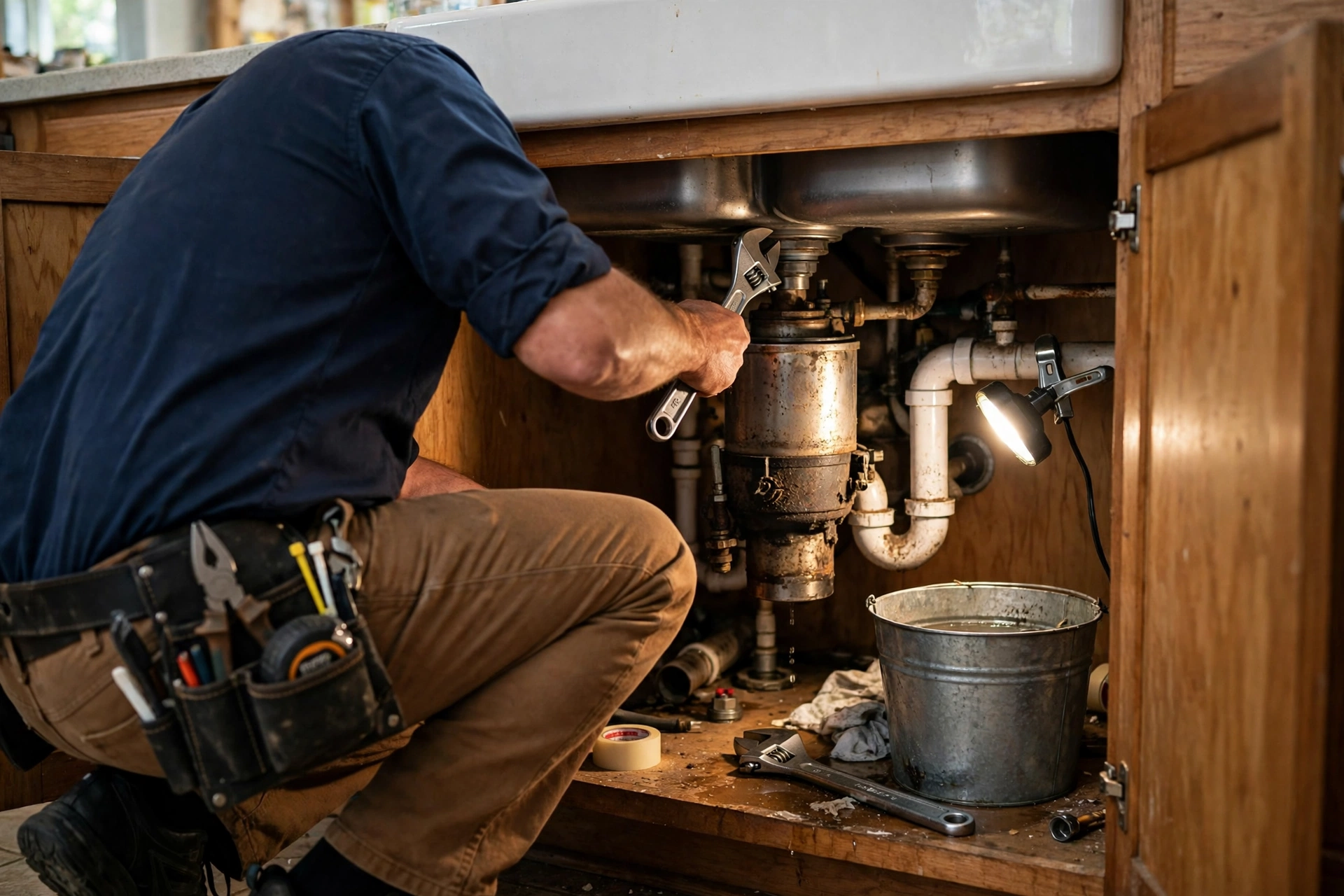
Removal sounds simple — take the disposal out and be done — but a proper removal is a small re-plumbing job, not just an uninstall. A disposal is not a plug-in appliance you can lift out and forget: it is part of the drain system, part of the dishwasher’s drain path, and part of the kitchen’s electrical circuit. Each of those three connections has to be dealt with properly, and skipping any one of them leaves you with a leak, a smell, or a live wire under the sink.
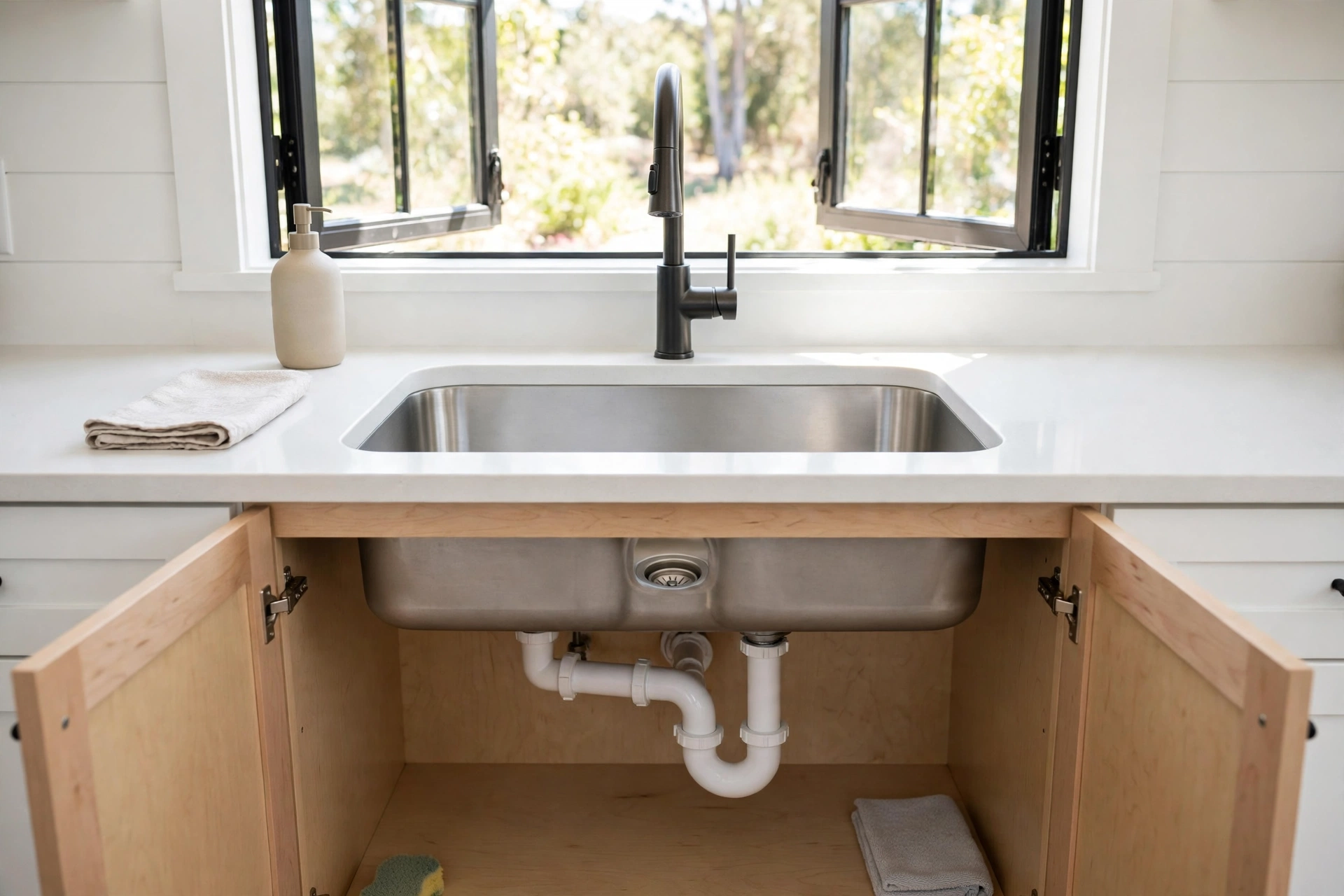
The drain re-plumb. This is the core of the job. The disposal sits between the sink drain and the P-trap, and once it is gone there is a gap of several inches in the drain line. The plumber removes the disposal and the mounting assembly, then installs a new tailpiece — the straight pipe from the sink drain down to the trap — and usually a new trap, because the old trap rarely lines up with the new drain height. Parts run $25–$100 for the tailpiece and trap, and the work takes most of the 1–2 hours on site. A basket strainer replaces the disposal’s sink flange in the drain opening, so the sink drains normally and nothing falls into the pipe. Done properly, the drain works exactly like a sink that never had a disposal — because that is what it now is.
The dishwasher drain line. This is the connection most DIY removals get wrong. In most kitchens the dishwasher drains through the disposal: the dishwasher hose connects to a nipple on the side of the disposal, and the disposal’s drain plug is knocked out so the water flows through. Once the disposal is gone, the dishwasher hose has nowhere to go. The correct fix is to re-route the hose to a dishwasher branch tailpiece on the new drain, or to an air gap fitting on the sink or countertop where local code requires one — and the hose has to loop up high under the counter (a “high loop”) so dirty sink water cannot flow back into the dishwasher. A dishwasher drain connection kit costs $15–$50. Get this wrong and the dishwasher backs up into the sink, or worse, sink water siphons back into the dishwasher — so if you are doing the removal yourself, this is the step to research first, and if you are hiring a plumber, confirm the dishwasher connection is included in the quote.
The electrical disconnect. The disposal is powered — either plugged into an outlet under the sink or hardwired into a junction box — and that power has to be made safe. A plug-in disposal is simple: unplug it and the outlet stays, dead-ended and harmless, though many homeowners have the outlet removed or the circuit capped at the panel. A hardwired disposal needs the wiring disconnected at the junction box and capped with wire nuts inside a covered box, and the wall switch that controlled it should be removed or blanked off. This is the one part of a DIY removal where a mistake is genuinely dangerous: a live wire left loose under a sink, inches from water and drain connections, is a shock and fire risk. If your disposal is hardwired and you are not confident working with household wiring, hire a pro for this part even if you do the plumbing yourself — an electrician’s visit for a disconnect typically runs $75–$150 as a standalone call, and a plumber who does the whole removal at $100–$300 will handle it as part of the job. Never leave a disconnected wire uncapped, and never just tuck a live wire behind the cabinet.
The sink flange and mounting assembly. The disposal mounts to the sink with a flange and a mounting ring that are sealed to the sink with plumber’s putty. Removal means taking the whole assembly out, cleaning the old putty off the sink, and fitting a standard basket strainer in its place. If the old flange is corroded or seized, it can take real force to remove — and a corroded sink opening may need cleaning or a new strainer at $15–$40. This is also the moment when hidden damage shows up: a slow leak at the flange that has been rotting the cabinet floor for years is only visible once the disposal comes off, and a damaged sink may need replacing at $200–$600+.
Removal cost breakdown:
| Removal cost component | Typical range |
|---|---|
| Plumber labor, removal and re-plumb | $100–$300 |
| New tailpiece and P-trap | $25–$100 |
| Basket strainer | $15–$40 |
| Dishwasher drain connection kit | $15–$50 |
| Electrical disconnect (if separate) | $75–$150 |
| Old disposal haul-away | Usually included |
| Typical pro removal total | $100–$300 |
| Typical DIY removal total | $0–$50 in parts |
Repair vs. Replace vs. Remove — Which One Actually Applies
The replace-or-remove question only matters once you know the disposal is truly dead. Many disposals that look finished are repairable for far less than either option, and many that are replaced could have been repaired. Here is how to tell which situation you are in:
| Symptom | Likely cause | Cheapest fix | Typical cost |
|---|---|---|---|
| Hums but does not spin | Flywheel stuck on food or a utensil | Hex key in the center socket, reset button | $0 DIY, $70–$150 pro |
| Does nothing at all | Tripped GFCI, tripped breaker, dead switch | Reset GFCI and breaker, check the switch | $0 DIY, $70–$150 pro |
| Leaks at the sink flange | Failed putty seal, loose mounting ring | Re-seal or tighten the flange | $70–$200 pro |
| Leaks at the drain connection | Loose or cracked trap, worn gasket | Tighten or replace the trap and gasket | $70–$200 pro |
| Leaks from the housing | Cracked grinding chamber | Replace — the housing cannot be repaired | $200–$625 replacement |
| Grinds slowly, jams constantly | Worn grinding plate, dull impellers | Replace — wear is not repairable | $200–$625 replacement |
| Loud grinding or rattling | Object in the chamber, worn bearings | Remove the object; worn bearings mean replace | $70–$150, or $200–$625 replacement |
| Motor burned out, smells of burning | Overheated or seized motor | Replace or remove | $200–$625 replacement, or $100–$300 removal |
| Unit is 10–15+ years old and failing | End of service life | Replace or remove | $200–$625 replacement, or $100–$300 removal |
| You never use it and hate the noise | Lifestyle choice, not a fault | Remove | $100–$300 pro, $0–$50 DIY |
Repair it when: the disposal is under 8 years old, the problem is a jam, a leak at a connection, or a tripped GFCI, and the motor still runs. A $70–$300 repair buys you years more service from an appliance that is otherwise sound, and it is cheaper than both replacement and removal.
Replace it when: the motor is dead, the housing is cracked, the grinding chamber is rusted through, or the unit is over 10–12 years old and failing repeatedly. At that age, a repair is money spent on an appliance that will fail again soon, and a new unit at $200–$625 installed comes with a fresh 2- to 10-year warranty.
Remove it when: you never use the disposal, you are on a septic system and want to cut the load on the tank, you are simplifying the kitchen for a rental or an elderly relative, or the disposal is dead and you have decided the appliance is not worth replacing. Removal at $100–$300 is the cheapest of the three end-of-life options — but only if you are sure you will not want a disposal back, because reinstalling later costs $350–$1,000.
The age rule of thumb. A garbage disposal lasts 8–15 years on average, depending on use and water quality. Under 8 years, repair is usually the right call. Between 8 and 12 years, compare the repair quote against replacement — if the repair is more than half the cost of a new unit, replace it. Over 12 years, replace or remove; a repair at that age is a short-term patch on a worn-out appliance.
Septic Systems, Composting, and the Case for Removal
For most homes on a city sewer, the replace-or-remove decision is about convenience and cost. For homes on a septic system, it is about the health of the tank — and that changes the math completely.
Septic systems. A garbage disposal adds a steady stream of ground food waste to a septic tank, and that waste is solid matter the tank has to break down. More solids means the tank fills faster, the drain field works harder, and pump-outs come more often — typically every 3–5 years instead of every 5–7, at $300–$600 per pump-out. Over a decade, a disposal on a septic system can easily add one or two extra pump-outs, or $300–$1,200 in extra maintenance, which dwarfs the $100–$300 saved by removing the disposal instead of replacing it. Some local codes restrict or discourage disposals on septic systems entirely, and some septic installers will tell you flatly not to fit one. If your home is on septic and your disposal has died, removal is often the financially smarter move — and if you do replace, fit a septic-safe model at $150–$300 for the unit and ask your septic service how often the tank should be pumped with a disposal in use.
Composting. The other side of the same coin is that food scraps do not have to go down the drain at all. A household that composts — a backyard bin, a countertop compost pail, or a municipal organics collection — has very little use for a disposal, because the scraps that used to go down the sink now go into the compost. The EPA’s own guidance on composting at home covers what can and cannot be composted and how to set a bin up. If you already compost, or you are willing to start, removal at $100–$300 (or $0–$50 DIY) buys you a simpler kitchen and a drain that never jams — and the scraps become garden material instead of sewer load. If you do not compost and have no intention of starting, removal just moves the food waste from the sink to the trash, where it goes to landfill — which is a worse environmental outcome than grinding it into the sewer system, and a less convenient one for you.
Rentals and simple kitchens. In a rental property, a disposal is one more appliance a tenant can break — by grinding the wrong things, by running it dry, by jamming it with a fork — and every service call costs the landlord $70–$300. Many landlords remove a dead disposal rather than replace it, because a plain drain has nothing to break and nothing to call a plumber about. The same logic applies to a kitchen used by an elderly relative, or a holiday home that sits empty for months: fewer appliances means fewer failures. In these cases removal at $100–$300 is not just cheaper today, it is cheaper every year the disposal would otherwise have needed attention.
The environmental middle ground. If you replace the disposal, use it properly — cold water running before, during, and after grinding, small amounts at a time, no grease, no coffee grounds in bulk, no fibrous vegetables like celery and artichokes — and it will last 8–15 years with minimal trouble. If you remove it, compost what you can and scrape plates into the trash rather than rinsing everything down the sink, because a plain drain clogs faster than a disposal drain when food waste is washed into it. Either way, the cheapest disposal is the one you look after.
When Removal Is the Right Call
Removal is not the default answer, but there are clear situations where it is genuinely the better choice — and not just the cheaper one.
You never use the disposal. If the disposal has sat unused for a year or more — you scrape plates into the trash, you compost, you simply do not put food down the sink — then replacing it at $200–$625 is paying for an appliance you will not use. Removal at $100–$300 (or $0–$50 DIY) ends the question, and the drain is simpler for it.
You are on a septic system. As covered above, a disposal on a septic system adds solids to the tank and brings pump-outs forward. If the disposal has died and the tank is due a pump-out soon anyway, removal is the moment to make the change — and the $300–$600 pump-out you delay is worth more than the disposal you lose.
You are selling and the disposal is dead. A dead disposal is a small negative in a sale — a buyer will notice it on inspection and may ask for a credit — but a missing disposal in a clean, properly re-plumbed sink is rarely flagged at all. If the kitchen is otherwise dated and you are not renovating before sale, removal at $100–$300 is a cleaner fix than a $200–$625 replacement on a disposal the buyer may replace themselves anyway. If the kitchen is recently renovated and the buyer expects a disposal, replace it instead — a new disposal in a new kitchen is a selling point, and a missing one looks like a corner cut.
The kitchen is being simplified. A rental, a holiday home, a kitchen for an elderly relative, a home being prepared for a tenant who will not maintain an appliance — in all of these, a plain drain is the lower-maintenance choice. A disposal that nobody maintains will jam, leak, or smell, and each of those is a $70–$300 service call. Removal ends that cycle.
The plumbing cannot support a disposal. Some older sinks — shallow basins, farmhouse sinks with a low drain outlet, sinks where the trap already sits too low — cannot fit a disposal without a drain reconfiguration that costs more than the disposal itself. If the drain geometry is wrong, removal is not a compromise, it is the correct plumbing.
When removal is the wrong call. If you cook daily and put food waste down the sink, if you are staying in the home long-term, if the kitchen is recently renovated, or if disposals are standard in your market and buyers expect one — replace it. The $100–$325 you save by removing instead of replacing is spent several times over if you reinstall later at $350–$1,000, and a missing disposal in a market where every comparable home has one is a small but real drag on the sale price. Removal is only the right call when you are sure the disposal is gone for good.
DIY vs. Hiring a Pro
Both replacement and removal are within reach of a confident DIYer — but the two jobs carry different risks, and the electrical work is where most DIY removals go wrong.
| DIY replacement | Pro replacement | DIY removal | Pro removal | |
|---|---|---|---|---|
| Parts cost | $75–$400 unit | Included in $200–$625 | $0–$50 | Included in $100–$300 |
| Labor cost | $0 | $100–$300 | $0 | $100–$300 |
| Total | $75–$400 | $200–$625 | $0–$50 | $100–$300 |
| Time | 1–3 hours | 1–2 hours | 1–2 hours | 1–2 hours |
| Tools needed | Plumber’s putty, wrench, screwdriver, bucket | — | Pipe wrench, screwdriver, bucket, plumber’s putty | — |
| Hardest step | Sealing the flange, aligning the drain | — | Dishwasher re-route, electrical disconnect | — |
| Risk if done wrong | Leak under the sink, bad seal | — | Leak, dishwasher backflow, live wire | — |
| Warranty | Unit warranty only | Unit warranty + 90 days to 1 year labor | None | Workmanship warranty on the re-plumb |
| Permit | Rarely required | Rarely required | Rarely required | Rarely required |
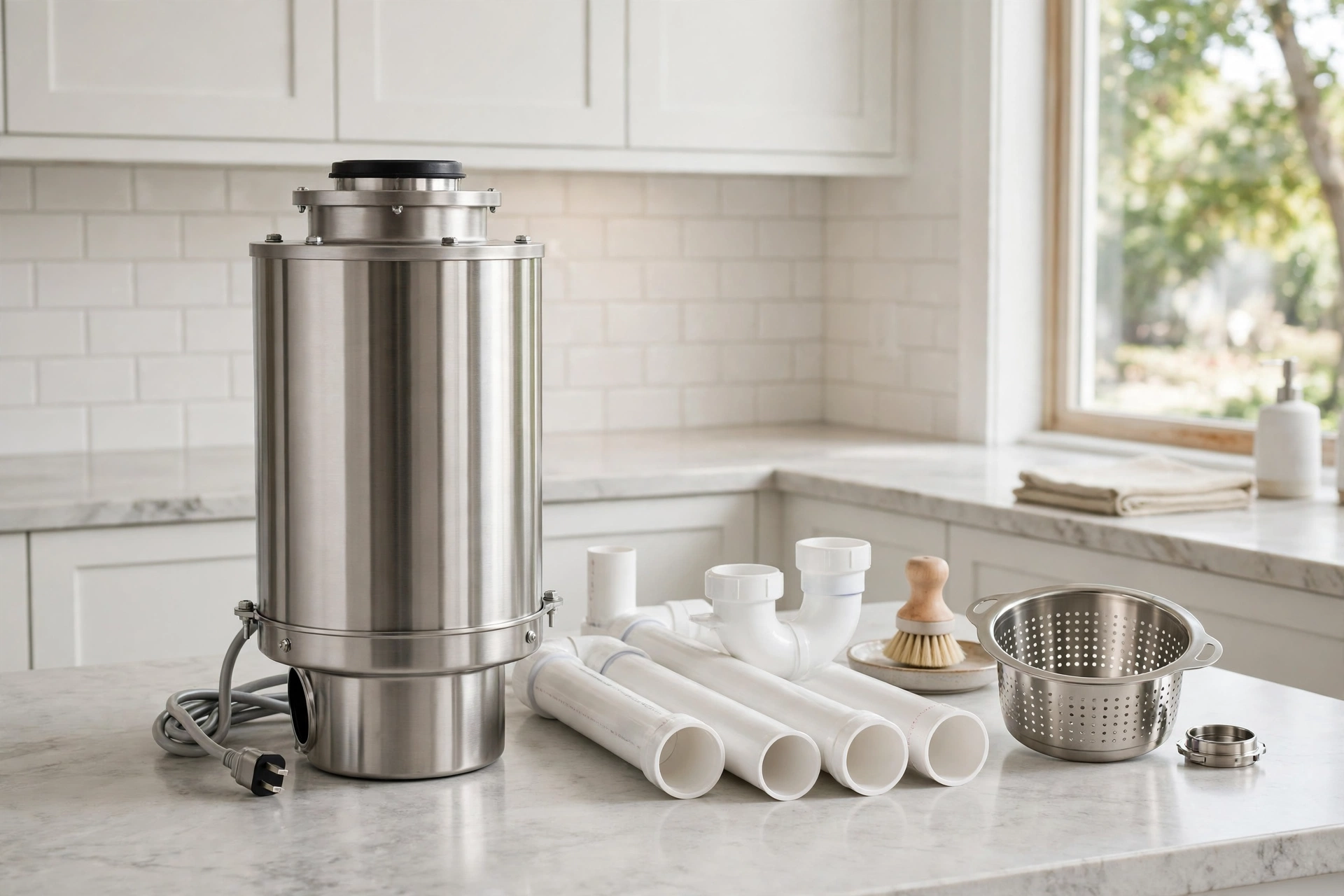
DIY replacement ($75–$400). A like-for-like replacement is one of the most DIY-friendly plumbing jobs: the flange, the drain, and the power are already in place, and most disposals come with clear instructions and a mounting assembly that fits the standard 3-bolt mount. The two steps that trip people up are sealing the sink flange with plumber’s putty — too little putty and it leaks, too much and it squeezes into the drain — and aligning the drain trap with the new disposal’s outlet, which is rarely at exactly the same height as the old one. Budget 1–3 hours for a first attempt, keep a bucket and towels under the sink, and test for leaks by running the tap for several minutes before you put the cabinet back together. The saving against a pro job is the $100–$300 in labor — worth it if you are comfortable under a sink, not worth it if you are not.
DIY removal ($0–$50). Removal is cheaper to DIY than replacement, because there is no new appliance to buy — just a tailpiece, a trap, and a basket strainer at $0–$50 in parts. The plumbing is straightforward: take the disposal off, fit the tailpiece and trap, fit the strainer. The two steps that matter are the dishwasher re-route and the electrical disconnect, and both are covered in detail above. If the disposal is plugged into an outlet, the electrical side is trivial — unplug it. If it is hardwired, and you are not confident with household wiring, pay a pro for that part. A $100–$300 pro removal that includes a safe electrical disconnect is cheap insurance against a live wire under a sink full of water.
When to hire a pro either way. Hire a pro if the disposal is hardwired, if the drain is corroded or the trap is seized, if the sink is a farmhouse or undermount model where the flange is hard to reach, if the dishwasher connection is unusual, or if you simply do not want to spend an afternoon under a sink. A plumber charges $75–$150 per hour — see our guide to plumber cost per hour for the full rate breakdown — and either job takes 1–2 hours, so the labor bill is $100–$300 whichever option you choose. The difference between the two jobs is the $75–$400 disposal, not the labor.
What Pushes the Cost Up
No two quotes for this work are identical, because the price is built from your sink cabinet, your drain, and your electrical setup. These are the factors that move it most:
No outlet under the sink. For a replacement this is rarely an issue, because the old disposal already had power. For a reinstall after a removal, it can be: if the outlet was removed when the disposal came out, putting a disposal back means adding an outlet at $150–$400, and possibly a new circuit at the same $150–$400 range. This is a large part of why reinstalling later costs $350–$1,000 instead of the $200–$625 a straight replacement costs.
Corrosion under the sink. A sink cabinet that has been leaking slowly for years hides corroded traps, seized mounting rings, and rotted cabinet floors. The installer cannot see any of it until the old disposal comes off — and a corroded trap at $25–$100, a seized flange at $25–$75, or a damaged sink that needs replacing at $200–$600+ can each become a change order on the spot. If the cabinet floor is stained or swollen, mention it when you call so the installer brings the parts.
Drain height and alignment. The new disposal is rarely exactly the same height as the old one, and if the drain outlet sits lower than the trap, the trap has to be lowered or the tailpiece replaced. A straight swap where everything lines up stays near the bottom of the $200–$625 range; a drain that needs reconfiguring adds $25–$100 in parts and time. Deep farmhouse sinks and disposals with a low outlet are the combination most likely to need drain work — and on a removal, the same alignment question applies to the new tailpiece.
Disposal horsepower and features. A budget 1/3 HP disposal at $75–$125 keeps a replacement near $200–$325; a premium 1 HP model at $250–$400 pushes it toward $370–$600. The labor does not change — the unit does — so the disposal you pick is the most controllable cost on a replacement, and the reason removal looks so cheap by comparison is simply that there is no unit to buy.
Your local market. The $100–$300 labor range for either job is wide for exactly this reason: the same work costs more in a high-cost metro area than in a smaller market, because the local plumber’s rate follows local labor costs. Get the quote in writing for your address before you commit, and compare it with one other plumber’s quote — the five-minute phone call is the cheapest way to know whether the price is fair in your market.
Dishwasher connection. If the disposal has to connect to a dishwasher, the installer has to knock out the disposal’s drain plug and connect the dishwasher hose — a small job when the hose is in good shape, and a $15–$50 kit plus time when it is cracked or the wrong length. On a removal, the dishwasher hose has to be re-routed instead, which is the same $15–$50 kit and the same amount of time. Either way, a dishwasher hose that has been leaking is the most common source of the musty smell under a sink, so ask the installer to check it while the cabinet is open.
Money-Saving Tips
1. Try the repair first. Before you pay for a replacement at $200–$625 or a removal at $100–$300, try the reset button and the hex key — a jammed disposal is often a five-minute fix, not a new appliance. If it hums but does not spin, the flywheel is stuck; if it does nothing at all, check the GFCI outlet and the breaker. A $70–$300 repair is cheaper than either option. 2. If you remove it yourself, spend the saving on the right parts. A DIY removal costs $0–$50 in parts, but do not skip the dishwasher drain connection kit at $15–$50 or a proper basket strainer at $15–$40 — a cheap tailpiece that leaks will cost more in water damage than a pro removal would have cost. 3. Buy the disposal yourself, on sale. On a replacement, the unit is the most controllable cost, and a standard 1/2 HP disposal at $125–$200 goes on sale regularly. A $50 saving on the unit is a $50 saving on the total — and buying it yourself means the installer charges labor only, with no markup on the fixture. 4. Get two quotes, one for each option. Ask a plumber to quote both the replacement and the removal on the same visit — the labor for either job is $100–$300, so the quotes will show you exactly what the disposal itself is costing you, and you can decide with real numbers instead of a guess. Our guide to how much someone should charge to install a garbage disposal gives you the benchmark to judge the replacement quote against. 5. Do not remove a disposal to save money if you will reinstall it. Removal saves $100–$325 today and costs $350–$1,000 to reverse. If there is any real chance you will want a disposal again, replacement at $200–$625 is the cheaper decision. 6. Bundle the work with other kitchen plumbing. If a plumber is already under the sink — replacing a faucet, fitting a new trap, connecting a dishwasher — adding a disposal swap or a removal to the same visit costs far less than a separate trip, because the trip and the cabinet setup are paid for once. Ask for a bundled price when you call. 7. Pick the 1/2 HP model, not the 1 HP model, unless you need it. A 1/2 HP disposal at $125–$200 handles normal daily use for most households, and the premium 1 HP model at $250–$400 costs roughly $125–$200 more for power most kitchens never use. Spend the difference on a better mounting assembly or an air switch instead. 8. Check for an outlet and a working switch before you call. If there is a switched, GFCI-protected outlet under the sink, say so when you call — the installer can quote the standard replacement instead of pricing for the worst case, and the job stays near the bottom of the $200–$625 range. A photo of the cabinet sent with your quote request gets you a tighter number. 9. Time the job outside the busy season. Plumbers are busiest in spring and early summer, when renovation season peaks. A fall or winter booking can mean a faster start date and occasionally a better price, especially for a removal that fills a short slot between bigger jobs. 10. Keep the old flange if it is in good shape. On a like-for-like replacement, a new sink flange and mounting assembly costs $25–$75, and the old one is often reusable. Ask the installer to check it before ordering a new one — and if it is corroded, replace it, because a new disposal on a bad flange will leak.
Frequently Asked Questions
Is it cheaper to replace a garbage disposal or remove it?
Yes — removal is cheaper on the day the work is done. A pro-installed replacement typically costs $200–$625, with most homeowners paying around $400–$550 once a mid-range or premium unit and normal extras are included, while a pro removal costs $100–$300 in labor, or $0–$50 in parts if you do it yourself. Removal is usually cheaper by $100–$325 or more. But removal is permanent in a practical sense: putting a disposal back later is a first-time install at $350–$1,000, so replacement is the cheaper decision over the life of the kitchen if there is any chance you will want a disposal again. And a repair at $70–$300 is cheaper than either option when the disposal is only jammed or leaking at a connection.
How much does it cost to remove a garbage disposal?
A plumber typically charges $100–$300 to remove a garbage disposal and re-plumb the drain, including the new tailpiece and trap at $25–$100, a basket strainer at $15–$40, and re-routing the dishwasher drain hose with a kit at $15–$50. The job takes 1–2 hours. If you do it yourself, the parts cost $0–$50. If the disposal is hardwired rather than plugged in, the electrical disconnect may add $75–$150 as a standalone call, though a plumber doing the whole removal usually includes it in the $100–$300 total.
Can I remove a garbage disposal myself?
Yes, if you are comfortable with basic plumbing and the disposal is plugged into an outlet rather than hardwired. The plumbing is straightforward — take the disposal off, fit a tailpiece and trap, fit a basket strainer — and the parts cost $0–$50. The two steps that matter are re-routing the dishwasher drain hose so it cannot backflow, and making the electrical supply safe. If the disposal is hardwired and you are not confident with household wiring, hire a pro for the disconnect: a live wire left loose under a sink, inches from water, is a shock and fire risk. A pro removal at $100–$300 includes the disconnect.
Does removing a garbage disposal affect home value?
Slightly, in markets where disposals are standard — a missing disposal in an otherwise modern kitchen can read as a corner cut, and a buyer may ask for a credit or install one themselves. In older kitchens, or in homes on septic systems where disposals are discouraged, a clean, properly re-plumbed sink without a disposal is rarely flagged at all. The effect is small either way — this is a $200–$625 appliance, not a structural feature — but if you are selling soon and the kitchen is recently renovated, replacing the disposal is the safer choice. If you are selling and the disposal is dead in an otherwise dated kitchen, removal at $100–$300 is a clean, cheap fix.
Should I remove my garbage disposal if I have a septic system?
Usually yes. A disposal adds ground food waste to the septic tank, which fills the tank faster and brings pump-outs forward — typically every 3–5 years instead of every 5–7, at $300–$600 per pump-out. Over a decade that can mean $300–$1,200 in extra maintenance, far more than the $100–$300 saved by removing the disposal instead of replacing it. Some local codes restrict disposals on septic systems. If you do keep a disposal on septic, fit a septic-safe model at $150–$300 for the unit and ask your septic service how often the tank should be pumped.
The Bottom Line
Is it cheaper to replace a garbage disposal or remove it? Removal is cheaper today: $100–$300 for a pro removal, or $0–$50 in parts if you do it yourself, against $200–$625 for a pro-installed replacement, with most homeowners paying around $400–$550 once a mid-range or premium unit and normal extras are included. Removal usually saves $100–$325 or more on the day the work is done. But the cheaper job is not always the cheaper decision. A repair at $70–$300 beats both options when the disposal is only jammed or leaking, a replacement buys you a new appliance with a 2- to 10-year warranty and a kitchen that works the way buyers expect, and removal is only the right long-term call when you are sure you will never want a disposal again — because putting one back later is a first-time install at $350–$1,000. If you cook daily, plan to stay in the home, or plan to sell soon, replace it. If you never use it, you are on a septic system, or you are simplifying the kitchen for a rental, remove it — and do the drain re-plumb, the dishwasher re-route, and the electrical disconnect properly, because a cheap removal done badly costs more than a pro job done right.
Prices are typical 2026 US ranges for planning purposes and vary by region, disposal choice, and site condition; get itemized local quotes for an exact project price.
2 thoughts on “Is It Cheaper to Replace a Garbage Disposal or Remove It in 2026”