
Toilet Installation Cost Labor Only in 2026
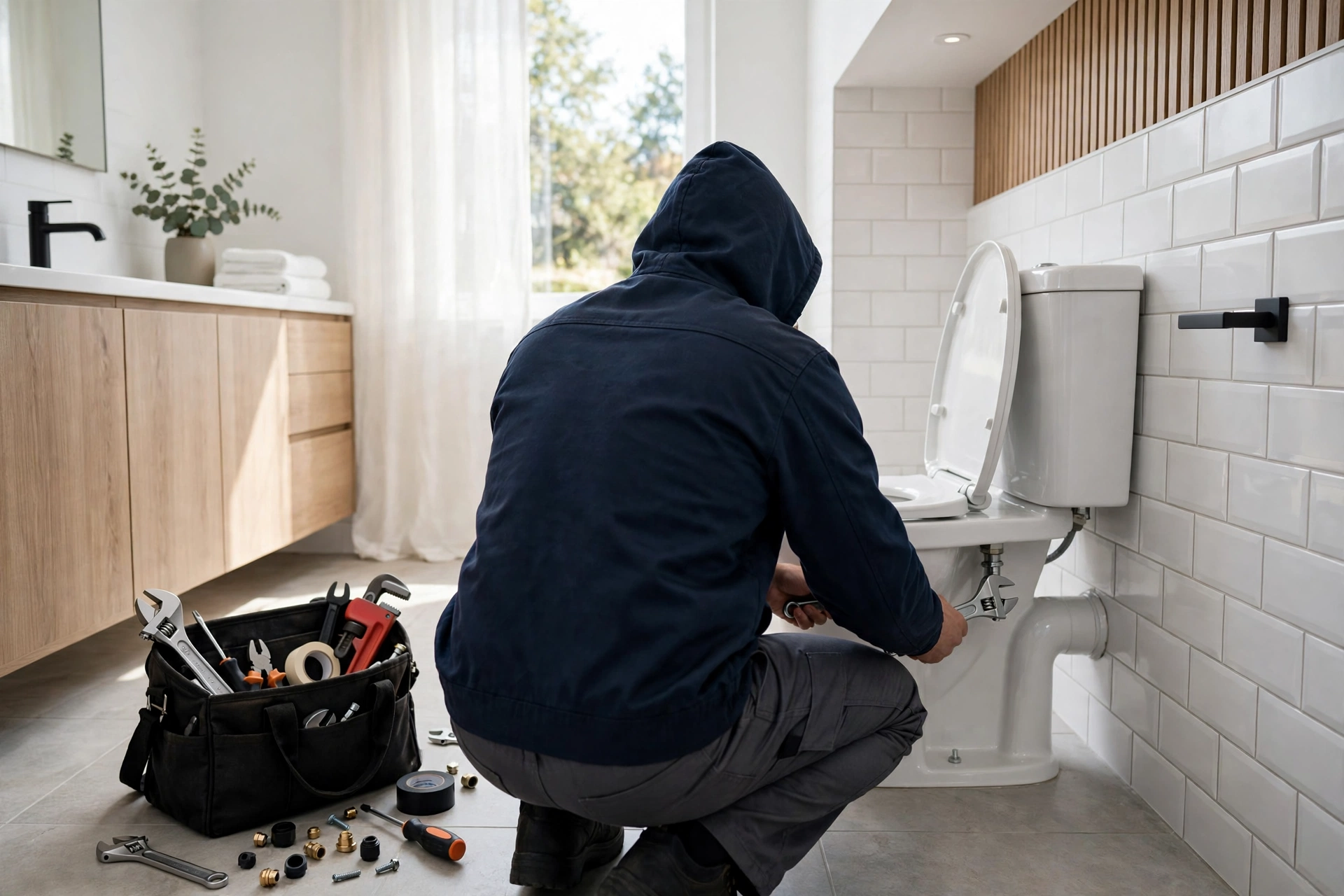
Toilet installation cost labor only in 2026 runs $150–$350 for a standard like-for-like swap, with the average job landing near $250 — and that is the labor alone, with the toilet itself bought separately. In high-cost metros such as New York, San Francisco, or Boston, the same standard swap can run $400–$500 in labor, while in smaller markets and rural areas it can come in at $150–$200. Most plumbers charge either a flat rate of $150–$350 for a standard swap or an hourly rate of $75–$150 per hour for a job that typically takes 1–3 hours on site. The labor price covers removing the old toilet, setting the new one on a fresh wax ring, connecting the water supply, and testing for leaks — it does not cover the toilet fixture, which costs $90–$100 for a basic gravity-flush model, $375–$500 for a standard mid-range model, and $1,500+ for a smart toilet, for the fixture alone. It also does not automatically cover the extras that turn up most often on older bathrooms: a flange repair at $145–$300, a shut-off valve replacement at $50–$100, a new supply line at $25–$75, or old-toilet disposal at $25–$75.
The reason a “labor only” quote is worth understanding on its own is that it is the one line on the bill you can actually compare between plumbers, retailers, and handymen — and it is also the line most likely to be misunderstood. When a plumber quotes $150–$350 for labor only, that number assumes a straightforward swap: the old toilet comes off, the flange underneath is sound, the shut-off valve turns, the floor is solid, and the new toilet is a standard two-piece floor-mounted model. Change any one of those assumptions and the labor changes with it. A wall-hung toilet that needs a carrier frame bolted inside the wall runs $400–$900+ in labor. A smart toilet that needs a GFCI outlet within about 3 feet of the fixture adds $150+ for an electrician on top of $400–$900+ in plumbing labor. A corroded flange discovered under the old toilet adds $145–$300 before the new toilet can even be set. This guide breaks down the real 2026 labor-only cost by toilet type, explains flat-rate versus hourly pricing, shows exactly what labor-only pricing includes and what it does not, compares a licensed plumber with a handyman and with the big-box retailers, and shows how to keep the labor bill down without ending up with a toilet that rocks or leaks.
For the official water-efficiency standard that many modern toilets are built to, see the EPA’s WaterSense toilets page, which explains the labeling program and lists qualifying models.
Quick-answer table (typical 2026 toilet installation labor-only costs):
| Item | Typical cost |
|---|---|
| Standard swap, labor only (flat rate) | $150–$350 |
| Standard swap, labor only (average) | About $250 |
| Standard swap in high-cost metros, labor only | Up to $400–$500 |
| Plumber hourly rate | $75–$150 per hour |
| Time on site, standard swap | 1–3 hours |
| Handyman, toilet installation labor | $150–$300 |
| Lowe’s installation labor | Starts around $180; $150–$400 |
| Home Depot installation labor | $179–$299 |
| One-piece toilet, labor only | $250–$450 |
| Comfort-height / elongated toilet, labor only | $175–$400 |
| Wall-hung toilet, labor only | $400–$900+ |
| Smart / bidet toilet, labor only | $400–$900+ |
| Flange repair / replacement | $145–$300 |
| Shut-off valve replacement | $50–$100 |
| New supply line | $25–$75 |
| Old toilet disposal / haul-away | $25–$75 |
| Floor repair | $100–$500+ |
| GFCI outlet for a smart toilet | $150+ |
| Toilet fixture, basic gravity-flush (not labor) | $90–$100 |
| Toilet fixture, standard mid-range (not labor) | $375–$500 |
| Toilet fixture, smart toilet (not labor) | $1,500+ |
| DIY, parts only (wax ring $5–$15) | $50–$100 |
Toilet Installation Cost Labor Only by Toilet Type
The toilet you choose is the biggest driver of the labor-only price, because different toilets take very different amounts of work to set. A standard two-piece toilet is a straightforward 1–3-hour swap; a wall-hung toilet needs a carrier frame installed inside the wall and can take 4–8 hours; a smart toilet needs water, power, and sometimes a new outlet. The fixture price is separate from all of these numbers — what follows is labor only:
| Toilet type | Labor only | Time on site | Typical total installed (labor + fixture) |
|---|---|---|---|
| Basic gravity-flush two-piece | $150–$350 | 1–3 hours | $270–$350 |
| Standard two-piece | $150–$350 | 1–3 hours | $270–$500 |
| Comfort-height / elongated | $175–$400 | 1–3 hours | $330–$650 |
| High-efficiency / one-piece | $250–$450 | 2–4 hours | $600–$1,500+ |
| Wall-hung | $400–$900+ | 4–8 hours | $900–$2,000+ |
| Smart / bidet toilet | $400–$900+ | 3–5 hours | $1,500+ (fixture alone) |
| Specialty / unusually heavy toilet | $250–$500+ | 2–4 hours | Varies |
Basic gravity-flush two-piece ($150–$350 labor). This is the entry point and the cheapest toilet installation labor: a basic gravity-flush toilet — the standard two-piece design where water flows from the tank by gravity — takes 1–3 hours to swap and costs $150–$350 in labor, with the average near $250. The toilet itself costs $90–$100 for the fixture, so the all-in total lands at $270–$350. Two-piece toilets are the most common replacement in American bathrooms: easy to carry in two pieces, simple to set, and the fastest job a plumber does. If your only goal is a working toilet at the lowest possible labor price, this is it.
Standard two-piece ($150–$350 labor). A standard two-piece toilet — separate tank and bowl, in the mid-range of fixture prices — costs the same $150–$350 in labor as a basic model, because the installer does the same job either way. The difference is the fixture: a standard two-piece at $100–$200 brings the all-in total to $270–$500. Most standard replacements fall in this range, and it is the range most plumbers quote sight unseen, because it is the job they do most often.
Comfort-height / elongated ($175–$400 labor). Comfort-height toilets — a taller seat, usually 17–19 inches, designed to be easier to sit on and stand up from — and elongated bowls cost $175–$400 in labor. The work is the same as a standard swap, but the fixture is heavier and bulkier, and an elongated bowl needs about two more inches of clearance in front than a round bowl, so the plumber may need to check the rough-in and the door swing before setting it. The fixture costs $150–$350, so the all-in total runs $330–$650. This is the category where most homeowners land when they replace a toilet deliberately rather than in an emergency: the extra height and the longer bowl are genuinely more comfortable, and the labor premium over a basic two-piece is modest.
High-efficiency / one-piece ($250–$450 labor). A high-efficiency or one-piece toilet — tank and bowl molded as a single unit, with a low-flow flush that meets EPA WaterSense standards — costs $250–$450 in labor, because a one-piece toilet is heavier and bulkier to carry and set than a two-piece, and it usually takes two people or a longer lift to place it without cracking the porcelain or breaking the wax seal. The fixture costs $400–$1,500, so the all-in total runs $600–$1,500+. One-piece toilets are easier to clean, with no seam between tank and bowl for grime to collect, and they look more modern — which is why the labor premium is worth paying for many homeowners. For the manufacturer’s own step-by-step instructions on setting a one-piece toilet, including the two-person lift warning, see Kohler’s one-piece toilet installation instructions.
Wall-hung ($400–$900+ labor). A wall-hung toilet is the most expensive toilet to install for labor alone, at $400–$900+, because the work is fundamentally different: the plumber must open the wall, install and anchor a steel carrier frame to the studs, connect the in-wall tank and drain, close the wall, and then hang the bowl on the carrier. It is a 4–8-hour job, often spread over two visits if the wall has to be patched and finished between the rough-in and the bowl installation. The fixture and carrier together can cost $500–$1,200+, so the all-in total runs $900–$2,000+. A wall-hung toilet is never a flat-rate standard swap — always get an itemized quote, and make sure the quote says whether wall repair and finishing are included or extra.
Smart / bidet toilet ($400–$900+ labor). A smart toilet or bidet toilet costs $400–$900+ in labor, because the plumber is setting a heavier, more complex fixture that needs a water connection, a power connection, and careful leveling — and because a smart toilet needs a GFCI-protected outlet within about 3 feet, which adds $150+ for an electrician if there is no outlet near the toilet. The fixture alone costs $1,500+, so the all-in total starts above $1,500 before any electrical work. Check for the outlet before you buy the toilet, not after the plumber arrives — the electrical work is a separate trade, and it is the most common reason a smart-toilet job runs over budget.
Specialty / unusually heavy toilets ($250–$500+ labor). If your toilet is unusually heavy, oversized, or non-standard in any way, expect labor of $250–$500+ rather than the standard $150–$350, because the job takes longer and may need two installers. Ask before you book whether the standard flat rate applies to your fixture — one question can save you a surprise on installation day.
If you want the full picture of what a new toilet installation should cost including the fixture, see our guide to how much a new toilet installation should cost. For the plumber-side numbers in full, see our guide to how much a plumber charges to fit a new toilet.
Flat-Rate vs. Hourly: How Toilet Installation Labor Is Priced
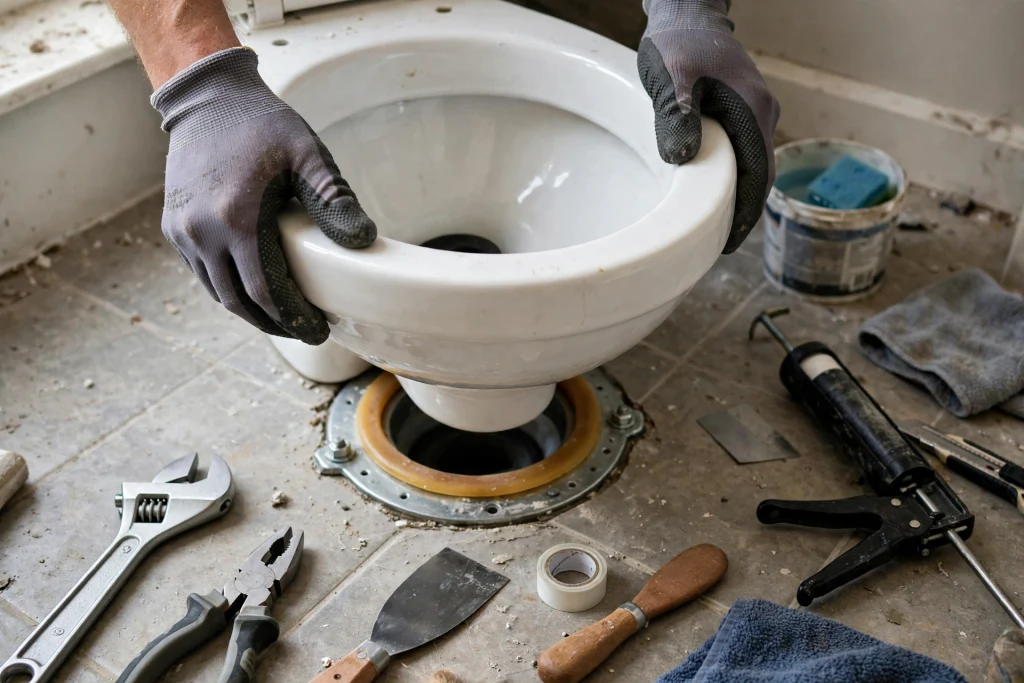
Most plumbers price a toilet installation one of two ways — a flat rate for the job, or an hourly rate for the time — and which one you get changes how the bill behaves when something unexpected turns up. Understanding the difference before you book is the single best way to avoid a surprise on the invoice.
| Pricing model | Typical price | How it works | Best for |
|---|---|---|---|
| Flat rate, standard swap | $150–$350 | One fixed price for the whole swap, agreed before work starts | A straightforward like-for-like replacement |
| Flat rate, standard swap in high-cost metros | Up to $400–$500 | Same fixed-price model, higher market rate | A standard swap in New York, San Francisco, Boston, or a similar metro |
| Hourly, licensed plumber | $75–$150 per hour | Billed by the hour, usually with a 1-hour minimum | A job with unknowns, or a job bundled with other plumbing work |
| Hourly, standard swap (1–3 hours) | $150–$350 total | $75–$150 per hour × 1–3 hours, plus a service call fee in some cases | A straightforward swap quoted by the hour |
| Service call / trip fee | $50–$100 | Charged on top of hourly work by some plumbers; often waived if you hire them | Any hourly job — ask whether it applies |
| Flat rate, one-piece toilet | $250–$450 | Fixed price reflecting the heavier, two-person set | A one-piece or high-efficiency toilet |
| Flat rate, wall-hung toilet | $400–$900+ | Fixed price for the carrier frame and in-wall work | A wall-hung toilet |
| Flat rate, smart / bidet toilet | $400–$900+ | Fixed price for the complex set; electrical work extra | A smart or bidet toilet |
Flat rate is the norm for a standard swap. Most plumbers and both big-box retailers quote a flat rate for a standard toilet swap — $150–$350 from an independent plumber, starting around $180 at Lowe’s and $179–$299 at Home Depot. The advantage is certainty: you know the labor price before the plumber arrives, and if the job runs a little long, that is the plumber’s problem, not yours. The catch is that the flat rate assumes a straightforward swap — a sound flange, a working shut-off valve, a solid floor, and a standard two-piece toilet. If the plumber lifts the old toilet and finds a corroded flange, the repair is a change order on top of the flat rate, typically $145–$300.
Hourly pricing is common when the job has unknowns. A plumber charging $75–$150 per hour will usually quote a standard swap at 1–3 hours, which works out to $150–$350 — the same range as a flat rate, because it is the same job. Hourly pricing makes sense when the job is not a clean swap: a toilet that has been leaking for months, a bathroom with old cast-iron pipe, or a job bundled with other work such as replacing a vanity or fixing a shower valve. The risk with hourly pricing is that the clock keeps running if the job gets complicated, so always ask for an estimate of hours in writing, and ask whether the quote includes a service call fee — some plumbers charge $50–$100 for the trip on top of the hourly rate, and some waive it if you hire them for the job.
Which one should you choose? For a straightforward like-for-like swap, a flat rate is almost always the better deal: it caps your exposure, and the plumber has every incentive to work efficiently. For a job with known complications — a rocking toilet, water staining around the base, a valve that will not turn — an hourly quote with a written hour estimate can be fairer, because the plumber is not padding a flat rate to cover unknowns. Either way, get the quote in writing before work starts, and make sure it says whether removal and disposal of the old toilet, the wax ring, the floor bolts, and the supply line are included or extra. To put the hourly rate in context against what plumbers charge across the board, see our guide to plumber cost per hour.
What’s Included in Labor-Only Pricing — and What’s Not
A labor-only quote covers the work of the swap itself. The trouble starts at the edges of that quote, where the items most likely to be needed on an older bathroom — a corroded flange, a seized shut-off valve, a damaged floor — are priced as extras. Before you book, know exactly where the line falls:
| Item | Labor-only quote | Notes |
|---|---|---|
| Removal of old toilet | Included | Standard labor covers lifting and removing the existing toilet |
| Disposal / haul-away of old toilet | Sometimes included; often $25–$75 extra | Confirm in writing — some plumbers include it, some charge a dump fee |
| New wax ring and floor bolts | Included | Standard installation parts are part of the labor price |
| Setting the new toilet | Included | Leveling, bolting down, and seating on the wax ring |
| Connecting the supply line | Included | Connection to existing plumbing |
| Leak testing | Included | Plumber tests for leaks before leaving |
| Cleanup | Included | Work area left clean |
| The toilet itself | Not included | Purchased separately, $90–$100 basic, $375–$500 mid-range, $1,500+ smart |
| Flange repair or replacement | Not included | $145–$300 extra |
| Shut-off valve replacement | Not included | $50–$100 extra |
| New supply line | Not included | $25–$75 extra if the old one is not reusable |
| Floor repair if rot or damage is found | Not included | $100–$500+ extra |
| Smart toilet electrical work (GFCI outlet) | Not included | $150+ for an electrician if no outlet within 3 feet |
| Plumbing or structural modifications | Not included | Priced per job |
| Drain clearing | Not included | Priced per job |
The three items most often missing. Flange repairs, shut-off valve replacement, and floor damage are the classic surprise charges on a toilet installation. The flange — the ring that bolts the toilet to the floor drain — is hidden under the old toilet, so nobody knows its condition until the old toilet comes off. If it is corroded or cracked, the plumber will not set a new toilet on a bad flange, and the $145–$300 repair becomes a change order on the spot. If your shut-off valve is old, seized, or dripping, that is another $50–$100. And if the floor under the toilet is rotted from a slow leak, the $100–$500+ floor repair can dwarf the installation labor itself. None of this is a scam — it is genuinely unknowable until the old toilet is lifted — but it is why a $150–$350 labor quote can become a $400–$500 labor bill, and why you should budget for at least one extra before you book.
Disposal is the most common gray area. Some plumbers include old-toilet haul-away in the $150–$350 labor price; others charge $25–$75 for it, or pass through a local dump fee. Porcelain is heavy and awkward, and not every municipality takes it in curbside pickup, so ask the question explicitly: “Is removal and disposal of the old toilet included in this price?” If it is not, you can save the $25–$75 by disposing of the old toilet yourself — most municipalities accept porcelain at a transfer station or through a bulk pickup.
Common Add-On Charges
Add-ons are where a $150 labor quote becomes a $400–$500 labor bill. Here is what each one typically costs and when you are likely to face it:
| Add-on | Typical cost | When it comes up |
|---|---|---|
| Flange repair / replacement | $145–$300 | Corroded, cracked, or broken flange found under the old toilet |
| Shut-off valve replacement | $50–$100 | Old valve seized, dripping, or corroded |
| New supply line | $25–$75 | Old supply line worn, kinked, or the wrong length for the new toilet |
| Old toilet disposal / haul-away | $25–$75 | Plumber does not include disposal in the labor price |
| Floor repair (rot or water damage) | $100–$500+ | Subfloor damaged by a long slow leak under the old toilet |
| GFCI outlet for a smart toilet | $150+ | No electrical outlet within 3 feet of the toilet; electrician required |
| Wall-hung carrier frame work | $400–$900+ labor | Wall-hung toilet; carrier frame must be installed inside the wall |
| Drain clearing | Varies by job | Clogged or slow drain discovered during the swap |
| Service call / trip fee | $50–$100 | Hourly-priced jobs where the plumber charges for the visit |
A real-world example. A standard swap can start with labor at $150–$350 — the average near $250 — and reach $400–$500 once a flange repair at $145–$300 is added, which is the most common story in customer reports: the base labor price is real, and one small repair on top of it is normal. Budget the base labor price plus $50–$300 for the most likely extra, and you will rarely be surprised. In a high-cost metro, the same job can start at $400–$500 in labor before a single extra is added, so the all-in labor bill there can reach $600–$800 with one repair on top.
What Drives the Cost of Toilet Installation Labor
No two toilet installation labor quotes are identical, because the price is built from your market, your toilet, and the condition of your bathroom. These are the factors that move it most:
Your local market. The $150–$350 labor range is wide for exactly this reason: the same standard swap costs $400–$500 in a high-cost metro and $150–$200 in a smaller market, because the plumber’s rate follows local labor costs. The plumber’s hourly rate of $75–$150 per hour is itself a market number — $75–$100 per hour in lower-cost areas, $125–$150 per hour in expensive metros. Your zip code sets the real number, which is why a flat-rate quote from a national retailer can look cheap in one city and expensive in another.
The toilet you pick. A basic two-piece toilet takes 1–3 hours and $150–$350 in labor, while a one-piece toilet takes 2–4 hours and $250–$450, a wall-hung toilet takes 4–8 hours and $400–$900+, and a smart toilet takes 3–5 hours and $400–$900+ plus $150+ for electrical work. The fixture is the lever with the biggest effect on the labor number, because heavier and more complex toilets take more time and more hands to set.
The condition of the flange. The flange is the single most common source of extra labor cost, at $145–$300 to repair or replace. It is also the most common reason a job takes longer than the quoted 1–3 hours: a corroded flange has to be cut out and replaced before the new toilet can be set. If your old toilet has been rocking, leaking at the base, or smelling of sewer gas, expect the flange to need attention.
The shut-off valve and supply line. An old shut-off valve that will not turn, or turns and then drips, has to be replaced — $50–$100. A supply line that is kinked, corroded, or the wrong length for the new toilet’s inlet is another $25–$75. These are cheap parts with real labor attached, and they are the most common “while we’re here” charges on an older bathroom.
Floor damage. If the subfloor under the old toilet is rotted from a slow leak, the plumber cannot set a new toilet on it. Floor repair runs $100–$500+ depending on how much subfloor has to be cut out and replaced, and it can turn a 1–3-hour swap into a multi-hour job — and a $150–$350 labor quote into a $500+ labor bill.
Smart toilet electrical needs. A smart or bidet toilet needs a GFCI-protected outlet within about 3 feet. If there is no outlet near the toilet, an electrician has to add one — $150+ — and that is a separate trade from the plumber doing the installation. Check for the outlet before you buy the toilet, not after the plumber arrives.
Who does the work. A licensed plumber at $75–$150 per hour costs more than a handyman at $150–$300 for the whole job, and both cost more than a DIY job at $50–$100 in parts — but the plumber brings a license, insurance, and a warranty, the handyman brings a lower price and a faster booking, and the DIY route brings no warranty at all. The labor price is not just a number; it is a package of skill, accountability, and recourse if the seal fails.
Toilet Installation Labor Cost by Region
Labor rates follow local wages, so the same standard swap can cost twice as much in one city as in another. These are typical 2026 labor-only ranges for a standard two-piece swap:
| Region | Typical labor, standard swap | Plumber hourly rate | Notes |
|---|---|---|---|
| Northeast — New York City, Boston | $300–$500 | $125–$150 per hour | Highest labor costs in the country; parking and access add time |
| West Coast — San Francisco, Los Angeles, Seattle | $300–$500 | $125–$150 per hour | High wages and high demand; book early |
| Midwest — Chicago, Minneapolis, Detroit | $200–$350 | $90–$125 per hour | Mid-range labor; $250 average holds here |
| Southeast — Atlanta, Charlotte, Tampa | $150–$300 | $75–$110 per hour | Lower labor costs; $150–$200 swaps are common |
| South Central — Dallas, Houston, Phoenix | $150–$300 | $75–$110 per hour | Competitive market; many plumbers, lower rates |
| Mountain West — Denver, Salt Lake City | $200–$400 | $100–$135 per hour | Growing metros; rates rising with demand |
| Rural areas and small towns | $150–$250 | $75–$100 per hour | Lowest labor costs, but fewer plumbers and longer waits |
The regional spread is the reason a single national number for toilet installation labor is misleading: a $150–$350 national range is really a $150–$250 range in a small town and a $300–$500 range in a high-cost metro. When you compare quotes, compare them against your own market, not against a national average — and remember that the average standard swap lands near $250 nationally, which is a Midwest number as much as it is a national one. If your quote is above $500 for a standard two-piece swap with no extras, get a second quote; if it is below $150, check what is excluded, because disposal, the wax ring, or the supply line may be billed separately.
Handyman vs. Licensed Plumber vs. Retailer Installation Labor
The same toilet swap can be priced three different ways depending on who does it, and the cheapest labor is not always the cheapest job. Here is how the three routes compare on labor alone:
| Licensed plumber | Handyman | Lowe’s / Home Depot | |
|---|---|---|---|
| Labor, standard swap | $150–$350 (average near $250) | $150–$300 | $150–$400 (Lowe’s, starts around $180); $179–$299 (Home Depot) |
| Hourly rate | $75–$150 per hour | $50–$100 per hour | Flat rate, not hourly |
| Who does the work | The plumber you hire, or their crew | The handyman | Licensed local third-party contractor |
| License and insurance | Licensed and insured | Usually not licensed for plumbing | Licensed, insured, background-checked |
| Labor warranty | Varies by plumber | Usually none | 1 year |
| Scheduling | Often faster; sometimes same-week or next-day | Often fastest | Typically a few days to a week |
| Time on site | 1–3 hours | 1–3 hours | 1–3 hours |
| Best for | The cheapest licensed labor, or a job with complications | A straightforward swap on a sound floor with a good flange | A one-stop buy-and-install with a warranty |
When a licensed plumber wins. An independent plumber’s labor runs $150–$350 for a standard swap, with the average near $250, and at the low end — $150–$200 for a straightforward swap — a local plumber can undercut both retailers. A plumber also wins when the job is complicated: a rotted floor, a flange that needs rebuilding, or a drain that needs clearing. The retailer model is built for standard swaps; a plumber is built for everything else. Get two quotes from local plumbers for the same scope before you book with a retailer, and compare the all-in labor totals — not just the headline rate. For the full retailer numbers, see our guides to toilet installation cost at Lowe’s and how much Home Depot charges to install a toilet.
When a handyman wins. A handyman charges $150–$300 for a toilet installation — cheaper than a licensed plumber at the low end, and often available faster. The trade-off is that a handyman usually offers no labor warranty and may not be licensed for plumbing work. For a straightforward swap on a sound floor with a good flange, a handyman is a fair budget option; for anything with complications, the retailer’s 1-year warranty or a licensed plumber is worth the extra money.
When a retailer wins. You want to buy the toilet and the installation in one transaction, with a vetted contractor and a 1-year labor warranty, and you do not want to find and vet a plumber yourself. At labor starting around $180 at Lowe’s and $179–$299 at Home Depot, the retailer price sits in the middle of the independent plumber’s $150–$350 range, not at the top of it. A budget job with a basic toilet at $90–$100 can come to $270–$350 all-in through a retailer, which is hard to beat anywhere.
DIY vs. Hiring a Pro for a Toilet Installation
| DIY | Hiring a pro | |
|---|---|---|
| Toilet cost | $90–$100 basic gravity-flush; $375–$500 mid-range | Same — you buy the toilet either way |
| Labor cost | $0 (your time) | $150–$350 (plumber); $150–$300 (handyman); $150–$400 (Lowe’s) |
| Parts (wax ring, bolts, supply line) | $50–$100 | Included in the labor price |
| All-in total, basic toilet | $140–$200 | $270–$350 |
| All-in total, mid-range toilet | $425–$600 | $600–$900 |
| Time required | 2–4 hours for a first-timer; 1–3 hours with experience | 1–3 hours on site |
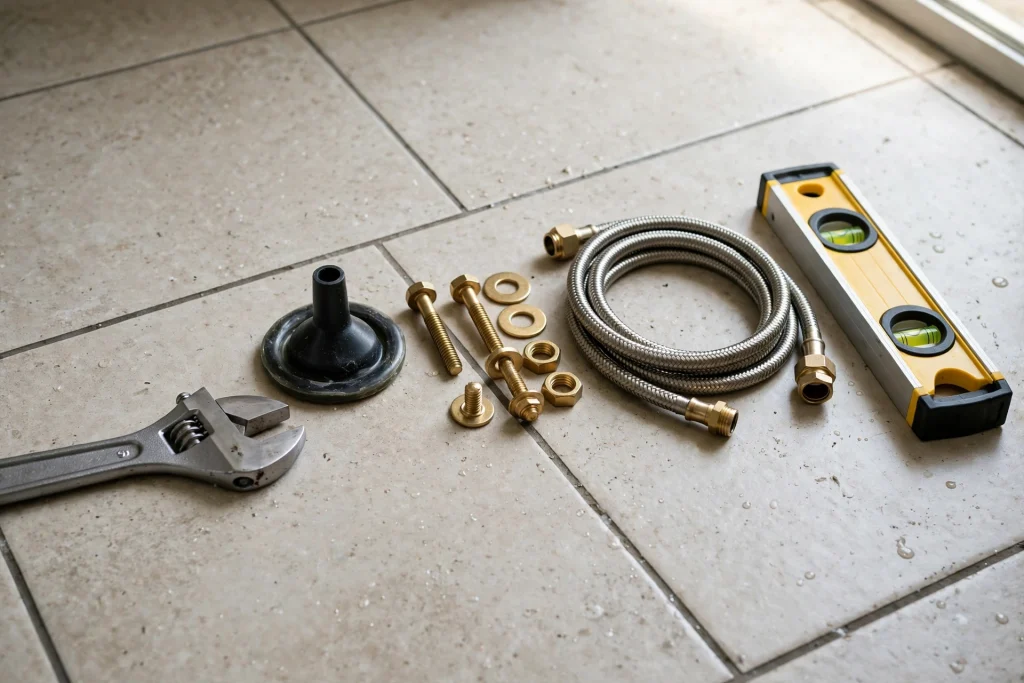
| Tools needed | Adjustable wrench, level, putty knife, sponge, bucket, new wax ring ($5–$15) | Included in the labor price |
| Flange repair | You do it — $145–$300 in parts and time if the flange is bad | $145–$300, done by the installer |
| Leak testing | You test it — mistakes are on you | Professional testing, with a warranty (1 year at Lowe’s) |
| Heavy lifting | You lift a 60–100 lb toilet, twice | The installer does it |
| Best for | A straightforward like-for-like swap by a confident DIYer | Any job with a bad flange, floor damage, or a smart toilet |
A toilet installation is one of the most DIY-friendly plumbing jobs in a house: the parts cost $50–$100 — a wax ring at $5–$15, floor bolts, and a supply line — and a straightforward swap is a 2–4-hour job for a first-timer. When DIY wins: the job is a like-for-like replacement, the flange is in good shape, the shut-off valve works, the floor is solid, and you are comfortable lifting a 60–100 lb toilet and setting it straight down onto a wax ring without rocking it. The saving is real — $140–$200 all-in for a basic toilet against $270–$350 with a pro, which means the $150–$350 in labor is the entire saving. When a pro wins: the flange is corroded, the floor is damaged, the shut-off valve is seized, or the toilet is a smart or wall-hung model that needs electrical or in-wall work. A mistake on a wax ring seal means water in your subfloor, and there is no warranty to fall back on when you did it yourself. If the toilet replacement is part of a bigger bathroom project, our guide to bathroom remodel cost per square foot shows how a fixture swap fits into a full remodel budget, and the bathroom remodel cost calculator will run the numbers for the whole project before you sign a contract.
Money-Saving Tips for Toilet Installation Labor
1. Get two local plumber quotes for the same scope. An independent plumber’s labor runs $150–$350, with the average near $250, and at the low end — $150–$200 for a straightforward swap — a local plumber can undercut a retailer’s flat rate. A five-minute phone call to two plumbers is the cheapest way to know whether the quote you have is a good deal in your market. 2. Ask for the all-in labor quote before you book. Labor at $150–$350 is not the total labor bill. Ask whether removal and disposal, the wax ring, the floor bolts, and the supply line are included, or whether disposal at $25–$75 and a new supply line at $25–$75 are billed separately. 3. Check the flange and valve yourself first. If the toilet rocks, if there is water staining on the floor around the base, or if the shut-off valve will not turn, expect a $145–$300 flange repair or a $50–$100 valve replacement. Knowing before the plumber arrives means you can budget for it — and it means you can ask for a firm price on the repair rather than accepting a change order on the spot. 4. Keep the toilet standard. A basic two-piece toilet costs $150–$350 in labor; a one-piece costs $250–$450; a wall-hung or smart toilet costs $400–$900+. The fixture you pick is the lever with the biggest effect on the labor bill, before the higher fixture price is even counted. 5. Do not buy a smart toilet without checking for an outlet. A smart toilet at $1,500+ for the fixture alone needs a GFCI outlet within about 3 feet. If there is no outlet, an electrician adds $150+ to the job. Check for the outlet before you buy the toilet. 6. Bundle the work. If you need other plumbing work — a new faucet, a shower valve, a vanity swap — have it done on the same visit. A plumber charging $75–$150 per hour will often do the second job at a lower effective rate than a separate visit, because the service call fee of $50–$100 is only charged once. 7. Replace the supply line and valve while the toilet is off. If the valve is old or the supply line is worn, replacing them during the installation costs $25–$100 in parts and a few minutes of the installer’s time. Replacing them later means another service call at $50–$100 plus the labor. 8. Time the job outside the busy season. Plumbers are busiest in spring and early summer. A fall or winter booking can mean a faster start date and occasionally a better price from a local contractor. 9. Do the old-toilet haul yourself if disposal is extra. Where haul-away is billed separately at $25–$75, you can save it by disposing of the old toilet yourself — most municipalities accept porcelain at a transfer station or a bulk pickup.
Frequently Asked Questions
How much is toilet installation labor only?
For a standard like-for-like swap in 2026, toilet installation labor only runs $150–$350, with the average job landing near $250. In high-cost metros such as New York, San Francisco, or Boston, the same swap can run $400–$500 in labor, while in smaller markets and rural areas it can come in at $150–$200. That is the labor alone — the toilet itself is bought separately, at $90–$100 for a basic gravity-flush model, $375–$500 for a standard mid-range model, and $1,500+ for a smart toilet, for the fixture alone.
How much does a plumber charge per hour to install a toilet?
Most licensed plumbers charge $75–$150 per hour, and a standard toilet swap takes 1–3 hours on site, which works out to $150–$350 in labor — the same range as a flat-rate quote, because it is the same job. Some plumbers add a service call or trip fee of $50–$100 on top of hourly work, and some waive it if you hire them for the job. Ask whether the fee applies before you book.
Is the toilet included in a labor-only installation price?
No. A labor-only price covers the work — removing the old toilet, setting the new one on a fresh wax ring, connecting the water supply, and testing for leaks — and the standard parts such as the wax ring and floor bolts. The toilet itself is always a separate purchase: $90–$100 for a basic gravity-flush model, $375–$500 for a standard mid-range model, and $1,500+ for a smart toilet, for the fixture alone. If a quote seems to include the toilet, check the line items — it is almost certainly an all-in price, not a labor-only one.
What is included in toilet installation labor?
A standard labor-only quote includes removal of the old toilet, a new wax ring and floor bolts, setting the new toilet, connecting the supply line, leak testing, and cleanup. It does not include the toilet itself, a flange repair ($145–$300), a shut-off valve replacement ($50–$100), a new supply line ($25–$75), floor repair ($100–$500+), electrical work for a smart toilet ($150+), or — with some plumbers — disposal of the old toilet ($25–$75). Confirm each item in writing before work starts.
How long does a toilet installation take?
A standard swap takes 1–3 hours on site, including removal of the old toilet and connection of the new one to the existing plumbing. A one-piece toilet takes 2–4 hours, a smart or bidet toilet takes 3–5 hours, and a wall-hung toilet takes 4–8 hours, often spread over two visits if the wall has to be patched and finished between the rough-in and the bowl installation. A job with a flange repair, floor damage, or a smart toilet’s electrical work takes longer than the standard 1–3 hours.
The Bottom Line
For toilet installation labor only in 2026, budget $150–$350 for a standard like-for-like swap, with the average job landing near $250 — and up to $400–$500 in high-cost metros such as New York, San Francisco, or Boston. Most plumbers charge either a flat rate of $150–$350 or an hourly rate of $75–$150 per hour for a job that typically takes 1–3 hours on site. The labor covers removing the old toilet, setting the new one on a fresh wax ring, connecting the water supply, and testing for leaks; the toilet itself is a separate purchase at $90–$100 for a basic gravity-flush model, $375–$500 for a standard mid-range model, and $1,500+ for a smart toilet, for the fixture alone. Heavier and more complex toilets cost more to set: a one-piece toilet runs $250–$450 in labor, and a wall-hung or smart toilet runs $400–$900+, with $150+ more for an electrician if a smart toilet needs a GFCI outlet. The extras that most often push the bill up are a flange repair at $145–$300, a shut-off valve replacement at $50–$100, a new supply line at $25–$75, and old-toilet disposal at $25–$75 where it is not included. Get the labor quote in writing, confirm whether disposal and the standard parts are included, check the flange and the shut-off valve before the plumber arrives, and compare two local plumber quotes against the retailer flat rates — Lowe’s labor starts around $180 and Home Depot’s runs $179–$299, both with a 1-year labor warranty. A handyman at $150–$300 is the cheapest route for a straightforward swap on a sound floor; a licensed plumber is the better hire the moment the job has complications.
Prices are typical 2026 US ranges for planning purposes and vary by region, toilet choice, and site condition; get itemized local quotes for an exact project price.
1 thought on “Toilet Installation Cost Labor Only in 2026”