Bathroom Sink Installation Cost in 2026
When homeowners ask about the bathroom sink installation cost, they usually want one all-in number: what will the sink, the faucet, and the fitting cost together, with nothing left out? The short answer is that bathroom sink installation typically runs $250–$1,290 all in for most homes in 2026. That total is made up of the sink itself at $40–$1,800 and professional installation labor at $250–$650. A bathroom install averages $1,290 all in according to Angi and HomeAdvisor data, while the national average total for a sink alone sits at $438 across 1,438 verified projects. A budget swap can come in at $250–$400 all in, a mid-range vanity sink replacement typically runs $400–$900, and a full remodel-level job with new pipes can reach $1,290–$2,500+. The gap between those numbers is the whole point of this guide: the sink type, the material, the scenario, and the state of the plumbing underneath all move the total, and the cheapest quote is not always the cheapest project once the fixtures and the extras are counted.
That gap is also why the numbers you see online disagree with each other. A sink alone, all in, typically costs $380–$1,400 in the kitchen world, with the national average total at $438 — but a bathroom sink is a different job: the sink is usually smaller and cheaper, the vanity or pedestal it sits on changes the labor, and a new faucet adds $90–$600 on top. Add a faucet, and the job becomes a combined replacement: the faucet itself costs $90–$600, faucet-only labor runs $120–$250, and the combined sink and faucet installation labor runs $250–$650. This guide breaks the full installation down the way a written quote does: the sink, the faucet, the labor, the removal, and the extras, by scenario, by sink type, and by material — so you can see the real all-in number before you buy anything. This article is about bathroom sink installation totals, fixtures plus labor; if you want the kitchen equivalent, see our guides to how much does it cost to have someone install a kitchen sink and kitchen sink installation labor cost.
Quick-answer table (typical 2026 bathroom sink installation cost):
| Item | Typical cost |
|---|---|
| Bathroom sink installation, all in | $250–$1,290 |
| Bathroom installs, average all in (Angi / HomeAdvisor) | $1,290 |
| National average total, sink alone (1,438 verified projects) | $438 |
| Professional installation labor | $250–$650 |
| Sink itself, by type and material | $40–$1,800 |
| Budget swap, all in | $250–$400 |
| Mid-range vanity sink replacement, all in | $400–$900 |
| Full remodel-level job, all in | $1,290–$2,500+ |
| Plumber labor | $50–$200 per hour |
| Job time | 2–3 hours |
| Labor-only, bathroom vanity sink (Yelp typical) | $385 |
| Labor-only, bathroom vanity sink (Yelp range) | $200–$580 |
| Old sink removal and disposal | $30–$150 |
| New faucet, adds | $90–$600 |
| New pipes | $150–$800 |
| DIY saving on labor | $150–$500 |
Bathroom Sink Installation Cost by Scenario
The single biggest driver of the bathroom sink installation cost is the scenario: a clean like-for-like swap on existing plumbing is a short, predictable job inside the $250–$1,290 range, while a first-time installation in a new location, or a wall-mount sink that needs the wall opened up, is custom work priced above it. The table below gives the all-in total for each scenario — sink, labor, removal, and the likely extras — so the totals are comparable across scenarios instead of mixing labor numbers with all-in numbers. Every total in this table uses the same figures throughout: the sink at $40–$1,800, installation labor at $250–$650, and removal at $30–$150 where added.
| Installation scenario | Sink | Labor | Removal | Likely extras | All-in total |
|---|---|---|---|---|---|
| Clean swap, same-size drop-in sink | $40–$1,800 | $250–$650 | $30–$150 | None | $250–$1,290 |
| Budget swap, basic drop-in sink | $40–$250 | $250–$650 | $30–$150 | None | $250–$400 |
| Mid-range vanity sink replacement | $150–$600 | $250–$650 | $30–$150 | None | $400–$900 |
| Replacement with a pedestal sink | $100–$700 | $250–$650 | $30–$150 | Drain and trap work | $300–$1,100 |
| Replacement with a vessel sink | $70–$1,000 | $250–$650 | $30–$150 | New faucet $90–$600 | $250–$2,000 |
| Replacement with a wall-mount sink | $100–$600 | $250–$650 | $30–$150 | Wall reinforcement, drain rerouting | $250–$1,050 |
| Replacement in an older bathroom, valve or pipe fixes | $40–$1,800 | $250–$650 | $30–$150 | New pipes $150–$800 | Above $1,290; toward the top of the range |
| Full remodel-level job | $40–$1,800 | $250–$650 | $30–$150 | New pipes, vanity and countertop work | $1,290–$2,500+ |
| First-time installation, new location | $40–$1,800 | $250–$650 | None | New pipes $150–$800, plus cabinet work | Above $1,290; quoted per job |
Clean swap ($250–$1,290 all in). A clean swap is the most common bathroom sink installation, because everything the installer needs is already there: the water supply lines, the shut-off valves, the drain, and an opening the new sink fits. The installer shuts off the water, disconnects the old sink, lifts the old sink out, sets the new sink in place, seals it, connects the water supply and the drain, and runs the water to check for leaks — usually 2–3 hours on site. With the sink at $40–$1,800 and installation labor at $250–$650, the project totals $250–$1,290 all in. A replacement with corroded supply lines or a seized shut-off valve lands above it — and the difference is the plumbing, not the sink. For the same job priced in a kitchen, see our guide to how much does it cost to have someone install a kitchen sink.
Budget swap ($250–$400 all in). A budget swap stays at the bottom of the range by keeping every choice basic: a drop-in sink at the low end of $40–$250, a clean like-for-like fitting with no plumbing changes, and the existing faucet kept in place. The sink totals $40–$250 at this level, and the labor is the same $250–$650 — so the saving comes from the fixture, not from cheaper fitting. If the old sink was a drop-in of the same size, the new one is a straight swap and the job stays near $250–$400. The trade-off is the finish: a basic sink does the job, but it will not have the heavier material, the deeper bowl, or the longer warranty of a mid-range model.
Mid-range vanity sink replacement ($400–$900 all in). A mid-range vanity sink replacement is where most homeowners land: a drop-in or undermount sink at $150–$600 fitted into the existing vanity, often with a new faucet at $90–$600 on top. The sink totals $150–$600 at this level, and with labor at $250–$650 the project totals $400–$900 all in. The vanity is the part to check before you buy: the sink must fit the vanity opening, and an undermount sink needs a solid-surface or stone top that can carry the fixings. If the vanity itself is damaged or the wrong size, the job becomes a vanity replacement too, and the total moves toward the $1,290–$2,500+ remodel-level range.
Replacement with a vessel sink ($250–$2,000 installed). A vessel sink is the most expensive common bathroom sink to have installed, at $250–$2,000 including installation, because the job is not a simple swap: the bowl sits on top of the countertop, so it needs a taller faucet — a new faucet at $90–$600 — and the drain height often has to change. The sink alone costs $70–$1,000, the installation labor runs $250–$650, and the faucet is an extra line on top. Get the faucet height checked in writing before you buy the sink — a vessel sink with a standard-height faucet splashes water everywhere, and a faucet that does not clear the rim is a return, not a fitting.
Replacement in an older bathroom (above $1,290). A replacement in an older bathroom costs more than a clean swap because the plumbing underneath is rarely clean: corroded supply lines, seized shut-off valves, and a drain that no longer lines up with the new sink all add work. New pipes run $150–$800, on top of the sink at $40–$1,800 and labor at $250–$650, so the project lands above the $250–$1,290 range and is quoted per job. If the valves under the sink will not turn off, expect a plumbing fix quoted per job on top of that total, and budget for it now rather than discovering it on installation day.
First-time installation (quoted per job; above $1,290). A first-time installation costs more than a standard replacement because there is no sink plumbing to connect to: the installer has to run water lines, connect a drain, and fit a trap where none existed. New pipes alone run $150–$800, on top of the sink at $40–$1,800 and labor at $250–$650, so the project lands above the $250–$1,290 replacement range and is quoted per job. This is also the scenario where a sink is most often installed alongside a new vanity, because the vanity carries the sink and hides the plumbing — and a sink plus vanity together is a bigger job than either on its own.

Bathroom Sink Installation Cost by Sink Type
The sink type moves the project total far more than the faucet does. A typical bathroom sink costs $40–$1,800 by type and material, but the installed total by type runs from $240 for a basic drop-in to $2,000 for a vessel sink. The table below gives the sink price and the installed total by sink type, using the same labor figures throughout so the types are comparable.
| Sink type | Sink price | Installed total | Typical time on site | Notes |
|---|---|---|---|---|
| Drop-in / self-rimming | $40–$750 | $240–$1,250 | 2–3 hours | Easiest and cheapest to install; rim sits on the countertop |
| Undermount | $150–$1,000 | $250–$1,500 | 2–3 hours | Mounted under the countertop; needs a solid-surface or stone top |
| Pedestal | $100–$700 | $300–$1,100 | 2–3 hours | Basin on a pedestal base; no vanity cabinet underneath |
| Vessel | $70–$1,000 | $250–$2,000 | 2–4 hours | Bowl sits on the countertop; needs a taller faucet |
| Wall-mount | $100–$600 | $250–$1,050 | 2–4 hours | Bolted to the wall; needs wall reinforcement and drain rerouting |
| Console | $200–$800 | $400–$1,250 | 3–4 hours | Basin on legs with exposed plumbing; needs drain and supply work |
| Corner | $150–$800 | $480–$1,350 | 3–4 hours | Fits a corner; plumbing must be rerouted to the corner |
Drop-in sink ($240–$1,250 installed). A drop-in sink costs $240–$1,250 installed, the cheapest bathroom sink job, because the sink drops into the existing cutout and seals from above — no countertop work, no wall work, and the same opening usually fits. The sink itself costs $40–$750, installation labor runs $250–$650, and the job takes 2–3 hours. The trade-off is the rim: it sits on top of the countertop, so water and toothpaste collect around it and it needs re-sealing every few years. If the old sink was a drop-in of the same size, the new one is a straight swap and the combined job stays near the bottom of the $250–$1,290 range.
Undermount sink ($250–$1,500 installed). An undermount sink costs $250–$1,500 installed, against $240–$1,250 for a drop-in, because the sink is mounted underneath the countertop and clamped and glued in place — which takes longer and needs a solid-surface, quartz, or granite top that can carry the fixings. The sink itself costs $150–$1,000, and the job takes 2–3 hours. The trade-off is the other way: the countertop edge is flush with the basin, so water wipes straight into the sink and there is no rim to clean around. An undermount sink cannot be fitted to a laminate countertop, so check the countertop material before you buy — a laminate top means a drop-in sink, not an undermount.
Pedestal sink ($300–$1,100 installed). A pedestal sink costs $300–$1,100 installed. The basin sits on a pedestal base with no vanity cabinet underneath, which saves space in a small bathroom — but the pedestal hides the drain and supply lines, so the trap and the shut-off valves have to line up exactly behind it. The sink itself costs $100–$700, and the job takes 2–3 hours. The trade-off is storage: there is no cabinet under a pedestal sink, so towels and cleaning supplies need somewhere else to live. Measure the drain height before you buy — a pedestal sink that does not line up with the existing drain needs the drain moved, and that is pipe work at $150–$800.
Vessel sink ($250–$2,000 installed). A vessel sink costs $250–$2,000 installed, the most expensive common bathroom sink, because the bowl sits on top of the countertop and needs a taller faucet at $90–$600 plus a drain height change. The sink itself costs $70–$1,000, and the job takes 2–4 hours. The trade-off is the look: a vessel sink is a design statement, and the bowl is easy to clean around because it sits proud of the countertop. The catch is the splash: a vessel bowl with a standard-height faucet throws water out of the bowl, so the faucet height has to be right — and a faucet that is too short is a second purchase, not a fitting adjustment.
Wall-mount sink ($250–$1,050 installed). A wall-mount sink costs $250–$1,050 installed. It bolts to the wall with no pedestal and no vanity, which frees the floor underneath and suits a small bathroom — but the wall has to carry the weight, so the installer often has to open the wall and add blocking, and the drain usually has to be rerouted to the wall. The sink itself costs $100–$600, and the job takes 2–4 hours. The trade-off is the plumbing: it is all visible or in the wall, so a leak shows immediately — but a wall that has no blocking behind it means a wall repair on top of the $250–$650 labor.
Console sink ($400–$1,250 installed). A console sink costs $400–$1,250 installed. The basin sits on legs with the plumbing exposed underneath, which gives a bathroom an open, furniture-like look — but the exposed drain and supply lines have to be finished neatly, and the legs have to be fixed to the floor. The sink itself costs $200–$800, and the job takes 3–4 hours. The trade-off is the same as a pedestal sink: no storage underneath, and every pipe is on show, so the finish has to be good.
Corner sink ($480–$1,350 installed). A corner sink costs $480–$1,350 installed. It fits into a corner where a standard sink would waste space, which suits a very small bathroom or powder room — but the plumbing has to be rerouted to the corner, and the sink itself costs more than a standard basin. The sink itself costs $150–$800, and the job takes 3–4 hours. The trade-off is the bowl: a corner sink is smaller than a standard sink, so it suits a powder room better than a family bathroom used every morning.
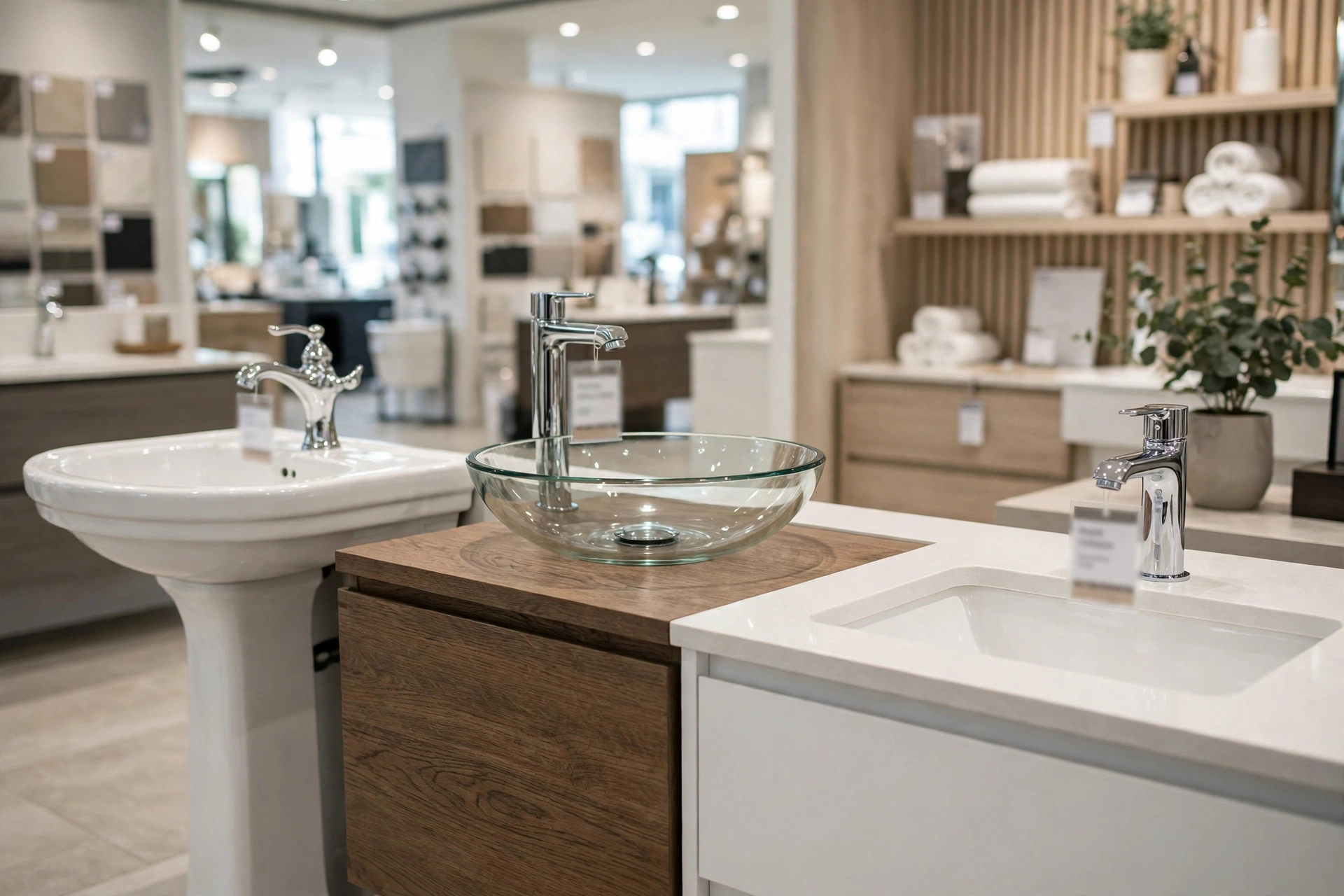
Bathroom Sink Prices by Material
The sink material moves the price of the fixture itself, and the range is wide: from $70 for a basic glass basin to $1,600 for a large acrylic sink. The table below gives the sink-only price by material, using the same figures throughout so the materials are comparable. The installed total for each material is the sink price plus installation labor at $250–$650.
| Sink material | Sink only | Installed total (sink + labor) | Notes |
|---|---|---|---|
| Acrylic | $145–$1,600 | $395–$2,250 | Lightweight and warm to the touch; can scratch and stain over time |
| Copper | $100–$1,100 | $350–$1,750 | Living finish that patinas; needs regular care to keep its shine |
| Glass | $70–$1,000 | $320–$1,650 | Usually a vessel bowl; striking look, shows water spots |
| Stainless steel | $200–$1,500 | $450–$2,150 | Durable and easy to clean; can show water spots and scratches |
| Cast iron | $200–$900 | $450–$1,550 | Heavy and durable with an enamel coating; needs a strong vanity |
| Quartz | $800–$1,200 | $1,050–$1,850 | Solid-surface look; resists stains and chips, premium price |
Acrylic sink ($145–$1,600 for the sink). An acrylic sink costs $145–$1,600 for the sink alone, the widest material range, because acrylic covers everything from a basic molded basin to a large solid-surface vanity top with an integrated bowl. It is lightweight and warm to the touch, which makes it easy to fit — but it can scratch and stain over time, and a scratched acrylic basin cannot be refinished the way an enamel one can. With labor at $250–$650, an acrylic sink totals $395–$2,250 installed.
Copper sink ($100–$1,100 for the sink). A copper sink costs $100–$1,100 for the sink alone. It is a living finish: the copper darkens and develops a patina over time, which some homeowners love and others do not. It needs regular care to keep its shine, and harsh cleaners will mark it. With labor at $250–$650, a copper sink totals $350–$1,750 installed. Copper suits a vessel bowl better than a drop-in, because the bowl is the feature — and a copper vessel with a tall faucet is the combination most often bought.
Glass sink ($70–$1,000 for the sink). A glass sink costs $70–$1,000 for the sink alone, and it is almost always a vessel bowl: a clear or colored glass basin sitting on the countertop. The look is striking, but glass shows every water spot and soap mark, so it needs wiping after every use. With labor at $250–$650, a glass sink totals $320–$1,650 installed. A glass vessel needs the same taller faucet as any vessel sink, at $90–$600 — and a glass bowl with a standard-height faucet splashes, so check the faucet height before you buy.
Stainless steel sink ($200–$1,500 for the sink). A stainless steel sink costs $200–$1,500 for the sink alone. It is durable, easy to clean, and the most forgiving material in a family bathroom — but it shows water spots and scratches, and a thin-gauge basin sounds hollow when water hits it. With labor at $250–$650, a stainless steel sink totals $450–$2,150 installed. Stainless steel suits a drop-in or undermount fitting in a vanity, where the basin is the workhorse rather than the feature.
Cast iron sink ($200–$900 for the sink). A cast iron sink costs $200–$900 for the sink alone. It is heavy and durable, with an enamel coating that resists stains and chips — but the weight means the vanity has to be strong enough to carry it, and a chipped enamel coating cannot be patched invisibly. With labor at $250–$650, a cast iron sink totals $450–$1,550 installed. Check the vanity before you buy: a cast iron basin on a weak vanity sags, and a sagging basin leaks at the seal.
Quartz sink ($800–$1,200 for the sink). A quartz sink costs $800–$1,200 for the sink alone, the most expensive material in this guide. It is a solid-surface material that resists stains and chips, and it usually comes as part of a vanity top with the bowl molded in — which is why the price is high and the range is narrow. With labor at $250–$650, a quartz sink totals $1,050–$1,850 installed. Quartz suits a mid-range or remodel-level job, where the vanity top is being replaced at the same time as the sink.
Labor vs. Materials: Where the $250–$1,290 Goes
The $250–$1,290 all-in total splits roughly into the sink and the labor, and knowing the split is how you tell whether a quote is fair. The sink runs $40–$1,800 by type and material. Installation labor runs $250–$650. The rest is removal, the faucet, and any plumbing the job uncovers.
| Cost element | Typical cost | Notes |
|---|---|---|
| Sink | $40–$1,800 | By type and material; $145–$1,600 acrylic; $800–$1,200 quartz |
| Installation labor | $250–$650 | Plumber at $50–$200 per hour; job takes 2–3 hours |
| Labor-only, bathroom vanity sink (Yelp) | $385 typical; $200–$580 range | Fitting only; sink supplied by the homeowner |
| New faucet | $90–$600 | Adds to the total where a new faucet is fitted at the same visit |
| Faucet-only labor | $120–$250 | Faucet fitting on its own, without a new sink |
| Old sink removal and disposal | $30–$150 | Lifting out and disposing of the old sink |
| New pipes | $150–$800 | Where new water lines must be run |
| Pipe replacement | $150–$800 | Where existing pipes must be replaced or rerouted |
| All-in total | $250–$1,290 | Sink + labor + removal + faucet where added |
| Bathroom installs, average all in | $1,290 | Angi / HomeAdvisor average for bathroom sink installs |
Plumber labor ($50–$200 per hour). A plumber charges $50–$200 per hour, and most bathroom sink installations take 2–3 hours on site, so the labor lands inside the $250–$650 range on a standard job. Yelp data puts labor-only for a bathroom vanity sink at $385 typical, with a range of $200–$580 — which is why fitting the sink and the faucet together costs less in labor than two separate visits: the water is already off, the cabinet is already open, and the plumber is already there. If a quote shows labor well above $650 for a clean swap, ask what is in it — it should be plumbing work, not the fitting itself. For the labor-only breakdown across plumbing work, see our guide to plumber cost per hour.
Removal and the faucet. Old sink removal and disposal costs $30–$150, and a new faucet adds $90–$600 for the fixture plus $120–$250 in faucet-only labor where it is fitted on its own. These are small lines, but they are often left off a headline quote — so check whether they are on yours before you agree. If you can haul the old sink yourself, the project total falls by $30–$150. If you cannot, the charge is money well spent — but it should be a decision, not a default you only notice after you have paid. For the faucet side, see our guides to bathroom faucet installation cost and kitchen faucet installation cost.
Replacement vs. Install-Only: What Is the Difference?
Homeowners often confuse a full replacement with an install-only job, and the two are priced differently because they include different things. A full replacement — the subject of this guide — includes the sink and the fitting, at $250–$1,290 all in. An install-only job is the fitting alone, with the sink supplied by the homeowner, and it is priced on labor only.
| Job type | What is included | Typical cost |
|---|---|---|
| Full replacement, bathroom sink | Sink, labor, removal where added | $250–$1,290 all in |
| Sink alone, all in | Sink, labor, removal where added | $250–$1,290 all in |
| Sink installation labor only | Fitting only; sink supplied by the homeowner | $250–$650 labor |
| Labor-only, bathroom vanity sink (Yelp) | Fitting only; sink supplied by the homeowner | $385 typical; $200–$580 range |
| Sink + faucet together, all in | Sink, faucet, labor, removal where added | $340–$1,890 all in |
| Budget swap, full replacement | Basic drop-in sink, fitted | $250–$400 all in |
| Mid-range vanity replacement, full replacement | Drop-in or undermount sink, fitted | $400–$900 all in |
| Vessel sink, full replacement | Vessel sink, tall faucet, fitted | $250–$2,000 installed |
| Full remodel-level job | Sink, new pipes, vanity and countertop work | $1,290–$2,500+ all in |
When replacement is the right call. Replacement is the right call when the sink is stained, cracked, or leaking around the rim, the faucet drips or has low pressure, or the two are mismatched in age and finish. Fitting a new faucet to an old sink saves money now, but the sink is the next thing to fail — and a second visit costs $120–$250 in faucet-only labor or $250–$650 in sink labor all over again. Replacing both together costs $250–$650 in combined labor once, instead of two separate labor charges. For the combined kitchen version of the same job, see our guide to cost to replace kitchen sink and faucet.
When install-only makes sense. Install-only makes sense when you have already bought the sink — for example, a sale purchase or a model the installer does not stock — and you only need the fitting. In that case the labor is the same $250–$650, and the sink is whatever you paid for it. The risk is fit: if the sink does not fit the opening, the installer cannot fit it, and the return is yours to sort out. Measure the opening before you buy, and check the countertop material before you choose an undermount sink.
What Drives the Total Cost of Installing a Bathroom Sink
The $250–$1,290 all-in total is the starting point, not the final price. Here is what moves the bill up or down, and by how much — and which of these drivers you can control before you get the quote.
| Cost driver | Effect on the total project cost | Notes |
|---|---|---|
| Sink type | $240–$1,250 drop-in; $250–$2,000 vessel | Vessel is the most expensive type; drop-in is the cheapest |
| Sink material | $70–$1,000 glass; $800–$1,200 quartz | Quartz is the most expensive material; glass is the cheapest |
| Installation scenario | $250–$400 budget swap; $1,290–$2,500+ remodel-level | Replacement is fixed-shape; new location is custom work |
| New faucet fitted at the same visit | Adds $90–$600 for the faucet | A vessel sink needs a taller faucet, which costs more |
| Region / ZIP code | $50–$200 per hour for plumber labor | Lower in small-town markets, higher in major metros |
| Old sink removal and disposal | Add $30–$150 | Separate line where charged |
| New supply lines / shut-off valves | Add parts and labor, priced per job | Most common extra on a replacement |
| New pipes or pipe rerouting | Add $150–$800 | Needed where the drain or supply must move |
| Wall work for a wall-mount sink | Add cost, priced per job | Wall must be opened and blocking added |
| Vanity or countertop work | Add cost, priced per job | Needed where the vanity or top must change for the sink |
| Who does the work | $250–$650 labor | A plumber at $50–$200 per hour; DIY saves $150–$500 in labor |
| Scheduling urgency | No fee difference, but a wait | A plumber can usually start in a day or two |
DIY vs. Hiring a Pro
| DIY | Hiring a plumber | |
|---|---|---|
| Sink cost | $40–$1,800 | Same — you buy the sink either way |
| Installation labor | $0 | $250–$650 |
| Labor-only, bathroom vanity sink | $0 if you fit it yourself | $385 typical; $200–$580 range |
| New faucet | $90–$600 | Same — you buy the faucet either way |
| Faucet fitting | Parts only, if you can do it | $120–$250 faucet-only labor |
| Old sink removal | $0 if you haul it yourself | $30–$150 generally for removal/disposal |
| Supply lines / shut-off valves | Parts only, if you can do them | Priced per job, done by the pro |
| New water connection | Not a DIY job | $150–$800 for new pipes, done by the pro |
| Pipe work | Not a DIY job | $150–$800 to replace or reroute, done by the pro |
| All-in total, standard replacement | $40–$1,800 for the sink, before removal and faucet | $250–$1,290 |
| All-in total, first-time installation | Not a DIY job | Quoted per job — above $1,290 |
| Time required | 3–5 hours for a first-timer on a replacement | 2–3 hours on site |
| Tools needed | Adjustable wrench, screwdriver, level, bucket, towels, flashlight, silicone sealant | Included in the labor price |
| Plumbing safety | A bad seal leaks slowly into the vanity — check for drips for a week | Pro leak-tests before leaving |
| Water damage risk | A cross-threaded supply line can flood a vanity | Licensed pro, insured, tested before leaving |
| Warranty | None — mistakes are on you | 90 days to 1 year on the workmanship is typical for a pro job |
| Scheduling | Whenever you are free | A day or two |
| Best for | A confident DIYer doing a like-for-like drop-in swap | Corroded plumbing, first-time installs, vessel or wall-mount sinks, or anyone who wants a warranty |
DIY saves $150–$500 in labor. Doing the job yourself saves $150–$500 in labor, which is the main reason homeowners attempt it — but the saving only holds on a clean like-for-like drop-in swap, where the opening, the plumbing, and the countertop all stay the same. A DIYer who buys the sink at $40–$1,800 and fits it in 3–5 hours pays only the sink, the faucet, and the removal. The risk is the seal: a bad seal leaks slowly into the vanity, and a cross-threaded supply line can flood it. Check for drips for a week after the job, and do not attempt a vessel or wall-mount sink, a first-time installation, or any pipe work yourself — those need a pro, and the labor at $250–$650 is cheaper than the water damage.
Money-Saving Tips for Installing a Bathroom Sink
1. Buy the sink on sale — that is where the real money is. The sink is the most controllable cost, at $40–$1,800 by type and material, and sinks go on sale regularly, especially around holiday weekends. A saving on the sink is a saving on the total, and the installation labor does not change with the sale price — so a sale sink plus the same $250–$650 labor is a cheaper project than a full-price sink with discounted labor. A basic drop-in sink at $40–$250 is the cheapest way to keep a standard job near $250–$400 all in. 2. Get the quote in writing before you buy — it is your price. The price depends on the sink type, the material, the scenario, and the plumbing underneath, and the written quote shows your price once the sink and the fitting are in the order. Check it before you pay, because the quote is the only reliable number for your area: a price quoted for another home, or a price from a review or a forum post, may not match yours. If the quote shows $250–$1,290 all in, you are looking at the typical prices in this guide; if it shows something else, that quote price is your price, and this guide’s totals should be recalculated from it. The quote should identify what is included, what requires an additional charge, and who handles permits — if it does not, ask before you agree. 3. Budget $250–$1,290 all in, not just the labor. The $250–$650 labor figure is the fitting only, not the job price — and the job price is what you pay. Budgeting $250–$1,290 from the start means the quote is expected, not a surprise — and budgeting $40–$1,800 for the sink means the whole project is expected too. The cheapest surprise on a bathroom job is the one you budgeted for before you got to the quote. 4. Replace the sink and faucet together, in one visit. Fitting both together costs $250–$650 in combined labor once, against $250–$650 for sink labor and $120–$250 for faucet-only labor on separate visits — and the combined job is cheaper than two separate visits, because the vanity is already open and the water is already off. If the faucet or the sink is due for replacement within a year, do it now. For the faucet side, see our guides to bathroom faucet installation cost and kitchen faucet installation cost. 5. Measure the opening before you buy. A standard bathroom vanity opening is 24 inches wide for a single-bowl sink — measure yours and compare it against the sink’s dimensions in the manual. A sink that is a fraction of an inch too wide will not fit, and the countertop cutting to make it fit is quoted per job on top of the $250–$650 labor. Five minutes with a tape measure is the cheapest insurance on the whole job. 6. Check the shut-off valves before you book. If the valves under the sink turn easily and shut the water off completely, say so when you get the quote — the plumber can quote the standard $250–$650 labor instead of pricing for the worst case, and the job stays near the $250–$1,290 range. If a valve will not turn off, expect a plumbing fix quoted per job on top of that total, and budget for it now rather than discovering it on installation day. A photo of the vanity sent with your booking gets you a tighter number. 7. Decide on removal deliberately, not by default. Old sink removal and disposal costs $30–$150, and it is a separate line on the order — so check whether it is on the quote before you agree. If you can haul the old sink yourself to a municipal drop-off, the project total falls by $30–$150. If you cannot, the charge is money well spent — but it should be a decision, not a default you only notice after you have paid. 8. Get three quotes: a local plumber, Home Depot, and Lowes. A plumber charges $50–$200 per hour with labor at $250–$650, and the big-box stores quote per job — so quotes for the same job can differ by a few hundred dollars between providers. A five-minute phone call to one more pro is the cheapest way to know whether the first price is fair. Compare the written quotes line by line: sink, labor, removal, parts, and any pipe work should each be named, so you are comparing the same job. For the labor-only breakdown, see our guide to plumber cost per hour. 9. Replace the supply lines and shut-off valves at the same time. New supply lines and shut-off valves are the parts most likely to fail next, and replacing them while the plumber is already there costs far less in extra labor than a second visit. A valve that will not turn off is a separate fix, quoted per job — but it is a fix worth doing now, while the vanity is open and the water is off, rather than later, when it means a second visit and a second service charge. 10. Check the water efficiency of the faucet you fit with the sink. A water-efficient faucet uses less water every day the sink is used, and the saving compounds over the life of the sink. The EPA’s WaterSense program lists water-efficient faucets and fixtures that meet its efficiency criteria — a useful check when the faucet is being replaced at the same visit as the sink. A typical faucet at $90–$600 that meets those criteria costs no more than a standard faucet, but it saves water for as long as the sink lasts.
Frequently Asked Questions
How much does it cost to install a bathroom sink?
In 2026, the bathroom sink installation cost typically runs $250–$1,290 all in for most homes. That total is made up of the sink itself at $40–$1,800 and professional installation labor at $250–$650. Bathroom installs average $1,290 all in according to Angi and HomeAdvisor data, while the national average total for a sink alone is $438 across 1,438 verified projects. A budget swap can come in at $250–$400 all in, a mid-range vanity sink replacement typically runs $400–$900, and a full remodel-level job can reach $1,290–$2,500+. Prices vary by sink type, material, scenario, and region, so the written quote is the reliable number — get it before you buy.
How much is labor to install a bathroom sink?
Professional bathroom sink installation labor typically runs $250–$650, with a plumber charging $50–$200 per hour and most jobs taking 2–3 hours on site. Yelp data puts labor-only for a bathroom vanity sink at $385 typical, with a range of $200–$580. The labor does not include the sink ($40–$1,800), a new faucet ($90–$600), old sink removal and disposal ($30–$150), or any pipe work ($150–$800 for new pipes). For the labor-only breakdown across plumbing work, see our guide to plumber cost per hour.
What is the cheapest bathroom sink to install?
The cheapest is a basic drop-in sink, at $240–$1,250 installed, with a budget swap coming in at $250–$400 all in when the sink is a basic model at $40–$250 and the fitting is a clean like-for-like swap with no plumbing changes. Buy the sink on sale, keep the existing faucet, haul the old sink yourself to save the $30–$150 removal charge, and get three written quotes before you book. A confident DIYer doing a like-for-like drop-in swap saves $150–$500 in labor on top of that. Do not save money by choosing a sink that does not fit the opening or a faucet that does not suit the countertop — the countertop and cabinet work to fix a wrong choice is quoted per job and costs more than the saving.
How long does it take to install a bathroom sink?
A standard installation takes 2–3 hours on site, including shutting off the water, removing the old sink, setting and sealing the new sink, connecting the water supply and drain, and testing for leaks. A drop-in sink takes 2–3 hours, an undermount sink takes 2–3 hours, a vessel sink takes 2–4 hours, and a console or corner sink takes 3–4 hours because the plumbing has to be rerouted. A first-time installation takes longer, because new pipes must be run — $150–$800 for new plumbing pipes — and the job is quoted per job. A DIY installation takes 3–5 hours for a first-timer on a clean swap, and DIY saves $150–$500 in labor.
Do I need a new faucet when I install a bathroom sink?
Not always, but it is usually worth doing. A new faucet adds $90–$600 for the fixture, and fitting it at the same visit costs little extra labor because the water is already off and the vanity is already open — against $120–$250 in faucet-only labor on a separate visit. A vessel sink needs a taller faucet, so a new faucet is not optional there: a standard-height faucet will splash water out of the bowl. If the existing faucet drips, has low pressure, or is mismatched in age and finish with the new sink, replace it now. For the full faucet breakdown, see our guides to bathroom faucet installation cost and kitchen faucet installation cost.
The Bottom Line
For homeowners asking about the bathroom sink installation cost in 2026, budget $250–$1,290 all in for most homes — the sink at $40–$1,800 and professional installation labor at $250–$650. Bathroom installs average $1,290 all in, while the national average total for a sink alone is $438. A budget swap can come in at $250–$400, a mid-range vanity sink replacement typically runs $400–$900, and a full remodel-level job can reach $1,290–$2,500+. A drop-in sink is the cheapest type to install, at $240–$1,250, while a vessel sink costs the most, at $250–$2,000, because it needs a taller faucet at $90–$600 and a drain height change. A quartz sink is the most expensive material, at $800–$1,200 for the sink alone, while a glass sink is the cheapest, at $70–$1,000. A first-time installation in a new location costs more than a standard replacement, because new pipes run $150–$800 and the job is quoted per job. The cheapest way to keep the bill down is to buy the sink on sale, replace the sink and faucet together in one visit, measure the opening before you buy, check the shut-off valves before you book, and get three written quotes — a local plumber, Home Depot, and Lowes — with the sink, the labor, the removal, and the parts each listed as its own line. And before you book at all, check whether the sink you want fits the opening you have: the difference between a $250 budget swap and a $2,000 vessel job is the sink type and the faucet, not the fitter — and the difference between $250–$650 labor and $250–$1,290 all in is the sink, the faucet, and the removal, not the fitting.
Prices are typical 2026 US ranges for planning purposes and vary by region, contractor, and site condition; confirm your price on an itemized written quote before you buy and get itemized local quotes for an exact project price.